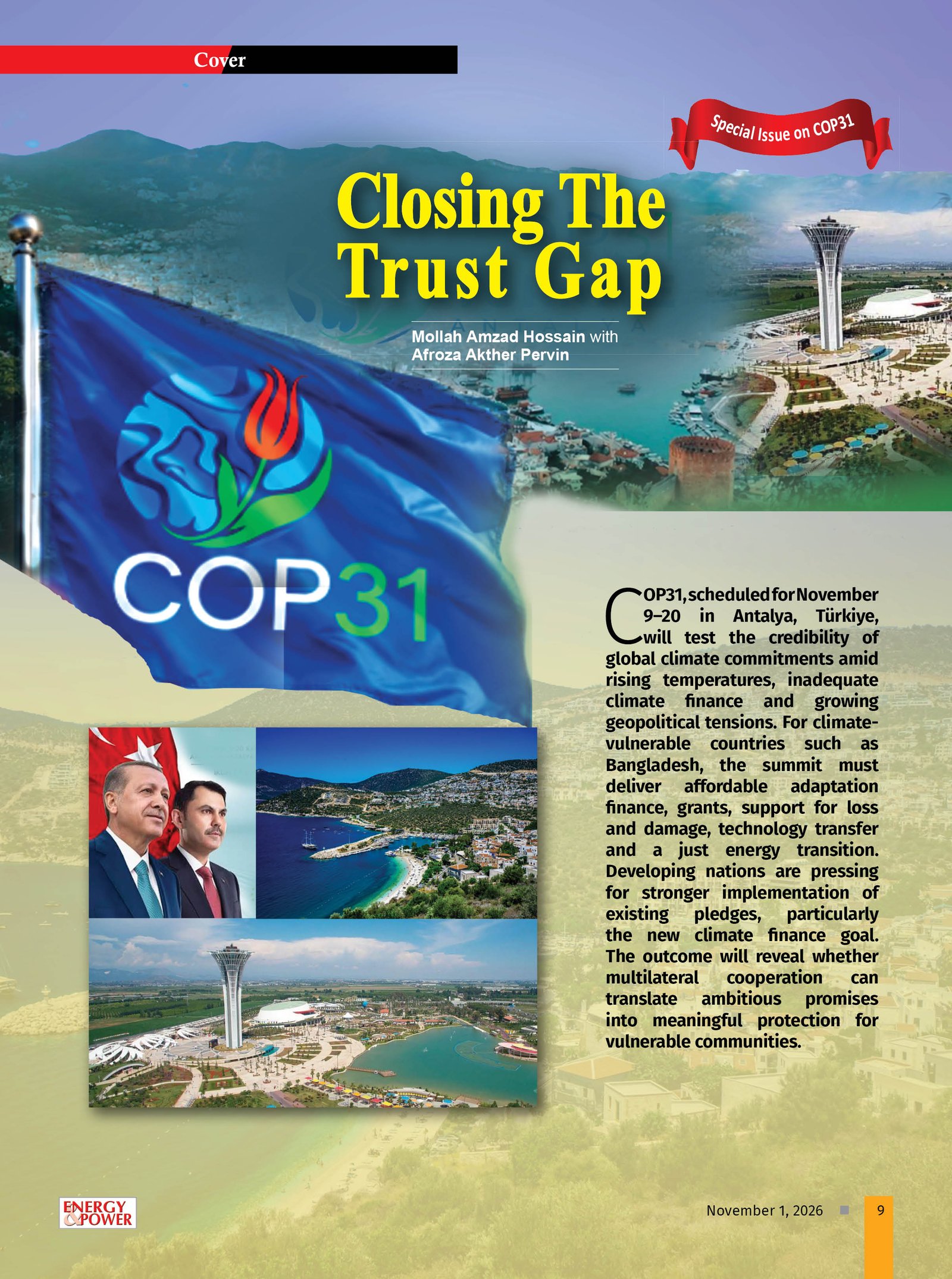
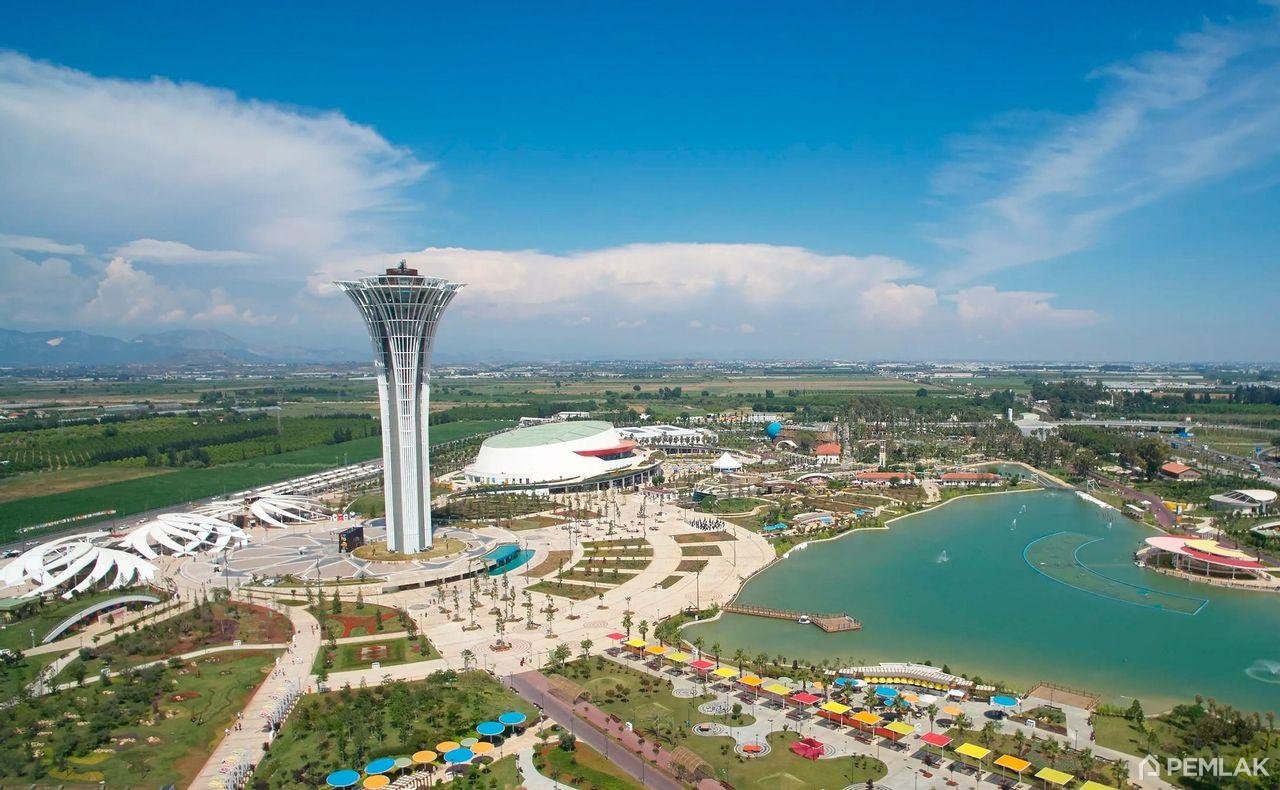
The world is approaching another climate summit as scientific warnings grow more urgent, climate finance remains inadequate, and geopolitical tensions test international cooperation. The 31st UN Climate Change Conference (COP31), scheduled for November 9–20 in Antalya, Türkiye, will confront a widening gap between countries’ climate commitments and the resources and action required to fulfill them. With global warming threatening to exceed the Paris Agreement’s 1.5°C threshold, negotiators face mounting pressure to move beyond declarations and demonstrate measurable progress.
For Bangladesh and other climate-vulnerable developing countries, the stakes extend far beyond diplomatic pledges. Access to affordable adaptation finance, grants for vulnerable communities, support for loss and damage, technology transfer, and a just energy transition will help determine whether climate commitments translate into tangible protection for people already experiencing the consequences of global warming. Antalya will therefore test not only the ambition of international climate policy but also the credibility of the multilateral system itself.
Emissions Gap Raises the Stakes
The release of the ‘UN Environment Programme’s Emissions Gap Report 2026: The Point of Return’ has sharpened the challenge facing negotiators.
Published in October, the report finds that the opportunity to limit global warming to below 1.5°C above preindustrial levels with no or limited overshoot has passed. Nevertheless, it argues that countries can still limit the magnitude and duration of the overshoot if they rapidly strengthen emissions reductions and return warming to 1.5°C by the end of the century.
Under the report’s lowest-overshoot scenario, global greenhouse gas emissions would need to fall by 18% by 2030, 45% by 2035 and 69% by 2040, compared with 2025 levels. By contrast, full implementation of current nationally determined contributions (NDCs) would reduce emissions by only 5–8% by 2030 and 11–15% by 2035 against the same baseline.
If current policies continue, global warming could reach 2.8°C this century. Full implementation of NDCs would limit the projected increase to approximately 2.6°C, although substantial parts of their implementation are conditional on receiving international support. Even a more optimistic scenario incorporating additional net-zero targets would result in warming of around 2.1°C.
UN Secretary-General António Guterres said the findings should not be interpreted as a reason to abandon the temperature goal.
“Overshoot is not surrender,” he said, adding that the world could still minimize the overshoot and bring temperatures back below 1.5°C by the end of the century.
The report presents a difficult political test for COP31. Developing countries are expected to press major emitters, particularly the G20 countries, which account for almost 80% of global emissions, to strengthen mitigation efforts, with developed countries taking the lead. At the same time, they will insist that more ambitious climate commitments must be accompanied by adequate finance, technology transfer and capacity-building support.
For countries with limited fiscal resources, including Bangladesh, the issue is particularly important. Stronger mitigation commitments without adequate financial and technological support could leave vulnerable economies facing rising climate damage while struggling to finance their own transitions to low-emission development.
The challenge for negotiators will therefore be to connect scientific urgency with a credible implementation framework that includes clear milestones, accountability, and support for developing countries.
Climate Finance: From Commitments to Delivery
Climate finance is expected to be one of the most contentious issues at COP31.
At COP29 in Baku, countries agreed on a new collective quantified goal (NCQG) calling for climate finance for developing countries to be scaled up to at least $1.3 trillion annually by 2035 from all sources. Within this broader ambition, developed countries are expected to take the lead in mobilizing at least $300 billion annually by 2035.
The agreement was intended to establish a new framework following the previous goal of providing $100 billion in annual climate finance. However, developing countries continue to question whether the new target is sufficiently ambitious, how much funding will come from public sources, and whether the money will reach vulnerable countries on affordable terms.
The distinction between the two figures is crucial. The $1.3 trillion ambition covers finance from multiple sources, including public resources and private investment by various actors. The $300 billion goal places developed countries in a leading role in mobilizing finance from a range of sources. Developing countries argue that neither figure should be treated as equivalent to grants or direct public support unless the composition and terms of the financing are clearly established.
The Baku-to-Belém Roadmap to $1.3 trillion has sought to identify ways to scale up resources through multilateral development banks, international financial institutions, public finance and private investment. COP31 will face pressure to move this work from broad ambition toward practical delivery, with greater transparency regarding funding sources, recipients, financial instruments and timelines.
COP31 President-designate Murat Kurum has made finance a central theme of the Turkish presidency. Speaking at the Istanbul Climate Finance Summit in September, he described the gap between climate-finance needs and current investment as a “chasm” that must be closed.
He also argued that climate finance should be treated as a strategic security priority rather than simply a cost. The presidency has promoted initiatives intended to connect national climate plans with investment-ready projects and mobilize capital for clean energy, electrification, resilient cities, and green industry.
The concern for developing countries is that mobilizing more finance does not necessarily mean providing more affordable finance. Loans can increase debt burdens, while commercial investment often favors projects capable of generating predictable financial returns. Adaptation, coastal protection, disaster preparedness, and support for vulnerable communities frequently require public or concessional resources because their benefits cannot always be captured as commercial revenue.
Consequently, developing countries are likely to seek clearer pathways toward the $1.3 trillion ambition, predictable delivery of the $300 billion goal, improved access to multilateral climate funds and a greater share of grant-based support.
Grants, Adaptation and the Debt Challenge
The quality of climate finance is as important as its volume. Many developing countries argue that loans, even when offered on concessional terms, are not an adequate substitute for grants when financing the impacts of climate change, which these countries did relatively little to cause.
This concern is particularly acute for least developed countries (LDCs), small island developing states (SIDS) and countries highly exposed to floods, cyclones, droughts, sea-level rise and extreme heat.
Adaptation investments often generate public benefits rather than direct financial returns. Coastal embankments, climate-resilient agriculture, early-warning systems, urban drainage and community-based disaster preparedness may protect millions of people but are difficult to finance through commercial borrowing alone.
Particularly vulnerable developing countries are therefore expected to press for substantially greater public and grant-based adaptation finance, more predictable replenishment of climate funds, and simplified application and approval procedures.
The LDC Group’s ministerial declaration, adopted in Dili, Timor-Leste, in September, called for NDCs and National Adaptation Plans (NAPs) to be implemented with adequate means of implementation, including scaled-up, predictable, accessible and grant-based climate finance. It also urged progress on the Global Goal on Adaptation and the provision of resources to address loss and damage.
The Group’s position reflects a broader concern that vulnerable countries cannot be expected to implement increasingly ambitious climate plans while relying on uncertain funding and accumulating debt.
The G77 and China, the main negotiating coalition representing developing countries, is also expected to emphasize equity and the principle of common but differentiated responsibilities and respective capabilities under the UN climate framework. The coalition’s broader 2026 ministerial position calls for finance to scale up to $1.3 trillion annually by 2035, greater access to concessional resources and stronger support for adaptation.
For these countries, COP31 must demonstrate that the new climate-finance goal can produce tangible improvements in access, affordability and delivery—not simply a larger headline figure.
Given the substantial shortfall in current climate-finance flows relative to the growing needs of vulnerable countries, countries with the financial capacity to do so are also expected to face calls to make additional voluntary contributions to the global effort.
Loss and Damage: Making Support Reach Victims
Loss and damage will be another major test of international cooperation.
The Fund for Responding to Loss and Damage was established to assist developing countries particularly vulnerable to climate change in addressing economic and non-economic losses. However, its ability to meet the scale of need remains a concern, given the enormous costs of climate-related disasters and the limited resources available to the fund.
Loss and damage includes destruction caused by cyclones, floods, droughts and other extreme events, as well as slow-onset impacts such as sea-level rise, coastal erosion, salinity intrusion and ecosystem degradation. Non-economic losses can include damage to cultural heritage, community identity, livelihoods and places that cannot readily be restored through financial compensation.
For Bangladesh, these issues are closely linked to coastal vulnerability, river erosion, displacement, agricultural losses and the growing cost of protecting settlements and infrastructure.
At COP31, vulnerable countries are likely to seek stronger and more predictable contributions to the Loss and Damage Fund, faster access to resources, simplified procedures and support that reaches affected communities without excessive administrative barriers.
The distinction between pledges and delivered finance remains important. Announcements of contributions do not automatically translate into money available for projects or affected households. Developing countries will therefore seek greater clarity on contribution schedules, disbursement arrangements and the scale of support available.
The fund’s governing arrangements and implementation progress will be considered through the formal COP31 agenda. The outcome will matter not only for countries recovering from disasters but also for communities facing irreversible damage that adaptation measures can no longer prevent.
Bangladesh is expected to argue that loss and damage support should be additional to existing development and adaptation assistance, rather than financed by diverting resources from programs designed to reduce future vulnerability.
LDCs and G77 and China: Equity and Implementation
The LDC Group is expected to pursue a negotiating agenda centered on climate justice, ambitious emissions reductions by major emitters, and the provision of finance and technology to enable poorer countries to implement their climate plans.
Its priorities include predictable, grant-based finance, stronger adaptation support, effective implementation of the Loss and Damage Fund, and progress on the Global Goal on Adaptation. The Group also wants just-transition policies to recognize the development needs of countries where energy access, industrialization, employment and poverty reduction remain pressing priorities.
A just transition should extend across all economic sectors while supporting climate-resilient, low-carbon development. For developing countries, this requires policies that reconcile emissions reductions with economic growth, employment generation, affordable energy and social protection.
LDCs are particularly concerned about the practical difficulties of accessing international climate funds. Complex project-preparation requirements, limited institutional capacity, accreditation procedures and lengthy approval processes can prevent vulnerable countries from obtaining support even when their needs are urgent.
The G77 and China are expected to emphasize the broader financial architecture, including the responsibilities of developed countries, access to concessional finance and the need to avoid transferring an excessive financial burden to developing economies.
China is also highlighting the relationship between climate action and international trade. Ahead of COP31, Chinese officials signaled that they would challenge protectionist measures affecting clean-technology exports, arguing that restrictions on solar panels, batteries, wind equipment and electric vehicles could complicate international cooperation.
This introduces an additional dimension to the negotiations. The global energy transition depends on affordable access to clean technologies, but countries differ over industrial policy, trade measures and the distribution of economic benefits. The challenge will be to address these disagreements without allowing them to undermine cooperation on emissions reductions and climate finance.
Small Island States Put 1.5°C and Ocean Protection First
Small island developing states enter COP31 with an urgent message: limiting warming to 1.5°C is essential for their long-term survival.
For Pacific island countries, climate change threatens coastlines, freshwater supplies, food security, infrastructure, marine ecosystems and, in some cases, the habitability of entire communities. Their priorities extend beyond emissions reductions to include ocean protection, adaptation, early-warning systems, resilient infrastructure and direct access to climate finance.
The Pacific Pre-COP meeting, held in Fiji from October 5–8 alongside a leaders’ gathering in Tuvalu on October 5–6, placed these concerns at the center of preparations for Antalya.
The Taku Pakasoa Declaration, adopted on October 6, highlighted international cooperation, the 1.5°C goal, climate finance, resilience and ocean protection. It reinforced the Pacific’s call for climate action that responds to the immediate needs of communities on the front lines of climate impacts.
UN Climate Change Executive Secretary Simon Stiell told the official Pre-COP opening that limiting warming to 1.5°C was “demanded by science, agreed by nations, and essential for the survival of small islands.”
He acknowledged that an overshoot of 1.5°C had become inevitable but stressed that the world must keep the breach as short and as small as possible. He also emphasized that climate-finance commitments must be delivered and that both access and quality must improve.
Pacific representatives want COP31 to strengthen adaptation and resilience, scale up support for loss and damage, protect ocean ecosystems and ensure that funding reaches frontline communities. They are also likely to press for stronger recognition of the relationship between ocean health, climate stability and national development.
Their demands carry broader significance for Bangladesh and other low-lying coastal countries, where sea-level rise, salinity, storm surges and coastal erosion threaten livelihoods and infrastructure.
Pre-COP Recommendations and the Leaders’ Summit
The Pacific Pre-COP helped establish a political direction for Antalya by bringing together ministers and representatives from more than 50 countries. Discussions focused on keeping 1.5°C within reach, accelerating the clean-energy transition, strengthening the ocean-climate agenda and unlocking finance for vulnerable countries.
The Taku Pakasoa Declaration provides a political signal rather than a binding negotiating outcome. Its significance will depend on whether governments translate its recommendations into formal decisions, financial commitments and practical implementation measures at COP31.
The World Leaders’ Summit is scheduled for November 11–12, providing an opportunity for heads of state and government to set the political tone before negotiations enter their most difficult phase.
The summit is expected to focus on climate ambition, finance, resilience and implementation. Leaders will face pressure to demonstrate that their governments can deliver on existing commitments while strengthening national climate plans and supporting vulnerable countries.
Türkiye’s presidency has promoted a climate Action Agenda alongside the formal negotiations. Its priorities include electrification, circular-economy measures, resilient cities and infrastructure, sustainable agriculture and food systems, green industrial transformation, and climate finance. One headline initiative aims to increase electricity’s share of global final energy demand to 35% by 2035.
These initiatives could help accelerate investment and implementation, but they will not replace the need for formal agreements on finance, adaptation, mitigation and loss and damage. The success of COP31 will depend on whether the two tracks reinforce each other.
Bangladesh’s COP31 Position and Preparations
Bangladesh is preparing to use COP31 to advance climate justice, predictable climate finance, adaptation, loss and damage support, and a just transition.
At a meeting on October 15, State Minister for Foreign Affairs Shama Obaid Islam highlighted climate justice, accountability, effective implementation of the Loss and Damage Fund, just transition, and green economic growth as priorities for climate-vulnerable countries such as Bangladesh.
The government has also been coordinating preparations through a technical committee and three subcommittees established by the Ministry of Environment, Forest and Climate Change in August. Their work includes preparing a national position paper, organizing the Bangladesh Pavilion and arranging logistical support for the delegation.
A September review emphasized the need to coordinate with the LDC Group, developing countries, and like-minded nations. Bangladesh is also examining opportunities to develop common positions with Nepal and Bhutan on shared regional interests.
The planned Bangladesh Pavilion will showcase the country’s climate vulnerabilities, adaptation experience, NDC 3.0, National Adaptation Plan, climate-finance requirements, loss and damage concerns, renewable energy, carbon markets, nature-based solutions and community-led initiatives.
Technical policy briefs are also being prepared on just transition, the European Union’s Carbon Border Adjustment Mechanism (CBAM), regional cooperation and early-warning systems. These issues are important as Bangladesh seeks to protect its export competitiveness while pursuing a lower-carbon development pathway.
A central priority will be financing the implementation of NDC 3.0. Bangladesh’s climate commitments require investment in renewable energy, energy efficiency, resilient infrastructure and adaptation, while the country must continue to address development, employment and energy-security needs.
The government is likely to seek greater international support for implementing its climate plans, including concessional and grant-based resources, technology transfer and capacity-building. It will also have an interest in ensuring that international climate finance is accessible to countries with high vulnerability and limited fiscal space.
For Bangladesh, the challenge is not simply securing new pledges. It is ensuring that announced resources are delivered on time, remain affordable, and can be used for priority projects without imposing unsustainable debt burdens.
A Defining Test for Climate Multilateralism
COP31 will take place at a moment when scientific warnings are becoming more urgent while international cooperation faces political and economic pressures.
The Emissions Gap Report has underscored the need for faster emissions reductions, while the continuing debate over climate finance highlights the gap between the resources required and the support available to developing countries.
For LDCs, small island states and vulnerable developing economies, a successful outcome must combine stronger mitigation by major emitters with practical support for adaptation, loss and damage, and the implementation of national climate plans.
The negotiations will also need to address the quality of finance, the role of grants, the burden of climate-related debt and the barriers that prevent vulnerable countries from accessing existing funds.
As UN Secretary-General António Guterres has stressed, the possibility of returning global warming to 1.5°C has not disappeared, but the window for action is narrowing. COP31 will be judged by whether governments respond to that warning with stronger commitments and credible delivery.
For Bangladesh, the priority is clear: climate ambition must be matched by predictable finance, effective implementation and support that reaches the people and communities most exposed to climate impacts. Antalya offers an opportunity to strengthen international cooperation, but the real measure of success will be whether commitments made at the conference translate into resources, stronger resilience and reduced risks on the ground.
Download Cover As PDF/userfiles/EP_24_10_Cover.pdf