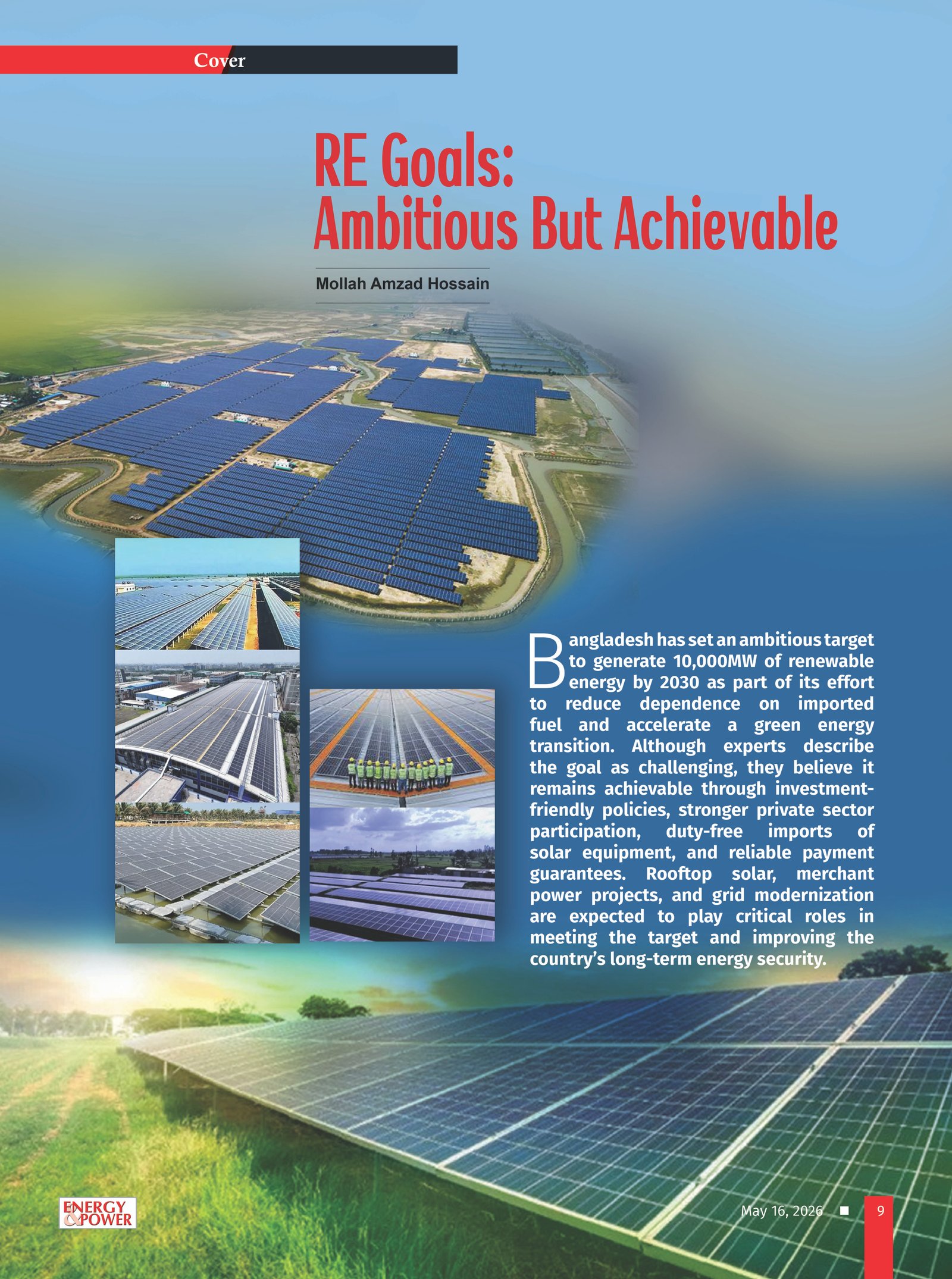
Bangladesh has embarked on an ambitious transition toward renewable energy as part of its broader effort to reduce dependence on imported fossil fuels and accelerate green energy development. Less than three months after taking office, the BNP-led government announced a new target to install 10,000MW of renewable capacity by 2030.
The decision was approved in April at a cabinet meeting, chaired by Prime Minister Tarique Rahman. Officials expect the initiative to help reduce the country’s growing dependence on imported energy while supporting low-carbon development and a green energy transition.
Energy and environmental experts have welcomed the move, although many describe the target as highly ambitious. They believe the goal remains achievable if the government adopts investment-friendly policies, removes import duties on renewable energy equipment, and implements effective strategies to attract private investment.
.jpg)
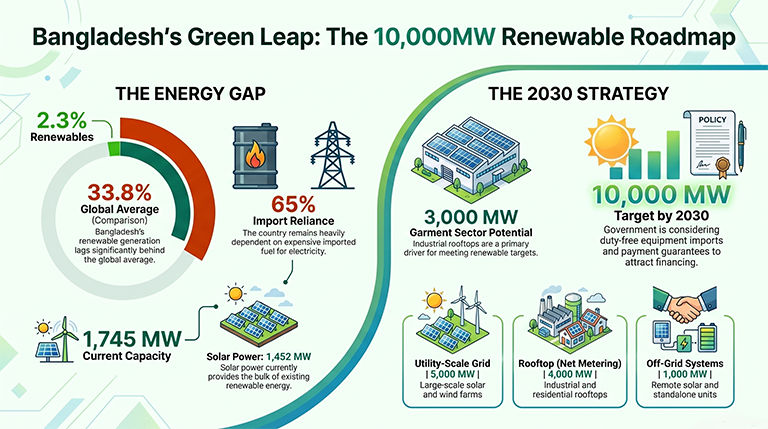
While renewable energy accounts for around 33.8 percent of global electricity generation, Bangladesh currently generates only about 2.3 percent of its electricity from renewables. The country remains heavily dependent on imported energy, more than 65 percent.
Bangladesh’s installed renewable energy capacity currently stands at around 1,745MW, including 1,452MW from solar, 230MW from hydropower, 62MW from wind, and small contributions from biomass and biogas. Of this, around 1,367MW is connected to the national grid, with solar contributing the largest share at 1,075MW. Another 26 renewable energy projects with a combined capacity of 1,174MW are currently under implementation.
According to the Power Division, an additional 810MW of solar power is expected to be added to the grid by 2028, while authorities believe total renewable capacity could reach 5,000MW by 2029.
Under the net metering policy implemented by SREDA, around 4,775 projects with a combined peak capacity of 262MW have already been installed. However, media reports suggest rooftop solar installations in industrial facilities alone may already exceed 800MW.
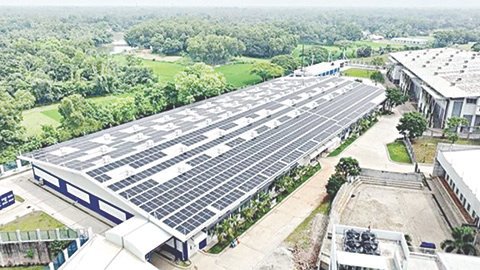
The government is also working on plans to expand rooftop solar systems in residential buildings across urban areas. Industry experts believe Bangladesh’s garment sector could add nearly 3,000MW of rooftop solar capacity by 2030, partly driven by European buyers’ requirements for increased use of renewable energy in manufacturing.
Despite the ambitious target, the sector continues to face major investment and policy challenges. During the final phase of the previous Awami League government, 37 independent power projects with a combined capacity of 5,800MW were approved under special legislation, but later cancelled by the interim administration over allegations of irregularities.
Subsequently, tenders were floated for 55 solar projects totaling 5,238MW, but the investors’ response remained weak due to changes in power purchase agreements and the absence of payment guarantees. Eventually, agreements were signed for only 918MW of projects.
At a recent event organized by the Centre for Policy Dialogue (CPD), Power, Energy and Mineral Resources Minister Iqbal Hassan Mahmood said the government had ordered a review of previously cancelled projects and may reconsider some of them to restore investor confidence.
When his attention was drawn to the matter, Mostafa Al Mahmud, President of the Bangladesh Sustainable and Renewable Energy Association, said that Bangladesh had been moving forward strongly in renewable energy development when the interim government cancelled the projects, slowing the momentum. He said that if the current government reviews the cancelled projects and reapproves some of them, it would help restore the confidence of investors in the renewable energy sector.
Industry stakeholders argue that achieving the 2030 target will require a comprehensive action plan, including both grid-connected and rooftop solar systems. Experts suggest the government may need to add more than 2,000MW of renewable energy capacity annually to reach the target — a significant challenge under current conditions.
They also stress the importance of removing tariff and non-tariff barriers, ensuring bankable power purchase agreements, resolving land shortages, and introducing payment guarantee mechanisms to attract local and international financing.
The government has recently indicated that it is preparing an investment-friendly renewable energy policy and considering duty-free imports of solar equipment and storage batteries. Authorities are also identifying land for future solar projects under public-private partnership arrangements.
Experts believe that if these policy reforms are implemented effectively, Bangladesh could make significant progress toward its renewable energy transition and reduce its long-term dependence on imported fuel.
Bangladesh’s history of implementing public-private partnership (PPP) projects has not always been encouraging, with many projects facing lengthy delays. Responding to concerns over whether renewable energy projects under the PPP model might suffer the same fate, a senior official of the Bangladesh Power Development Board (BPDB), speaking on condition of anonymity, said that although these initiatives are being labeled as PPP projects, they will effectively be implemented as Independent Power Producer (IPP) projects under BPDB oversight.
According to the official, government agencies such as the Bangladesh Economic Zones Authority (BEZA) and the Bangladesh Export Processing Zones Authority (BEPZA) will provide land for solar projects and receive lease payments or equity participation. However, the responsibility for financing, implementation, and operation will remain entirely with private developers under Power Purchase Agreements (PPAs) signed with BPDB. Public sector power companies will also be allowed to participate as project sponsors.
Former Senior Secretary Siddique Zobair told Energy & Power that Bangladesh has failed to make significant progress in renewable energy compared to neighboring countries. He said the 37 renewable energy projects approved during the final phase of the previous government could have marked a turning point had they not been cancelled. He emphasized that Bangladesh must reduce the cost of solar power generation by adopting strategies similar to those used in countries such as India.
In his view, if Bangladesh wants to achieve the target of adding 10,000MW of renewable energy capacity, the government must first identify and develop land, establish transmission infrastructure, and then invite private investment through auction to set benchmark tariffs and fixed implementation timelines. He believes that with proper planning, Bangladesh could reduce solar electricity prices to below 6 US cents per unit. However, he stressed that guarantees for electricity purchases and payment security must be ensured.
Bangladesh has already introduced the Merchant Power Plant Policy, allowing solar power plants to sell electricity directly to private buyers, especially industrial consumers. Under this framework, two companies have already signed memorandums of understanding to develop projects targeting the garment sector.
However, the Bangladesh Energy Regulatory Commission (BERC) has yet to finalize wheeling charges and open access fees. The Power Grid Company of Bangladesh (PGCB) and distribution utilities have proposed a charge of Tk2.75 per unit, which developers and experts consider unrealistic. Industry stakeholders believe these charges must be rationalized if merchant solar projects are to succeed.
Experts argue that 1,000MW to 2,000MW of renewable capacity could come from merchant power projects alone, especially as Bangladesh’s garment industry faces growing pressure from European buyers to use at least 25 percent renewable energy by 2030.
To achieve the government’s 10,000MW target, experts say at least half of the capacity must come from rooftop solar. It is estimated that up to 4,000MW could be added through net metering systems by 2030, while another 1,000MW to 1,500MW could come from off-grid rooftop solar systems.
An official involved with the net metering program noted that Pakistan has achieved far greater success because rooftop solar connections there are approved within seven working days. In contrast, some projects in Bangladesh reportedly take more than a year to receive grid connectivity approval. He suggested that Bangladesh should introduce a rule requiring net metering approvals within 15 working days.
Discussing the government’s renewable energy strategy, energy analyst Shafiqul Alam of the Institute for Energy Economics and Financial Analysis (IEEFA) described the 10,000MW target as highly ambitious but achievable.
He said the government must urgently finalize a detailed action plan outlining how much renewable capacity will come from grid-connected solar, rooftop solar under net metering, and off-grid systems. According to his proposal, 5,000MW should come from utility-scale grid-connected projects, 4,000MW from rooftop solar under net metering, and the remaining 1,000MW from off-grid systems.
Shafiqul Alam also emphasized the need for policy reforms to restore investor confidence, including guarantees for electricity purchases and payments, as well as duty-free import facilities for solar equipment.
He added that although investments are already being made to modernize the national grid, Bangladesh must also start integrating battery storage systems into both utility-scale and rooftop solar projects to support future renewable energy expansion.
A high-level committee led by Power, Energy and Mineral Resources Minister Iqbal Hassan Mahmood is currently working on policy support measures to achieve the renewable energy targets. The committee has already held two meetings to review issues related to tax exemptions, incentives, and payment guarantees.
Committee member and BPDB Chairman Md Rezaul Karim said the government is finalizing strategies to achieve 20 percent renewable electricity generation by 2030 and 30 percent by 2040 under the national renewable energy policy. Discussions are ongoing regarding duty-free imports of solar equipment, tax holidays, and mechanisms to guarantee power purchases and payments under PPAs.
Bangladesh remains significantly behind many neighboring countries in renewable energy development. However, experts believe that if the government adopts the right policies and implementation strategies, the 10,000MW renewable energy target could mark a major turning point in the country’s green energy transition.
Download Cover As PDF/userfiles/EP_23_23_Cover.pdf