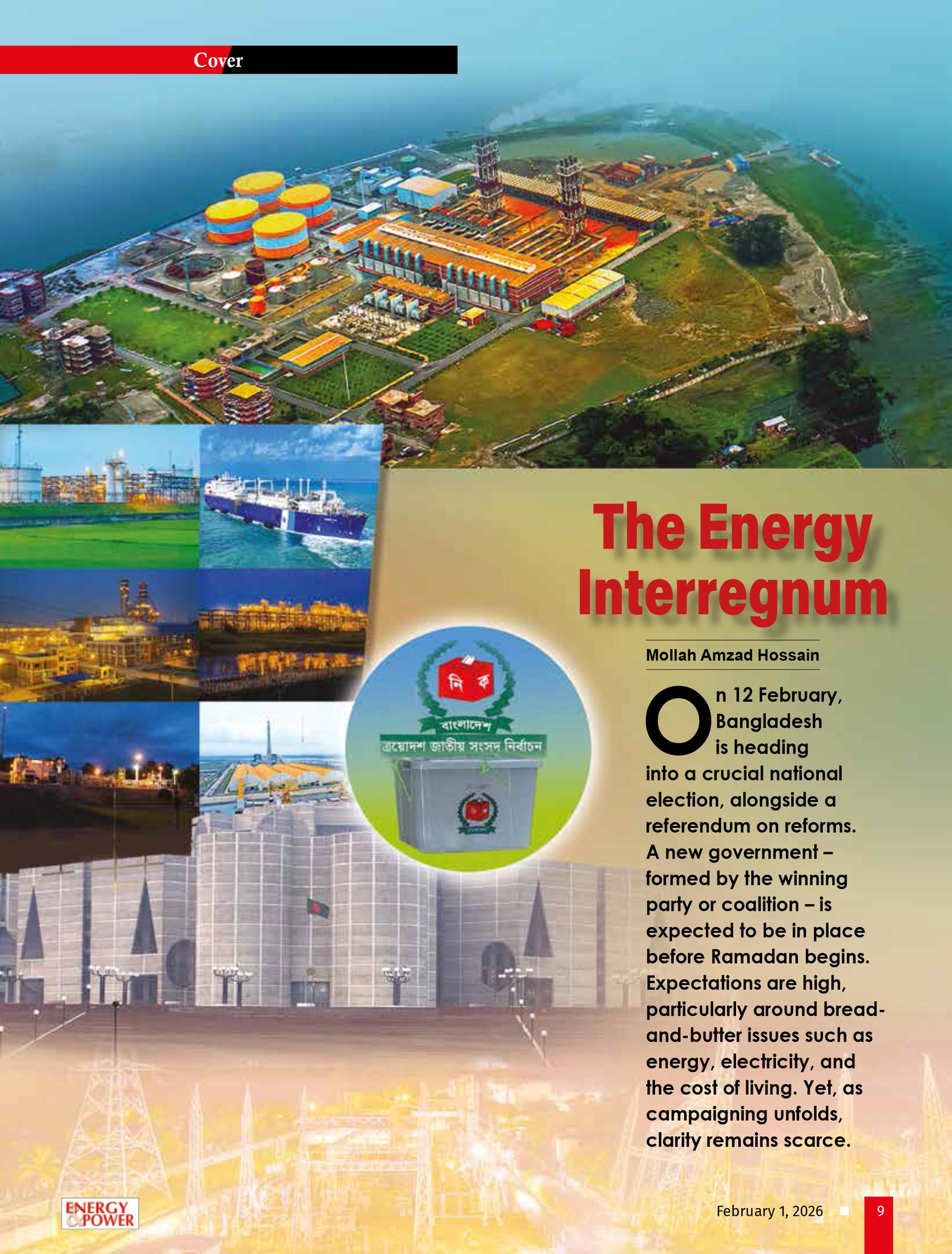
On 12 February, Bangladesh is heading into a crucial national parliamentary election, alongside a referendum on reforms. A new government – formed by the winning party or coalition – is expected to be in place before Ramadan begins. Expectations are high, particularly around bread-and-butter issues such as energy, electricity, and the cost of living.
Yet, as campaigning unfolds, clarity remains scarce. So far, only the NCP has published a full election manifesto. The BNP has outlined some energy-related commitments within its 31-point program, while Jamaat-e-Islami has shared policy ideas through a recent summit. These proposals talk about reducing corruption, expanding renewable energy, and even holding energy prices steady for several years.
What is missing, however, is the “how.” None of the major parties has clearly explained how these promises will be implemented, how a truly people-friendly energy and power sector will be built, or how the sector will be rescued from its deepening financial crisis.
Energy analysts point out that, after 54 years of independence, Bangladesh’s power and energy sector is now in one of its most fragile states. Over the past three decades, the cost of producing and supplying energy and electricity has risen steadily. But political and social realities have made it impossible to pass the full burden on to consumers. The result has been rising subsidies and a steady erosion of the financial health of state-owned energy institutions.
At the same time, the sector has failed to guarantee what citizens care about most: a reliable supply of quality electricity and gas. Bangladesh’s inability to systematically develop its own energy resources – particularly gas, coal, and renewables – has pushed the entire system toward heavy import dependence.
Today, more than 56 percent of Bangladesh’s combined energy and electricity supply depends on imports. Experts warn that without a significant increase in domestic gas and coal extraction, and a meaningful expansion of renewable energy, import dependence could climb to 80–90 percent within the next five to seven years.
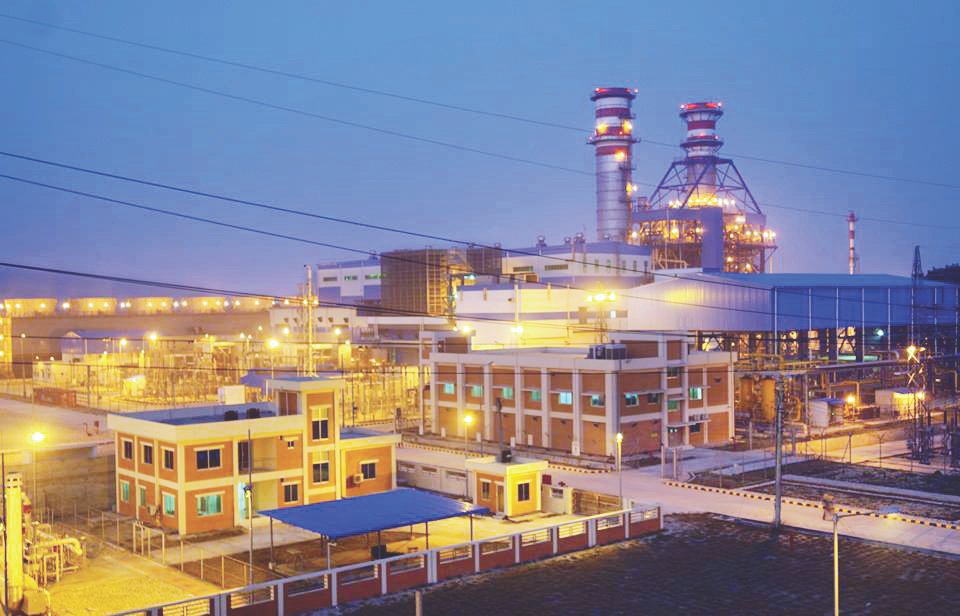
This growing dependence has made the sector increasingly vulnerable to global fuel price volatility and the steady depreciation of the taka against the US dollar. As a result, the cost of gas and electricity supply continues to rise, placing even greater financial pressure on already weakened institutions.
Official figures show that in 2024 alone, Bangladesh spent about USD 20 billion on energy and power imports and debt repayments. If the country were to meet full demand for electricity and fuel, this figure could cross USD 24 billion in the current year.
Against this backdrop, the government that takes office after the election will face an enormous challenge. It will need to cut electricity generation costs, secure adequate gas and coal supplies, ensure access to foreign currency for imports, clear mounting arrears, and rein in subsidies, all at the same time.
Perhaps the hardest task of all will be reducing losses and subsidies without raising gas and electricity prices, while still ensuring an uninterrupted supply. This challenge is urgent. Gas shortages and poor-quality electricity have already disrupted industrial production by an estimated 30–40 percent, while energy constraints have effectively stalled new investment.
Meanwhile, the entire sector is sinking into irregularities, corruption, and a lack of transparency. Restoring good governance and making the sector corruption-free has become a necessity—though everyone knows this will not be easy.
Although there was hope that political parties would finalize specific plans and strategies before the election, the contesting parties appear unprepared. Civil society organizations and NGOs have continued to present recommendations on what political parties should do in the energy and power sector, urging them to adopt these proposals and include them in their manifestos. However, political parties have not formally accepted or rejected these recommendations.
This lack of preparedness may waste valuable time after the government is formed, delaying the finalization of strategies to address the energy and power crisis, thereby prolonging the crisis further.
Public expectations regarding the energy sector are high ahead of the election. People particularly want uninterrupted gas supply, affordable gas and electricity, and proper investigations into the various financial irregularities and corruption that have occurred in recent years.
Although in some areas candidates have promised during campaigning to resolve the ongoing gas crisis, this is not realistically possible under current conditions. In fact, the crisis is likely to worsen.
Let us now look at what the major political parties are saying about the power and energy sector:
BNP
The BNP, one of the country’s largest political parties, has not yet released an election manifesto. However, party policymakers have said that the BNP’s declared “31-point program for repairing the state structure” will form the core basis of its election manifesto.
In the BNP’s 31 points, point 18 calls for the modernization of the power, minerals, and energy sectors and the establishment of good governance. It states that all “black laws,” including the indemnity law related to power, energy, and mineral resources, will be repealed. It also pledges to stop the ongoing unlimited corruption involved in purchasing electricity from anti-public-interest quick rental power plants, with the aim of preventing bleeding of the national economy.
The BNP also says that, instead of import dependence, it will pursue electricity generation based on renewable and mixed energy sources, and will take appropriate steps to discover and extract neglected gas and mineral resources. It claims that the programs followed under Shaheed Zia and former Chairperson Khaleda Zia’s Vision 2030 will also be considered in shaping energy and power sector policies.
Although BNP Chairperson Tarique Rahman’s election campaign across the country has raised many local issues, it has not clearly explained how fundamental problems like electricity and energy will be solved.
In one election rally, Tarique Rahman assured residents that the water and gas crisis would be addressed. He said that people pay their bills but do not receive gas properly. Regarding gas well exploration, he said, “In the past, obstacles were created against exploring new gas in the country. If we are elected, we will ensure planned investment in oil and gas exploration.”
BNP Standing Committee member and former State Minister for Power Iqbal Hasan Mahmud Tuku said that the shortage and financial crisis in the power and gas sector have become a major burden for the country. Therefore, resolving the accumulated crisis will not be easy in any way. However, he said the BNP is finalizing a specific plan for the power and energy sector, and if elected, work will begin based on that plan.
Reducing import dependence by expanding domestic gas, coal, and renewable energy is a major challenge. At the same time, ensuring a regular supply of dollars and taka for imports is also a major challenge in order to maintain supply continuity.
Moreover, because the gap between production cost and selling price is widening, subsidies continue to increase. Iqbal Hasan Mahmud believes that even with preparation, overcoming the crisis will not be easy for a new government.
Jamaat-e-Islami
Bangladesh Jamaat-e-Islami has not yet published its election manifesto. However, the party held a policy summit in the capital on 20 January. At that event, Jamaat-e-Islami pledged that if it comes to power, it will not increase the prices of gas, electricity, and water for all industries over the next three years.
However, no clear explanation was provided on how the party would keep prices stable. The summit also did not include any significant commitment on how import dependence would be reduced, or how the core crises in the power and energy sector would be addressed. Nevertheless, Jamaat has stated that if it comes to power, it will keep electricity and energy prices unchanged for three years.
On this issue, Jamaat’s Assistant Secretary General Ahsanul Mahbub Jubayer claimed that frequent changes in both government and policy are among the biggest problems in the power and energy sector. He said the sector has fallen into a severe financial and supply crisis due to corruption and irregularities. He argued that establishing a national consensus among political parties is essential to overcome this situation, and that Jamaat would take such an initiative if it forms the government.
NCP
In August last year, the NCP announced a 24-point manifesto aimed at establishing a “Second Republic.” The 19th point focused on national resource management. It stated that the NCP is committed to strengthening domestic capacity for natural resource exploration and extraction.
Recently, the NCP published its election manifesto titled “Manifesto of Youth and Dignity.” The manifesto promises a diversified energy mix, stating that as a developing economy, one of the country’s strategic priorities is energy security.
It promises that within five years, 20 percent of the country’s total electricity generation will come from renewable sources. It also mentions load forecasting, grid upgrades, storage technology, overcapacity, and reducing system loss. The manifesto targets reducing system loss from 10–12 percent to 5–6 percent over the next five years.
It also sets targets to reduce industrial peak electricity tariffs from Tk 15 to Tk 13, and off-peak tariffs from Tk 11 to Tk 9. In addition, it proposes several measures, such as making rooftop solar mandatory for government buildings and installing solar projects along riverbanks.
The NCP also promises to implement an “Energy Efficiency Master Plan,” treating energy savings as a “fourth fuel.” However, the manifesto does not clearly explain how these targets will be achieved.
The Energy Crisis is Deepening
In Bangladesh, the backbone of primary energy is natural gas. Even 10 years ago, gas supplied about 80 percent of the country’s total commercial energy. Today, that share has fallen to below 40 percent.
Currently, the minimum daily gas demand in the country is 4,000 million cubic feet per day (MMcfd). On 27–28 January, Petrobangla supplied 2,588 MMcfd, leaving a shortfall of 1,412 MMcfd. Petrobangla was able to supply only 65 percent of the total demand.
Of this supply, 67 percent came from domestic sources and 33 percent from LNG. Within domestic supply, national gas companies supplied 726 MMcfd, while IOCs supplied 1,020 MMcfd.
During the period in question, gas supply to the grid electricity was only 30 percent of demand.
Bangladesh’s current LNG import infrastructure capacity is 1,100 MMcfd, against which a maximum of about 1,050 MMcfd can be supplied. However, on those particular days, LNG supply was only 842 MMcfd.
This data clearly indicates that the country’s gas crisis is severe, and there is no quick way out. In fact, Energy Adviser Dr Fouzul Kabir Khan has said that domestic gas supply is declining by about 200 MMcfd per year.
The Gas Crisis is Not New
The gas crisis is not new. In 2018, domestic gas supply peaked at around 2,786 MMcfd, and since then, the decline has continued. To address the shortfall, LNG imports began in that same year.
In 2018–19, domestic gas supply amounted to 965 billion cubic feet (BCF), while LNG imports were 116 BCF. By FY 2024–25, domestic production had fallen to 696.1 BCF, while LNG imports rose to 281.9 BCF.
Gas Price Hikes under the Previous Government
During the tenure of the ousted Awami League government, gas prices were raised repeatedly despite promises of uninterrupted gas supply.
According to IEEFA analysis, from June 2022 to April 2025, the gas price for grid electricity rose from Tk 5.02 per cubic meter to Tk 14.75, an increase of 194 percent.
For captive power plants, the gas price was increased from Tk 16 to Tk 42, an increase of 162.5 percent.
For small industries, gas prices rose from Tk 10.78 to Tk 40, an increase of 271 percent.
For medium industries, prices increased from Tk 11.78 to Tk 40, an increase of 240 percent.
For large industries, the gas price per cubic meter rose from Tk 11.98 to Tk 40, an increase of 234 percent.
Exploration and Production Efforts
After spending a long period with little progress in oil and gas exploration, the ousted Awami League government began exploration initiatives in 2020.
Under domestic efforts, a program of 50 wells was undertaken, including 18 exploration wells. By the end of 2025, only 20 wells had been completed. This added 181 MMcfd of gas to the grid, but it did not prevent the decline in domestic production.
Meanwhile, Petrobangla has finalized another plan to drill 100 wells. It has been stated that drilling of 50 wells will be completed by June of the current year, and from July, drilling of 20 wells will begin under the new plan.
Petrobangla claims that if this program is completed by 2028, it will add around 1,400 MMcfd of gas. However, during this period, production from the Bibiyana field, which currently produces around 900 MMcfd, may decline to its minimum level. Therefore, it is difficult to say how much domestic supply will actually increase.
Offshore bidding rounds have also failed to attract responses. Even if an elected government can issue tenders and attract investment, it would take around 10 years to see results.
LNG Infrastructure Plans and Uncertainty
To increase LNG import capacity, the Awami League government had partnered with the Summit Group to install an FSRU, which was expected to come into operation within this year.
It had also finalized negotiations with Excelerate Energy to install another FSRU in Patuakhali. In addition, negotiations were at a final stage with two entities to import LNG via pipeline from India, which would have had a capacity of 1,200 MMcfd. However, those initiatives were later cancelled.
Even if a new government takes initiatives, installing an FSRU would take at least three years. Work is also underway to build a land-based LNG terminal under a PPP framework, but implementation does not appear likely before 2032.
The plan to connect Bhola gas to the national grid also remains uncertain. As a result, there is virtually no chance that the gas supply situation will improve before 2030.
The Power Sector in the Midst of Crisis
Bangladesh’s current grid-based power generation capacity stands at 28,909 MW. In addition, industries have nearly 6,000 MW of captive power generation capacity. However, on 23 July 2025, the country’s highest power generation was 16,794 MW.
Bangladesh’s electricity demand pattern is also somewhat different. The residential sector consumes the highest share, up to 56 percent. The industrial sector accounts for 27 percent, and this share has remained stable for several years. Last year, considering grid electricity demand, the reserve margin was 61 percent.
In FY 2020–21, the per-unit cost of electricity generation was Tk 6.61. By FY 2024–25, it had risen to Tk 12.10. Over this period, the increase in generation cost was 84 percent. It is said that the continued rise in generation cost is driven by an excessive reserve margin, increased dependence on imported fuel and electricity, and the depreciation of the taka against the US dollar.
At present, the bulk selling price of electricity is Tk 7.04 per unit. As a result, more than Tk 5 is being lost on every unit of electricity sold.
Data analysis shows that the lowest-cost electricity comes from gas. However, due to inadequate gas supply, 50 percent of gas-based generation capacity is sitting idle. After gas, coal power plants also provide an opportunity for relatively low-cost electricity. Yet, because full financing for coal imports could not be ensured, the plant load factor of coal-based power generation last year was only 56 percent. If this could be kept above 75 percent, it would be possible to reduce generation costs.
On the other hand, in the last fiscal year, the share of furnace oil in electricity generation was 10.73 percent. If this could be limited to 5 percent, and if gas and coal supplies could be increased, it would be possible to reduce per-unit generation cost by Tk 1 to Tk 1.50.
Despite payments being made to clear outstanding dues, arrears have once again risen to nearly Tk 30,000 crore. IPP entrepreneurs have claimed that if these arrears are not cleared, it will not be possible for them to supply electricity according to demand during the upcoming Ramadan and summer season. Financial constraints in public sector companies have become severe. As a result, after the election, the winning party or coalition that forms the government will face a major crisis in ensuring electricity supply according to demand.
The Financial Burden of the Power and Energy Sector
The financial capacity of institutions in the power and energy sector is gradually weakening. Even with continued subsidies, losses at institutions such as Petrobangla and BPDB continue to rise.
Since 2022, complications have emerged regarding the price of gas supplied by IOCs, LNG prices, and payments for electricity purchased from IPPs. In this context, the Awami League lost power amid public protests, and an interim government took responsibility. At that time, outstanding dues amounted to USD 3.1 billion.
Although the interim government gradually cleared these dues and restored relative normalcy in the power and energy sector, BPDB’s arrears have started rising again. At present, arrears stand at nearly Tk 30,000 crore.
Despite receiving Tk 38,300 crore in subsidies, BPDB’s loss in FY 2023–24 was Tk 8,700 crore. In FY 2024–25, even after receiving Tk 36,600 crore in subsidies, BPDB’s losses increased further to more than Tk 17,000 crore.
Meanwhile, Petrobangla continues to incur losses because it sells gas at an average price lower than the average cost of domestically produced gas and LNG. According to available data, from 2018 to last year, Petrobangla imported USD 17.6 billion worth of LNG. To cover the cost of LNG imports, Petrobangla has spent almost the entire amount accumulated in the fund created for oil and gas exploration.
According to Hydrocarbon Unit accounts, in 2024, the cost of importing oil, fuel, and electricity was USD 13.2 billion, accounting for 21 percent of the country’s total import expenditure. During the same period, an additional USD 7 billion was spent on debt repayment and interest for the energy and power sector. That means total spending in the power and energy sector in 2024 amounted to USD 20.2 billion.
This estimate considers the reported 56 percent rise in power and energy imports annually. However, imports continue to increase. Considering that trend, experts believe that in the current fiscal year, this expenditure could rise further and exceed USD 24 billion.
As a result, the financial fragility of the power and energy sector will become the responsibility of whichever party or coalition forms the government after winning the election. The key question is what strategy they will adopt to overcome this situation.
However, BNP Standing Committee member and former State Minister for Power Iqbal Hasan Mahmud Tuku recently said at an event that this crisis cannot be overcome through a “business-as-usual” approach.
What the Experts Think
Former BERC member Engineer Mizanur Rahman believes that reducing the cost of electricity generation is now the biggest challenge. Therefore, costs must be brought down by increasing the supply of comparatively low-cost fuels such as gas and coal, and by reducing furnace oil-based power generation to the minimum possible level. However, he noted that the task will not be easy.
Engr. Shafiqul Alam, Lead Energy Analyst (Bangladesh) at the Institute for Energy Economics and Financial Analysis (IEEFA), believes that to stop the use of furnace oil-based electricity during the daytime, a rapid expansion program for grid-connected solar is necessary. At the same time, the new government should undertake a rooftop solar crash program to add 1,000 MW within one year. He also said that to reduce losses, electricity selling prices must be adjusted alongside subsidies.
Former BAPEX Managing Director Murtuza Ahmed Faruque Chishti said, “The main reason behind the crisis in the gas sector is the lack of emphasis on exploration and extraction. It is difficult to predict how much success will come from the ongoing program to drill 50 and 100 wells. However, to achieve quick success, exploration should be initiated in the Chittagong Hill Tracts through IOCs (International Oil Companies). Still, it is hard to say how much this will reduce the gas shortage. The crisis will continue until 2030. The only real option is to reduce the shortfall by expanding LNG import infrastructure.”
Energy expert and geologist Professor Badrul Imam said, “There is no immediate solution in the gas sector. Investment is needed. In particular, a method is required through which Bangladesh can exit LNG imports within a defined timeframe. It is not possible to sustain the national economy using expensive fuel. Moreover, given the kind of interventions taking place in the global energy market, a country like ours could face major risks at any time.”
Although there are plans to increase gas supply domestically, a large share of the supply is still dependent on imports. Gas supply management will be handled in two ways. Under the interim government’s integrated energy plan, the energy sector has been structured in three phases, to be implemented from 2026 to 2050. Implementing this plan will require USD 70–80 billion in investment in the energy sector.
Referring to this, Energy Division Secretary Mohammad Saiful Islam told a daily newspaper, “To overcome the gas crisis, the government will increase both imports and domestic gas extraction. As part of this, an initiative has been taken to build another floating LNG terminal. Work on a land-based LNG terminal is also progressing. On the other hand, BAPEX and other companies are working on domestic gas exploration and extraction. Two new rigs are being purchased, and deep drilling is underway. Previously, the plans that were taken were not part of any integrated initiative, which is why various crises emerged in the gas sector.”
Regarding the government’s plan to address the gas crisis, the secretary said, “Greater importance has been given to surveys in the domestic gas sector. The integrated energy plan outlines how energy security will be ensured. The program to drill 100 wells is already ongoing. At the same time, to reduce expensive spot LNG imports, a decision has been taken to move toward short-term LNG contracts over the next three years.”
Professor M. Tamim, Vice Chancellor of Independent University, Bangladesh (IUB), said that beyond ongoing efforts for domestic gas and coal exploration and extraction, special initiatives are required. Alongside domestic investment, foreign investment and technology must also be attracted for oil and gas exploration. Foreign experts should be hired to rapidly increase production from domestic gas reserves. At the same time, special strategies must be adopted to expand renewable energy and ensure efficient energy use. Advancing all of these in an integrated way will be the new government’s biggest challenge. However, he said, it cannot be confidently claimed that this will be enough to curb imports.
Professor Ijaz Hossain believes that Bangladesh must ensure, through wartime-level preparedness and drilling 100 wells per year, whether new gas discoveries are realistically possible. Based on that, a new energy supply plan must be developed. The elected government must adopt special strategies to explore and extract domestic resources, such as gas and coal. Even then, he said, he is not optimistic about reducing import dependence.
Conclusion
Bangladesh’s deepening power and energy crisis did not emerge overnight. Years of hesitation and political indecision, particularly around exploring domestic gas and coal resources, have steadily weakened the country’s energy security. While coal-fired power plants were built, no serious effort was made to use domestic coal. Renewable energy expansion lagged far behind regional peers. The outcome has been a growing reliance on imported fuel and electricity, exposing the economy to global shocks.
Today, the country is supplying roughly 30 percent less gas than required. Factories are operating below capacity, export earnings are under pressure, and industrial confidence is eroding. Although remittance inflows have improved in recent months, the broader trend is troubling: over the past seven years, dependence on imported power and energy has risen to at least 56 percent—and many believe the real figure is even higher.
Experts warn that without breakthroughs in domestic gas, coal, and renewable energy development, import dependence could rise to 80–90 percent in the coming years. If that happens, annual fuel import bills will continue to climb, placing unbearable pressure on foreign exchange reserves and public finances.
This leaves the next elected government with little room for delay or half-measures. Addressing the accumulated crisis in the power and energy sector will require a clear, long-term strategy built on national consensus – not partisan politics. It will also require skilled institutions, transparent decision-making, and the political courage to implement difficult reforms. Without these, the energy crisis will continue to deepen, steadily tightening its grip on Bangladesh’s economy and everyday life.
Mollah Amzad Hossain, Editor, Energy & Power
Download Cover As PDF/userfiles/EP_23_16_Cover.pdf