Following the recent political change from the mass uprising, disputes have surfaced among Petrobangla and gas companies over the gas supply chain management. Petrobangla companies are registered under the Companies Act which provides the companies autonomy to be governed by the properly constituted board of directors. But neither the boards are constituted properly nor Petrobangla lets companies operate autonomously. Various disparities and anomalies have created controversies. Major disputes are Petrobangla unnecessarily delaying the organogram of companies like TGTDCL and GTCL after the approval in the respective board of directors, irrational pay scales of energy sector companies, and Petrobangla creating disputes in system loss determination. Bangladesh gas supply management could not establish International Standards. Under the circumstances, officials of Petrobangla companies have unleashed aggressive agitation programs that tarnished the dynamic image of the energy sector.
Despite fuel diversification over the past one-and-a-half-decade, natural gas remains the dominating fuel in the Bangladesh energy sector. Gas still contributes about 50% of the power generation, is used as primary raw material for urea fertilizer, used as fuel, and in some cases raw material in industries and used as cooking fuel in gas franchises. In 2018, Bangladesh started importing Liquefied Natural Gas by setting up floating terminals off the coast of Moheshkhali, Cox’s Bazar. According to the Petrobangla sources, the present coincident peak demand is 4,200 MMCFD but the highest supply on 20 May 2024 was 3115.52 MMCFD which included 1101.05 MMCFD of imported RLNG. Own production from gas fields of Petrobangla companies and IOCs operated gas fields are fast depleting. Chevron from its operated Bibiyana Gas field produced 1015.62 MMCFD on 20 May 2024. It has been reported that the production of Bibiyana is also depleting and will deplete faster soon. The present exploration campaign needs expediting and stranded gas at Bhola needs to be evacuated to the national gas grid without further delay. Moreover, gas supply chain management needs to grow smarter to eliminate non-technical losses and limit technical losses. Modern metering systems can limit the technical loss of transmission systems to below 1% and distribution networks to below 2%.
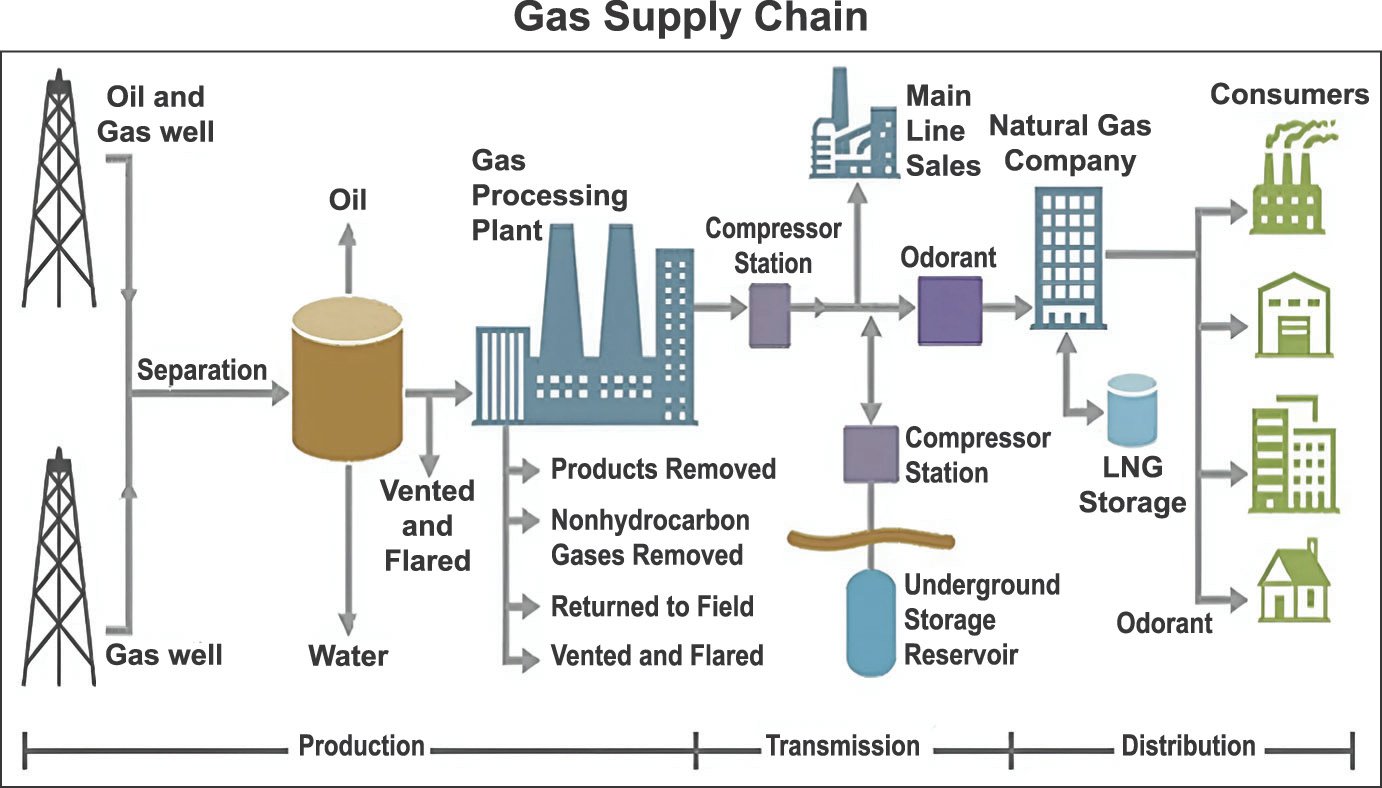
The gas supply chain has three distinct activities. Exploration and Production is termed upstream activity, transmission is the midstream activity and distribution, and supply is the downstream activity. A well-managed gas supply chain needs a well-coordinated and coherent gas supply chain. Custody of gas is transferred from E&P companies to transmission companies and from transmission companies to local distribution companies through custody transfer metering stations. The global supply chain manages custody transfer by SCADA and telemetry. Distribution systems use digital mapping and smart sensing. The old distribution pipelines are replaced. These days MDPE and HDPE pipes and fittings are used to reduce costs as these do not need anti-corrosion coating. Distribution networks also use smart sensing with fiber optics. However, E&P companies must ensure the delivery of pipeline-quality gas. At the delivery point, the online chromatograph should continuously monitor the gas composition and heating value, and the dew point tester should monitor the water dew point and hydrocarbon dew point. This writer visited the Alliance Pipeline in Calgary Alberta Canada, the Gasuine Transmission network in the Netherlands, British Gas Transco Transmission system in the UK.
Bangladesh Gas Supply Chain
Bangladesh's gas supply chain has one exploration and production company, BAPEX, and two production companies – BGFCL and SGFL. In addition, two international oil companies, Chevron and Tullow, supply gas to the national gas grid under a production-sharing agreement with Petrobangla. RPGCL manages LNG import and supplies to the grid,
Bangladesh's gas supply chain at the start was vertically integrated. Gas exploration and production before independence was done by Pakistan Petroleum Limited (PPL) in the Sylhet region and Shell BV in the rest of Bangladesh. Shell from its Titas Gas field constructed a gas transmission pipeline from Titas Gas field in Brahmanbaria to Demra in Dhaka via Norshingdi. Titas Gas Transmission and Distribution Company (TGTDCL) started operation in the late 1960s. PPL was responsible for supplying gas to Fenchuganj and Chattak Gas fields to Fenchuganj Fertilizer Factory and Chattak Cement Factory.
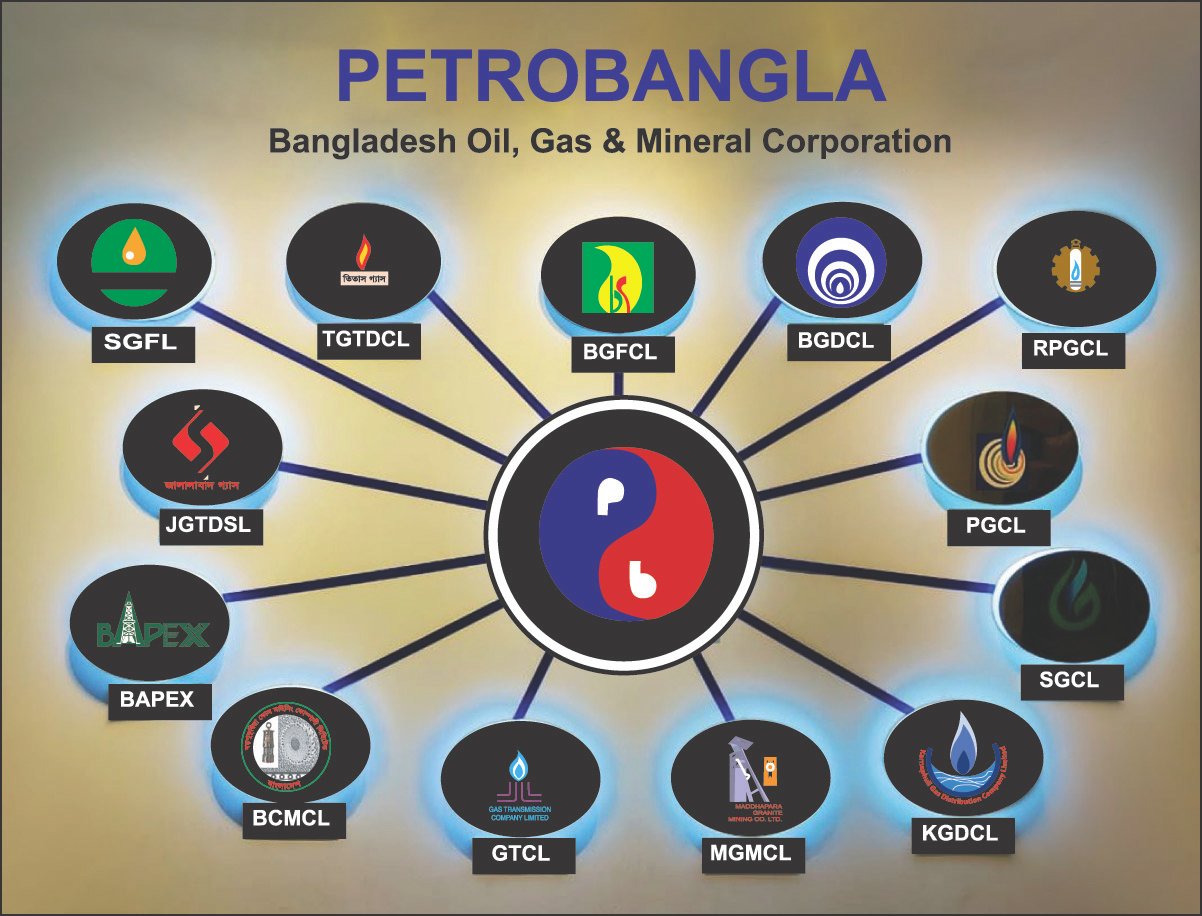
Following the liberation of Bangladesh, PPL was changed into BPL and later SGFL. Bangladesh Oil Gas and Mineral Corporation (BOGMC) and Later with the separation of mining activities from the petroleum sector Bangladesh Oil and Gas Corporation (BOGC) Petrobangla was formed. Gradually BGSL, JGTDSL, PGCL, and SGCL were formed. KGDCL and BGDCL were created from BGSL. In the unbundling process of vertically integrated gas supply chain operation, Gas Transmission Company Limited (GTCL) was created in December 1993 for midstream activity of the gas supply chain. All 13 companies in the Petroleum are registered under the Company Act and are supposed to be operated as autonomous bodies. Petrobangla holds all shares of the companies on behalf of the Bangladesh government. Only 20% share of TGTDCL has been let out to the public through stock exchange.
The above shows that the vision and objective of unbundling vertically integrated gas system operations were not completely achieved as TGTDCL and JGTDSL retained some transmission activities. Petrobangla also did not transfer the operation of some IOCs’ constructed transmission pipelines after IOCs handed these pipelines over cost recovery. All gas transmission assets must be handed over to GTCL for specialized operations. Distribution companies must concentrate their operations on gas distribution network modernization, automation, and curbing non-technical losses. Petrobangla must not directly own any gas transmission asset.
E&P Activity
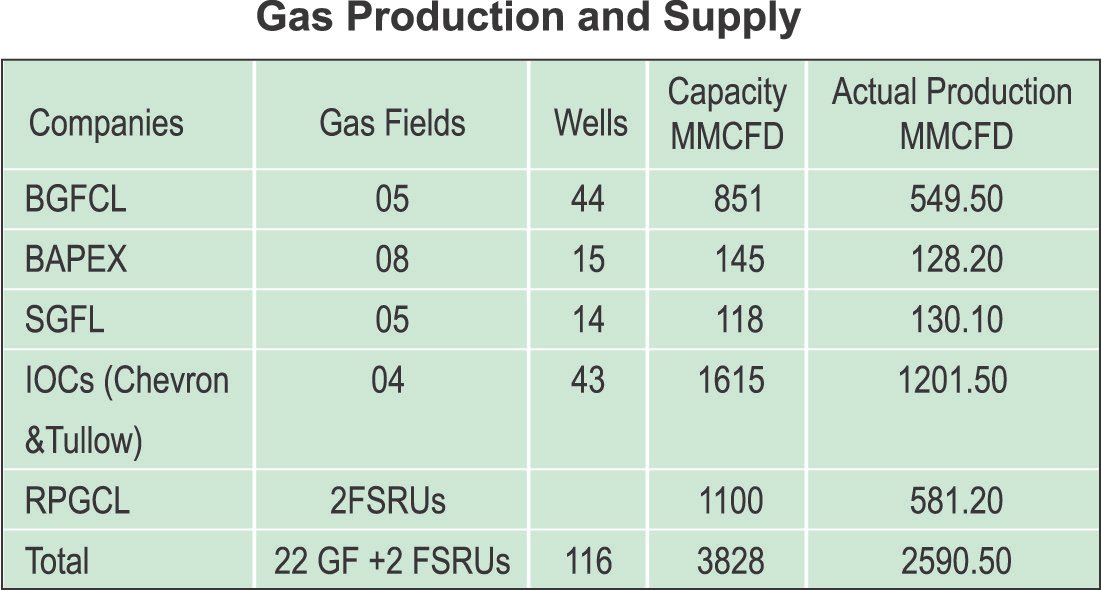
BAPEX, BGFCL, and SGFL are three companies of the Petrobangla family. The following table will justify that for better management it will be far more logical that upstream activities should be consolidated into one large E&P company as SGFL and BGFCL activities have become very limited. An integrated E&P can have two to three regional subdivisions in the Present BGFCL, SGFL area, and another for the rest of the region. Reservoir study and reservoir management as part of E&P activity must also be transferred from Petrobangla to E&P Company. A properly restructured E&P company can also manage all exploration activities including PSCs. In that case, the restructured E&P can be developed like Petronas, PERTAMINA, ONGC, and Petrobras. A self-sustaining competent E&P company must be organized now to ensure the gas supply security of Bangladesh. Otherwise, the 48 wells or 100 wells drilling program and professional management of offshore activities will remain a dream.
Petrobangla must mention the present capacity of gas wells. BGFCL and IOC gas wells do not have the capacity mentioned in the report. Moreover, a general reader or even an investor gets confused reading that IOCs can produce 1,200 MMCFD from 43 wells but BGFCL only produces 550 MMCFD from 44 wells. SGFL and BGFCL should merge with BAPEX for a single competent E&P company.
Gas Transmission System
Evacuating pipeline-quality gas from gas fields and LNG supply sources and transporting gas to distribution companies is a specialized nature of the job. In the unbundling process of the vertically integrated gas supply management chain Gas Transmission Company Limited (GTCL) was created in 1993. The objective was to consolidate all high-pressure gas transmission operations in GTCL. But in 31 years of GTCL creation, some transmission pipelines and infrastructure remain under Petrobangla, TGTDCL, and JGTDSL. GTCL was designed to evacuate gas from sources through modern custody transfer metering stations and deliver gas at required pressure to distribution companies through custody transfer metering stations. Unfortunately, BGFCL and SGFL still rely on outdated orifice meter technology and chart reading. GTCL has SCADA-connected flow meters. However, there is no meeting of mind between GTCL and production companies. On the other hand, there are no existing custody transfer meters at all points whether gas custody is handed over from GTCL to distribution companies. Hence there remains a dispute in gas metering and system loss determination. The transmission system has zero leakage, but there can be some technical losses due to metering inaccuracies. International best practice is 1-1.5% technical losses. We are not sure if BERC or Petrobangla has considered international best practices in determining wheeling charges, and distribution margins for the gas companies. The present disputes among Petrobangla, GTCL, and distribution companies have originated from not following the standard practice. GTCL has no business with end users. All gas delivery from the transmission network to the distribution company must be done through GTCL Custody transfer meters. If necessary, distribution companies may set up check meters. Under no circumstance, any customer be given connection through hot-tapping of transmission pipelines. BERC must serve notice to all its licensees about the above. There is no scope for fugitive emissions from the gas transmission network. GTCL however must regularly carry out onstream pigging of its transmission network. GTCL must also refurbish SCADA for supervisory control. SCADA should incorporate leak detection and pipe modeling software. BERC should instruct Petrobangla to arrange the transfer of all transmission facilities to GTCL for unified operations.
It may be noted that the GTCL transmission network now extends from Moheshkhali, Cox’sbazar to Rangpur and from Beanibazar Sylhet to Khulna. The company has over 2017.60-kilometer gas transmission pipelines, Compressor stations, and over 100 gas delivery stations. Presently, the GTCL delivers gas to distribution companies through 20 of its owned delivery stations while 44 of the delivery stations are below to distribution companies. The disputes over metering can not be resolved until all delivery points have modern accurate GTCL-owned metering stations. No gas dispatch from the transmission system from the transmission network to the distribution company should be measured by the metering stations of end users. Customers, who have been given connections through hot-tapping, must be brought under a standard metering facility as soon as possible.
Gas Distribution System
TGTDCL as the oldest and largest gas distribution company has a very complex and cumbersome gas distribution network. It accounts for almost 60% of the total gas used in Bangladesh. The networks spread over greater Dhaka and greater Mymensingh districts. BGDCL and KGDCL are two other distribution companies in the southeast Bangladesh. JGTDSL distributes gas regionally. PGCL supplies gas to Pabna, Bogura, and Rajshahi regions. It will also supply gas soon to Rangpur and Dinajpur. SGDCL supplies gas to southern Bangladesh.
Many pipelines of TGTDCL, KGDCL, and BGDCL are old and corroded and are leaking. Moreover, unscrupulous elements through illegal tapping and extension of distribution lines have made distribution networks messy and vulnerable to fatal accidents. Titas pipelines in many areas have been now buried well below the ground. Many pipelines cannot be traded. An initiative taken for digital mapping could not be completed. Bringing gas distribution networks to Dhaka, Narayanganj, and Gazipur areas is a huge challenge. It is also difficult to isolate gas distribution networks into separate zones. Suspending gas supply to domestic consumers was not a smart decision. Millions of unauthorized connections have been given. It has become almost impossible to eliminate unauthorized gas use in widespread areas. The situation in KGDCL and BGDCL is somewhat better for the design by experienced Engineers of TGTDCL. KGDCL has a ring main, HP DRS, and IP DRS. Setting up meters in DRSs and digital mapping of distribution network systems can be brought under control. TGTDCL must replace many pipelines in the Dhaka, Narayanganj, and Gazipur areas, and set up digital mapping, including GIS and Fiber optics. Even after all these will suggest dividing huge TFA into three companies.
Dhaka, Manikganj, Gazipur: Company One
Narayanganj and Munshiganj: Company Two
Greater Mymensingh including Norshingdi: Company three.
Managing TGDCL is extremely difficult. It needs special attention. It is not fair to criticize TGTCL. EMRD and Petrobangla are equally responsible for the messy system operations of the TGDCL.
Gas supply chain management must be modernized and automated. Gas companies are deprived of similar salaries and benefits given to some power companies. As such companies cannot attract and retain smart young graduates. Company officials are demanding for special salary for a while and rational treatment. Their legitimate demand must be given attention.
Conclusion
Given the extensive discussion, the following recommendations can be put forward:
• Gas Evacuation and Delivery to and from the gas transmission network to the distribution system must be covered under modern metering and control systems (preferably under SCADA).
• No customer should be supplied gas through hot tapping of the gas transmission network.
• GTCL and distribution companies must have a custody transfer metering station at every point of change of custody of gas.
• At all custody transfer metering stations, there must be provision for an online chromatograph, dew-point analyzer, and Wobbe index meter.
• Gas purchased and sold must be done based on heat content, not volumetric.
• Gas must not be sold to any customer without a meter.
• Distribution pipelines in general and pipelines in city areas must be covered under digital mapping, above ground installations must also be covered under GIS
• Distribution networks may be covered under telemetry. Telemetry may be linked with the SCADA of the transmission system.
• For ease and comfort of maintenance of the gas distribution system wherever possible MDPE and HDPE pipes may be used.
• Smart sensing devices may be installed in Gas Transmission and distribution systems for remote monitoring of unauthorized access
One must remember that gas companies will explore, develop, and supply primary energy. Necessary reforms are essential at all segments of gas supply chain management to ensure efficiency and conservation of energy and energy security.
Download Article As PDF/userfiles/EP_22_9_Article.pdf