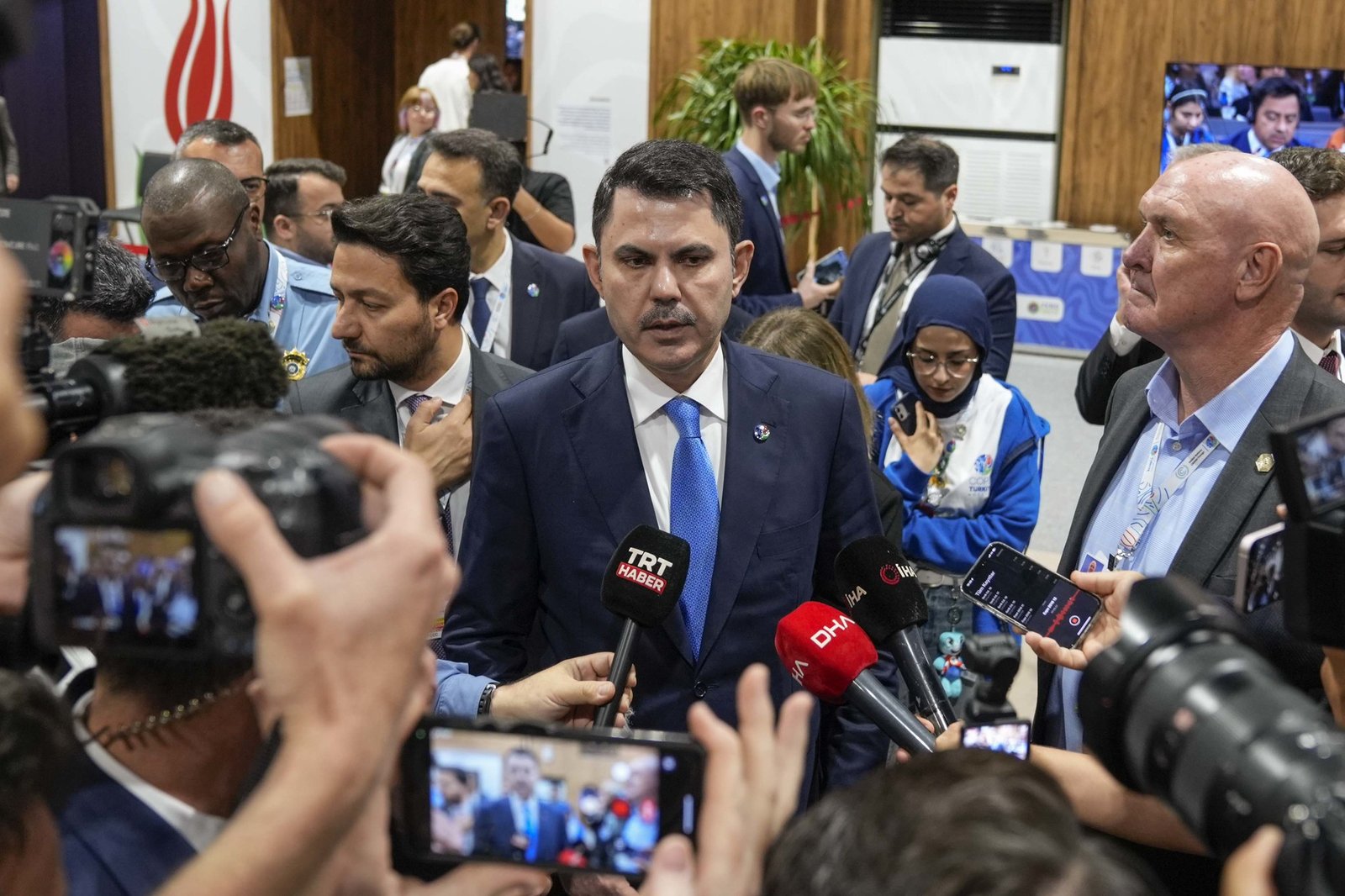
Mollah Amzad Hossain with Afroza Akther Pervin from Türkiye
November 22, 2026 — The 31st UN Climate Change Conference (COP31) in Antalya, Türkiye, ended after two additional days of negotiations beyond its scheduled closing date, but failed to secure consensus on an overarching political outcome. Deep divisions over fossil fuels, climate finance and support for vulnerable countries prevented governments from adopting the proposed Cover Decision, leaving the summit with one of the most serious setbacks in recent UN climate diplomacy.
The conference, which began on November 9 and was scheduled to conclude on November 20, became the longest COP on record after negotiations continued through November 21 and into Sunday. Despite intensive consultations led by the Turkish Presidency and Australia’s Presidency of Negotiations, countries remained divided over the final text.
COP31 President Murat Kurum told the closing plenary that there was no further action he could take to bridge the differences. “There is nothing to do. We did all that we could,” he said, indicating that he would not present another revised text.
Australia’s Climate and Energy Minister and COP31 President of Negotiations Chris Bowen described the outcome as “very disappointing”. He said the parties had maintained strong positions on several key issues and that repeated efforts to find a compromise had failed.
“Unfortunately we were unable to reach agreement on a cover decision and that’s very disappointing,” Bowen said. He added that some parties had insisted they would veto any text containing references to transitioning away from fossil fuels.
Fossil fuel transition becomes the breaking point
The absence of an explicit reference to fossil fuels in the final proposed Cover Decision became the principal reason for opposition from the European Union and several other countries.
The latest draft had removed references to coal, oil and gas and the transition away from fossil fuels, despite demands from a large group of countries to retain stronger language. Ireland’s Environment Minister Darragh O’Brien, speaking on behalf of the EU, said the proposed agreement was unacceptable.
“It is unconscionable that we would have a climate act that makes no reference to fossil fuel, no reference to transitioning away from fossil fuels,” he said.
Saudi Arabia and other major fossil fuel-producing countries opposed the inclusion of such language, arguing that fossil fuels would continue to play a role in the global economy. Their position remained a major obstacle to reaching consensus.
The proposed text also included faster development of carbon-removal technologies to address projected temperature overshoot. However, critics warned that relying on carbon removal without clear emissions-reduction commitments could provide an excuse for continued fossil fuel production.
Türkiye’s proposal to increase electricity’s share of global final energy consumption to 35% by 2035 was retained in the proposed Antalya Pact. Bowen said the electrification target had received considerable support, although it was not sufficient to overcome the wider disagreements.
Climate finance remains unresolved
Climate finance was another major source of disagreement. Developing countries demanded predictable, accessible and adequate financial support to address climate impacts, particularly adaptation and loss and damage.
The proposed Cover Decision called for tripling adaptation finance but did not specify a clear baseline or the annual amount required. Developing countries criticised the lack of concrete financial commitments, arguing that vulnerable nations need grants and concessional resources rather than increased dependence on loans and private investment.
The African Group of Negotiators (AGN) expressed profound disappointment with the outcomes of key negotiations. Its Chair, Nana Dr Antwi-Boasiako Amoah, said the decisions on Action for Climate Empowerment and long-term climate finance failed to adequately reflect Africa’s concerns and negotiating positions.
The African Group also questioned the Presidency’s handling of the process, stating: “The Presidency’s responsibility is to facilitate consensus among Parties, in accordance with the rules of procedure, not to determine or impose an outcome on their behalf.”
The group raised concerns that some provisions of the draft decisions had not been adequately negotiated and questioned the evidence used to assess progress towards the US$100 billion climate finance goal. It called for a more robust methodology to improve transparency and trust in climate finance reporting.
UN chief and civil society express disappointment
UN Secretary-General António Guterres expressed deep disappointment over the failure to reach consensus.
“I am deeply disappointed that COP31 has ended without consensus on an overarching outcome. I share the very profound frustration of all those who expected governments to rise to the moment the climate crisis demands,” he said.
He recalled that countries had agreed at COP28 in Dubai to transition away from fossil fuels in a just, orderly and equitable manner, stressing that the priority now was to accelerate, finance and deliver that transition.
Civil society organisations also criticised the outcome. Mohamed Adow, Director of Power Shift Africa, described COP31 as a “ghost COP” and warned that its lack of progress would have serious consequences for climate-vulnerable communities.
“Rich nations and polluting governments cannot keep arriving empty-handed and expecting a carefully worded declaration to get them off the hook,” he said.
Jasper Inventor, head of the Greenpeace COP31 delegation, said campaigners had come to Antalya to end fossil fuels, not extend their use. He described the absence of a credible pathway to phase out fossil fuels as deeply disappointing, while acknowledging that rejecting a weak agreement was preferable to accepting a deal that favoured continued fossil fuel dependence.
Asad Rehman, Chief Executive of Friends of the Earth, said an agreement based on further empty promises would not have delivered the transformative action required. He urged governments to return to negotiations with stronger commitments to emissions reduction, a fair energy transition and public climate finance.
A setback for multilateral climate diplomacy
The failure to adopt a consensus Cover Decision does not cancel existing obligations under the Paris Agreement or decisions reached at previous COPs. However, it exposes the growing difficulty of achieving agreement among nearly 200 countries on the scale and direction of global climate action.
Belgium’s Climate Minister Jean-Luc Crucke described the outcome as difficult but said it was “not the end of multilateralism”.
The Antalya conference has therefore ended without the political consensus its Presidency had sought. Its most significant unresolved questions—how to accelerate the transition away from fossil fuels, mobilise adequate climate finance and protect vulnerable countries—will remain central to international climate diplomacy in the period ahead.