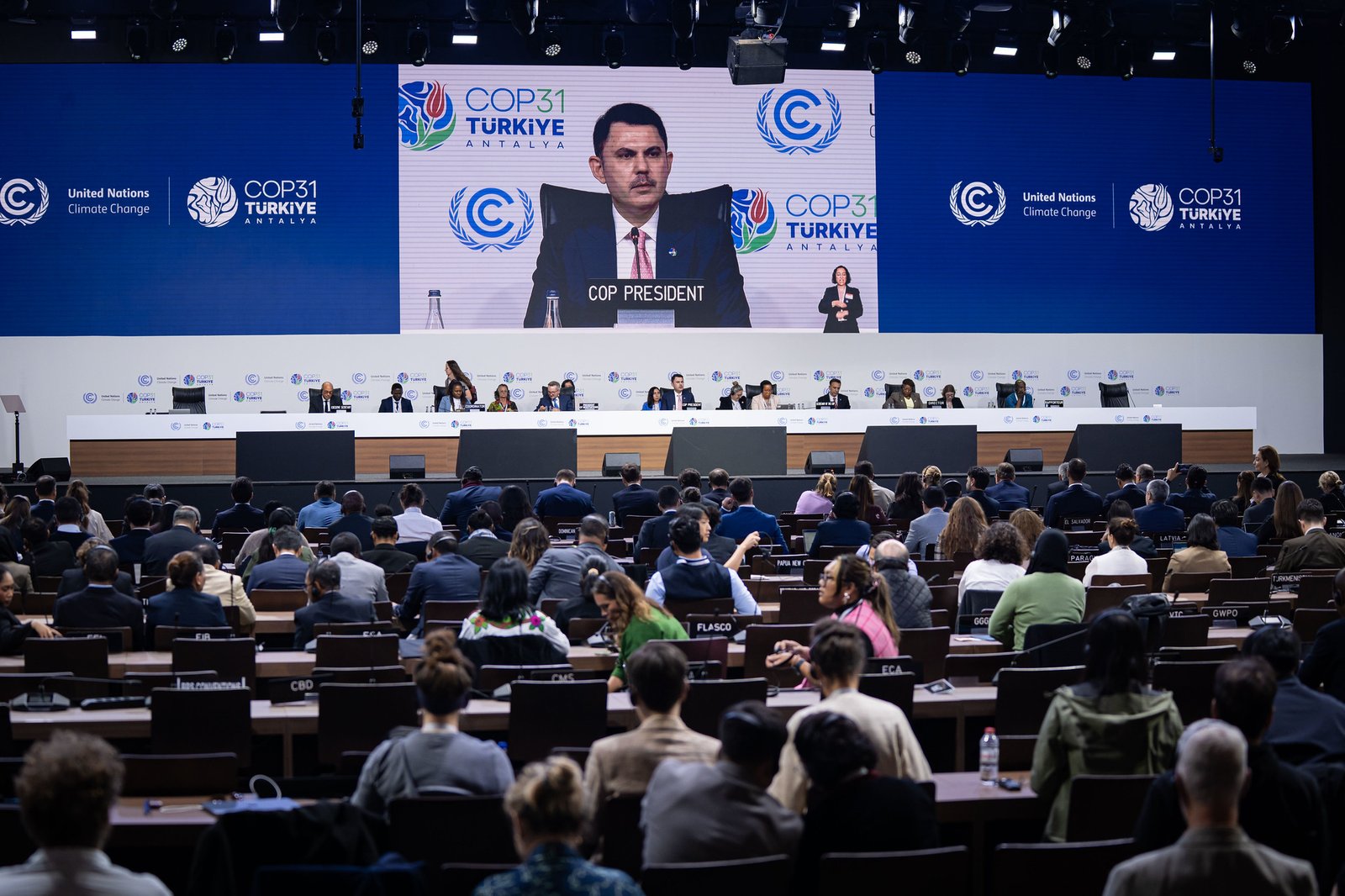
Mollah Amzad Hossain with Afroza Akther Pervin from Antalya, Türkiye
November 21, 2026 — The UN Climate Change Conference (COP31) has entered extended negotiations in Antalya, with the closing process still under way as the Turkish Presidency and the Australian Presidency of Negotiations seek to secure consensus on the outstanding issues. Although the conference was scheduled to conclude on November 20, disagreements over the cover decision, climate finance, fossil fuels, adaptation and just transition have prevented governments from reaching a comprehensive political agreement within the official timeframe.
A closing plenary was scheduled for Friday evening to address matters on which negotiations had already made progress. However, the broader political negotiations were expected to continue into Saturday, with delegates awaiting another version of the draft cover decision. The Presidency is continuing consultations with negotiating groups and ministers to identify compromises acceptable to all parties.
Progress alongside unresolved differences
The Presidency has acknowledged progress on several agenda items, including the Green Climate Fund (GCF), Global Environment Facility (GEF), Fund for Responding to Loss and Damage (FRLD), National Adaptation Plans (NAPs), least developed country issues and Article 6 of the Paris Agreement. Work has also advanced on the Climate Technology Centre and Network and Action for Climate Empowerment.
However, the Presidency’s mid-week update identified 21 mandated agenda items that had yet to be resolved. Major outstanding issues included the Climate Finance Work Program, Adaptation Fund, Article 2.1(c) of the Paris Agreement, Response Measures, Mitigation Work Programme, Global Goal on Adaptation and Just Transition Work Program.
The Thursday update from the two Presidencies called on countries to intensify efforts and identify areas of agreement. It said ministerial consultations would focus particularly on the cover decision, climate finance and Article 2.1(c), while officials continued discussions on just transition, mitigation, adaptation and response measures.
Cover decision remains the central political challenge
The latest available draft cover decision has become a major source of disagreement. The first version, circulated on November 16, contained 18 pages and 144 paragraphs, including competing proposals on fossil fuel phase-out, the 1.5°C temperature goal, electrification and adaptation finance. The revised nine-page draft issued on November 19 removed explicit references to fossil fuels and the proposed US$120 billion annual adaptation finance target by 2035.
The revised text retained a reference to increasing electrification, including the proposed 35% target for electricity’s share of global final energy consumption by 2035. However, critics argue that electrification without a clear commitment to renewable energy and a transition away from fossil fuels could leave room for continued reliance on coal, oil and gas.
The disagreement has divided countries. France and a group of other countries, along with several vulnerable nations, have called for stronger language on the transition away from fossil fuels to be restored. Saudi Arabia and other opponents have resisted such references. The debate has also involved the proposed role of carbon capture, utilisation and storage (CCUS).
COP31 President of Negotiations Chris Bowen said there was still a willingness among parties to reach an agreement. “There is still a spirit of goodwill,” he told journalists on November 20, adding that no one had suggested abandoning the negotiations. He said electrification was central to the energy transition and that further meetings were needed to complete the work.
COP31 President Murat Kurum defended the Presidency’s approach, arguing that the proposed electrification target represented practical progress towards reducing fossil fuel dependence. The Presidency has maintained that it is seeking an ambitious but balanced outcome that takes account of different national circumstances.
African countries demand delivery on finance
Climate finance remains a fundamental dividing line between developed and developing countries. The African Group of Negotiators (AGN), the G77 and China, and other developing-country coalitions have demanded predictable, accessible and adequate financial support, particularly for adaptation and loss and damage.
At a press conference on Friday, Ghana’s Environment Minister and AGN Chair Zanetor Agyeman-Rawlings strongly criticised the lack of concrete financial commitments. “We didn’t come here to beg,” she said. “We came here to claim what is rightfully ours for our people who are suffering the brunt of anthropogenic activities of developed countries.”
She also criticised the use of inaccessible finance and what she described as shifting goalposts. “Africa is not a continent merely seeking assistance. We are asking the developed countries to keep promises that they already made,” she said.
Developed countries, including the European Union, have highlighted their existing climate finance contributions and the role of private investment. A senior EU official said the bloc and its member states provided €32.3 billion in public finance and mobilised €9.3 billion in private finance in 2025 for developing countries. Developing-country representatives, however, argue that existing contributions do not adequately address their needs or replace developed countries’ obligations.
Small island states and civil society raise alarm
The Alliance of Small Island States (AOSIS) has rejected the latest draft as inadequate. Fiji’s climate minister Lynda Tabuya, speaking at a special ministerial meeting, said: “As it stands, we cannot accept it. This text is not a meaningful response to overshoot.” She described the draft as a major setback on mitigation and raised particular concerns over the removal of fossil fuel language and the inclusion of CCUS.
Civil society organisations have also expressed strong dissatisfaction. Climate Action Network International Executive Director Tasneem Essop said: “We are unambiguously stating that we are rejecting what is currently on the table in these negotiations today.” She argued that the text failed to protect people or address the priorities of the Global South.
Mohamed Adow, director of Power Shift Africa, also criticised the proposed outcome, warning that the conference risked becoming a missed opportunity for meaningful climate action. Activists have called for stronger commitments on fossil fuel transition, climate finance, adaptation and a just transition mechanism.
The final outcome now depends on whether the Presidencies can reconcile these competing demands. While progress on several technical matters offers a basis for agreement, the central political questions remain unresolved. As the closing process continues beyond the scheduled deadline, governments face the challenge of producing a consensus decision that reflects both the urgency of climate science and the financial and development needs of vulnerable countries.