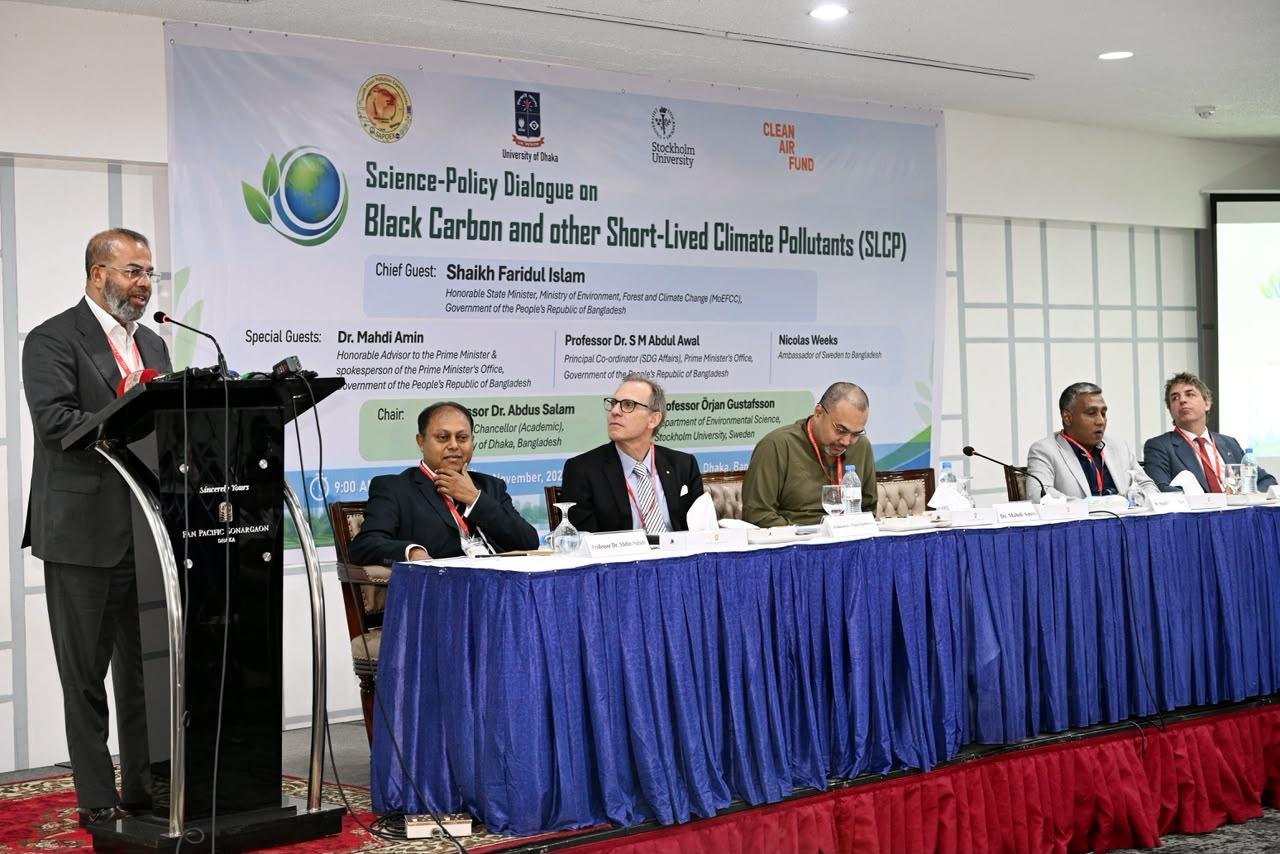
DHAKA, November 1, 2026 — Bangladesh needs stronger policy enforcement, cleaner transport and energy systems, and regional cooperation to reduce black carbon and other air pollutants, experts said at a high-level science-policy dialogue in Dhaka on Sunday.
The University of Dhaka (DU) and Stockholm University of Sweden jointly organized the dialogue on black carbon and other short-lived climate pollutants (SLCPs), in cooperation with the Clean Air Fund, at the Pan Pacific Sonargaon Hotel.
State Minister for Environment, Forest and Climate Change Shaikh Faridul Islam attended the inaugural session as chief guest. Prime Minister’s Adviser and PMO Spokesperson Dr Mahdi Amin, Principal Coordinator for SDG Affairs at the Prime Minister’s Office Professor S M Abdul Awal, Swedish Ambassador to Bangladesh Nicolas Weeks and Stockholm University Professor Orjan Gustafsson addressed the event as special guests. DU Pro-Vice Chancellor (Academic) Professor Abdus Salam presided.
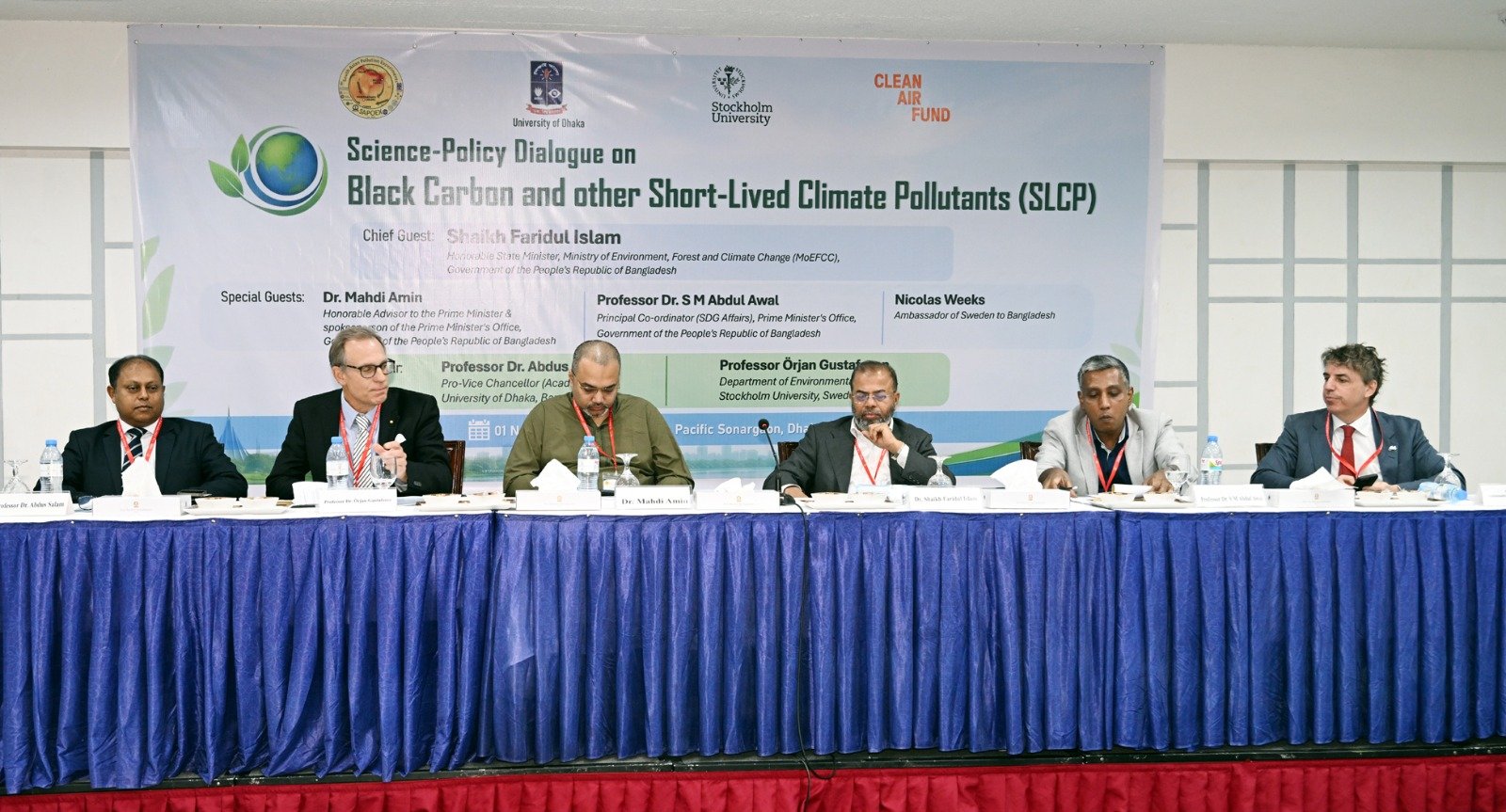
Addressing the dialogue, Professor Salam said black carbon is produced by the incomplete combustion of fossil fuels, such as diesel and petrol, as well as biomass. These tiny airborne particles absorb solar radiation and heat the Earth’s surface, contributing to global warming.
He said black carbon concentrations in Bangladesh had declined from around 40 micrograms per cubic meter in the past to between 6 and 12 micrograms in recent measurements. However, the level remained considerably higher than the 0.1–2.5 micrograms per cubic meter reported in many developed countries.
Both fossil-fuel combustion and biomass burning contribute to black carbon emissions, particularly in Dhaka, he said, adding that transboundary pollution was another significant source of air pollution in Bangladesh.
Professor Salam called for effective enforcement of vehicle and industrial emission standards, promotion of clean fuels and public transport, improved household energy practices, better construction and industrial management, and stronger air-quality monitoring. He also stressed the need for increased institutional capacity and regional cooperation to address pollution crossing national borders.
State Minister Shaikh Faridul Islam said coal-fired power plants inherited from the previous administration burn around 12,000 tonnes of coal daily, contributing to black carbon emissions. He also said brick kilns account for approximately 13 percent of the country’s air pollution, with many using high-sulphur coal.
The government is moving to shut down 200 wood-burning brick kilns and replace them with concrete block production facilities to reduce smoke emissions, he added.
The state minister also announced plans to generate 4,000MW of solar power within the next three months, including 296MW in Dhaka, as part of an initial 10,000MW solar power target. He said expanding renewable energy would help reduce dependence on fossil fuels and support the transition to cleaner energy.
Prime Minister’s Adviser Mahdi Amin said the government was prioritizing renewable energy, particularly solar power, and pursuing waste-to-energy projects to diversify the energy mix. Promoting electric vehicles and reducing dependence on fossil fuels were also among the government’s priorities, he added.
Swedish Ambassador Nicolas Weeks said Sweden’s new five-year development cooperation strategy with Bangladesh placed strong emphasis on green transition, climate resilience and environmentally sustainable growth. He stressed the importance of joint scientific research and stronger partnerships, saying economic development and environmental sustainability should advance together.
The dialogue highlighted the importance of translating scientific research into practical policies to improve air quality, protect public health and mitigate climate change. It also underscored the need for stronger cooperation among policymakers, universities, researchers and international partners.