EP Analysis
The proposal to establish Bangladesh’s third floating storage and regasification unit (FSRU) has been withdrawn from the Cabinet Committee on Government Purchase (CCGP), raising questions about the cost, ownership structure and procurement process of the proposed terminal. The proposal, submitted by China National Energy Engineering & Construction Co Ltd (CNEE), had drawn criticism over its relatively high tariff and the company’s lack of experience in developing FSRU facilities.
The Energy and Mineral Resources Division forwarded CNEE’s unsolicited proposal to the purchase committee after negotiations. However, media reports and energy experts raised concerns about the financial terms and the proposed Build, Own and Operate (BOO) model, under which CNEE would retain ownership of the terminal after the 15-year contract period.
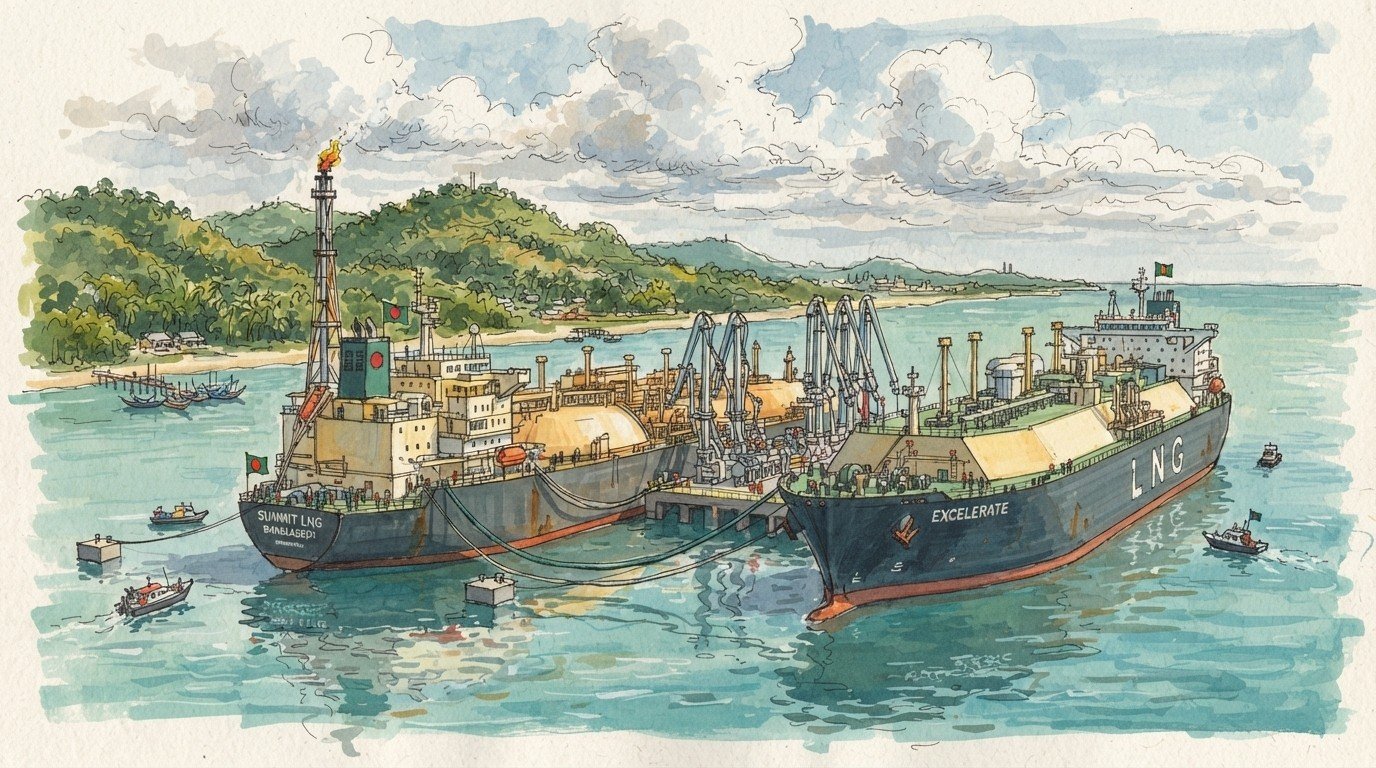
In contrast, Bangladesh’s two operational FSRUs, operated by Excelerate Energy and Summit LNG, follow a Build, Own, Operate and Transfer (BOOT) arrangement. Under this model, ownership is transferred to the government after the contract period, providing the country with a long-term infrastructure asset.
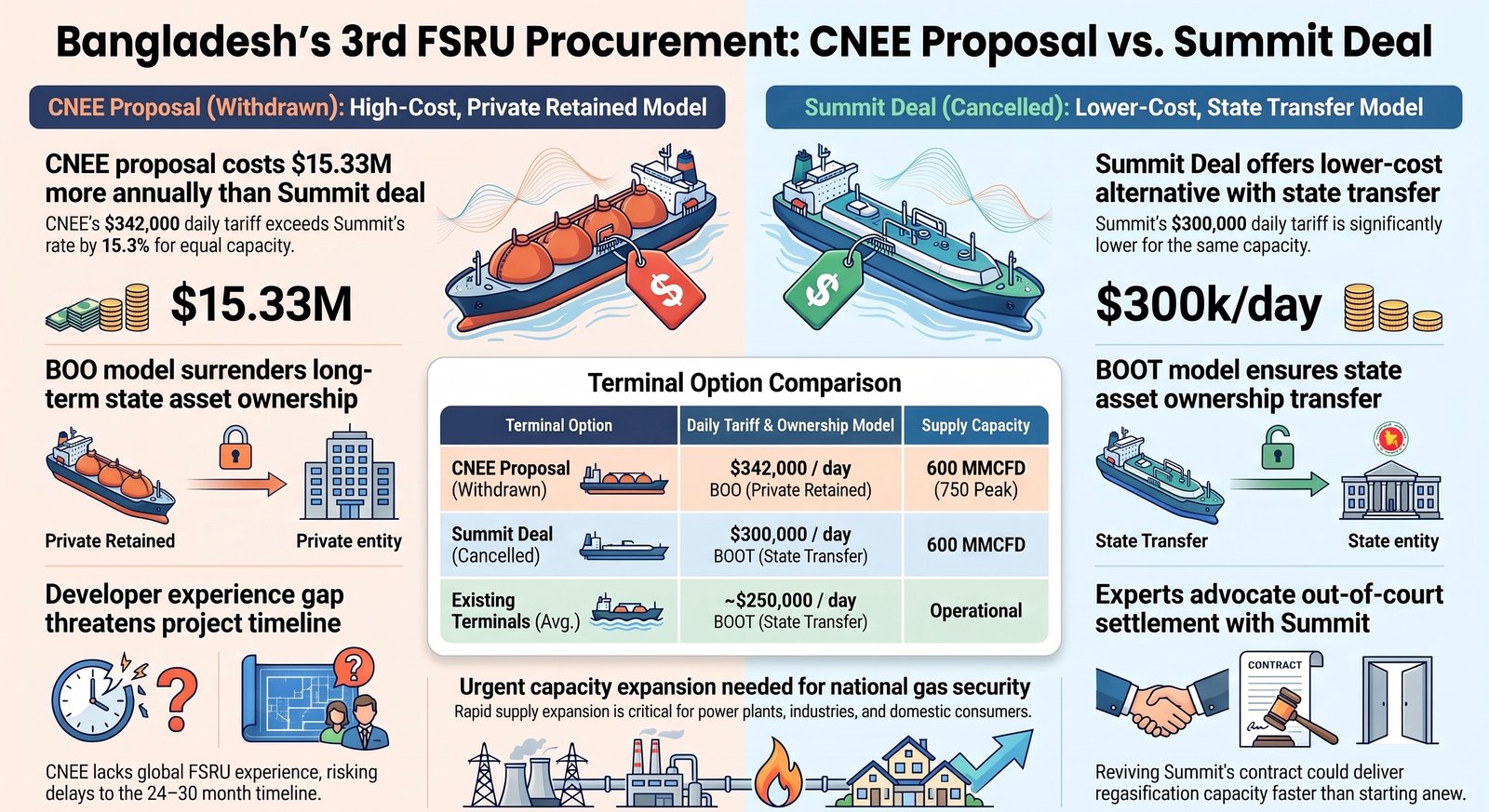
The proposed CNEE terminal at Kutubjom, Maheshkhali, was designed to supply 600 million cubic feet of gas per day, with a peak regasification capacity of 750 MMCFD. CNEE negotiated a daily tariff of US$346,000 for the proposed facility. This was higher than the US$254,000 daily charge for Excelerate Energy’s terminal and the US$249,115 rate reported for Summit LNG’s existing terminal.
A further comparison can be made with Summit LNG’s cancelled contract for a third FSRU. That project was also designed to supply 600 MMCFD and was based on a BOOT arrangement, with a reported daily tariff of US$300,000. The contract was expected to bring the terminal into operation around the middle of 2027, but its cancellation has become the subject of legal proceedings initiated by Summit.
The difference between the proposed CNEE tariff and Summit’s cancelled contract is significant. CNEE’s proposed daily charge of US$342,000 was US$42,000 higher, or approximately 15.3% more, than Summit’s reported tariff for the same daily gas supply capacity. Over a year, assuming uninterrupted operation and the same tariff throughout, the difference would amount to approximately US$15.33 million. The comparison also highlights a fundamental difference in ownership: Bangladesh would retain the terminal under the proposed Summit BOOT arrangement, whereas CNEE would retain ownership under its BOO model.
An Energy Division source, speaking on condition of anonymity, said the previous interim government cancelled Summit’s third FSRU contract, prompting the company to challenge the decision in court. The case remains pending. The source also noted that a separate long-term LNG supply agreement between Summit and Petrobangla had been cancelled during the same period.
According to the source, Bangladesh’s worsening gas shortage left the government with limited options for rapidly expanding LNG import infrastructure. The Energy Division therefore proceeded with negotiations on CNEE’s proposal under a government-to-government (G2G) procurement arrangement. The source maintained that the negotiated tariff reflected prevailing global market conditions and that securing an FSRU at a lower cost would have been difficult.
However, energy experts question whether the CNEE proposal offers the best solution to Bangladesh’s immediate and long-term gas supply challenges.
Energy expert Engineer Khondkar Abdus Saleque said CNEE had no previous experience in developing FSRUs anywhere in the world. Given Bangladesh’s urgent need to expand gas import capacity, he expressed doubts about whether the company could complete the project within the proposed 24–30 months.
Saleque argued that the costs associated with the CNEE proposal were higher than those of both the existing terminals and Summit’s cancelled third-terminal project. He suggested that the government’s best option would be to explore an out-of-court settlement with Summit and consider reviving the cancelled contract. Such an approach, he said, could bring additional regasification capacity online sooner than starting afresh with a new developer, provided the legal and contractual issues could be resolved.
Energy experts Professor M. Tamim and Professor Dr. Ijaz Hossain have also questioned the decision to cancel Summit’s third FSRU contract. Speaking on Energy & Power talk shows in recent months, they argued that the government could review the agreement in light of the country’s continuing gas shortage and the need for additional LNG import capacity.
The issue now presents the government with a difficult choice. Proceeding with CNEE could provide a route to additional LNG infrastructure, but the higher tariff, BOO ownership model and questions about implementation capacity require careful scrutiny. Reviving the Summit project, meanwhile, could offer a lower reported tariff and eventual government ownership, but would require a legally and commercially viable resolution of the existing dispute.
The CCGP’s withdrawal of the CNEE proposal has created an opportunity for the government to reassess its options before making a fresh commitment. It remains unclear whether the Energy Division will resubmit the proposal after further review or undertake a broader assessment of alternatives.
A Petrobangla source said the possibility of reviewing Summit’s cancelled contract through an out-of-court settlement had been discussed, but the company had received no written instruction from the Energy Division to pursue such a course.
With domestic gas production under pressure and demand from power plants, industries and other consumers exceeding available supplies, the government’s decision will have implications beyond the cost of a single terminal. The key challenge is to secure additional regasification capacity as quickly as possible while ensuring value for money, credible project delivery and the best long-term ownership arrangement for Bangladesh.