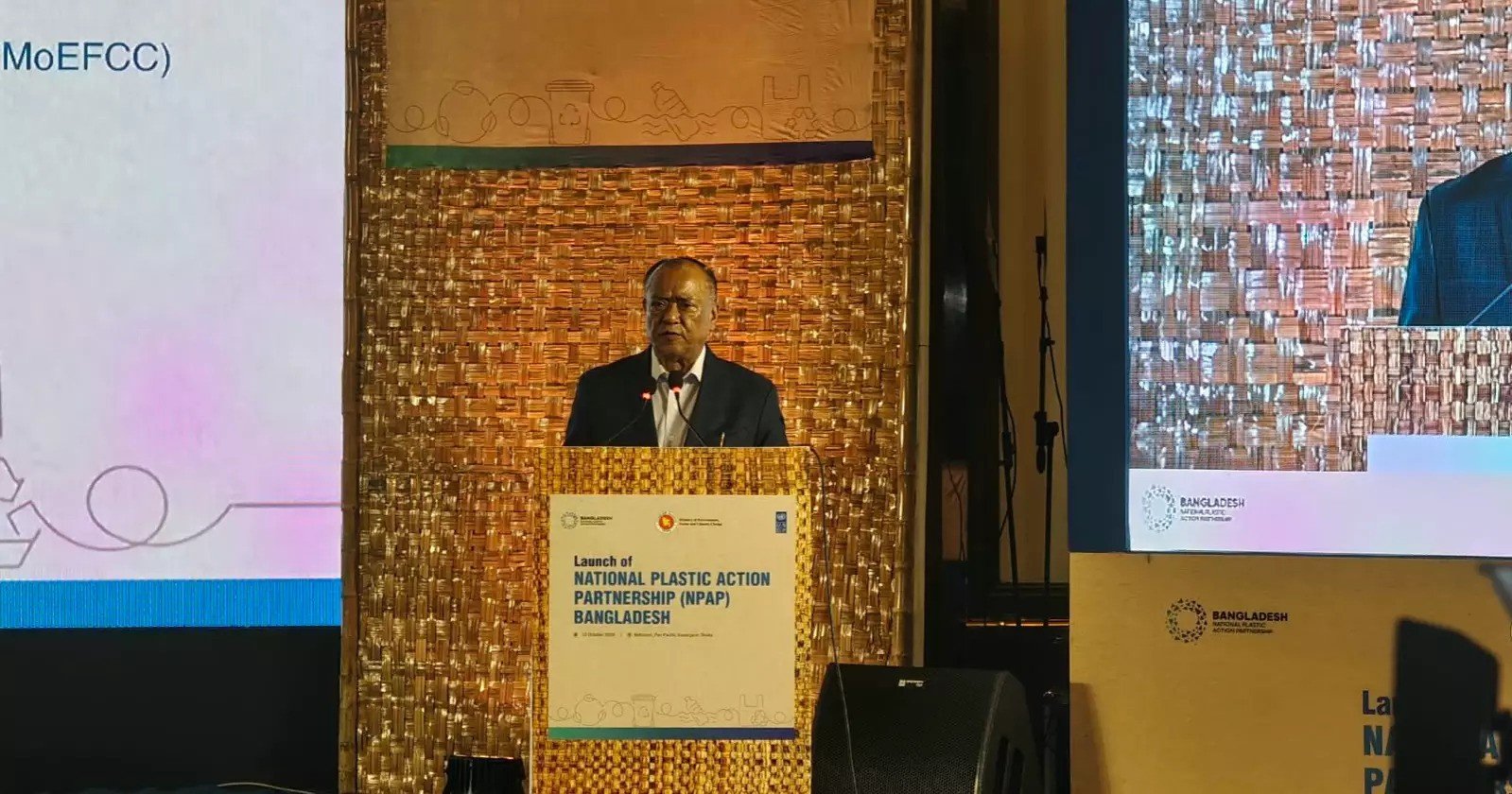
DHAKA, October 13, 2026: Bangladesh has launched the National Plastic Action Partnership (NPAP) to strengthen coordination among government agencies, businesses, development partners and civil society in tackling plastic pollution and promoting a circular economy.
Environment, Forest and Climate Change Minister Abdul Awal Mintoo formally launched the initiative at a city hotel on Tuesday, stressing the need for effective enforcement of plastic waste management policies and coordinated action across the plastics value chain.
The partnership brings together the Ministry of Environment, Forest and Climate Change, the Department of Environment, UNDP Bangladesh and the World Economic Forum’s Global Plastic Action Partnership.
Mintoo said plastic pollution poses serious threats to public health and ecosystems, affecting urban areas, rivers, wetlands and coastal regions. He called for a comprehensive approach that goes beyond waste disposal to reduce plastic use, encourage reuse, expand collection and recycling, and keep materials in productive use for longer.
Referring to the recently issued Guidelines for Plastic Waste Management 2026, the minister said the framework outlines the responsibilities of manufacturers, importers and brand owners, including obligations to collect and recycle plastic waste. Producers can meet these responsibilities individually or through collective arrangements involving producer responsibility organisations.
He cautioned, however, that effective implementation would require stronger enforcement, reliable data, adequate recycling infrastructure, viable markets, transparency and accountability.
The NPAP is expected to coordinate existing initiatives, address information gaps and connect policy commitments with implementation, innovation and investment. Mintoo urged businesses to develop sustainable materials and industrial solutions, research institutions to strengthen the evidence base, development partners to support national priorities and financial institutions to explore circular economy investments.
He also emphasized the importance of involving civil society and waste-sector workers in decision-making, noting that the partnership’s success should be measured by tangible improvements in policy implementation, investment, recycling and working conditions.
Held under the theme “Unifying Action to Move to a Circular Economy”, the launch event brought together around 150 representatives from government, business, development organisations, academia, civil society and the waste management sector.
Other speakers included Sayed Monjurul Hoque, project manager of NPAP Bangladesh at UNDP Bangladesh; Clémence Schmid, director of GPAP at the World Economic Forum; Mohammed Solaiman Haider, additional director general of the Department of Environment; Shaikh Faridul Islam, state minister for environment, forest and climate change; and Dr Fahmida Khanom, acting secretary of the ministry.
A high-level panel discussion, titled “Breaking Silos: Building a Plastic Circularity Ecosystem”, followed the launch, focusing on collaboration and practical solutions to advance plastic circularity in Bangladesh.
The panellists included Rezaul Karim, joint secretary (ENV-2K) at the MoEFCC; Parimal Sarker, joint secretary at the Local Government Division; Shadab Ahmed Khan, general manager and managing director of The Coca-Cola Company; Razinara Begum, director of Waste and Chemicals Management at the DoE; Sumaiya T. Ahmed, head of sustainability at PRAN-RFL Group; and Khadem Mahmud Yusuf, managing director of Bangladesh Petrochemical Company Limited (BPCL).