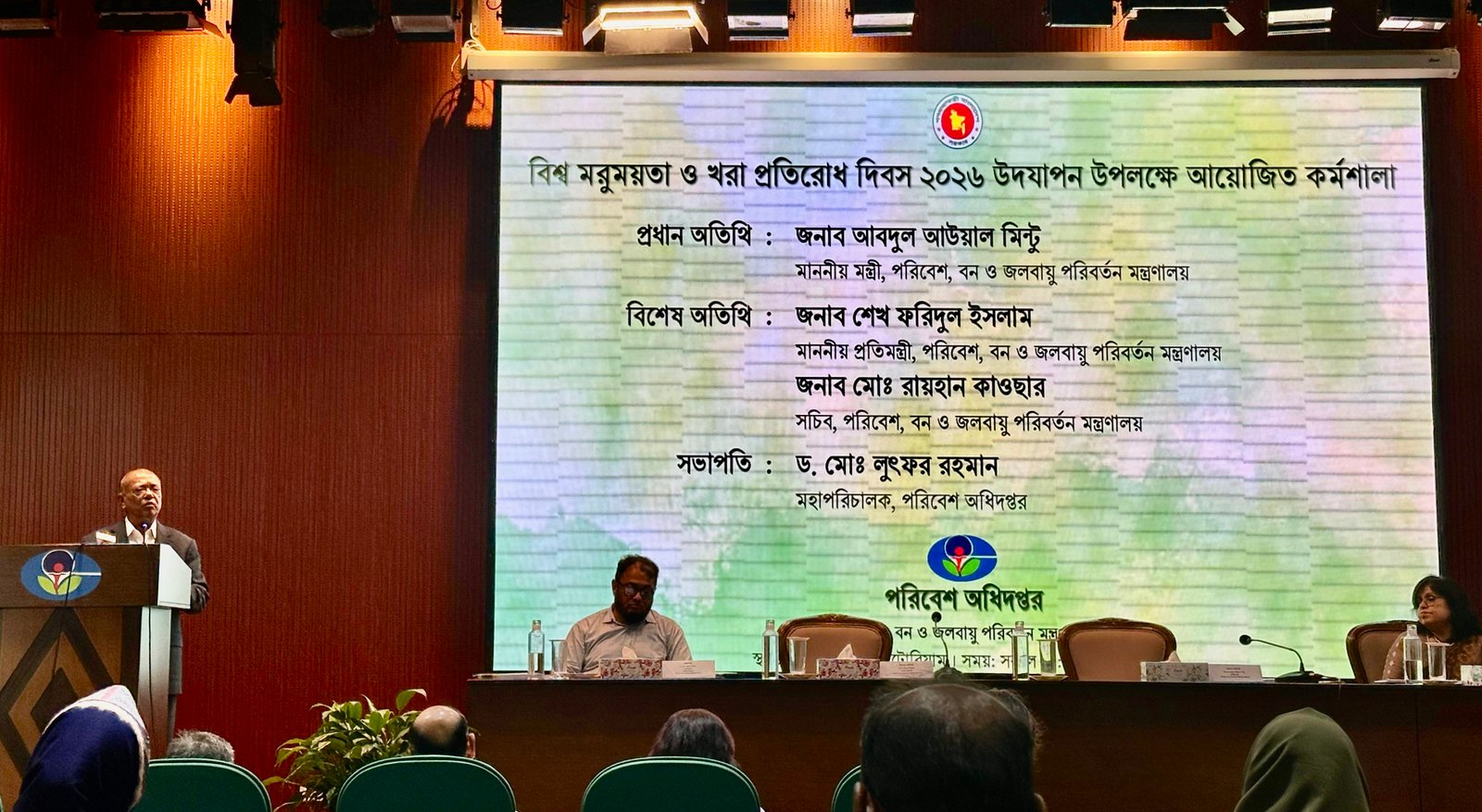
Dhaka, 17 June 2026 - On the occasion of World Day to Combat Desertification and Drought 2026, Minister for Environment, Forest and Climate Change Abdul Awal Mintoo called for urgent action to protect and restore rangelands and natural grasslands.
The Minister made the call while addressing a workshop organized at the Department of Environment in Dhaka as the chief guest.
Speaking at the event, the Minister said that World Day to Combat Desertification and Drought is not merely an international observance; it serves as a reminder of our collective responsibility toward land, the environment, food security, livelihoods, and future generations. This year’s theme, “Rangelands: Recognize, Respect, Restore,” highlights the importance of conserving and restoring the world’s rangelands and natural grasslands.
He noted that nearly half of the Earth’s land surface consists of some form of rangeland ecosystem, which plays a vital role in supporting the livelihoods of billions of people, ensuring food security, conserving biodiversity, regulating water cycles, and storing carbon.
Although Bangladesh is not a desert country, the Minister emphasized that it remains vulnerable to desertification, land degradation, and drought. The adverse impacts of climate change, unsustainable land use, declining soil fertility, increasing salinity, river erosion, deforestation, and prolonged dry seasons are intensifying land degradation risks in various regions of the country.
He highlighted that drought-prone areas in northwestern Bangladesh, saline-affected coastal lands, degraded hill tracts, and fragile river basin ecosystems are becoming increasingly vulnerable.
Citing research findings, the Minister stated that the area affected by moderate to severe land degradation increased from 10.70 million hectares in 2000 to 11.24 million hectares in 2020. This indicates an average annual degradation of approximately 27,000 hectares over the past two decades.
Similarly, drought-prone areas expanded from 1.43 million hectares in 2000 to 1.54 million hectares in 2020, accounting for nearly 10.4 percent of the country’s total land area. At the same time, rising salinity in coastal regions is adversely affecting agricultural production, freshwater availability, and biodiversity.
The Minister further noted that climate change-induced irregular rainfall, prolonged dry spells, excessive rainfall, flash floods, cyclones, and sea-level rise are exerting multidimensional pressures on land and water resources. In particular, recurring droughts in northwestern Bangladesh are having long-term impacts on agricultural productivity, water resources, and local livelihoods.
He mentioned that Bangladesh signed and ratified the United Nations Convention to Combat Desertification (UNCCD) in 1994 and has since remained committed to implementing its international obligations.
Under the leadership of Prime Minister Tarique Rahman, the government has prioritized environmental protection, climate adaptation, and sustainable development at the national level.
The Minister said that social forestry programmes are being expanded across the country to increase tree cover. Coastal greenbelt initiatives are helping reduce the impacts of cyclones and storm surges while simultaneously protecting land and biodiversity.
In addition, the government is promoting sustainable agriculture, integrated soil fertility management, organic fertilizers, conservation agriculture, and the expansion of climate-resilient crop varieties.
Emphasizing the importance of international cooperation, the Minister said that land degradation, drought, and climate change are global challenges that require collective action. Bangladesh calls upon the international community to strengthen financial support, facilitate technology transfer, enhance capacity building, and promote knowledge sharing.
He also urged development partners, international financial institutions, and relevant United Nations agencies to increase investments in land restoration, drought resilience, and nature-based solutions.
Reaffirming the government’s commitment, the Minister stated that efforts to achieve Land Degradation Neutrality (LDN) will be further intensified. Programmes to restore degraded forests, wetlands, char lands, and other ecosystems will be expanded, while drought early warning systems and climate adaptation measures will be strengthened. Greater emphasis will also be placed on science-based land management and the use of digital technologies.
Furthermore, young people, women, and local communities will be actively engaged as key stakeholders in these efforts.
Concluding his remarks, the Minister urged all citizens to join hands in protecting the environment.
“Let us recognize the value of our land, respect nature, and work collectively to restore degraded ecosystems. Through this commitment, we can build a greener, more prosperous, climate-resilient, and sustainable Bangladesh,” he said.
The workshop was chaired by Dr. Md. Lutfor Rahman, Director General of the Department of Environment. Among those present were Dr. Fahmida Khanam, Additional Secretary of the Ministry of Environment, Forest and Climate Change, senior officials from various ministries and agencies, representatives of development partners and United Nations organizations, researchers, academics, and environmental experts.