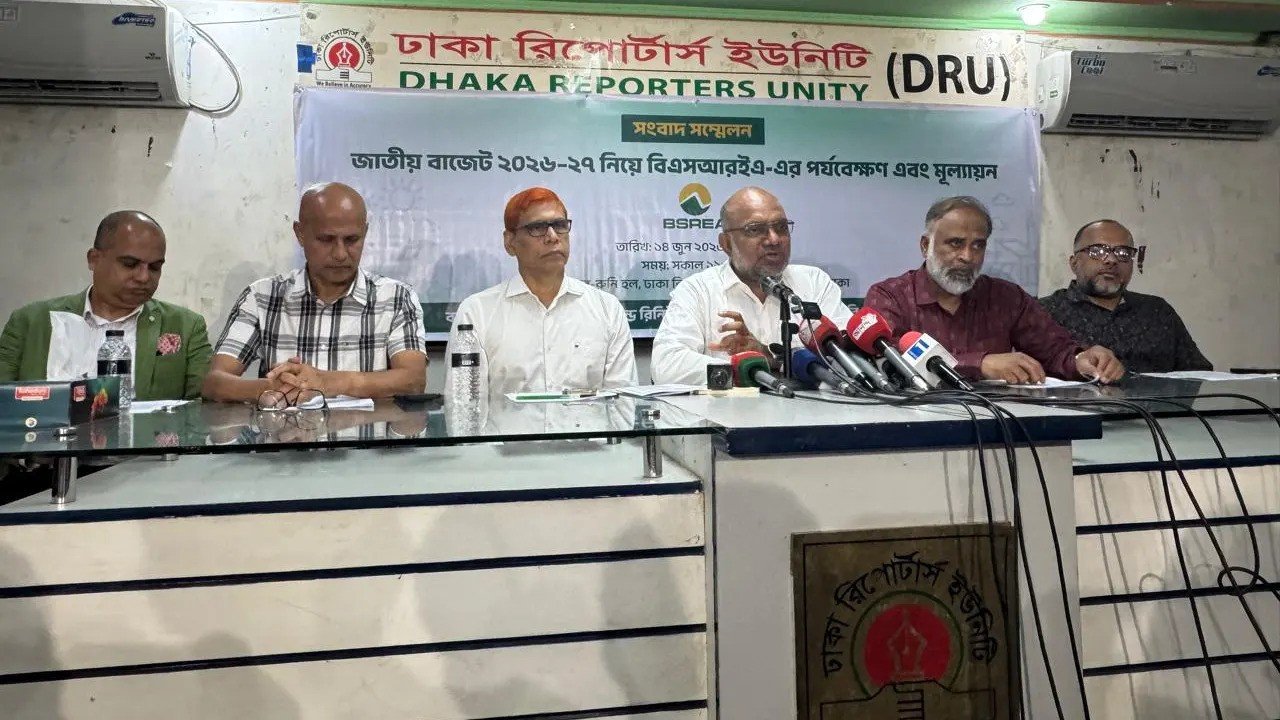
Bangladesh’s renewable energy industry has welcomed the tax and duty incentives announced in the national budget for FY2026-27, but industry leaders argue that the benefits are being directed toward a small group of companies rather than the broader market.
At a press conference held on Sunday at the Dhaka Reporters Unity, the Bangladesh Sustainable and Renewable Energy Association (BSREA) expressed concern that the current incentive structure could undermine the country’s renewable energy ambitions and slow the expansion of the solar power sector.
According to BSREA, the revised Statutory Regulatory Order (SRO) issued by the National Board of Revenue (NBR) primarily benefits selected solar power producers and companies operating under the Renewable Energy Service Company (RESCO) model. As a result, residential consumers, solar irrigation users, small businesses, importers, distributors, dealers, and Engineering, Procurement and Construction (EPC) firms remain largely excluded from the incentives.
Presenting the association’s statement, BSREA President Mostafa Al Mahmud said the incentives currently target only a limited segment of electricity consumers, representing roughly 20–22 percent of the country’s power demand. He warned that without revising the SRO, Bangladesh would struggle to meet its renewable energy targets for 2030.
“The RESCO model may be suitable for large industrial consumers, but it offers little benefit to residential users, agricultural customers, or rural communities,” he said.
Mahmud noted that the country’s renewable energy market has been built largely through the efforts of importers, distributors, retailers, and EPC companies. However, these stakeholders have not been adequately included in the new incentive framework, creating uncertainty for thousands of businesses and jobs linked to the sector.
He further explained that the budget provides tax and duty benefits for solar projects that have secured power purchase agreements. In contrast, individuals investing in rooftop solar systems, solar irrigation projects, IPS backup systems, or off-grid solar solutions must still purchase equipment from the open market without receiving similar benefits.
According to BSREA, under the current SRO framework, only around 4 to 5 percent of market participants are likely to benefit from the announced incentives.
The association also expressed concern over public confusion regarding solar equipment prices. Many consumers believe import duties on solar panels and related technologies have been completely removed, leading to expectations of lower prices. In reality, BSREA says, the existing tax and duty structure remains largely unchanged for most solar products.
The organization further criticized the budget for failing to introduce meaningful incentives for solar irrigation, solar street lighting, and Battery Energy Storage Systems (BESS). Despite Bangladesh having approximately 1.7 million diesel-powered irrigation pumps, the budget does not provide a clear roadmap or financial incentives to accelerate their transition to solar-powered alternatives.
BSREA also highlighted the absence of reforms in customs valuation practices. The association has long advocated replacing the existing weight-based assessment system with the internationally recognized transaction-value method, arguing that inflated valuations continue to increase project costs and discourage investment.
Another concern raised by the industry body is the decision to limit duty exemptions for mounting structures, lithium cells, battery packs, and BESS equipment until June 30, 2028, which it says may discourage long-term investment planning.
BSREA warned that if the current SRO remains unchanged, Bangladesh may achieve only 2,000 to 3,000 megawatts peak (MWp) of solar capacity by 2030—far below the national target of 10,000 MWp.
However, the association believes that opening zero-duty and tax benefits to all importers, EPC companies, distributors, and renewable energy businesses could significantly accelerate solar adoption. It estimates that utilizing just 25 percent of rooftop space in Dhaka and other divisional cities could generate between 6,000 and 8,000 MW of solar power by 2030.
To support sector-wide growth, BSREA called for equal duty exemptions on all renewable energy equipment, including solar modules, inverters, battery storage systems, mounting structures, DC cables, connectors, and smart meters. The organization also urged the government to introduce a minimum 10-year tax holiday, income tax exemptions, and broader incentives for residential and agricultural users.
“Renewable energy is not a privilege for a specific business group; it is directly linked to the energy security of every citizen,” Mahmud said. “Therefore, the incentive framework must be accessible and inclusive for all stakeholders.”
The press conference was also attended by BSREA Senior Vice-President Zahidul Alam, Vice-President MA Taher, General Secretary Md Ataur Rahman Sarkar Rozel, Finance Director Nitai Pada Saha, among others.