Amid ongoing global energy instability triggered by tensions in the Middle East, the government of Bangladesh has intensified large-scale fuel imports and adopted a range of measures to ensure uninterrupted energy supply. Report BSS
Officials said the country, heavily dependent on imported energy, is facing pressure from rising international fuel prices, which are impacting both the economy and daily life. In response, authorities are accelerating imports of liquefied natural gas (LNG) and refined fuels to maintain adequate reserves.
According to sources at Petrobangla, Bangladesh has already procured 20 LNG cargoes from countries including the United States, Australia, and Angola. Of the nine cargoes purchased in April, six have already arrived, while 11 more shipments are scheduled for May.
Petrobangla Chairman Md Arfanul Hoque said there is currently no shortage of gas, adding that supply to power plants is continuing as planned.
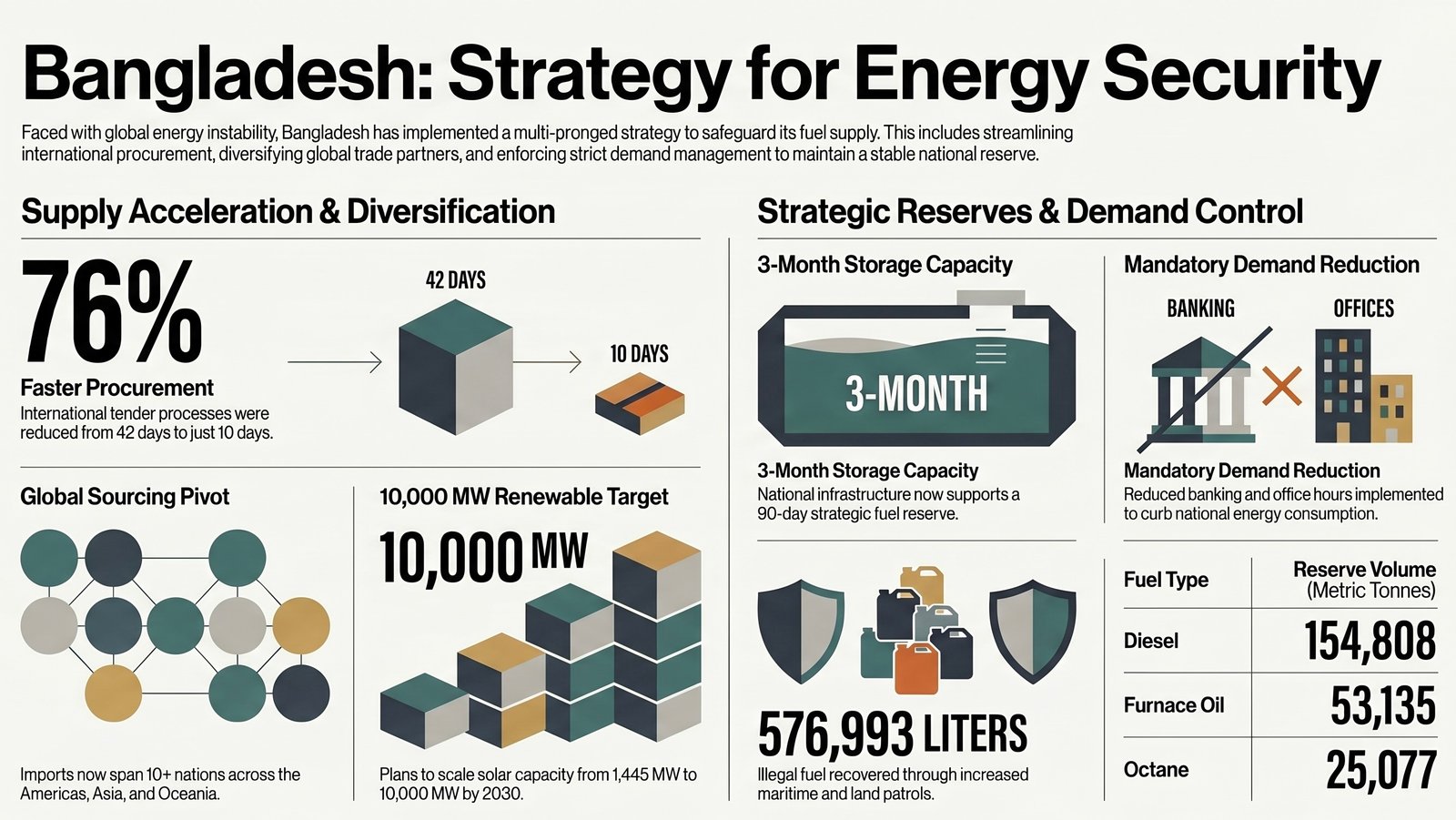
The government is also diversifying its energy sources, importing fuel from countries such as the UAE, Kazakhstan, Oman, Indonesia, Malaysia, China, and Singapore to reduce reliance on the Middle East.
Meanwhile, Bangladesh Petroleum Corporation (BPC) reported that three tankers carrying over 100,000 tonnes of diesel and octane recently arrived at Chattogram port. Additionally, 25,000 metric tonnes of diesel have been imported from India’s Numaligarh Refinery Limited, with supplies already reaching northern depots.
To accelerate procurement, the government has reduced the international tender process from 42 days to just 10 days, significantly speeding up fuel imports.
Alongside supply measures, authorities are focusing on demand management. Steps such as reducing office and banking hours and limiting market operating times have been introduced to curb energy consumption. Special emphasis is being placed on ensuring diesel supply for the agricultural sector during the peak irrigation season.
The government is also expanding its renewable energy capacity, with over 1,445 MW currently generated from solar power and plans to reach 10,000 MW by 2030.
Energy Division spokesperson Monir Hossain Chowdhury said fuel imports are being maintained in a planned manner and storage capacity has been increased to hold up to three months’ supply.
He assured that there is no immediate risk of supply disruption, cautioning that panic or illegal hoarding could create artificial shortages. To address this, authorities have strengthened monitoring through mobile courts, vigilance teams, and enhanced patrols by Border Guard Bangladesh and the Bangladesh Coast Guard.
As part of ongoing enforcement, nearly 576,993 liters of illegally stored fuel have been recovered nationwide as of April 21.
Energy expert Badrul Imam welcomed the government’s initiatives but emphasized the need for proper implementation and responsible fuel consumption.
As of April 22, national fuel reserves include 154,808 metric tonnes of diesel, 25,077 tonnes of octane, 19,201 tonnes of petrol, 53,135 tonnes of furnace oil, and 17,484 tonnes of jet fuel—indicating a stable supply position for the coming months.