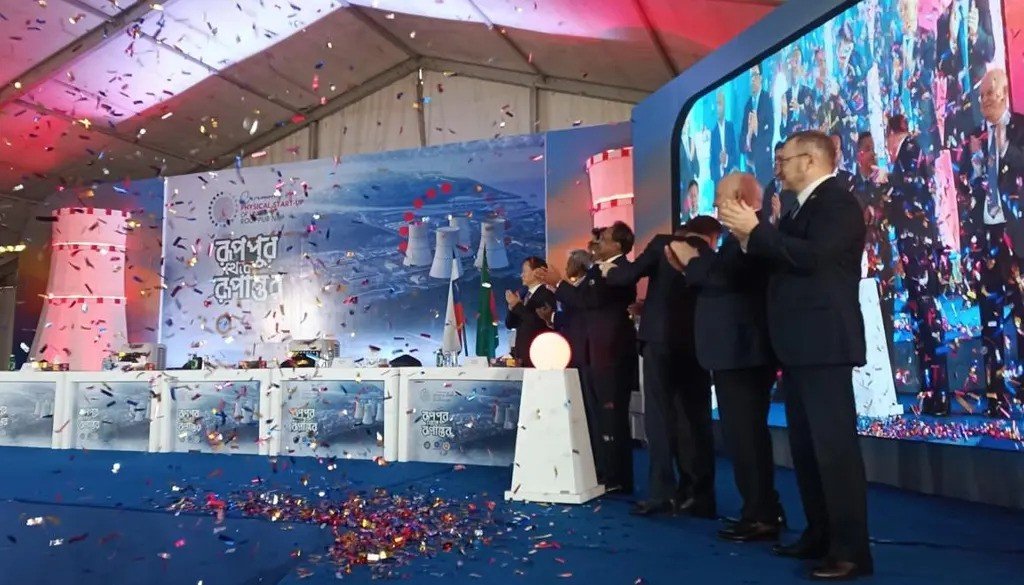
Bangladesh has marked a historic milestone as the first unit of the Rooppur Nuclear Power Plant officially began uranium fuel loading—known as the “physical startup”—on Tuesday (April 28).
The inauguration took place through a program where Science and Technology Minister Faqir Mahbub Anam and Alexey Likhachev, head of Rosatom, jointly initiated the process by pressing the launch button.
Senior representatives from the International Atomic Energy Agency (IAEA) and the Russian Federation attended the event, while IAEA Director General Rafael Grossi joined virtually.
Calling it a landmark moment, Faqir Mahbub Anam said the project represents not just a power plant but a symbol of Bangladesh’s growing technological capability and confidence. He noted that the plant will play a crucial role in strengthening the national grid, supporting industrialization, and ensuring long-term energy security.
Rosatom chief Alexey Likhachev described the fuel loading as the moment the plant “comes to life,” adding that the facility is expected to operate for up to 100 years, providing clean and reliable electricity for generations. He also said work on the second unit is progressing rapidly, with startup activities expected to begin next year.
The Rooppur plant uses advanced VVER-1200 Generation III+ reactor technology. Once fully operational, its ??? units will generate a combined 2,400 megawatts of electricity. The fuel loading process is expected to take 30 to 40 days, with test electricity supply likely to begin by early August.
Officials highlighted that the concept of a nuclear power plant at Rooppur dates back to 1961. Over time, the project evolved through multiple political and policy stages before gaining momentum in recent years. Now, more than 900 highly trained Bangladeshi professionals are working at the facility.
Science and Technology Adviser Rehan Asif Asad described the day as a significant step forward for the country’s technological advancement.
The plant is designed for a base lifespan of 60 years, with the possibility of extending operations by another 30 years through maintenance and upgrades. A single fuel load can run the reactor for about 18 months, reducing the need for frequent fuel imports compared to conventional fossil-fuel plants. Under current agreements, Russia will supply fuel for the first 3 years.
Globally, nuclear energy remains a key source of low-carbon power, with around 416 reactors operating across 31 countries, supplying around 9% of the world’s electricity. Dozens more plants are under construction, including several in emerging economies like Bangladesh.