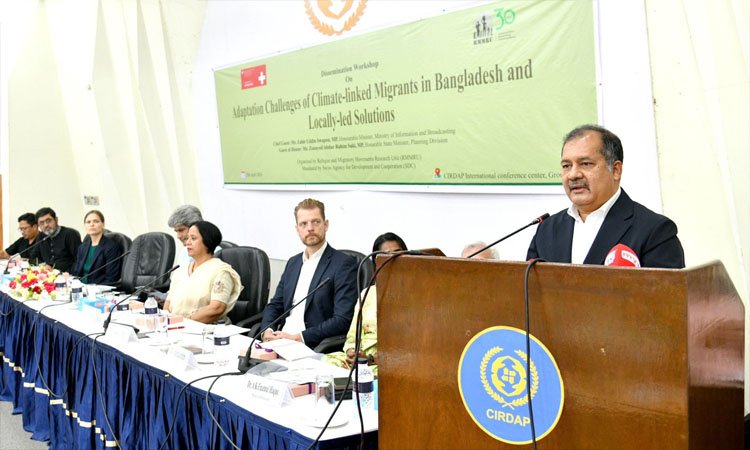
DHAKA, April 28, 2026 — Information and Broadcasting Minister Zahir Uddin Swapon has urged policymakers to treat climate-induced migration as a major public policy priority rather than merely a humanitarian concern.
“It is the need of the hour to integrate migration-related challenges into the country’s ongoing development process,” he said while addressing a workshop held at the CIRDAP auditorium in Dhaka.
The workshop was organised by the Refugee and Migratory Movements Research Unit in collaboration with the Swiss Agency for Development and Cooperation.
Speaking as chief guest, the minister noted that alongside natural disasters, political and economic factors are increasingly contributing to migration trends. He said the government is committed to addressing these challenges through inclusive governance and development planning.
Highlighting the urgency of climate action, Swapon said there is no alternative to protecting Earth. “We must work together to keep this planet liveable,” he added, calling for stronger collaboration between the government, researchers, and civil society to reduce the suffering of displaced populations.
The keynote address was delivered by Dr Tasneem Siddiqui, executive director of RMMRU and a retired professor of University of Dhaka. She emphasized that migration is not limited to Dhaka and called for timely, regionally balanced policy interventions.
Dr Siddiqui pointed out that people are often forced to migrate due to the closure of industries in regions such as Khulna. “If industries and growth centres are developed at divisional and district levels, people can find livelihoods locally,” she said.
Other speakers included Planning State Minister Zonayed Abdur Rahim Saki and migration expert Lisa Tanitha Greminger, along with representatives from academia and development organisations.
The workshop also discussed climate risks in vulnerable regions such as Jashore and Satkhira, the human cost of displacement, and the need for affordable housing solutions for migrants. Participants stressed the role of local governments and civil society in managing climate migration effectively.