Global energy demand grew at a slower pace in 2025, but electricity consumption continued to rise strongly, with solar power emerging as the leading source of new energy supply, according to the latest report by the International Energy Agency.
The IEA’s Global Energy Review 2025 shows that overall energy demand increased by 1.3% last year—slightly below the previous decade’s average and significantly lower than in 2024. The slowdown was attributed to weaker global economic growth, milder weather conditions in some regions, and rapid adoption of energy-efficient technologies.
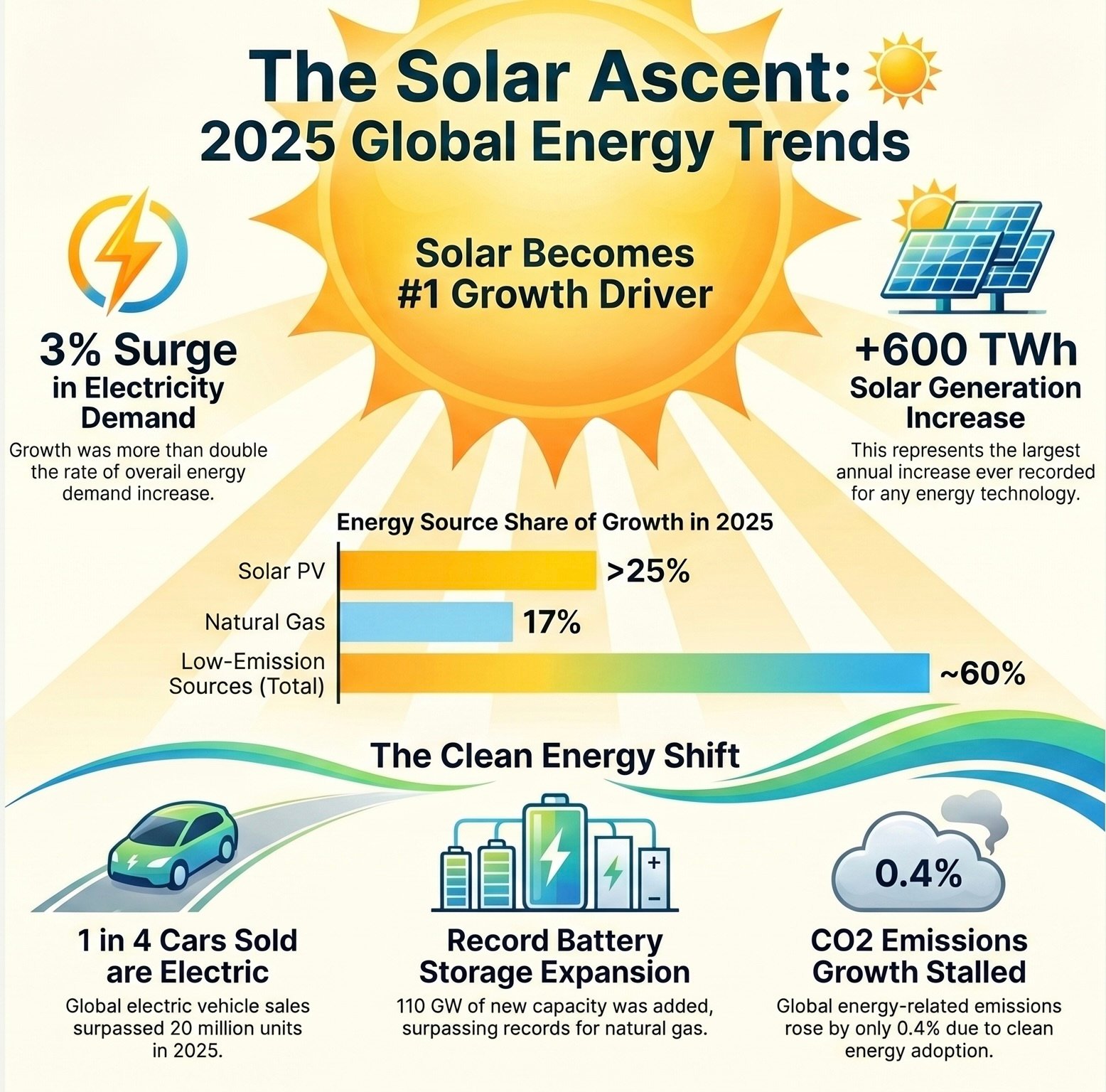
In contrast, global electricity demand rose by around 3%, more than double the rate of overall energy demand growth. This increase was driven by expanding use across buildings and industry, alongside rising demand from electric vehicles and data centers.
Solar photovoltaic (PV) power made history in 2025 by becoming the largest contributor to global energy supply growth for the first time, accounting for over 25% of the increase. Natural gas followed as the second-largest contributor, making up 17% of the growth, largely due to its continued role in electricity generation.
Overall, renewable energy sources and nuclear power together met nearly 60% of the total increase in global energy demand. Electricity generation from these low-emission sources also exceeded the overall growth in electricity demand.
Oil demand saw modest growth of 0.7%, constrained by the rapid expansion of electric vehicles. Global electric car sales rose by more than 20% in 2025, surpassing 20 million units and accounting for roughly one in four new car sales worldwide.
Coal demand growth slowed overall. While renewable expansion reduced coal use in China, higher natural gas prices in the United States led to increased coal use in power generation.
IEA Executive Director Fatih Birol said the data highlights a clear shift in global energy trends. “Electricity consumption is growing much faster than overall energy demand, and solar PV is leading that growth for the first time,” he noted, emphasizing the importance of resilience and diversification in energy systems.
Regionally, trends varied. Energy demand in the United States recorded one of its strongest increases this century, driven by industrial activity, data center expansion, and colder weather. Meanwhile, China remained the largest contributor to global demand growth, though its growth rate slowed to 1.7% due to increased renewable adoption and efficiency gains.
Growth in global energy-related carbon dioxide emissions also slowed, rising by about 0.4% in 2025. Emissions declined in China due to increased use of clean energy, while India recorded flat emissions for the first time in decades—excluding the pandemic period—partly due to a strong monsoon season. However, emissions in advanced economies rose by 0.5%, slightly outpacing the 0.3% increase in developing economies.
In the power sector, solar generation expanded by an additional 600 terawatt-hours in 2025—the largest annual increase ever recorded for any energy technology. Battery storage also saw record growth, with around 110 gigawatts of new capacity added, surpassing previous records for natural gas.
Meanwhile, more than 12 gigawatts of new nuclear power capacity began construction, reflecting renewed global interest in nuclear energy.
The report noted that the widespread adoption of low-emission technologies since 2019 has significantly reduced reliance on fossil fuels, avoiding energy consumption equivalent to that of Latin America and displacing natural gas demand comparable to half of global LNG exports.