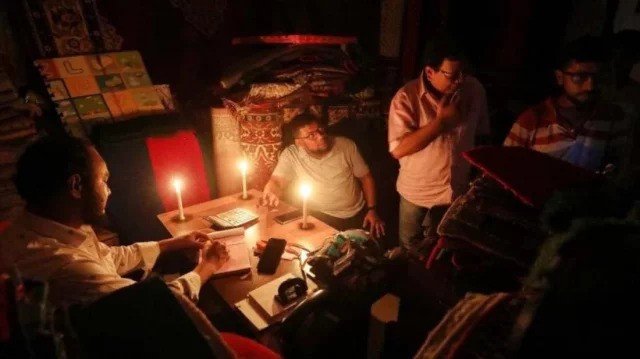
The ongoing power crisis in Bangladesh is expected to ease by May, as the Ministry of Power, Energy and Mineral Resources has taken a series of steps to boost electricity generation and improve supply.
“We are hopeful that the situation will improve by May,” said Umme Rehana, spokesperson and Joint Secretary of the Energy Division, at a press briefing held at the ministry.
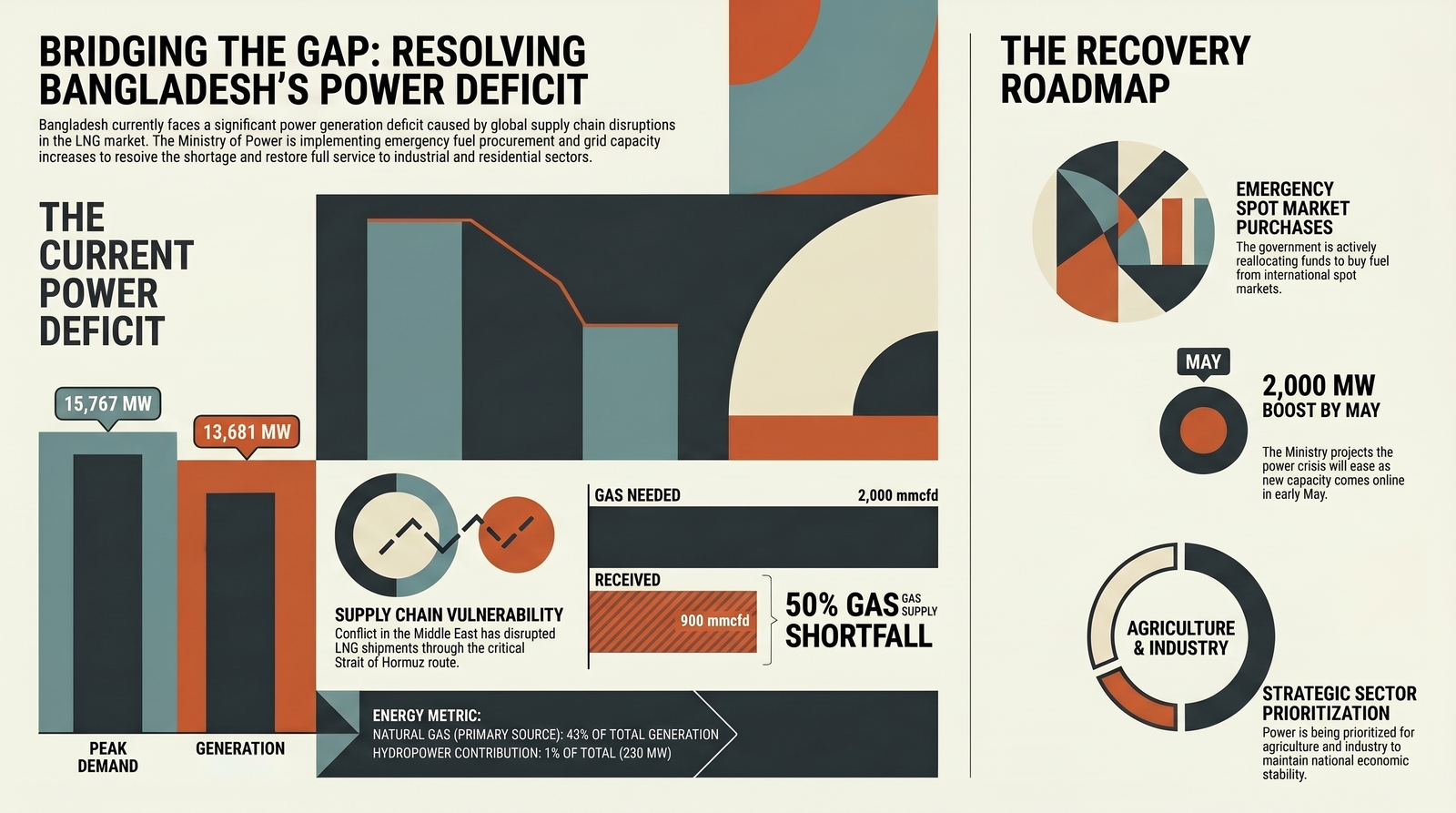
She explained that the current crisis has largely been driven by global factors, particularly the Middle East conflict, which has disrupted the movement of liquefied natural gas (LNG) shipments through the Strait of Hormuz—one of the country’s key import routes.
“As a result of the energy supply disruption, it has not been possible to generate sufficient electricity, leading to load shedding in different parts of the country,” she said.
To address the situation, the Power Secretary convened a meeting with distribution companies on April 7, instructing them to take more effective measures to improve supply.
Rehana noted that while seasonal load shedding is common during summer due to increased demand, the situation has worsened this year because of the global energy shock. “We usually import LNG through the Strait of Hormuz, but disruptions there have limited our ability to do so,” she added.
In response, the government has been purchasing fuel from the spot market and reallocating it to support power generation.
Bangladesh generates electricity from a mix of sources, including natural gas, diesel, coal, hydropower, and renewable energy such as solar and wind. Among these, hydropower remains the cheapest, but contributes only about 230 megawatts—roughly 1% of total generation.
Natural gas remains the primary energy source, accounting for about 43% of electricity generation, or around 12,154 MW. However, supply constraints persist. “To fully utilize gas-based generation, we would need around 2,000 mmcfd of gas, but currently we are receiving only 850 to 900 mmcfd,” she said.
“If we could receive even 1,200 mmcfd, we could generate around 7,200 MW of electricity at lower cost,” she added.
Despite the shortfall, efforts have been made to minimize load shedding in major urban areas like Dhaka, while rural areas have experienced more frequent outages.
On Wednesday, electricity demand reached 15,767 MW, while generation stood at 13,681 MW, leaving a deficit of nearly 3,000 MW.
The ministry expects the situation to improve in early May, when an additional 2,000 MW of electricity is projected to come online. Priority is currently being given to agriculture and industrial sectors to sustain economic activity during the crisis.