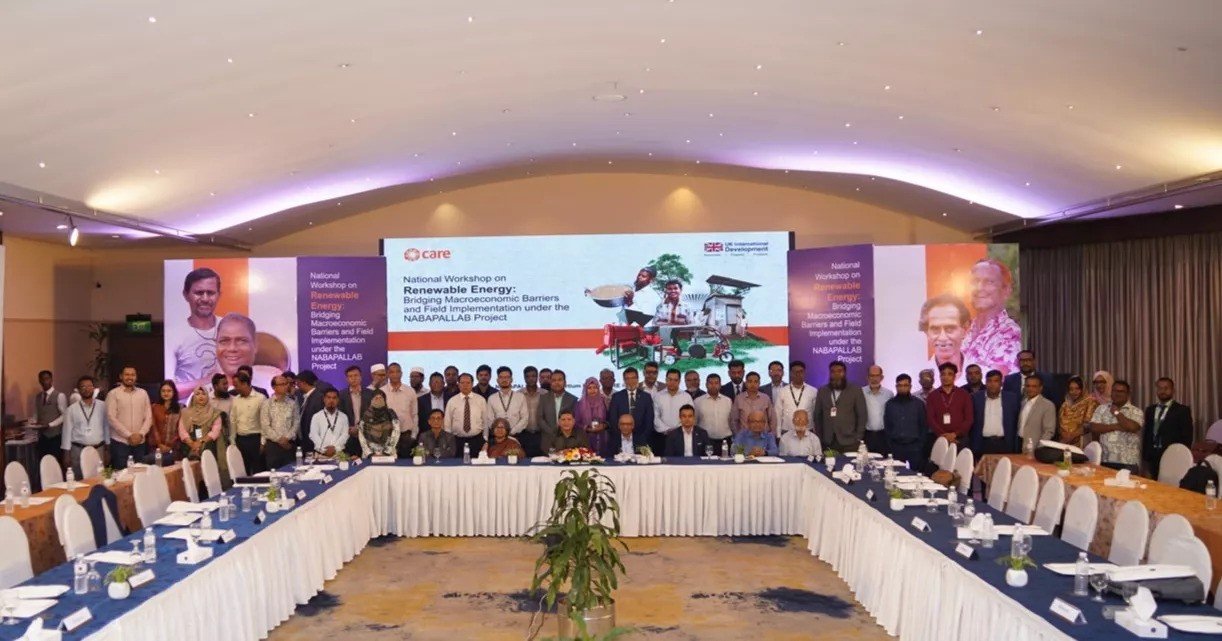
A national workshop in Dhaka has highlighted critical financing, policy, and implementation gaps that continue to hinder the expansion of renewable energy in Bangladesh’s most climate-vulnerable areas.
Titled “Bridging Macroeconomic Barriers and Field Implementation under the NABAPALLAB Project,” the event brought together policymakers, development partners, private sector leaders, and financial institutions. The workshop was jointly organized by CARE Bangladesh and iDE Bangladesh.
Focus on Climate-Vulnerable Regions
Discussions centered on identifying scalable and financially viable renewable energy solutions for ecologically sensitive regions such as the Sundarbans and Hakaluki Haor.
The workshop was part of the NABAPALLAB project under the Adaptation in Ecologically Critical Areas in Bangladesh (AECAB) programme, funded by the UK government. The initiative is being implemented by a consortium led by CARE, including organizations such as CNRS, Cordaid, C3ER at BRAC University, DSK, Friendship, Humanity and Inclusion (HI), iDE, and Practical Action.
Renewable Energy and Livelihood Integration
As a consortium partner, iDE Bangladesh is working to strengthen market systems by engaging private sector actors and enhancing local institutional capacity. The project promotes integrated approaches that combine livelihood development with ecosystem restoration.
Pilot initiatives include solar irrigation systems, solar-powered livelihood solutions, and biodigesters—aimed at reducing energy poverty while creating income opportunities in underserved areas.
Key Challenges Identified
Speakers emphasized that despite growing demand for clean energy, translating policy into real-world implementation remains a major hurdle.
Sameer Karki noted that while renewable energy is essential for a resilient future, coordination among government, private sector, and communities is still lacking—especially in remote and vulnerable regions.
From the development partner side, Nathaniel Smith highlighted that Bangladesh’s energy transition is not only an environmental necessity but also crucial for long-term economic resilience amid global energy uncertainties.
Structural Barriers and Financing Gaps
Drawing on field experience, participants pointed out a significant disconnect between national renewable energy targets and ground realities. Adoption of innovative technologies remains limited due to:
• Limited access to financing and working capital
• High upfront investment costs
• Weak supply chains and market systems
• Policy implementation challenges
• Lack of incentives for private sector engagement
Financial institutions and renewable energy firms also stressed the difficulty of managing risks and sustaining operations in rural and underserved markets.
Call for Inclusive Financing and Stronger Markets
Delivering the keynote address, economist Hossain Zillur Rahman said that Bangladesh’s renewable energy transition is being constrained more by structural and political economy challenges than by technology.
He emphasized the need for inclusive financing models and stronger local market systems to unlock the full potential of renewable energy in climate-vulnerable regions.
Way Forward
Participants agreed that addressing these systemic barriers will require coordinated policy reforms, innovative financing mechanisms, and stronger partnerships between public and private stakeholders.
The workshop concluded with a shared recognition that scaling renewable energy solutions in vulnerable regions is not just an environmental priority—but a critical pathway for sustainable development and economic resilience in Bangladesh.