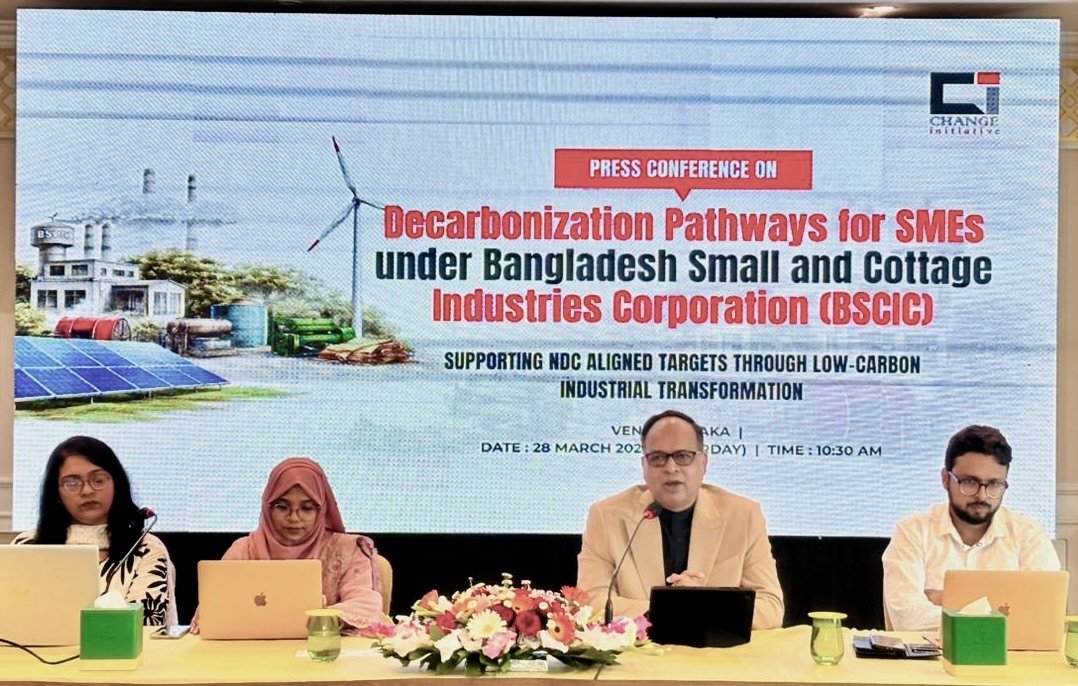
A new study by Change Initiative has outlined a transformative roadmap for Bangladesh’s small and medium enterprises (SMEs), showing that targeted solar adoption in industrial zones could significantly reduce costs, emissions, and boost export competitiveness.
Presented at a press conference in Dhaka on March 28, the study highlights that interventions in BSCIC industrial estates could unlock over 14.09 million tonnes of CO? emission reductions annually and generate up to $0.40 million in carbon credit revenue each year.
SMEs at the Center of Energy Transition
SMEs dominate Bangladesh’s industrial landscape, accounting for more than 90% of industrial units, employing around 85% of the workforce, and contributing 25–30% of GDP. However, they remain heavily dependent on fossil fuels, with about 95% of electricity sourced from fossil-based systems—leaving them vulnerable to global price volatility.
The study links this challenge to Bangladesh’s climate commitments, noting that the country’s updated NDC targets require reducing 69.84 MtCO?e from the energy sector by 2035, making industrial energy transition an urgent priority.
High-Impact Sectors and Emission Reduction Potential
The research focuses on four major SME sectors within BSCIC estates:
• Tannery
• Plastic manufacturing
• Plastic packaging
• Light engineering
Together, these sectors emit approximately 46.99 MtCO?e annually, with a technically feasible reduction potential of 14.097 MtCO?e per year.
Sector-wise findings show strong opportunities for efficiency gains:
• Tannery: 19–33% reduction potential
• Light engineering: 19–31%
• Plastic manufacturing: highest at 33–49%
• Packaging: 15–28%
Solar Power as a Game Changer
A key finding of the study is the massive potential of rooftop solar systems in industrial estates.
• Using just 10% of estate space could install 57 MW of solar capacity, generate nearly 83,000 MWh annually, and cut over 51,000 tons of emissions per year.
• Expanding to 20% could double capacity to 114 MW, producing around 166,000 MWh annually and avoiding over 102,000 tons of emissions.
At the factory level, a typical 20 kW rooftop solar system can generate about 79 units of electricity daily, recover investment within 4.2 years, and deliver a 23% internal rate of return. Under OPEX models, SMEs can adopt solar with no upfront cost while immediately reducing electricity bills.
Policy, Finance, and Structural Barriers
Despite the strong economic case, the study identifies key barriers to adoption:
• Limited access to concessional finance
• High upfront investment costs
• Lack of technical expertise
• Absence of standardized energy auditing systems
To overcome these, the study proposes a cluster-based decarbonization model built on:
• Shared renewable energy systems at industrial estate level
• Innovative financing (OPEX models, concessional funding)
• Stronger institutional coordination through BSCIC and related agencies
Call for Energy Sovereignty
Lead researcher M Zakir Hossain Khan emphasized that renewable energy transition is no longer optional but essential for economic resilience.
He warned that global conflicts and fuel dependency are increasing risks for Bangladesh’s energy security, adding that SMEs must be protected from grid instability and volatile fossil fuel prices.
He also urged policymakers to accelerate reforms through tax incentives, carbon pricing, and innovative financing tools to reduce fiscal pressure and avoid debt risks.
Economic and Strategic Impact
The study positions SME decarbonization as both a climate and economic priority. Transitioning to renewable energy could:
• Reduce production costs significantly
• Increase profit margins
• Strengthen export competitiveness
• Enable industrial expansion and job creation
The event brought together policymakers, financial institutions, development partners, and industry stakeholders, signaling growing momentum toward scaling low-cost, high-impact clean energy solutions across Bangladesh’s industrial sector.