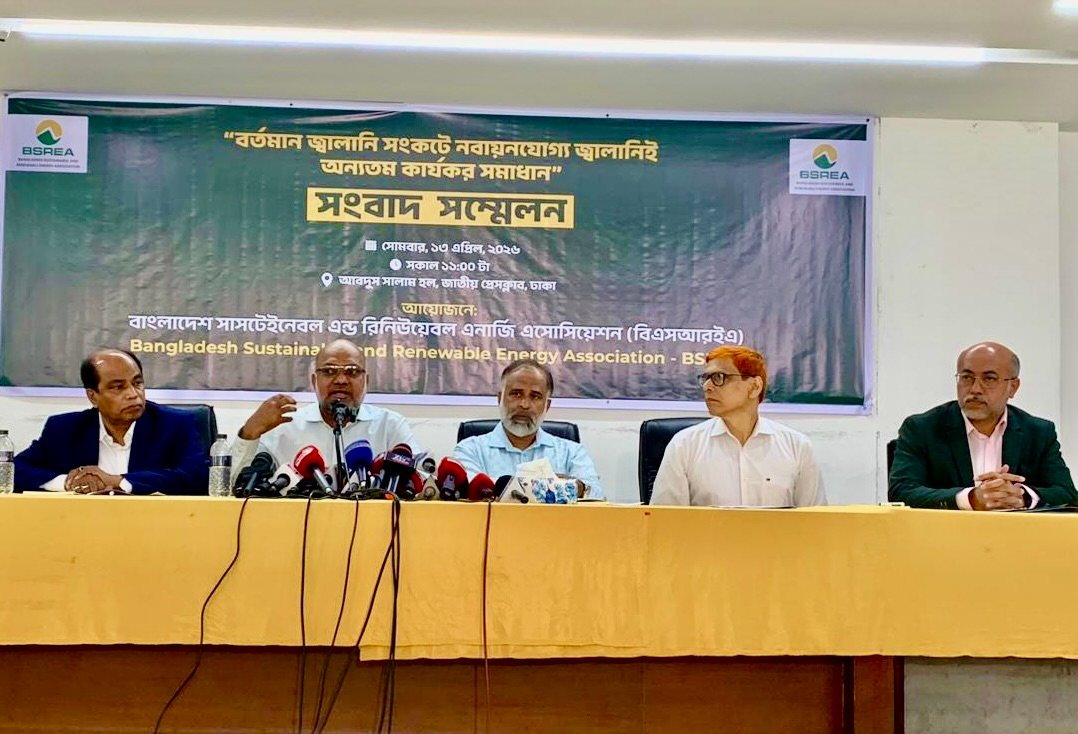
The Bangladesh Sustainable and Renewable Energy Association (BSREA) has called for prioritizing renewable energy expansion to tackle Bangladesh’s ongoing energy crisis, warning that continued reliance on imported fuels poses serious economic risks.
The call came at a press conference held at the National Press Club in Dhaka on Monday.
In a written statement, the association said Bangladesh is facing a severe energy crisis driven by heavy dependence on imported fuel, rising global energy prices and mounting pressure on foreign exchange reserves.
It noted that high prices of LNG, coal and oil used in power generation are forcing the government to provide over Tk 200 crore in daily subsidies, creating long-term fiscal risks.
BSREA President Mostafa Al Mahmud said renewable energy—particularly solar—remains the most cost-effective and environmentally sustainable solution, but the sector lacks adequate policy support.
The association highlighted that 50–60% taxes and duties on renewable energy equipment imports are discouraging investment, while conventional energy continues to receive subsidies—creating a policy imbalance.
It said countries such as India, Vietnam, China and Pakistan have made rapid progress in renewable energy through tax incentives, lower duties and easier financing.
High duties on lithium-ion batteries and energy storage systems are also slowing sector growth in Bangladesh, it added.
BSREA warned that global geopolitical tensions, including instability involving Iran, have pushed Brent crude prices to around $115–120 per barrel and created risks for key supply routes like the Strait of Hormuz.
With over 60% of Bangladesh’s energy demand dependent on imports and nearly 70% of LNG sourced from Qatar, the country faces growing vulnerability to supply disruptions.
Gas shortages have already reduced supply to 850–950 MMCFD against demand of over 2,300 MMCFD, risking a 1,500–1,800 MW power generation shortfall, the association said.
The crisis is also affecting industries, particularly the readymade garments sector, where production has fallen by 30–40% due to gas shortages and load-shedding.
Key recommendations
BSREA proposed a series of measures, including:
• Reducing duties and taxes on renewable energy equipment
• Zero-duty on lithium-ion batteries
• Ensuring low-cost, long-term financing
• Fast-tracking stalled solar projects
It also called for reviving rooftop solar programs, simplifying net metering, expanding solar irrigation, and offering tax incentives for clean energy investments.
The association said with the right policy support and investment, renewable energy can play a critical role in strengthening Bangladesh’s energy security and economic stability.
If you want, I can also cut this down into a 250-word sharp news brief or turn it into an opinion/editorial piece.