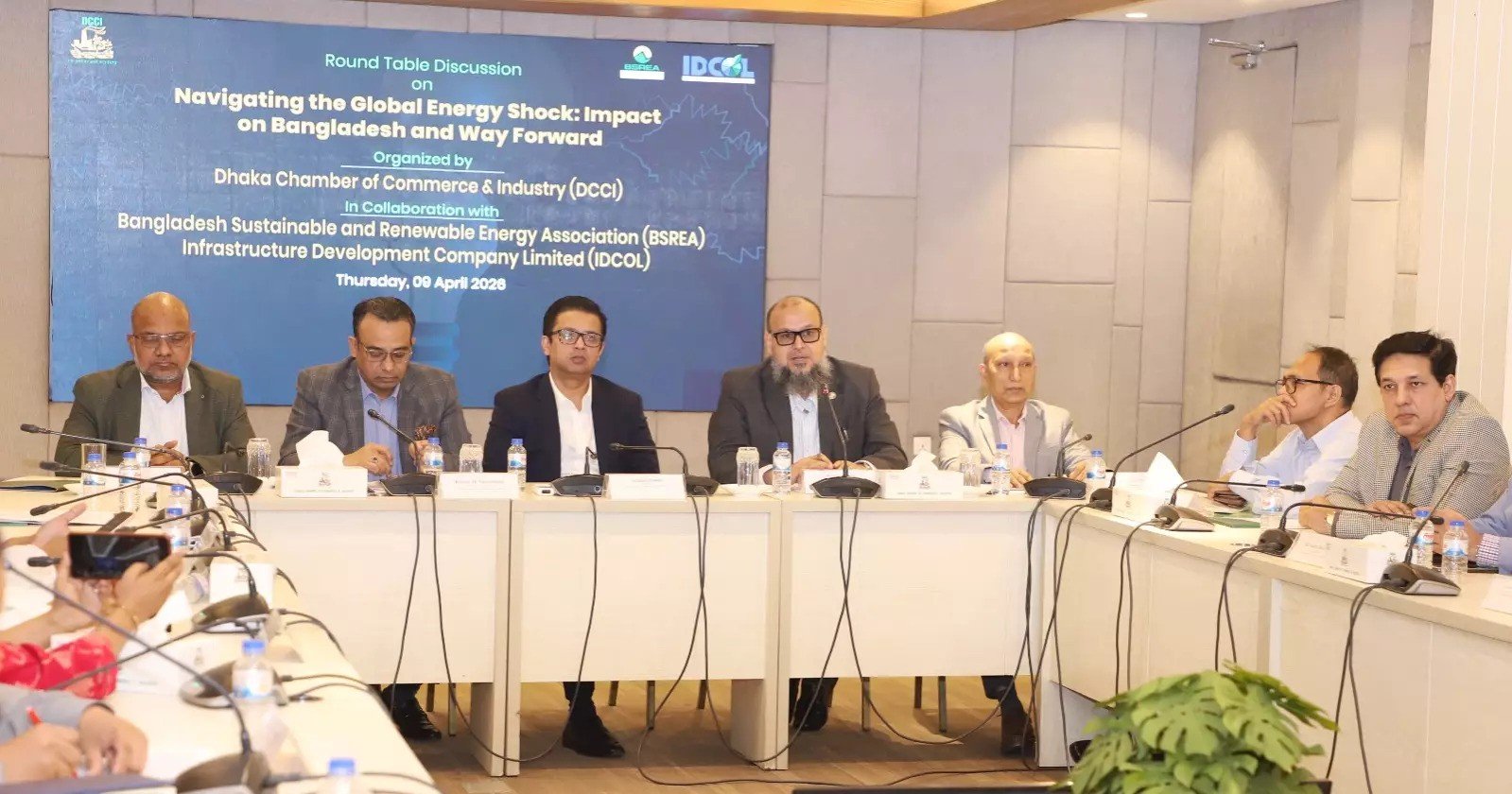
Dhaka, April 9, 2026: Energy experts have called for expanding renewable energy, strengthening storage capacity, accelerating policy reforms and improving inter-agency coordination to address Bangladesh’s ongoing and future energy challenges.
The recommendations came at a roundtable titled “Navigating the Global Energy Shock: Impact on Bangladesh and Way Forward,” organized by the Dhaka Chamber of Commerce & Industry (DCCI) in collaboration with the Bangladesh Sustainable and Renewable Energy Association (BSREA) and Infrastructure Development Company Limited (IDCOL) at the DCCI auditorium in Dhaka.
Speakers emphasized the need to boost gas exploration, reduce bureaucratic delays, form a national-level energy taskforce and provide financial incentives to attract both local and foreign investment in the energy sector.
Industries Secretary Md Obaidur Rahman, speaking as chief guest, said Bangladesh has long faced energy shortages that have worsened due to geopolitical instability in the Middle East. He noted that disruptions in energy supply have also affected fertiliser production, creating a significant shortage ahead of the upcoming agricultural season.
Rahman said the government is working to reduce bureaucratic delays, while acknowledging that limited capacity and insufficient initiative in gas exploration remain key challenges. He also noted that a national policy on electric vehicles is in its final stage and will be announced soon.
Administrator of the Federation of Bangladesh Chambers of Commerce and Industry (FBCCI), Md Abdur Rahim Khan, said the energy crisis is affecting all aspects of economic activity and stressed the importance of accurate data to formulate effective strategies.
Member (Power) of the Bangladesh Energy Regulatory Commission (BERC), Md Shahid Sarwar, said renewable energy could play a major role in addressing both current and future energy shortages, but added that expanding onshore and offshore natural gas exploration remains essential for long-term energy security.
BSREA President Mostafa Al Mahmud highlighted the need for strong political commitment and long-term, low-interest financing for small and medium enterprises investing in renewable energy. BSREA Senior Vice President Zahidul Alam added that high import duties on solar equipment—ranging between 27 and 30 percent—are slowing the expansion of solar power and called for temporary duty exemptions for batteries used in solar systems.
Chief Investment Officer of IDCOL, Nazmul Haque, recommended forming a national-level taskforce and establishing energy-related committees in each ministry to ensure quicker decision-making and implementation.
Experts also stressed improving grid infrastructure, diversifying energy imports, encouraging solar adoption in industries and strengthening energy conservation measures to reduce subsidies and enhance long-term energy security.
Business leaders, policymakers and representatives from both public and private sectors attended the discussion, including officials from Bangladesh Power Development Board and academics from leading universities.