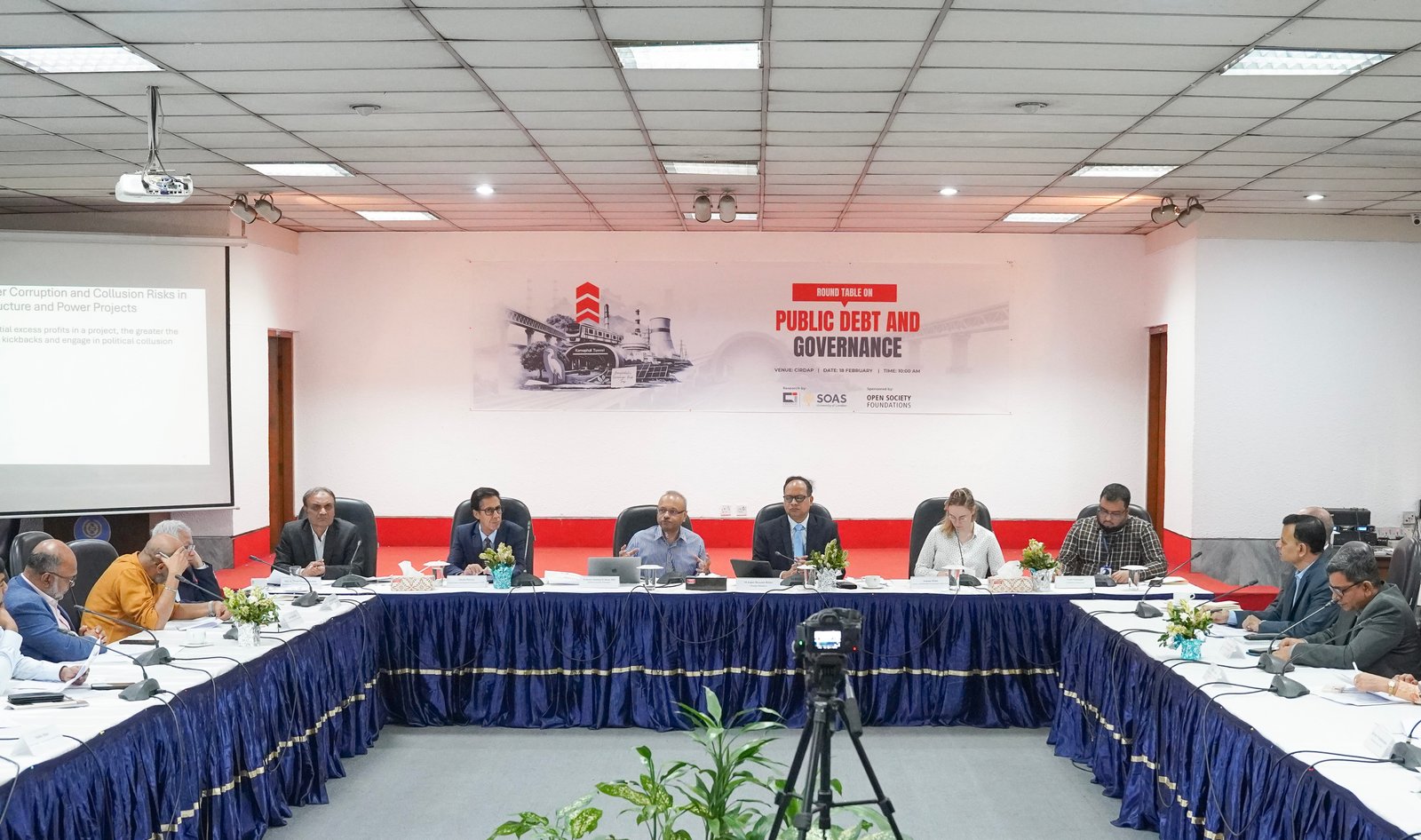
February 18, 2026, Dhaka (PR) - Bangladesh's external debt has increased from US$ 23.5 billion in 2009 to approximately US$ 112 billion in 2025, which is a 377% increase. At the same time, out of every 5 taka of government revenue, 1 taka is now being spent on interest payments alone, even before the principal is repaid. Approximately 29 mega projects have faced an average cost increase of 70.3%, while nearly 5 billion dollars in subsidies must be provided annually to keep overpriced power contracts affordable.
The roundtable discussion titled 'Public Debt and Governance' was held on February 18, 2026, organized by the research institution 'Change Initiative', a think-and-do tank, at the CIRDAP Auditorium in Dhaka. This session focused on project governance, efficient contracts, and operational incentives to reduce corruption and mitigate the risk of debt traps. Notably, following the 2022 financial meltdown in Sri Lanka, Change Initiative conducted the Bangladesh portion of the research led by SOAS University of London with support from Open Society Foundations.
By analyzing 42 mega projects (2009-2025) across transport, power, aviation, ports, and industrial zones, the research found that the problem of corruption-induced debt is increasingly a problem of governance; there is no alternative to effective accountability and a zero-tolerance policy against corruption. The research revealed that if mega-corruption in infrastructure projects and the cycle of overpricing or intentional poor planning continue, the government's debt liability - namely the debt-to-GDP ratio - could reach 65-70% by 2030. High-value power projects are particularly sensitive to corruption and political collusion; profit-making from irrationally overpriced projects encourages bribery over efficiency. Consequently, interest payments are now consuming one-fifth (20%) of the national revenue budget. Approximately 29 mega projects have faced an average cost increase of 70.3%, while nearly 5 billion dollars in annual subsidies are required to keep overpriced power contracts affordable.
This research argues that transparency and accountability alone are not enough. Strong "horizontal checks" with sufficient power are needed to identify and prosecute cases of significant corruption and to ensure effective competition. Emphasis was placed on ensuring accountability at the social and institutional levels to prevent horizontal and high-level corruption in the administration.
What This Research Puts on the Table
Fast facts:
|
Indicator |
What it signals |
|
External debt stock |
US$23.5B (2009) to nearly US$112B (2025), +377% |
|
Interest burden |
1/5 of revenue spent on interest |
|
Solvency stress |
External debt-to-foreign exchange earnings reached 192% (2025) |
|
“True” debt ratio |
42% debt-to-GDP (corrected) vs “safe” 33% previously reported |
|
Leakage estimate |
23% to 40% of project value lost via collusion, inflated expenses, and inefficiency |
|
Power sector drain |
Fixed capacity charges projected to reach Tk 38,000 crore (2025), regardless of dispatch |
The study warns that Bangladesh is moving from a “moderate debt” position toward a solvency risk-trap; statistical shielding and hidden liabilities have further increased this risk, as it is difficult to verify the actual state until a moment of liquidity crisis arrives. It is much like taking a long-term mortgage, but even if the procurement price increases and contracts do not ensure real results, the interest bill arrives on time while the results do not.
In the technical presentation, Professor Mushtaq H. Khan presented comparative political economy findings for Bangladesh and Sri Lanka and how the lack of governance in the power and infrastructure sectors contributed to Sri Lanka's sovereign crisis. He urged, "We do not only lack horizontal checks; we suffer from horizontal collusion. Rather than imposing more rules from the top, we must ensure the type of economic competition that disrupts these collusive contracts. Only through genuine competition can we transform horizontal pressure from a tool of corruption into a robust mechanism of accountability".
Why This Research matters Now
Following the sovereign crisis in Sri Lanka (2022), multiple countries, including Bangladesh, were identified for national debt risks in the power and infrastructure sectors. Bangladesh has been struggling to make contracted payments to private power producers since 2023, while large repayments for major infrastructure loans are approaching. The research revealed that the real risk is not only the debt ratio but "governance uncertainty". Even if the debt level is manageable, when governance is flexible, it can become fragile under repayment spikes and currency stress.
The roundtable focused on three main questions important to taxpayers, investors, and policymakers:
-
How governance failures translate into higher debt: The research estimates that up to 40% of project costs can be lost to corruption and inefficiency, where direct government-to-government (G2G) deals increase costs by more than 400% compared to more transparent, competitive methods.
-
Why contract design can cause recurring financial bleeding: In the power sector, "take-or-pay" contracts can reward availability over performance or efficiency, locking the budget into specific obligations even when electricity is not used.
-
What reforms are possible within political and institutional reality: The proposed shift is from “Borrowing for Speed” to “Governance by Design,” targeting those obstacles where political contracts override economic logic.
The roundtable was moderated by M. Zakir Hossain Khan, Co-founder and Chief Executive of Change Initiative. He highlighted debt governance in the light of 'Natural Rights Led Governance', where public finance must be tested against the rights of people and nature, focusing on long-term prosperity rather than short-term fiscal frameworks.
Mr. M Zakir Hossain Khan said, "Energy is the lifeline of the economy. But even after our external debt crosses 100 billion dollars, if an annual subsidy of 5 billion dollars continues in the corruption-submerged power and energy sector, Bangladesh will quickly move towards financial bankruptcy. The power and energy master plan has been hijacked by the masterminds of corruption".
Honored guests and designated speakers provided additional commentary:
· Owais Parray, Country Economic Advisor, UNDP: "Rising debt reflects growing demands for infrastructure and social protection. The risk is disconnecting policy from finance; we must bridge this gap through integrated planning and stronger institutional capability to ensure borrowing translates into real, sustainable development".
· Emma Wind, Governance Advisor, FCDO: "As Bangladesh nears LDC graduation, power sector reform is a financial necessity. By using IMF governance diagnostics and donor expertise to strengthen the procurement process, we can ensure a financially stable, energy-secure future that benefits both the nation and its global development partners".
· Md Jahangir Alam Molla, Director, BPDB: "Repealing special acts and introducing competitive bidding has allowed solar tariffs to be reduced from 10 cents to 5 - 8 cents. By prioritizing land availability and fuel diversification, we are transforming structural challenges into a sustainable, cost-effective energy future".
· Mostafaa Al Mahmud, President, BSREA: "With solar under 5 cents, we must stop wasting billions of dollars on imports. Scaling renewables through grid-adjacent land is no longer an option; it is an essential survival strategy for Bangladesh".
· Kawsar Chowdhury, Co-chair, Bangladesh America Alliance: "With a 5 billion dollar subsidy and 9,500 MW excess capacity, we face an existential crisis. To reduce costs and corruption, competitive solar power projects on government land, such as on top of canals, are essential".
A reform outline was provided which can be implemented within existing governance structures alongside efforts for a perfect situation, including:
· Open-book Procurement: Publishing bid abstracts, supplier origins, and variation order logs, along with ensuring digital mandates for e-GP beyond specified limits.
· Readiness Gates: Verifying land acquisition, utility relocation, and design checks before signing or construction to reduce variation order spirals and delay-driven budget inflation.
· Performance-linked Activities: Connecting Operation and Maintenance (O&M) payments to output and uptime, including reforms to power sector payment discipline.
· Rings of Responsibility: Maintaining a public tracking system for work delays to ensure accountability across the project chain with named officers and dated action plans.
Power and Energy Minister Iqbal Orders Seamless Electricity During Ramadan
Power Minister Iqbal Hasan Mahmud has ordered uninterrupted power supply during Ramadan to ensure that citizens can observe the month’s rituals without disruption.
Speaking at his Secretariat office on Wednesday, the newly sworn-in minister issued the directive just a day after the BNP formed the government with an absolute majority.
“The sector we are in and the timing of our arrival are critical, as Ramadan starts tomorrow [Thursday]. Since everything depends on power, I am counting on you to ensure there are no disruptions,” said the minister.
The spirit should be to manage power supply with minimum outages, which may occur only due to technical issues, he said.
Outlining his own work at the ministry, he said he is there to carry on the works that were planned.
“We want to leave Bangladesh at the hands of an administration that will protect Bangladesh. As my prime minister said, ‘Bangladesh first’,” he said.
He demanded full cooperation of his colleagues.
He was previously elected from the Sirajganj-2 constituency in 1986 and 1988 as a Jatiya Party candidate.