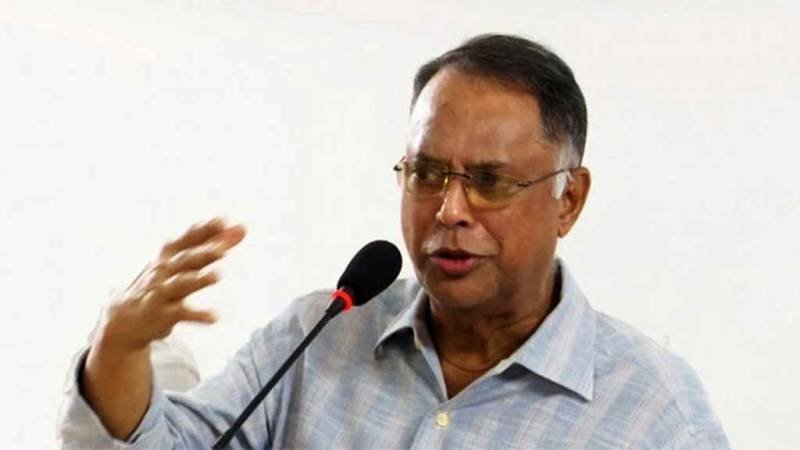
Iqbal Hasan Mahmud Tuku has been appointed as the Minister for the Ministry of Power, Energy and Mineral Resources. He previously served as the State Minister for the Power Division.
Anindya Islam Amit has also been appointed as State Minister in the same ministry. He was elected as a Member of Parliament from Jessore. He is the son of the late minister and BNP leader Tariqul Islam.
He will have to begin work immediately upon assuming office to deal with the ongoing crisis in the power and energy sector. In particular, the huge volume of outstanding liabilities, the pressure of the upcoming Ramadan period, irrigation season and summer demand, the gas shortage, and the loss-making power sector are expected to pose major challenges.

Anindya Islam Amit
Although Dr. M. Fouzul Kabir Khan, who served as energy adviser during the interim government, was successful in clearing some outstanding payments, he has left behind a large amount of accumulated liabilities. Meanwhile, he failed to take any effective steps over the past 18 months to address the fuel shortage. On the other hand, by cancelling a number of contracts and Letters of Intent (LOIs), he prolonged the crisis further.
Tuku is the 54th person to serve in a leadership role—minister, state minister, or adviser—at this important ministry. Since independence, a total of 53 ministers, advisers, and state ministers have held responsibility for the Ministry of Power, Energy and Mineral Resources, making his position the 54th.
After the fall of the Awami League government, Chief Adviser Dr. Muhammad Yunus held the ministry during the first few days of the interim government. Later, former civil servant Dr. M. Fouzul Kabir Khan took oath as adviser.
The longest-serving leader of the ministry was former Prime Minister Sheikh Hasina. After forming the government in 2009, she kept the Ministry of Power, Energy and Mineral Resources under her direct authority. She served as minister from 6 January 2009 until the final day of her government (5 October 2024). During the first six months under her leadership, Advocate Shamsul Alam Tuku served as state minister. Mohammad Enamul Haque served for about four and a half years.
The record for the longest-serving state minister in the ministry belongs to Nasrul Hamid. He served from 6 January 2014 to 5 August 2024. No one before him served as state minister in this ministry for such a long period.
The record for the shortest tenure is held by Captain (Retd.) Nurul Haque, who served for only seven days in 1980. In 1996, Oli Ahmed, Bir Bikrom, served as minister for 11 days.
In the first cabinet after independence, Professor M. Yusuf Ali held responsibility for the ministry from 29 December 1971 to 12 January 1972. He was followed by Khondaker Mushtaq Ahmed, who served as minister from 13 January 1972 to 13 April 1972. Dr. Mofiz Chowdhury served from 13 April 1972 to 16 March 1973. Khondaker Mushtaq Ahmed again held the portfolio from 16 March 1973 to 19 January 1974.
Abdur Rab Serniabat became minister on 19 February 1974 and served until 26 January 1975. During the same period, KM Obaidur Rahman served as state minister from 4 December 1973 to 8 July 1974. Dr. Kamal Hossain was appointed minister on 26 January 1975 and served until 15 August 1975.
In Khondaker Mushtaq’s cabinet, Dewan Farid Gazi served as state minister for about two months and 16 days (20 August 1975 to 6 November 1975). During the same time, Momin Uddin Ahmed also served as state minister.
The first adviser to hold responsibility for the ministry was Air Vice Marshal M. G. Tawab, who served from 10 November 1975 to 3 May 1976. He was followed by advisers Commodore Mosharraf Hossain Khan, Ashfaq Hossain Khan, and BM Abbas Ati. After a period of advisers, BM Abbas Ati took oath as minister on 4 July 1978 and served until 15 April 1979.
He was followed by AZM Enayet Ullah Khan, who served as minister for three months, and Colonel (Retd.) Akbar Hossain, who served for around six months. Captain (Retd.) Nurul Haque served for only seven days.
From 15 April 1979 to 2 January 1980, then Deputy Prime Minister Moudud Ahmed held responsibility for the ministry, with Sunil Kumar Gupta serving as state minister. From 2 January 1980 to 27 November 1981, Kazi Anwarul Haque served as minister and LK Siddiqi as state minister. AKM Maidul Islam served as minister for one month and ten days.
From 27 November 1981, Sunil Kumar Gupta served again as state minister for about four months. After that, Air Vice Marshal Sultan Mahmud served as adviser for one year and nine months, and later served as minister for about six months (11 December 1983 to 1 June 1984). Over the next six months, SM Shafiul Azam served as minister, with Sunil Kumar Gupta as state minister. Major General Muhammad Munim served as minister for two months.
Anwar Hossain Manju was the first to serve a relatively long tenure as minister, holding the portfolio from 25 March 1985 to 27 March 1988. Under him, Jafar Imam served as state minister for two months.
Ziauddin Ahmed Bablu served as minister from 19 July 1989 to 6 December 1990. During the caretaker government in 1990, Professor Wahid Uddin Ahmed served as adviser.
When the BNP formed the government, Khaleda Zia kept the ministry under her direct authority. Dr. Khondaker Mosharraf Hossain served as state minister, and later became full minister and served for the rest of the term.
Following the one-sided election on 15 February 1996, Oli Ahmed, Bir Bikrom, served as minister for 11 days. During the caretaker government afterward, Dr. Jamilur Reza Chowdhury served as adviser.
After winning the election, the Awami League appointed former army chief Mohammad Nuruddin Khan as minister, who served until 29 March 1998. During that period, Professor Rafiqul Islam served as state minister.
During another caretaker government, AKM Amanul Islam Chowdhury served as adviser.
When the BNP returned to government, AKM Mosharraf Hossain was appointed state minister. Following allegations of corruption, he was removed on 18 June 2005 and Iqbal Hasan Mahmud Tuku was appointed state minister. He served for seven months, after which Anwarul Kabir Talukder served as state minister for four months.
During the “1/11” period, Hasan Mashhud Chowdhury, Major General Ruhul Alam Chowdhury, and finally Tapan Chowdhury served as advisers. During that period, Professor M. Tamim served as Special Assistant to the Chief Adviser and remained in the role until the formation of the government in 2009.
After more than 15 years, Iqbal Hasan Mahmud Tuku, MP, is now set to take responsibility as a full minister of the Ministry of Power, Energy and Mineral Resources.