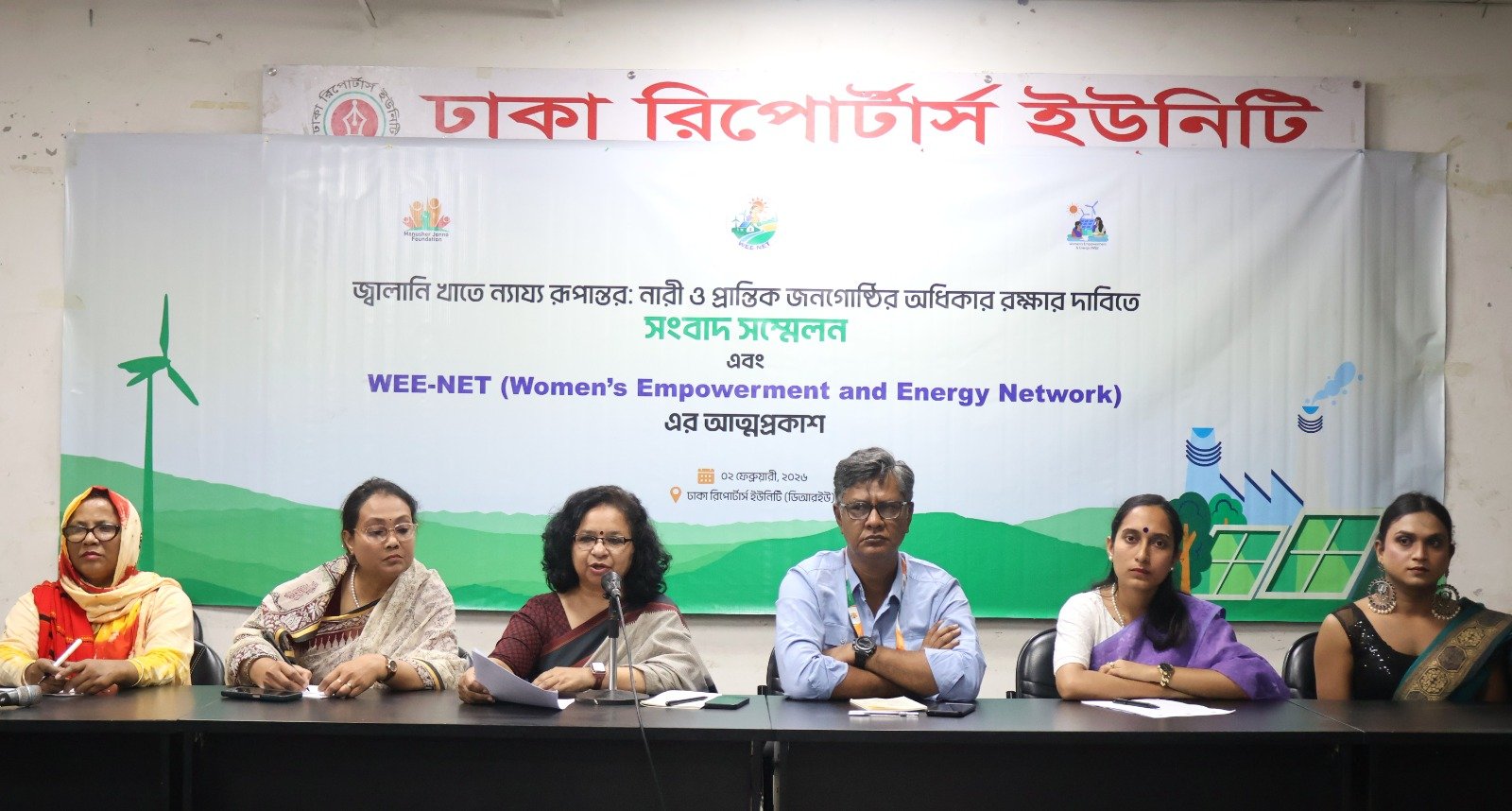
Manusher Jonno Foundation (MJF) on Monday called for guaranteeing the rights of women and marginalized communities in Bangladesh’s energy transition to ensure energy justice and gender equality. The call was made at a press conference held at the Dhaka Reporters Unity (DRU), where MJF, along with 34 network member organizations, officially launched WEE-Net (Women’s Empowerment and Energy Network).
At the press conference, Banasree Mitra Neogi, Director of Rights and Governance Programmes at MJF, stated that women’s participation in the national labor force remains only 19 percent. She added that 86 percent of those who lost their jobs in the first half of FY25 were women.
Highlighting structural inequality in the energy sector, she noted that women’s participation in renewable energy is below 10 percent, and nearly 90 percent of households still rely on harmful biomass fuels - posing severe health risks that disproportionately affect women.
The newly launched network aims to strengthen women’s skills, expand employment in the renewable energy sector, support women-led initiatives, and amplify coordinated advocacy for gender-just energy policies. Civil society organizations, individuals, institutions, and all relevant stakeholders will be invited to join the platform.
WEE-Net’s objectives include strengthening women’s leadership and capacity in the just energy transition; ensuring public and private financing for women-led renewable energy initiatives; and actively engaging in national platforms and joint initiatives to advocate for gender-responsive renewable energy policies and planning.
Wasiur Rahman Tonmoy, MJF’s Lead - Youth and Social Cohesion, urged the post-election government to take appropriate measures so that women can play active roles in all sectors of renewable energy.
MJF’s Advocacy Officer Mousumi Yesmin emphasized the need to ensure women’s participation and leadership in renewable energy policymaking, along with targeted investments for women entrepreneurs, rural women, and marginalized groups.
Representatives from WEE-Net member organizations also spoke at the event, including Sanjida Rahman from Waterkeepers Bangladesh (Dhaka), Sharifa Khatun from Welfare Efforts (Jhenaidah), and Amaira Irteja Ira from Pathchola Foundation (Chattogram).
WEE-Net’s key demands include: ensuring meaningful participation of women at all stages of policy formulation; strengthening transparency and accountability in the energy sector; reducing fossil fuel subsidies and reinvesting in renewable energy; stopping approval of new fossil-based power plants; reducing taxes and duties for EV expansion; setting a national target of 100% renewable energy by 2050; and providing training, employment, and financial support for women entrepreneurs and workers to ensure an inclusive and gender-just energy transition.
WEE-Net declared that a just energy transition is impossible without women’s leadership, and no transition can be considered just without gender justice. MJF expressed hope that with collective effort, Bangladesh will move toward a fair, inclusive, and people-centered energy future.