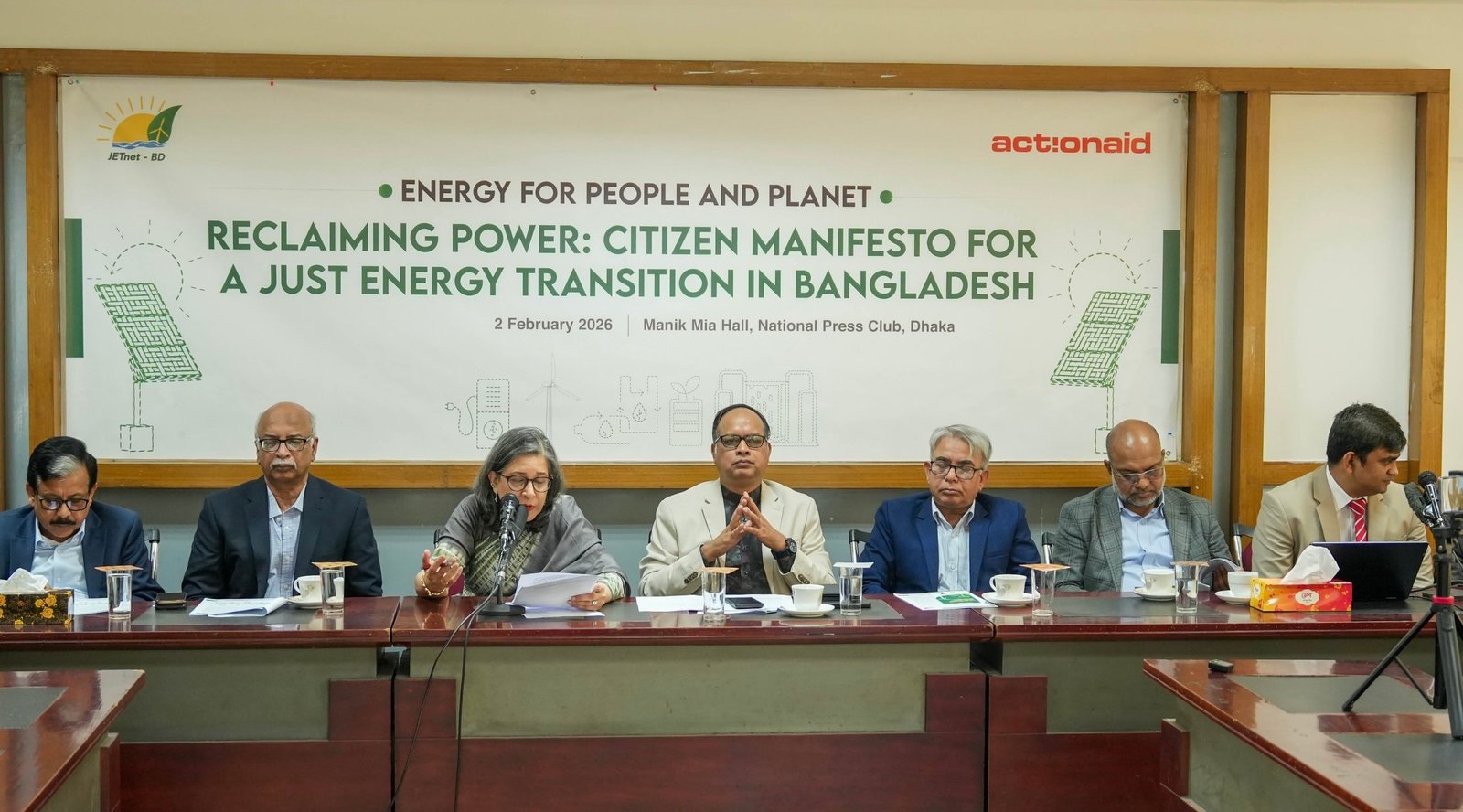
To ensure national energy security and reduce dependence on imported fossil fuels, a 14-point Citizens’ Manifesto has been presented, setting a target of achieving net-zero carbon emissions by 2050. The manifesto was unveiled on Monday at a press conference held at the National Press Club, organized by ActionAid Bangladesh and the Just Energy Transition Network Bangladesh (JETnet-BD).
Titled “Reclaiming Power: A Just Energy Transition for Bangladesh,” the manifesto urges political parties contesting the upcoming national election to take concrete actions to ensure energy security, climate justice, and a people-centered energy future. JETnet-BD is a nationwide civil society platform comprising 155 civil society organizations, with ActionAid Bangladesh serving as its Secretariat.
Speakers at the press conference highlighted that 97 percent of Bangladesh’s current energy demand is met by fossil fuels, of which around 70 percent is imported. This dependence results in an annual import cost of nearly BDT 1.5 trillion, placing severe pressure on the national economy and posing significant risks to long-term energy security. To address this crisis, ActionAid Bangladesh and JETnet-BD proposed a just energy transition pathway that targets at least 20 percent renewable energy by 2030, 50 percent by 2040, and net-zero emissions by 2050.
Key demands outlined in the Citizens’ Manifesto include the formulation of a comprehensive National Energy Transition Policy to guide all energy-related laws and plans; the phased closure of costly, import-dependent fossil fuel–based power plants and their replacement with domestic renewable energy sources to ensure energy sovereignty; and the development of sector-specific transition roadmaps and net-zero targets not only for the power sector but also for agriculture, the ready-made garment industry, transport, and cement.
The manifesto also calls for strengthening the Bangladesh Energy Regulatory Commission (BERC) as an independent and effective regulatory authority to ensure transparency, reform, and accountability in the energy sector. In addition, it proposes zero import duty on renewable energy equipment for the next five years, alongside prioritizing domestic innovation and local manufacturing.
Speakers further noted that despite Bangladesh’s estimated 50–300 gigawatts of solar and wind
energy potential, the absence of a coherent national energy transition policy and effective planning has prevented this potential from being realized. The manifesto stresses that energy policies and master plans must be developed through the direct participation of national experts and stakeholders, rather than relying predominantly on foreign organizations and consultants.
The press conference was moderated by Farah Kabir, Country Director of ActionAid Bangladesh. Shafiqul Alam, Lead Analyst at IEEFA and Advisory Committee Member of JETnet-BD, presented a paper outlining the current state of Bangladesh’s energy sector, identifying critical gaps and warning that continued dependence on LNG, coal, and oil would expose the sector to escalating
economic and energy-security risks. He emphasized that improving energy efficiency is essential
to reducing fossil fuel dependence and improving affordability.
Abul Kalam Azad, Manager – Just Energy Transition at ActionAid Bangladesh and Member Secretary of JETnet-BD, formally presented the demands of the Citizens’ Manifesto to the journalists.
Calling for collective action, Farah Kabir stated:
“The Citizens’ Manifesto has been developed based on the views and analyses of more than 150
civil society organizations and energy experts across the country. A just and sustainable energy transition requires a strong national policy framework, prioritization of local expertise, and meaningful participation of grassroots communities. Bangladesh does not seek energy deficiency—rather, the country must build a sustainable, efficient, and people-centered energy sector.” Members of the JETnet-BD Advisory Panel also shared expert insights. Dr. M. Tamim, Vice Chancellor of Independent University, Bangladesh (IUB), emphasized the need for a least- emission energy transition roadmap that safeguards affordability and energy security, noting that renewable energy must be added in actual megawatts, not just percentages.
Zakir Hossain Khan, climate finance expert and Executive Director of Change Initiative, stressed the urgency of an nature base transition pathway, calling for protection of rivers and canals, cancellation of risky power agreements, and strict transparency and anti-corruption measures in
the energy sector.
Mostafa Al Mahmud, President of BSREA, highlighted that renewable energy, particularly solar, offers lower planning and generation costs and strong job-creation potential, urging future governments to ensure land allocation and renewable-friendly grid infrastructure.
Professor Khasru Mohammad Selim, renewable energy expert, underscored the importance of de-centralized and community-based solutions such as solar irrigation, community grids, and solar charging stations, noting their lower investment requirements and higher potential for women’s participation in the rural areas.
In the concluding remarks, Dr. Ijaz Hossain, former Professor of BUET, stated that as an energy- importing country, Bangladesh’s most sustainable path forward lies in renewable energy. He noted that grid parity has already been achieved and that no new fossil fuel–based power plants are required up to 2035 if renewable deployment is prioritized.
Representatives from JETnet-BD member organizations, including Manjurul Hannan Khan of NACOM, Mohammad Hossain of Paribesh Rokkha Unnayan Society, and Rayhan Noman Nurnabi
of youth organization Surjyodoy, were also present at the event.
In closing, Farah Kabir announced that ActionAid Bangladesh and JETnet-BD will formally hand over the Citizens’ Manifesto to political parties contesting the 13th National Election, as well as parliamentary candidates nationwide through the JETnet-BD network. Network members expressed hope that elected representatives will reflect public aspirations by integrating the manifesto’s commitments into national policy.