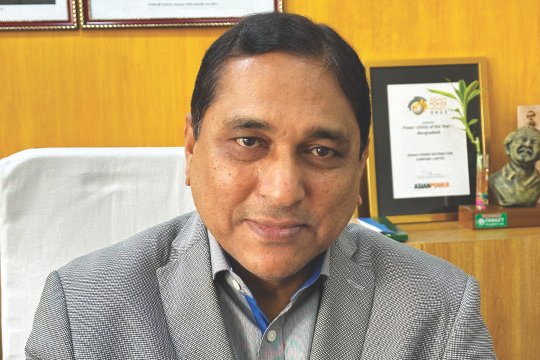
Remaining financially sound is now the major challenge of the Dhaka Power Distribution Company (DPDC). Over a long time, the company’s monthly losses now rose to Tk 90-100 crore. The latest adjustment of electricity prices will marginally reduce it. However, there is no alternative to fixing the appropriate distribution margin to get out of the losses. Despite this setback, the DPDC continues investing in system expansion and development. Through that process, the DPDC will reach a position by 2026 to ensure supplying quality electricity to all in its franchise on an uninterruptible basis.
Newly appointed Managing Director of DPDC Engr. Abdullah Noman said this in an exclusive interview with Mollah Amzad Hossain, Editor of Energy & Power.
It often comes into discussion that the distribution utilities of Bangladesh have not achieved the level of skills and expertise of other countries in supplying quality electricity to consumers. How far is the DPDC now from achieving that level? What are you doing to get there?
There is no denying that the DPDC now lags in ensuring quality power supply to all in its franchise on an uninterruptible basis. But we are advancing at a rapid pace to reach there. It is expected that by 2026 DPDC will emerge as a smart power distribution utility. Now works are in progress under the expansion and strengthening of the power system network (ESPSN) in the China-Bangladesh G2G Project. When completed, the capacity of DPDC will be doubled. The DPDC franchise area is very sensitive. Bangabhavan, Ganobhabon, the national parliament, a few major hospitals, and some other important installations are in this region. Only a few years from now, the substations in the area used to be operated at 90% load. But to ensure quality power supply, these need to be operated below 60% load. It has been possible to restrict load in the recently established sub-stations. It will be possible to restrict the load to 50-55% when 50 more new substations are set up under a new project. By this time, the SCADA system will also be fully operational.
Subject to the availability of the required power supply, the DPDC will be in a position by 2026 to supply quality and uninterruptible power to all.
The quality of customer service of power distribution utilities has significantly improved over the past decade. All substations of DPDC have come under dual sources of supply. What are your plans for achieving 2030 and 2041 power sector visions?
Please note that the improvement of customer services of power supply is a dynamic process. One must keep pace with continuously evolving technologies. After the successful implementation of ESPSN, no major new infrastructure will be added to the DPDC system by 2030 or 2041. Considering 5-8% growth in demand, technology upgrades shall continue. Our priority will be enhancing the skills of technology-friendly human capital.
Kolkata Power Distribution Company in our neighboring country is a 100-year-old power distribution utility. They generate power and supply it to their consumers. At the same time, they are also upskilling their human capital making them technology -and customer-friendly. They are also working in joint ventures with similar companies in other countries. Has DPDC received any proposal from them?
We have not received any such proposal from them yet. Possibly they may have given such a proposal to the Power Division. DPDC continues its human resources development through its training center and Bangladesh Power Management Institute (BPMI).
The energy transition is now a widely discussed global agenda. There is a popular view that distribution should invest in renewable energy in addition to its work. Are you considering this?
DPDC commenced doing this a long time ago with the installation of solar power on the rooftop of Bangladesh Secretariate. Following the introduction of the net metering system, an agreement has been signed among Bengal Solar, Dhaka University, and DPDC. This agreement will enable the generation of 3 MWp of solar electricity at Dhaka University. After meeting the demand of DU, DPDC will purchase the remaining power. Besides, DPDC has signed agreements with 351 users under net metering. The total capacity will be 3.626 MW. The total capacity of generation from the rooftop solar of 50,935 consumers is 26.590 MW.
DPDC will continue its program of purchasing rooftop solar power through net metering. Other than that, DPDC has no plan now to invest in renewable energy.
Except for BREB, DPDC is responsible for supplying power to the highest number of industrial consumers. There are complaints that quality and reliable power are not being made. Consequently, their operations are badly impacted. What are your plans for addressing this?
Please note that DPDC is now supplying quality and reliable power to industrial consumers. Keeping load-shedding at a comfortable level, there should not be any issue in supplying power to industries. But holiday staggering is being done now in industries. 30% of the total electricity in the DPDC system goes to industries. Various projects for further improving the quality of supply continue.
Is the demand-side management continuing now? It does not seem so to look at the shopping malls of Dhaka city. There are discussions that other than the holidays, shopping malls will pull the shutters down by 5 PM on 5 working days. On weekends, these may continue business till 11 PM. What are your views?
Domestic consumers account for 53% of DPDC-supplied electricity, 30% goes to industries, and 17% to commercial users. There is a policy for shops to close business by 8 pm but this is not being complied with. We are continuing our campaigns. But most shops do not close business before 9 pm. Stresses must be given on demand-side management to contain load-shedding in high summer.
We do not have any instructions about the new timing of business operation of Dhaka city shops. Business owners are also not thinking about it. We do not think businessmen will agree with any such initiative.
Work on setting up SCADA and the Twin Tower Head Office of DPDC is now going on. How long will these take to complete? Is a GIS substation being installed beneath the building?
Initially, PGCB was supposed to set up a GIS substation. But now that idea has been abandoned. But work on setting up SCADA at level two of the Twin Tower is in progress. The SCADA is expected to be fully operational following the completion of work on the Twin Towers in 2026.
The government has undertaken a program for burying the entire power distribution networks underground in phases. DPDC is implementing a project in the Dhanmondi area. When will it be completed?
Under the Bangladesh-China G2G project, the work on completely burying the 11 KV distribution network of DPDC in the Dhanmondi area is in progress now. 30% of the work has been completed. The inability to cut all roads at the same time is causing the delays. In addition to this, all the source lines of 50 new substations being built under the G2G project will be underground. Besides these, the construction work of the underground distribution line from Jahangir Gate to Bangabhaban is in progress. The construction work up to Bangla Motor has been completed so far. Again, work on an underground distribution line along the roadside from Gabtoli to Azimpur has been undertaken. The entire distribution network will be taken underground in phases. These will enable bringing issues to zero when completed.
When it will be possible to provide pre-paid meters for all consumers of DPDC? What is its present status?
DPDC now has 16 lakh consumers. Of these, 3 lakh have pre-paid meters now. The initiative has been taken to bring another 6 lakh consumers under pre-paid metering under automated metering infrastructure development of pre-paid metering system expansion. Radiofrequency can be used for this. This will enable direct monitoring of the usage by the consumers. It is expected to complete the entire project within 18 months. Besides this, an initiative has also been taken to install another 1.5 lakh pre-paid meters under another project. We expect to bring all domestic and commercial consumers under a pre-paid metering system by 2030.
What are the preparations of DPDC for catering to the ensuing summer demand? What will be the peak demand this time? Will you get the supply per maximum demand?
There is a possibility of summer peak demand exceeding 2200MW this year in the DPDC command area. In 2023 the peak demand was 2135MW. During the fuel supply crisis of 2023 summer, DPDC had to execute 300-400MW load-shedding. All 80 substations of DPDC now have dual sources of supply. These are no longer overloaded. In such a situation, the DPDC network can manage 4500MW power demand now. Subject to the supply of power per demand, DPDC is in a position to seamlessly catering peak demand this summer. There will not be any load-shedding in the DPDC area in such circumstances.
While reviewing reports of fire service, we find electric short circuits as the source of the majority of fire accidents. We know in most cases these are due to inferior quality of materials and poor workmanship. Do you check the suitability of the building and the work before giving new connections? If not, what are your plans?
Please note that DPDC only gives connection after finding a valid certificate of Rajuk for the category of building and a certificate of fire safety from the fire service department. Electric connection to the building at Bailey Road was given after finding the certificate as a commercial building. In the case of each connection, the capacity of the substation and other associated technical aspects are given due attention. In case of old customers increasing load beyond sanction notice is served to them. However, internal wiring and other works are done by the consumers. We have no control over these.
What is the major challenge of DPDC as a distribution utility? What plans do you have to confront this?
All distribution utilities need to undertake new projects after meeting all operational and administrative expenses from their revenues. All loans including interest need to be paid. The distribution margin is our only source of earnings. For not adjusting the retail tariff following the adjustment of the bulk tariff last year, DPDC accounted for Tk 90-100 crores loss each month. With an 8.5% price increase in consumers' end now that loss will be partially reduced.
We need to bear in mind that distribution utilities do not get any government subsidy. Hence maintaining financial health is the major challenge of the distribution utilities now. The government must adjust retail tariffs keeping consistency with the bulk tariff to ensure that distribution companies do not incur losses in the process.
Download Interview As PDF/userfiles/EP_20_19_Interview.pdf