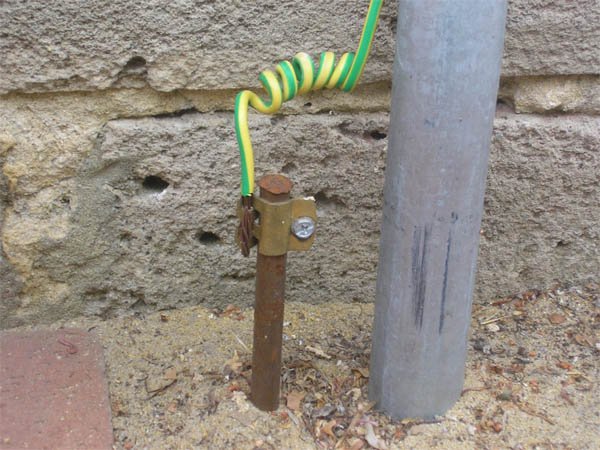
Earth grounding is commonly known as earthing and pays a very important role in electrical systems. Moreover it has a great necessity. Few main reasons of grounding electrical currents are like, protection against electrical overload, helps direct electricity, stabilizes voltage levels, earth is the best conductor, prevents damage, injury and death.
Basically an ideal “Electrical Earthing System (EES)” has three (3) main components.
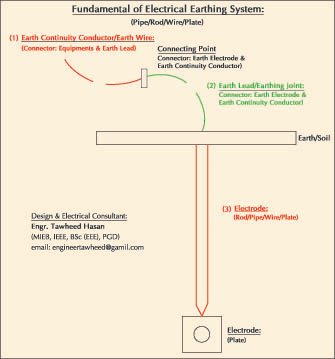
Earth Continuity Conductor or Earth Wire:
This part of the earthing system which connects all metallic parts (switches motors etc.). According to IEEE rules, resistance between consumer earth terminal and earth continuity conductor (at the end) should not be more than 1Ω.
Size of the Earth Continuity Conductor or Earth Wire depends on the cable size used in the wiring circuit. The cross sectional area of the Earth Continuity Conductor should not be less than the half of the cross sectional area of the thickest wire used in the electrical wiring installation.
Earthing Lead or Earthing Joint
The conductor wire connected between “Earth Continuity Conductor (1)” and “Earth Electrode (Electrode) or Earth Plate (3)” is called “Earthing Joint or “Earthing Lead (2)”. The point where earth continuity conductor and earth electrode meet is known as “connecting point”. There should be minimum joints in earthing lead (2) as and straight in the direction. Generally, copper wire can be used as earthing lead but, copper strip is also used. The size or area of earthing lead should not be less than the half of the thickest wire used in the installation. The size for earthing lead is 3SWG to 8SWG.
Earth Electrode (Electrode) or Earth Plate
A metallic electrode or plate which is buried in the earth (underground) and it is the last part of the electrical earthing system. In simple words, the final underground metallic (plate) part of the earthing system which is connected with Earthing Lead (2) is called “Earth Plate (Plate) or Earth Electrode (Electrode) (3)”.
A metallic plate, pipe or rode can be used as an earth electrode which has very low resistance and carry the fault current safely towards ground (earth). Both copper and iron can be used as earthing electrode. The size of earth electrode (copper). 2×2 and 1/8 inch thickness (I.e. 2’ x 2’ x 1/8”). (600x600x300 mm). In case of Iron (2’ x2’ x ¼” = 600x600x6 mm). It is recommended to bury the earth electrode in the moisture earth. If it is not possible, then put water in the GI (Galvanized Iron) pipe to make possible the moisture condition. In the earthing system, put the earth electrode in vertical position (underground) as shown in the above fig. Also, put a 1 foot (about 30cm) layer of powdered charcoal and lime mixture around the earth plate (don’t confuse with earth electrode and earth plate as both are the same thing). So every concern person must ensure proper Earth Grounding for all electrical equipments.
Engr. Tawheed Hasan;
(MIEB, IEEE, BSc (EEE), PGD (Govt.),
The CEO, Adverb Group, tawheed111@gmail.com