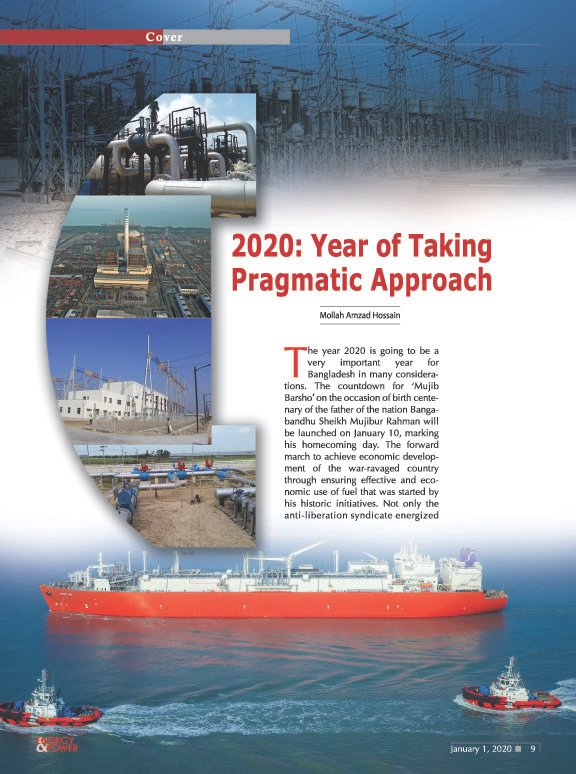
The year 2020 is going to be a very important year for Bangladesh in many considerations. The countdown for ‘Mujib Barsho’ on the occasion of birth centenary of the father of the nation Bangabandhu Sheikh Mujibur Rahman will be launched on January 10, marking his homecoming day. The forward march to achieve economic development of the war-ravaged country through ensuring effective and economic use of fuel that was started by his historic initiatives. Not only the anti-liberation syndicate energized through the midnight massacre of August 15 in 1975, the initiatives and policies of his government to create competent human resources for exploration and exploitation of own resources have also been abandoned. The Awami League-led government assuming office in 1996, following the 21-year rule of military dictators, resumed the development works of the energy and power sector through formulating blueprints following the doctrines of Bangabandhu. Notable achievements could be made in five years. A foundation for redeveloping a modern, dynamic energy and power sector could be virtually laid. The main essence of Bangabandhu’s policy was making power supply hassle-free for achieving and ensuring economic development of the country. That has to be affordable also. Instead of imported fuel dependency, he thought about the need for effective use of own fuel, especially the natural gas resources. Besides natural gas, the thoughts for exploration of other primary fuel coal also started during his regime. But at the door step of the golden jubilee of glorious independence in 2021, Bangladesh is approaching towards 90 percent dependence on imported primary fuel. The Awami League-led government over the past 11 years has completely failed to supply power and energy at an affordable cost. The power tariff required increasing in phases for several times to manage the situation. For utilizing the imported LNG in the wake of depletion of own natural gas, the price of gas needed to be increased too. Consumers have already become panicked due to increased electricity and gas prices. Energy experts and leaders of Consumers Association of Bangladesh have alleged that this situation has been created due the failures of the government in exploring and exploiting own primary fuel resources. Even now, no such initiative is visible for sourcing low-cost fuel option.
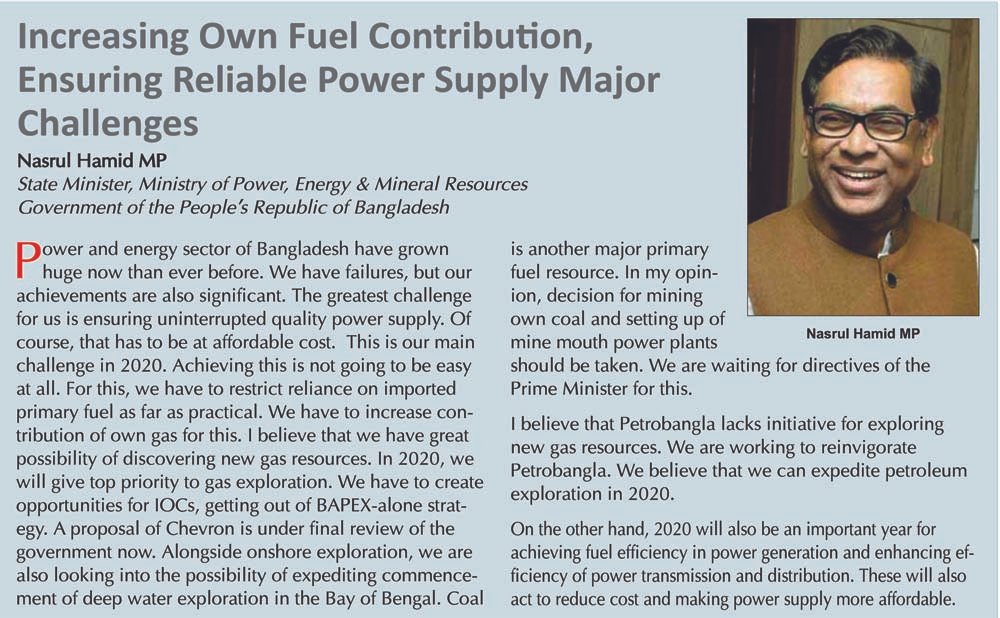
From the present situation, it would not be easy at all to start turning around in 2020 towards self-sustaining energy and power sector. State Minister for Power, Energy and Mineral Resources Nasrul Hamid also thought that supplying reliable power at affordable cost is now the main challenge of the government. The challenges, according to him, are efficient use of fuel for power generation and supplying power efficiently to all consumers. The other main challenge, however, is increasing contribution of own fuel to the fuel mix. This is not an easy task though.
Experts and analysts of the energy and power sector observed that ensuring seamless supply of primary fuel would be a major challenge for the government in 2020. This has to be at affordable least cost also. For this, contribution of own gas and coal needs to be increased through expeditious exploration and exploitation. On the other hand, we have to ensure that the price remains competitive with the neighboring countries. Unfortunately, over the past 11 years the government over its consecutive terms has miserably failed to explore and exploit own primary fuel resources, for example, natural gas. The government also failed to adopt right policy and strategy for exploiting discovered coal reserve. The government is talking about expediting exploration initiative for gas in the onshore, but nothing is being heard about exploring coal. The government is still hesitating to take a political decision in this regard. Exploration of coal now entirely depends on the Prime Minister’s mindset and directives.
Natural Gas, LNG
Own natural gas used to contribute about 89% of the fuel mix for power generation in 2009 when the Awami League-led government returned to power for the second term. That contribution has dropped to 62% now. But the gas crisis started rocking at least two years before 2009. The interim caretaker government for managing the gas crisis diverted the gas to power, suspending supply to new industries. The interim government had also initiated process to set up liquid fuel-based power plants as a contingency measure for confronting the crisis. Short, medium and long-term power generation strategies were worked out in 2009 for implementing the fuel mix in accordance with the Power System Master Plan 2010. Basically, with the intention to supply power at affordable cost, 50% of the 40,000 MW power generation target by 2030 was planned for generation from coal. Local coal was given priority in this planned fuel mix. Contribution of natural gas was planned to be 25%. The scenario of depletion of own gas reserve was taken into consideration. Initiative was taken on urgent basis for the import of LNG. The plan was to start LNG import within two years through setting up Floating Storage and Regasification Unit (FSRU). But the first 3.5 million tonnes per annum FSRU came into operation at the end 2018. A similar capacity FSRU also became operational in 2019. The production of own gas in 11 years could be increased from 1600 MMCFD to 2700 MMCFD. There is hardly any success in finding new gas resources over the past 19 years. Over this period, about 13 Tcf gas has been consumed, but the new addition is only about 2 Tcf. Moreover, these are only marginal gas fields.
The recoverable reserve of natural gas in Bangladesh is 27.9 Tcf. Out of this, 16.9 Tcf has already been used. The remaining reserve is 11 Tcf. Petrobangla informed that the entire reserve would be depleted by 2031 if no new reserve is added through discovery in the meantime. The total number of gas consumers is now 4.2 million. Of the 27 discovered gas fields, 20 are in operation with 112 producing wells. The coincident peak demand is 3685 MMCFD. Adding RLNG, the maximum supply capacity now is 3300 MMCFD. There exists 385 MMCFD of deficit now. The RLNG-supplying capacity is 1000 MMCFD. But for restricted capacity of the gas grid, the RLNG supply now is 600 MMCFD. Over the last one year, 300 MMCFD RLNG could be supplied on average per day. Around 1600 MMCFD of the 2700 MMCFD own gas is coming from IOC-operated gas fields. Of the gas produced, 42.9% is being used for power generation, 15.64% for captive power, 15.76% in industries, 15.21% by the domestic consumers, 5.5% for fertilizer production, 4.05% goes to the CNG fuelling stations and the remainder to commercial consumers. It has been seen over the past four years that the annual gas use is about 1 Tcf.
Over the last 10 years till August 2019, only 4 fields (Sundalpur, Sreekail, Rupganj and Bhola North) could be discovered from 17 exploration wells. Four drilling rigs were purchased for BAPEX. Apart from the exploration wells, 55 development wells were drilled and 36 wells were worked over. Compressor stations were set up on the gas grid and wellheads.
Coal Politics
In PSMP 2010, coal was considered as preferred fuel for power and 20,000 MW power was planned to be generated from coal. But in PSMP 2015, planned contribution of coal was brought down to 35%. Almost the entire coal is planned to come through import. Right now about 22000 MW coal-based power generation initiatives are under contract, negotiation and implementation stages. Of these, 660 MW capacity of the first of the 2X660=1320 MW Payra Power Plant is now ready for commencing operation. Construction works for power plants at Rampal and Matarbari are also advancing. The preliminary works of a private sector S Alam Group 1320 MW power plant at Bashkhali has also started. But no deep sea coal port for coal import could be constructed by now. For shallow draft, coal is being brought using smaller 20,000 MT capacity vessels for Payra power plant now. Deep sea coal terminal at Matarbari is expected to come into operation in 2023. The capacity initially would be 5 million tonnes a year. There is a plan to expand the capacity to 30 million tonnes coal transshipment terminal in future. The planned target to implement this is by 2030. Consequently, all imported coal-based power plants elsewhere than Matarbari have to import coal by transshipment. This would add about USD 10-20 per tonne for coal transportation. As such coal transportation would present a major challenge for all imported coal-based power plants other than those at Matarbari. Payra Port Authority has a plan for developing a deep sea coal terminal. But there is no definite timeframe as yet when it will materialize. This has limited the possibility for getting power at affordable cost from imported coal-based power plants. Right now local coal effectively contributes only about 2% to fuel mix for power. But for inefficient mining, the price of local coal is US$130 per tonne.
Five discovered coalfields of Bangladesh (Barapukuria, Phulbari, Dighipara, Khalaspir and Jamalganj) have a total proven reserve of 3.3 billion tonnes. Of these, the mining from the largest field at Jamalganj having 1.1 billion tonnes has not been found feasible as yet. A study done for extracting Coal Bed Methane (CBM) also did not give encouraging result. Petrobangla has just completed a feasibility study for mining from Dighipara. A project for open pit mining in the Southern flank of Barapukuria mine has been prepared. The government has not given any green light for this yet. There is no directive yet also about whether mining will be done at Dighipara. A Scheme of Development (SOD) with all techno-economic feasibility studies were submitted in accordance with the contract for Phulbari mining in 2006. But over the last 13 years, this is waiting for government approval. A Chines company and local Hosaf Group Joint Venture submitted a SOD for mining from Khalaspir. During the tenure of the interim government, a company has been assigned to evaluate it. They identified some inadequacies in their report and advised for further study. But all these remained buried and gathering dust somewhere.
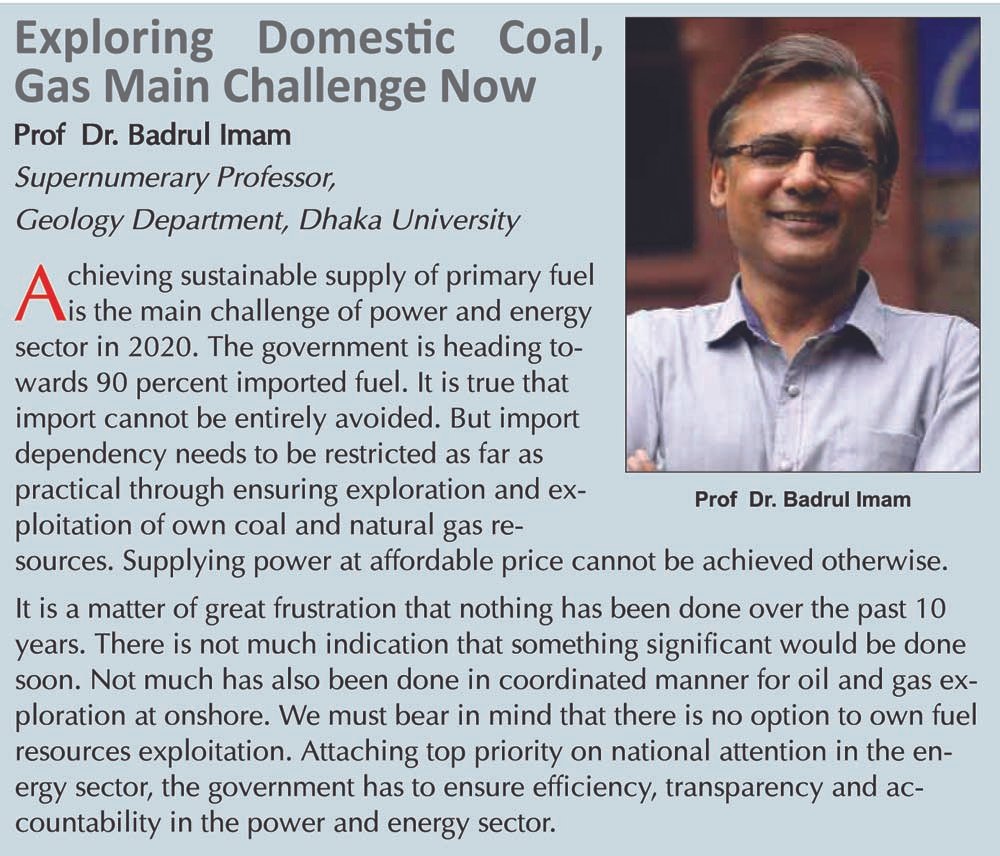
Energy expert Prof Dr. M Tamim said, “Exploring own coal and setting up of mine mouth coal power plant is the best option for Bangladesh for supplying power at affordable cost. There are challenges for mining coal, but there are technology for successfully managing all challenges and impacts. Mining own coal is now an absolute political issue. Without political decision, it is no longer possible to start coalmining now.”
State Minister Nasrul Hamid also acknowledged that local coal should be used for power generation. But he also mentioned that the Prime Minister would have to take decision for mining own coal.
Prof Dr. Badrul Imam also observed that using local coal is the best option if we want to supply power at affordable cost. Energy experts and research fellows also considered that this is the prime time for taking decision on mining own coal. Cost of mining will increase sharply as time whistles by. On the other hand, it would be possible to get power from plants using local coal by 2024 if the decision for mining is taken in early 2020. This would significantly reduce the emerging dependence on imported fuel.
Exploration of Oil and Gas
Oil and gas exploration has practically lost momentum since long. Relevant experts observed that the BAPEX-only strategy for exploration in the onshore area proved counter productive. There has been virtually no effective exploration at all. Over the last 10 years, only 4 marginal gas fields could be discovered from 17 exploration wells. Production from one has already stopped for depletion of recoverable reserve. Right initiative of the government could help resolve long standing maritime boundary disputes with India and Myanmar in the Bay of Bengal. Despite that no success could be achieved in a long time for exploration from offshore resources. Contractors could not be engaged in 5 years of efforts by Petrobangla for 2 non-exclusive multi-client surveys in the Bay of Bengal. Although a company has been selected in 2019, the first phase of the survey may not be completed before winter 2020. The government has approved the final version of updated model PSC in 2019. Experts observed that this updated PSC creating some additional incentives for IOCs may encourage them for risk investments. But it is unsure whether without enough required information,the bidding would encourage major IOCs. But if the bidding round has to wait for the outcome of multi-client survey, it may not be possible going for it before 2022. Right now three IOCs are working in four offshore blocks. Petrobangla expects that by the first half of next year, 4 exploration wells may be completed. The date for next bidding round has not been firmed up yet.
Petrobangla has planned for carrying out and completing more 2D and 3D seismic surveys by 2023. Over the past 10 years, 28,347 line kilometer 2D and 5000 square kilometer 3D seismic surveys have identified 22 potential structures. Plan has been made for 11 exploration wells, 14 development wells and 15 work overs by 2023. Over the past 10 years, 13 field compressors have been set up for augmenting gas production. BAPEX developed a five-year mega plan in 2016 for drilling 108 wells which included 53 exploration wells. But practically the overambitious plan could now grow to encouraging stage. In a recent workshop, State Minister for Energy Nasrul Hamid blamed Petrobangla and BAPEX for their inefficiency in exploration of oil and gas. But according to Prof Dr M Tamim, absence of required directives of the government is the main reason for failures in exploration of petroleum resources. For successful exploration, the blocks and areas outside BAPEX-allotted blocks onshore should be leased out through PSC bidding rounds to IOCs. Prof Dr Tamim thought that there would be encouraging responses to such bidding round if fresh PSC for onshore blocks is invited by 2020. Some successes would be achieved by 2023. He suggested the government for not leasing out any block in joint venture with BAPEX.
The government is not yet completely prepared for going to fresh bidding round in the offshore. The government could encourage IOCs more in the offshore exploration if data bank of information could be developed by now. We must do it quickly and go for bidding as soon as possible. Bangladesh could not achieve any mentionable success in the vast offshore areas as yet. Only required extensive exploration can prove whether we really have expected resource in the vast explored offshore and frontier areas in the onshore. But there is considerable doubt about the preparedness of the government for this. However, Nasrul Hamid is optimistic that massive exploration campaign can be launched from 2020.
Energy Efficiency
Sustainable and Renewable Energy Development Authority (SREDA) on the behalf of the government is working under a master plan for ensuring efficient use of power and energy. They are working to achieve a target for reducing 30% of power use through implementing efficient use of power and energy. The impacts of their work started getting visible now. Investment has started in the industry sector for enhancing efficiency. Power generation is a major area in Bangladesh for increasing fuel efficiency. But fuel efficiency in power generation to an acceptable limit has not been achieved yet. Power division stated of achieving nearly 50% efficiency by 2021. Works for constructing high efficiency power plants has started. But expected success could not be achieved yet. The average efficiency in power generation is now 33%. The price of gas is increasing. It will keep on rising with more and more LNG is introduced in the fuel mix. The generation cost of power would increase if this does not become more fuel efficient. Experts observed that if fuel efficiency can be increased to 45%, at least 1.5 times power can be generated using the same amount of fuel being used now. The enhancement of fuel efficiency will be a challenge for the government in 2020.
Imported Fuel Dependency and Price Impact
Two FSRUs, each 3.5 million tonnes capacity, have started operation in the country for LNG import. The capacity is 1000 MMCFD though 600 MMCFD RLNG is being delivered to gas grid now. Over the last 1 year, 300 MMCFD LNG has been used on average. At least for 87 days every year, FSRU cannot operate in Bangladesh coastal areas for turbulence of the sea during high monsoon. Petrobangla is accounting for minimum charge to FSRU operators though it fails taking full 1000 MMCFD delivery for restricted capacity of gas grid. Bangladesh is purchasing LNG from Qatar and Oman under long term contract. In addition, 17 companies have been short-listed for supplying LNG from spot market. The present LNG price is US$10 per MMBTU. Former Power Secretary Dr. Fouzul Kabir Khan in a presentation at Dhaka Chamber of Commerce and Industry claimed that Bangladesh is buying LNG at higher than international market price. The landing cost of LNG in India is US$6.00 per MMBTU. The government has abandoned plan for any new FSRU. Initiative has been taken for a land-based LNG terminal at Matarbari. The initial capacity would be 7 million tonnes equivalent to 1000 MMCFD. Eventually the capacity may be doubled.
Experts believe that long term contracts alone cannot bring down the LNG price effectively. We have to go for spot purchase. The government may engage consultant group to look after the negotiation. On the other hand, local manpower must be trained effectively to gain expertise at all segments of the LNG supply chain. Petrobangla evidences state that the gas demand in 2021 will be 3600 MMCFD and own gas production will be depleted to 2400 MMCFD. LNG import through FSRU and import from India may become 1200 MMCFD. Gas demand in 2030 would be increased to 4700 MMCFD. Own production would then may stand at 1800 MMCFD and LNG availability would be 2900 MMCFD. In 2041, the gas demand would be 5900 MMCFD. Petrobangla expects that including 500 MMCFD supply from offshore (in the event of discovery), own production would be 2000 MMCFD and LNG availability would be 3900 MMCFD.
It appears that about two-thirds or even more of the projected demand would be required to be met from imported LNG. Hence, we will have to ensure LNG purchase from the global market at competitive price. Even then, a lot would depend on global geopolitics and associated impacts on energy price in global market.
On the other hand, 66 million tonnes of coal will be required every year to meet the projected demands for the planned imported coal-based power plants. At present, the entire amount of coal purchase is being planned through long-term contracts. Absence of deep sea port would add cost of transportation. The cost of generation would increase and would be reflected upon power tariff.
Uninterrupted Power Supply
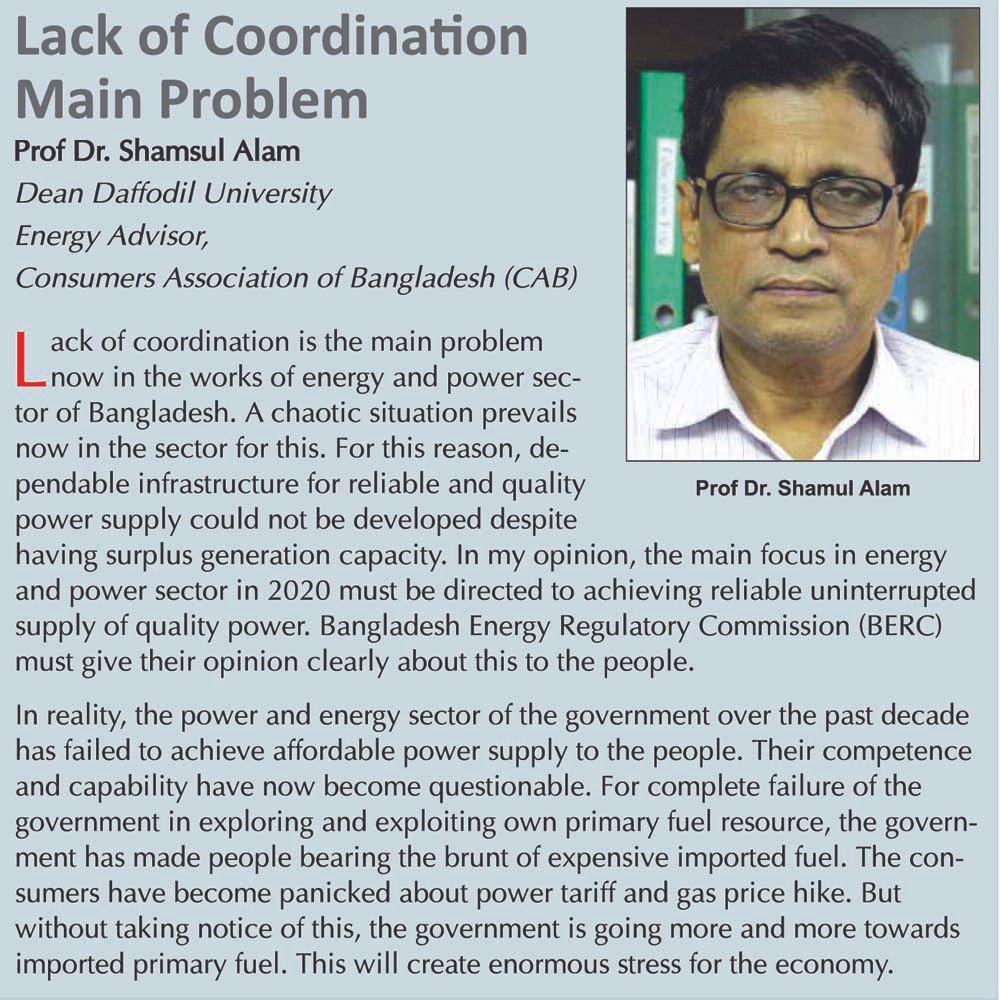
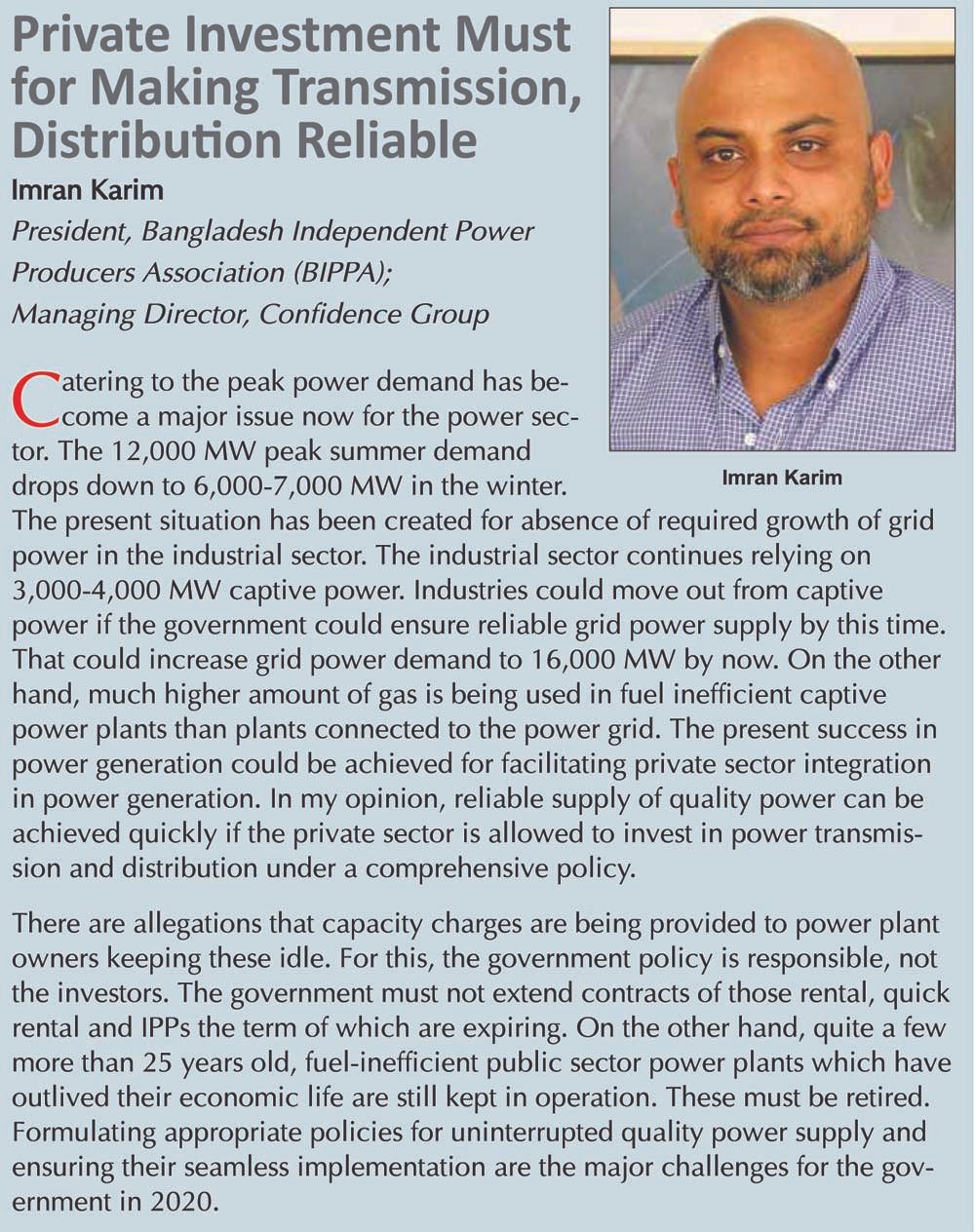
There is no denial of the government achievements in the powergeneration. But the cost of generation remains higher for not being able to utilize most of the installed capacity. Consumers are bearing the brunt paying higher power tariff. BIPPA President Imran Karim observed that the grid power demand could be increased to 16000 MW during high summer of 2019 if power transmission and distribution system could be developed to make these reliable for supplying quality power on uninterruptible basis. One example would evidence the lack of coordination among different utilities in the power sector. Plan for developing power transmission system was made almost at the same time when imported coal-based power plant was planned at Payra, Patuakhali. The first 660 MW unit of the 2x660=1320 MW is now ready for delivering power. But the commissioning is being held up for non-completion of power evacuation facilities. Industries are not showing any interest for grid power as it is not yet reliable for uninterrupted supply. Industries still rely on captive power. Chief Executives of power distribution utilities told EP during discussions that they are moving ahead with required projects for making distribution system completely reliable. It may take 2-3 years to achieve complete success.
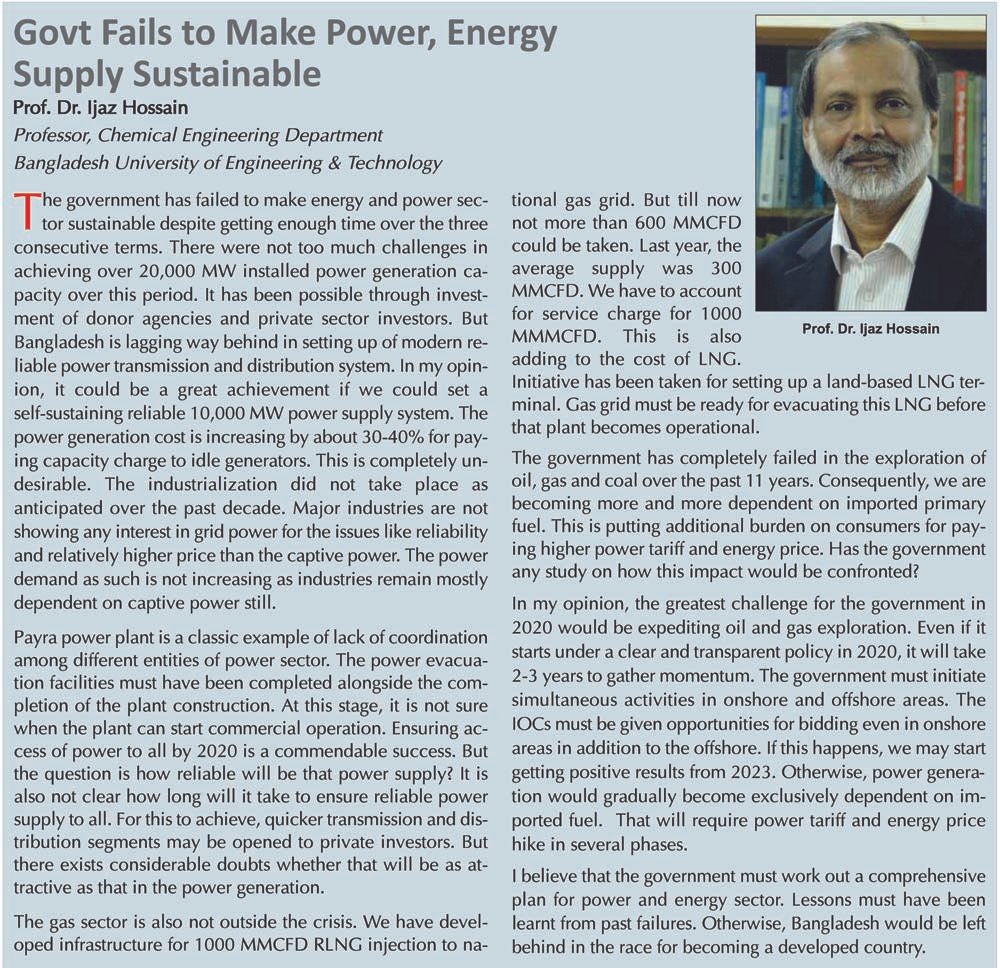
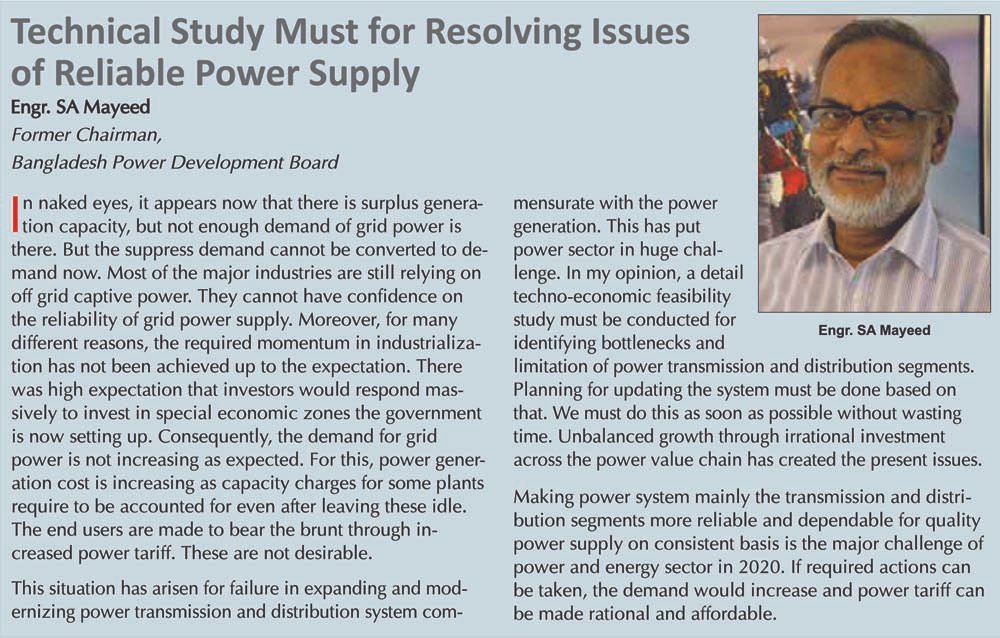
Former Chairman of Bangladesh Power Development Board (BPDB) SA Mayeed told the EP that the government must know where is the shortcomings and bottlenecks in the power transmission and distribution system and what are the most appropriate actions to address these. He suggested carrying out a detail study to identify and assess these for subsequent follow up actions. He suggested that all activities for updating and modernizing power transmission and distribution system must be done according to the findings and recommendations of the above study report. Nasrul Hamid also admitted the constraints of the power transmission and distribution system. He informed that works have already started to confront these challenges for upgrading and modernizing power supply system. In 2020, these works would be better coordinated.
Conclusion
Proven gas reserve could not be increased due to very limited new gas discovery over the past 20 years. Increased gas production from discovered fields is causing fast depletion of the reserve. The gas demand would grow double in 2041. There is no option now than importing more and more LNG even if we launch major exploration drive for new gas soon. Possibly right initiatives can bring down the quantity of LNG imports to some extent. On the other hand, Bangladesh is not yet efficient in using gas for power generation, fertilizer production and industry. To increase this efficiency, actions must be taken in 2020, along side reinvigorating initiatives for oil and gas exploration in offshore and onshore. Procurement of LNG must be done through proper negotiation and at competitive price.
Up to 10,000 MW coal-based power can be generated for 50 years if we can exploit our own discovered coal reserve and set up power plants. Local coal can generate power at 5 US cents while imported coal-based power generation cost would not be below 7-8 cents. But the power plants need to be setting up at the mine mouth. This will relieve stress from natural gas also. On the other hand, this also can reduce dependency on imported fuel at least by 50%. In consideration of all, there is no other option but going for mining own coal without wasting any more time. Experts believe that it will be a blessing to the nation if MPEMR can start this in 2020.
In 2020, another major challenge is expediting construction of deep sea port and land-based coal terminal for supplementing initiatives of coal and LNG import. These must be given top priority attention for speedy implementation. Fuel supply would be reliable in the event of failure in completion of coal port and LNG terminal at Matarbari in 2023. The cost of power generation would further increase.
Works for upgrading and modernizing power transmission and distribution system under long term plan must get required momentum in 2020 for achieving efficient and reliable power supply. Attention must be directed towards achieving 45% efficiency in power generation by 2025. The works of different utilities must be properly coordinated.
Finally, there is no other option but upgrading and modernizing infrastructures of power and energy system. In case of a developing economy, power supply must be affordable to all besides making this reliable and sustainable. Exploration and exploitation of own primary fuel and ensuring its maximum use also need to be ensured. Eventually, import of fuel cannot be avoided. Appropriate utilization of own fuel can delay the requirement for huge import in the near future. Optimum use of own fuel would definitely make significant impacts on overall development of the national economy. Keeping the higher price of primary fuel in global market, Bangladesh must gradually transit to lower energy-intensive industries. Otherwise, our vision 2021 for becoming mid-income country and vision 2041 for developed economy would be impeded.