People of Bangladesh have been reeling under a series of energy price hikes in the past nine years since 2009. In a litany of cascading effects, the energy price hikes raised the cost of living as well as cost of production and transportation of goods. In a result, low-to-middle income groups as well as fixed earners to entrepreneurs have been struggling relentlessly to maintain their living standards and productivity respectively. The prices of natural gas, fuel oils and electricity were increased in a row between 2009 and 2014. Increasing oil and gas exploration capacity of state-run petroleum exploration company, Bapex, and government’s revenue earning pressed the hikes in gas prices over the period. Rationalizing fuel oil prices in the domestic market with the international market was said for raising fuel oil prices in the five years. The government also justified its proposals to raise the prices of both bulk and retail electricity showing the growing dependence on imported diesel and furnace oil in electricity generation that doubled the generation cost until 2014.

In the next three years closing December 2017, the Bangladesh Energy Regulatory Commission (BERC), apparently under the government pressure, raised the price of natural gas twice in a bid to increase the government’s earning. At the same time, it also increased the prices of electricity twice citing the grounds of adjusting power generation costs and distribution costs respectively.
Excepting a nominal reduction in fuel oil prices, the government, however, continued charging much higher prices for fuel oils than its import costs citing the grounds that it was realizing the ‘outstanding debt’ owed by the state-run Bangladesh Petroleum Corporation to it. The government at the same time used the ‘irrationally’ high fuel oil prices, which was caused by its profiteering policy in fuel oil market, as the cause of power price hike that came into effect in September 2015.
Both electric energy and primary energy (liquid fuels and natural gas) have multistage impact on the people of a land. Changes in energy prices leave serous impact on the people who might not even consume the products as electricity or primary energy acts as an input to the economy. Any hike in energy prices first affect its consumers directly and then affect the entire population as the hike increases cost of production and transportation of goods triggering rise in house rent and the other essential commodities including those are in kitchen markets. Cost of boro (Bangladesh’s major crop) production has increased significantly due to increased cost for irrigation due to hikes in electricity and diesel prices.
Energy Price Hikes In Nine Years
Now, if we look at the net energy price hikes during the ruling Awami League-led government, it gives a terrific picture of a consistent high inflation trend snatching away the scopes of increasing living standards from common people and profit margin from manufacturers and service providers. The other nations with solely dependence on imports for fuel oils, have however been enjoying the dividend of lower fuel oil prices in the international market by reducing the prices in their domestic markets. People reaped no benefit of the nominal reduction in fuel oil prices in April 2016, when the government reduced the prices of diesel and kerosene by only Tk 3 per liter, petrol and octane by Tk 10 and a month ago the furnace oil by Tk 18 offering no significant leverage in boosting people’s living standards, experts observed.
People experienced average inflation at the rate of 7.31 percent in 2009-10 FY, 6.46 percent in 2010-11 FY, 6.52 percent in 2011-12 FY, 6.01 percent in 2012-13 FY and 6.06 percent in 2013-14 FY when the prices of fuel oils remained high in the international market. The scenario remained almost unchanged even after the fuel oil prices went down in the next three years. In this phase, people continued reeling under the inflation at 6.41 percent in 2014-15 FY, 5.92 percent in 2015-16 FY and 5.44 percent in 2016-17 FY, according to the data provided by the Bangladesh Bureau of Statistics. The BBS also estimated the monthly inflation at 6.04 in October 2017.
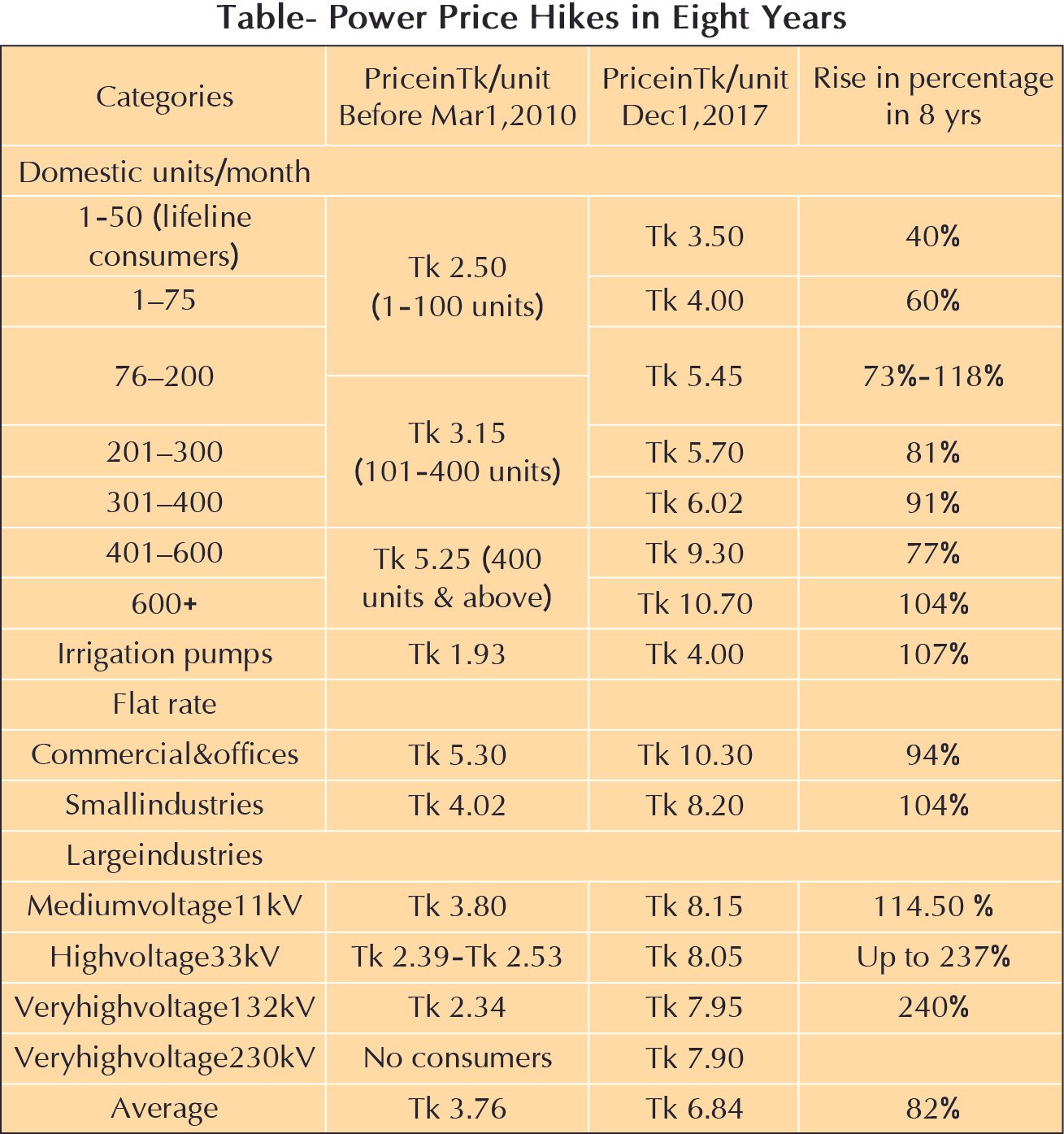
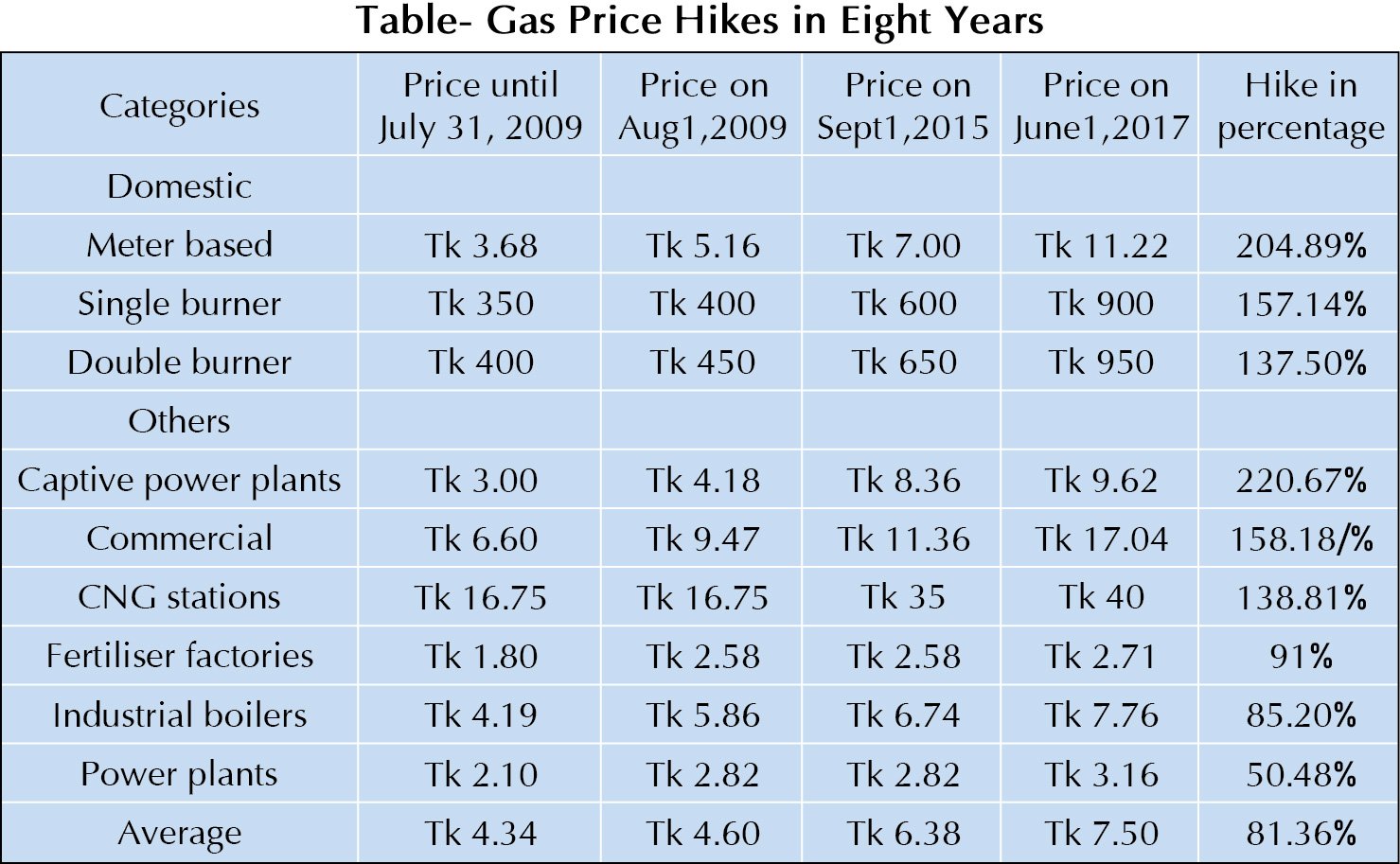
With the latest hike that came into effect on December 1, the average prices of electricity were increased to Tk 6.84 per unit or kilowatt-hour, 82 percent up from Tk 3.76 per unit, at consumers’ end since 1 March 2010. Likewise, with the hike that came into effect on June 1, the average prices of natural gas to Tk 7.50 per cubic meter, 81.36 percent up from Tk 4.34, at consumers’ end since 1 August 2009. After the little adjustment, now, the price of diesel and kerosene stands at Tk 65 per liter, 47.73 percent up from Tk 44, furnace oil at Tk 42 per liter, 61.54 percent up from Tk 26 per liter, petrol at Tk 86 per liter, 16.23 percent up from Tk 74, and octane at Tk 89 per litre, 15.58 percent up from Tk 77.
People Reap No Benefit From Lower Fuel Oil Import Costs
The fuel oil market started going down from its peak in June 2014 when the price of Brent Crude was $117 barrel and now it had so far rebounded to as high as $65 in December last year. State minister for power, energy and mineral resources Nasrul Hamid said that the government recently had backtracked from a decision of another spell of fuel oil price cuts observing upward trend of the prices in the international market. Energy division officials, however, said that the government, apart from earning revenues in taxes and duties, would continue making profit until the Brent Crude price exceeds $80 per barrel.
Citing different grounds, the government ultimately managed to earn approximately Tk 21,000 crore in the past three fiscal years closing June 2017, according to the budget documents issued before placing national budget for the 2017-18 FY. The government also earned revenue worth nearly Tk 20,000 crore in taxes and duties from the import and sales of the petroleum products in the three financial years, according to the BPC’s provisional annual report for the 2016-17 FY.
The government claimed that it had lent more than Tk 27,500 crore to help BPC adjusting its deficits cumulated since its inception in 1974. The finance division in the past three years since 2015 has been mounting pressure on the BPC and its focal ministry, energy and mineral resources division, to realize the money from the profit earned out of fuel oil sales. BPC and energy division, however, managed to hold back the repayment of the debt or the subsidy to the government. The issue was still undecided, said officials.
Offering the dividend of lower import cost to the common people by slashing the fuel oil prices remained absent in the government’s activities. Energy experts including M Tamim, a petroleum engineering professor and the special assistant to the chief adviser of the former interim government, opined that people should get the benefit. He said that the government’s claim of realizing the debt of BPC was not acceptable as the government gave the money as subsidy. Usually subsidy is allocated and spent from the government’s annual budget and the annual budgets of the next years do not count any return from the subsidy provided in the previous year. Therefore, there is no provision or justification of repayment of the subsidy.
It is clearly observed that the government tapped the benefit of the lower fuel oil prices in the international market to balance its deficit budget. The experts, however, suggested that the government could help creating economic value many fold by a proper adjustment of fuel oil prices than it earned by not reducing the prices.
Nation Without A Strategic Primary Energy
An industrial unit acts as a multiplier or ‘amplifier’ to the economy by adding value to a product using workers, raw materials, investments and other infrastructures including water and energy supplies and well communication facilities. And in Bangladesh, cheap natural gas and water supplies and cheap labors coupled with minimum investment requirements for protecting environment from industrial pollutions have played the key role in adding value to the industrial products (mainly apparel outputs) as the country does not produce raw materials, technologies and capital machinery expanding the value addition scopes. The governments of Bangladesh being failed in ensuring uninterrupted supplies of electricity to the industries offered gas supplies to run captive power generators for their own consumptions. The arrangement for captive power generation created a scope of value addition to the industrial products. But uninterrupted gas supplies from domestic reserves became a permanent phenomenon in the past one decade due to shrinking reserves of gas against poor discovery.
Thus, with the depleting domestic gas reserves and its growing prices, the country now does not have a strategic primary energy to help flourishing industries, mainly apparel sector. Obtaining state’s sole ownership as well as operatorship of some discovered gas fields including the big ones like Titas, Bakhrabad and Shahbazpur helped the governments to offer primary energy supplies at cheap prices to the industries for running their boilers and captive generators.
If no major discoveries are brought through the oil and gas exploration, import of liquified natural gas (LNG) will begin dominating over domestic supplies in the next 10 years as the domestic supplies have already started depleting from its peak supplies of 77.90 million cubic meters per day. Between 1 August 2009 and 1 June 2017, the BERC raised the prices of natural gas to Tk 9.62 per cubic meter, 220.67 percent up from Tk 3 for captive power generation units and that to Tk 7.76 per cubic meter, 85.20 percent up from Tk 4.19. The gas prices will see further significant hikes once imported gas starts feeding the national transmission pipelines. In the wake of severe shortage of gas supplies, the government plans to increase the daily supplies by 14.16 million cubic meter (500mmcfd) form May 2018 while another 14.16 mmcmd from March 2019 from Imported LNG.
A joint study carried out by the Bangladesh Energy Regulatory Commission and the energy division in 2016 showed that the blended price of natural gas (considering 76.46 mmcmd from domestic gas fields and 28.32 mmcmd from imported LNG) would require a five times hike if the government continued charging 122.22 percent duties and taxes from natural gas. On 12 June 2017, the National Board of Revenue (NBR) issued a notice that it would not charge 93.24 percent in supplementary duty (SD) from natural gas once the import begins. The NBR would however continue charging 28.986 percent in value added tax (VAT). Officials have estimated that the blended price of natural gas would require to be doubled even after the SD on gas was exempted. The government continued holding discussions with the business bodies to estimate the tolerance limit of the businesses in case of further rise in gas prices to absorb the increased supply costs due to LNG imports.
Now, if we agree with the need for increasing spending on wages and environmental protection from industrial pollution, scopes of value addition to the industrial products will narrow down farther. For the past three decades, the apparel sector entrepreneurs of Bangladesh have been dependent on the indirect incentives including tax waivers and duty-free access to the international markets with their products. They, however, remained reluctant in developing own designs and technologies to expand scopes of adding value to their products.
Business bodies, particularly those who run export-oriented manufacturing business, said that the hikes in gas prices in the past nine years have already shrunk their scopes of adding value to industrial products increasing competitiveness in the international market. Now they are seeking government approval for duty-free imports of high-speed furnace oil to run their captive power generation units as they find it more reliable source than current gas supply situation with unpredictable price escalations. In November, the Bangladesh Textile Mills Association sought the approval keeping consistence with opportunity enjoyed by the rental power suppliers. The demand reminded a government policy adopted by military dictator HM Ershad-led government in mid-80’s that offered furnace oil at its supply cost (perhaps at Tk 7 per liter) to facilitate industrialization in the areas where gas supplies were not feasible. The policy helped flourishing light engineering industries including agricultural tool manufacturing industries in Bangladesh’s northern districts. After serving a decade and a half, the role of furnace oil was forgotten as the government started raising its prices. Price of furnace oil, which was obtained from Bangladesh’s Eastern Refinery at a rate of approximately 300,000 tons per annum, was increased by almost five times to Tk 26 per liter before the Awami League-led government took office on 6 January 2009.
The furnace oil was snatched away from medium industries through raising its price as high as to Tk 60 per liter from Tk 26 in 2011 in six phases. At that time, the government argued that it was unable to meet the growing demand for furnace oil in electricity generation from the country’s lone refinery. It was needed to begin furnace oil imports to meet the demand at the power plant leading to increase its price with the international market. In the process, the government totally ignored about the dire consequences of the price hikes of furnace oil in case of industries run on the fuel.
Electricity Generation Doubled At High Cost
The Awami League-led government has increased electricity generation by more than 116 percent (more than double) in the past eight years but at a very high cost that burdened consumers with 82 percent hikes enforced in nine phases between March 2010 and December 2017. Electricity generation was increased to 55,347 million units in 2016-17 FY from 25,622 million units in 2008-09 FY, when the government took office. In nine years, net electricity generation was increased by 26,725 million units, of which 37.21 per cent was added from diesel- and furnace oil-fired power plants. In a bid to sustain the power generation growth, the government had to persuade the BERC to raise the average retail price of electricity to Tk 6.84 per unit from Tk 3.76.
The retail prices were increased due to abnormal rise in bulk electricity prices at which state-run Power Development Board supplies electricity to the distribution utilities. The BERC raised the average bulk price of electricity to Tk 4.84 per unit, 104.22 percent up from Tk 2.37. The rise in bulk price of electricity was triggered by the increased cost of power generation that stood at Tk 5.44 per unit on an average by the end of 2016-17 FY, 110 percent from Tk 2.59 until the government started purchasing rental power in early 2010. Additional public money worth Tk 3,600 crore was also needed in subsidy to offset the remaining deficit of PDB created due to higher spending for supplying bulk electricity than the returns.
The PDB’s reports show that sharp rise in dependence on imported fuel oil-fired power plants accompanied by the higher capacity payments to the rental power suppliers shot up the power generation costs. Net contribution of fuel oil-fired power plants was 5.90 percent to the total generation of 25,622 million units in 2008-09 FY. In the year, diesel-fired power plants generated 520.52 million units and that furnace oil-fired power plants generated 996.41 million units. The contribution was increased to 22.73 per cent to the total generation of 55,347 million units in 2016-17 FY. In the year, diesel-fired power plants generated 2,627 million units and that furnace oil-fired power plants generated 9,951 million units.
The dependence on liquid fuels was prompted by the government’s failure in brining coal-fired power plants into generation by 2015-16 FY. Meanwhile, the government extended a number of contracts twice for purchasing electricity from rental power suppliers with provisions of paying capacity payments at much higher rates considering their cost recovery in the first contract periods. The government is also firm to buy electricity from fuel oil-fired private power plants with approximately 3,000MW capacity for the next five to 15 years to meet the growing demands. Officials fear that the dependence on fuel oils will not be ended soon as the demand for electricity will grow further when coal-fired power plants will start generation from 2020.
M Ahsan Shuvro;
A Dhaka-based journalist with interest in energy sector,
Email: ma.shuvro@gmail.com