
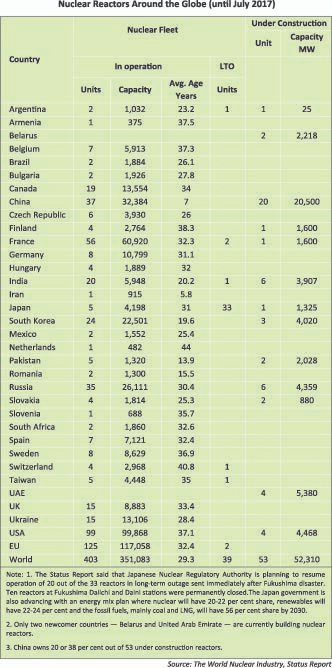
A 56-year journey with a desire to have nuclear power plant in Bangladesh has come close to an end with apparent fulfillment of the preconditions, including obtaining license from the regulators concerned. The country is set to mark its first pouring of the structural concrete (FCP) on November 30, 2017 to start construction of its first nuclear unit of the two-unit power plant being installed at Rooppur, Pabna. With the FCP, the country is going to join the world nuclear clubas 32nd nation for electricity generation using Russia-built VVER-1200 reactors.Bangladesh would also become the third member in the SAARC and sixth in the Asia’s elite club.
Each of the other five Asian countries, however, have the capacities oftwo to all of uranium mining, uranium ore’s conversion into oxide, uraniumenrichment, fuel fabrication, reprocessing of spent nuclear fuel and waste management facilities, according to the World Nuclear Association.The five Asian countries have developed its own manpower for operation and maintenance of approximately 130 nuclear power plants and developed linkage industries to supply spares and many other components of nuclear reactors.
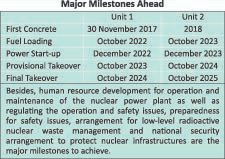
However, Bangladesh is joiningthe club without having these preparations or even ambition to develop most of the facilities as of now. It has only adopted a program to develop its manpower for operation and maintenance of the nuclear power plant.The government expects to develop its own capacity to operate and maintain the power plant in three to four years after its commissioning, scheduled for 2022 for first unit and 2023 for the second unit of the 2,400MW plant.
Bangladesh Atomic Energy Commission(BAEC) has been implementing the country’s first nuclear power project, following Milestone Approach and the Guidelines recommended by the International Atomic Energy Agency(IAEA), a global body to facilitate development of nuclear technology-based industries for peaceful use.
The BAEC made the progress and set the schedule for FCP in six years after it had signed an intergovernmental cooperation agreement with Russia on November 2, 2011 for building the nuclear power plant with supplier’s credit arrangement. Meanwhile, IAEA Integrated Nuclear Infrastructure Review(INIR) mission visited Bangladesh twice. The mission, followed by a five-day visit from May 10 to 14 of 2016, expressed its satisfaction over the progress made by the country in line with the IAEA guidelines. In its report, the INIR mission said that Bangladesh had implemented most of the recommendations and suggestions made in 2011 to set up the nuclear infrastructure.The IAEA expert team, however, suggested finalizing a plan for human resource development at national and institutional levels, and a national communication strategy for involvement of stakeholders and for public information.
Though, it is recommended by the IAEA to build a national consensus before developing large-scale nuclear infrastructures, the government apparently took a strategy to build the consensus on the way of construction of the nuclear power plant. A good number of officials and policymakers believe that the strategy worked well and helped them advance the project with minimum criticism.
The government also showed reluctance in developing an information dissemination system for the nuclear infrastructures in the country. A website, http://www.rooppurnpp.gov.bd/, is now under development process, which might play an effective role in disseminating information about the project.
There are a few other initiatives, including setting up of the Nuclear Industry Information Center at Bangabandhu Sheikh Mujibur Rahman Novo Theatre, are yet to become effective in information dissemination which could help develop national consensus.
Meanwhile, Bangladesh Nationalist Party (BNP), one of the country’s major political parties, in its Vision-2030, said that it would promote ensuring safe use of nuclear power. It, however, stated that ‘The issue of Rooppur Nuclear Power Plant will be re-examined’. The BNP made its vision public on May 10, 2017. Besides, a section of left democratic parties took a stand against the project due to the project’s huge capital-intensive nature and risk factors.
Significance of FCP
The FCP is an interfacing milestone that marks the formal start of construction of a nuclear unit. It means, the project implementation authority has successfully completed preparation for beginning of the main construction.The FCP requires a prior approval for design and construction of a nuclear unit from the country’s regulatory authorities. A government celebrates the occasion of FCP after a project obtains the design and construction license by the regulators.
In an ideal case, the implementation authorities can start construction of a nuclear unit immediately after the FCP. The project director and managing director of Nuclear Power Plan Company Bangladesh Limited,Md Shawkat Akbar, said that it was a legal instrument which is mandatory to mark FCP and begin the construction of the first nuclear unit.
In Bangladesh, the BAEC and its contractors will have to obtain further approval from the Bangladesh Atomic Energy Regulatory Authority (BAERA) as the authorities concerned divided the design and construction license into two parts --one was FCP and the other was building structuresof the first nuclear unit. On November 4, the BAERA issued conditional design and construction license allowing BAEC to mark the FCP only. The implementation authorities are now legally entitled to issue work orders and take all preparations for beginning the construction of the nuclear structure.
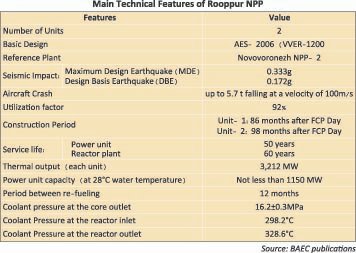
BAERA chairman Naiyyum Choudhury is hopeful about issuing the final approvals to begin the construction by March 2018 if the BAEC and its Russian contractors fulfil the conditions. Officials of BAERA and BAEC said that durability or stability of the alluvial soil of Rooppur was a major concern as the soil needed to be improved in such a way that it could contain a VVER-1200 nuclear reactor for at least hundred years.The BAEC and its contractors used a German technology named Deep Soil Mixing for soil stabilization. The technology has already earned its reputation around the globeand the government expects the improved soil using the technology would safely contain the reactors.
Other issues the BAERA will examine include addressing liquefaction problem of the soil, engineering solution to embankment of the river Padma to protect the integrity of the nuclear infrastructures there and plan for emergency response and physical protection of the plant, said officials.The FCP for the second reactor is also scheduled for 2018.
Breaking the Stalemate
Between 2007 and 2009, a drastic change was brought into its efforts by the BAEC to build the nuclear power plant with a view that building such infrastructure could only be possible through a government-to-government deal with a supplier country having the technological and funding capacities as well as political commitments to the host country. The earlier efforts were mainly aimed at awarding such contract through tendering process, yielding no positive results.
At least two other events took place simultaneouslyat home and abroad that helped Bangladesh to advance the program at this level. In 2007, Russia enacted a fresh law and created ROSATOM to organize its nuclear establishments and to facilitate building nuclear infrastructures in the other countries on commercial basis. Soon Russia came up with a ‘One Stop Solution’ for building the nuclear infrastructures. Russia advanced mainly with the G-to-G approach with its previous(during the Soviet Era) ties.
In 2008, the Awami League, in its election manifesto, pledged to advance the nuclear power program. In 2009, the party took office through a general election and initiated collaboration with Russia recalling its contribution toBangladesh’s War of Independence and post-war reconstruction projects.At the same time, the government enhanced its collaboration with the IAEA to obtain its technical and knowledge-based supports in constructing and regulating nuclear infrastructures in the country.
Another trend was observed for the first time in Bangladesh’s development history since it had moved towards electoral-based democratic system in 1991. The elected governments until 2009 used to prefer development projects with an implementation period of less than their 5-year tenure. But the Awami League-led government, after assuming office on 9 January 2009, started taking development projects including construction of Padma Multi-Purpose Bridge, imported coal-fired power plants, metro rail project and the Rooppur nuclear power plant with 10-15 years of implementation period.
Learning-by-Doing with $13.21b Project
It sounds absurd that exercising the idea of Learning-by-Doing in case of developing large-scale nuclear infrastructures. TheBangladesh government, however, took a $13.21 billion risk by conceiving the 2,400MW nuclear power project with a tight schedule for a beginner country. It started with its only firm determination and ‘blind reliance’ on the government of the Russian Federation that it would not supply capital machinery and services of poor quality in building the country’s first nuclear power plant. Perhaps another factor that earned confidence to the Bangladesh government believing that Russia would provide its best in building the Rooppur nuclear power plant for the sake of its reputation and future plan to expand and dominate the nuclear industry.
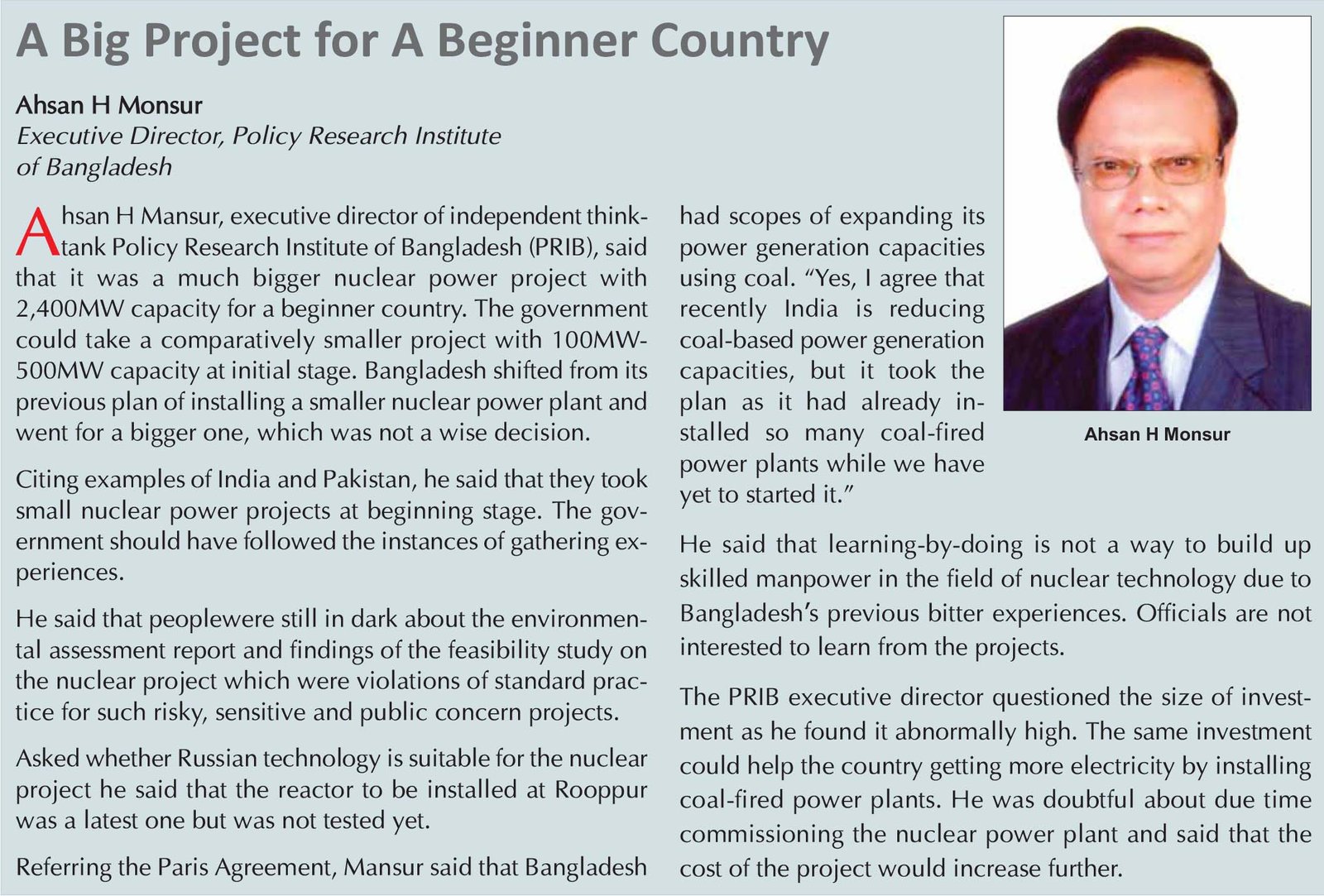
The BAEC signed the general contract with ROSATOM, the Russia’s highest nuclear energy authority, without having any expertise in negotiations. The incident sparked criticism at home on allegation that Russiacharged a high price for designing, manufacturing and installation of the plant. In response, the policymakers and the officials of BAEC said that each of such contracts is unique for different scope of works.The contracts with Russian agencies cover many areas, including human resource development, which other countries do by their own means.
The BAEC depends on its foreign consultants for examining every piece of work done by Russian contractors before disbursing their payments. The BAERA is also solely dependent on foreign consultants for examining documents submitted by the BAEC and the contractors for obtaining different licenses and approvals like the licenses for site, nuclear reactor’s design, construction, commission of the plant and its operation, etc from it.
The government’s firm determination in implementing the project without its own skilled manpower accompanied by its ‘hide-and-seek’ approach might have prompted the conscious citizens to believe that the ruling Awami League had been using the project for its political interest and as means of earning Russia’s support to remain in the power for long time.
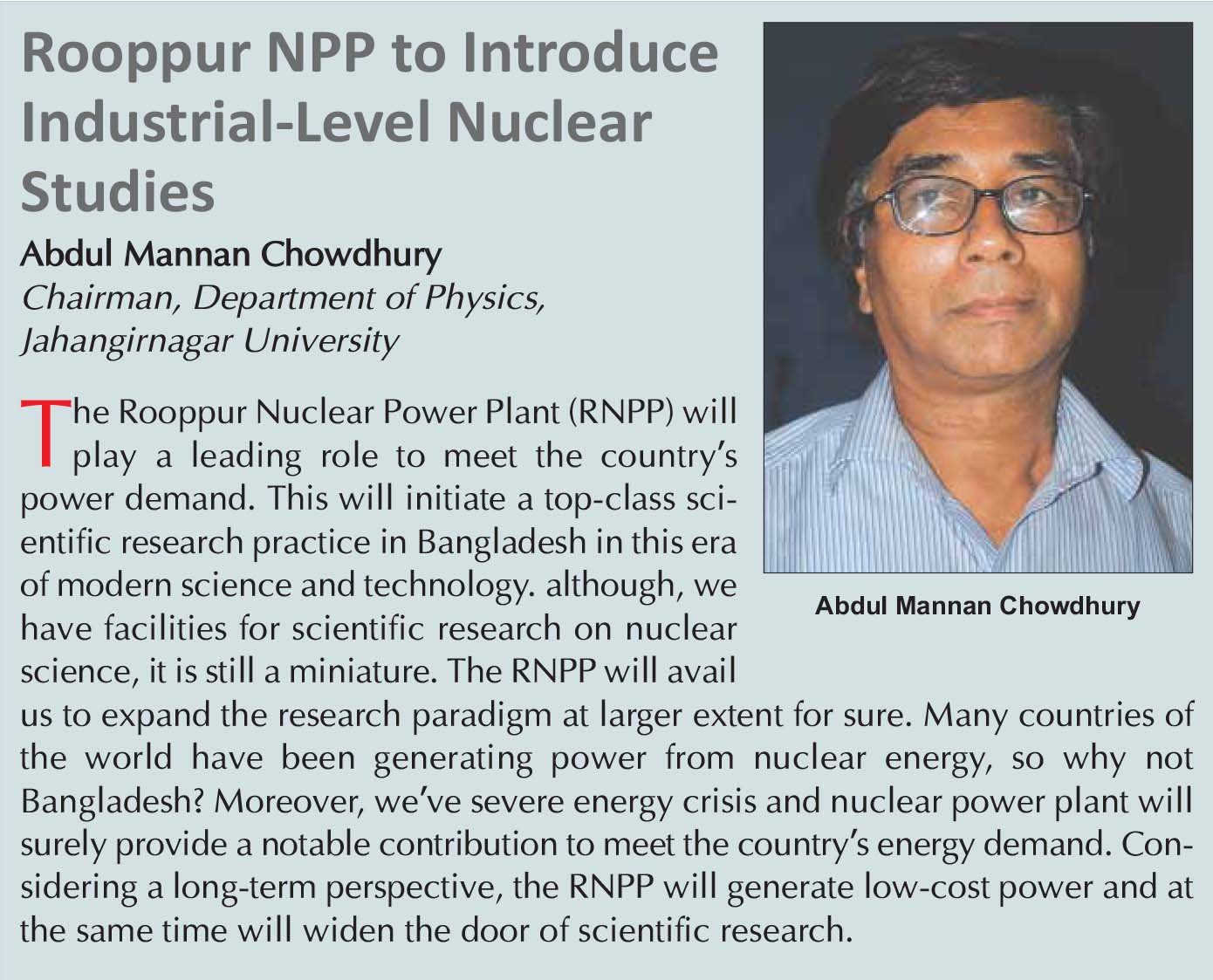
Policy movers from among the government and academics, however, love to explain the project as a single ‘great’ milestone for the nation which would help transform the society to a sophisticated one.It is a ‘dream project’ that would help building a knowledge-based developed society, said science minister Yeafesh Osman. It has potentials to introduce new quest for the citizens and that to shape the syllabus curriculum for the students, he said, adding that a nuclear program creates a new industry with quality job opportunities.
Meanwhile, the ministries of science and education have initiated a move to introduce nuclear technology and safety issues related to nuclear infrastructures in the text books at secondary and higher secondary levels. In Bangladesh, the technology has been used in diagnosis and medical treatments as well as in agricultural research for the past several decades. But large-scale use of nuclear technology like electricity generation demands mass-level consciousness about safety measures against nuclear radiation.
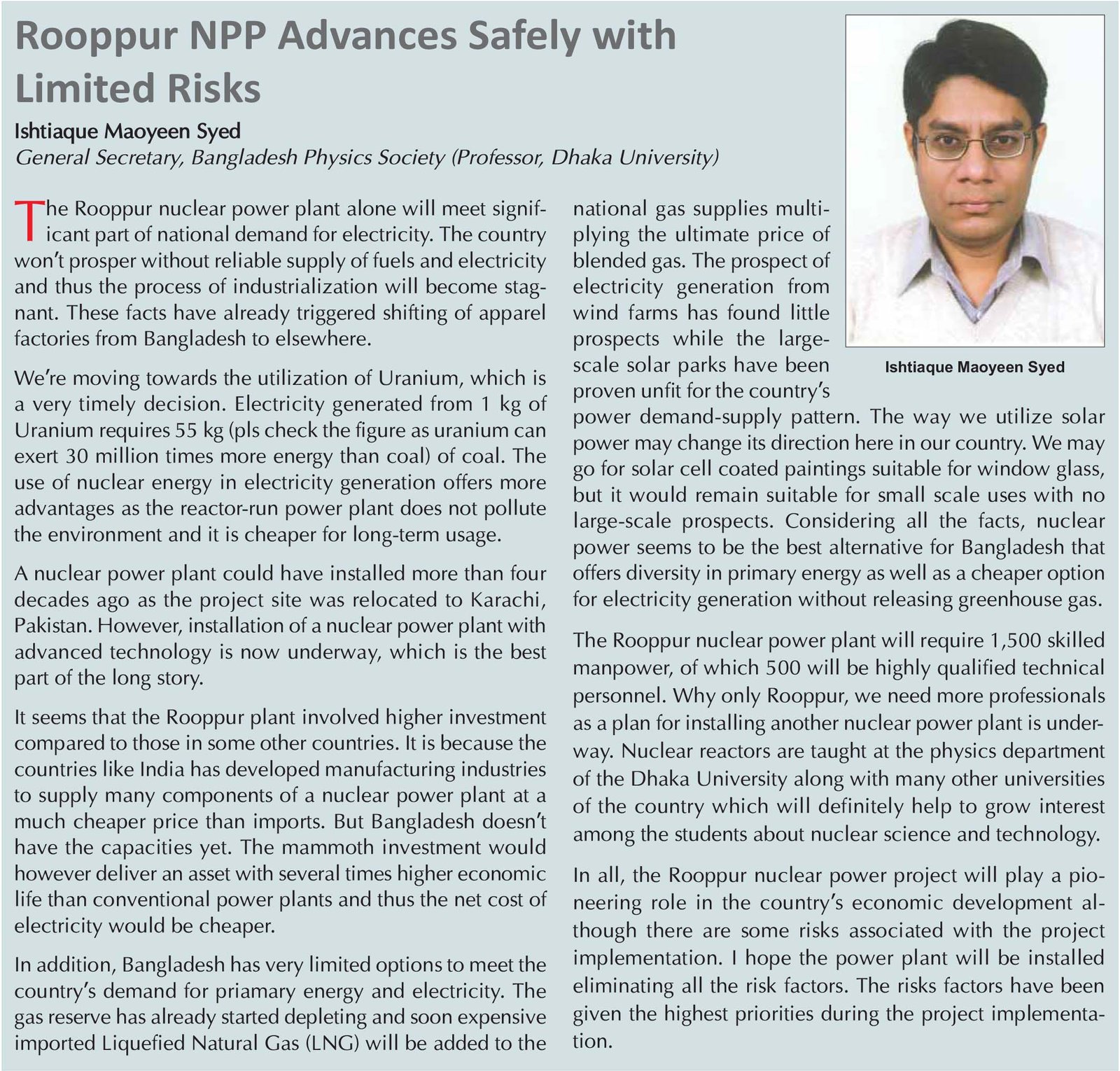
No doubt it is a belated move to introduce the nuclear technology in the country’s general education system as the world of the technology have made significant advancement since its inception more than a hundred years ago. Being liberated from the race of piling stocks of nuclear weapons after the second world war, many scientists and engineers paid attention to use immense energy hidden in the nucleus of an atom and use radioactive behavior of an unstable nucleus (usually a radioactive element like uranium, plutonium,etc.)in electricity generation, diagnosis of diseases and medical treatments and many more industrial production systems.
It is very unfortunate that the common people of Bangladesh have been away from knowing the advancement in nuclear technology. The common perception about nuclear technology in Bangladesh is mainly dominated by the destructive capacity of nuclear weapons, particularly experienced in Japan towards the end of the World War II, and nuclear explosion at a power plant in Chernobyl in 1986. The Fukushima nuclear disaster at a Japanese power station in 2011 was the last accident that solidified people’s fear about nuclear technology.
Safety Culture and Ground Reality
If everything goes on schedule, Bangladesh is set obtain its first nuclear power plant in the next six years and the nation has those years to develop a safety culture at micro-level to cope with such nuclear infrastructures. Many expressed doubts over the possibilities of developing a safety culture at the project’s implementation pace as the country is yet to educate its citizens about traffic rules and safety issues on roads.Despite having a very poor probability of leaking radiations in the atmosphere, the IAEA and worldwide practices assigned high priority to the preparedness for radiation safety and to develop a safety culture before nuclear facilities go into operation. The government has only taken awareness building programs on radiation safety in a smaller area around Rooppur nuclear power project site.
Bangladesh, however, has almost a clean track record of operating and maintaining foreign technology-based infrastructures like underground mines (a coal mine and a hard rock mine), the power plants run on fuel oils, gas, coal and hydro and so on. This might have been one of the indicators to have hopes that Bangladesh would be able to manage installation of safe infrastructures for its first nuclear power plant with Russia’s assistance and that to operate and maintain the facilities by its own manpower.
Financing
It has become a big question whether a country like Bangladesh could afford a $13.21 billion project under 90 percent Russian supplier’s credit with 1.75 percent interest on top of LIBOR (London Interbank Offered Rate). As per an estimate by the Economic Relations Division under the finance ministry, Bangladesh would have to pay up to $8 billion in interest against the Russian credit of $11.385 billion for main construction of the power plant. The government has also started repayment of the $500 million Russian credit invested in the preparatory works to facilitate the main construction of the power plant.It signed a $500 million credit agreement on 13 January 2013 and the $11.385 billion credit agreement on 26 July 2016.
The Bangladesh government will repay the $11.385 billion Russian credit with interest in 40 equal installments beginning from March 2027, as it gets 30 years with a 10-year grace period for the repayment.The half-yearly installment would be around US$ 500 million and would stand at around $1.0 billion annually. The country’s own investment in the power project alone would be $1.32 billion over the project’s implementation period in two phases — preparatory phase until 2017 and the construction phase until 2025 — as the construction phase included provisional operation period of the two-unit power plant until final takeover scheduled for 2025.
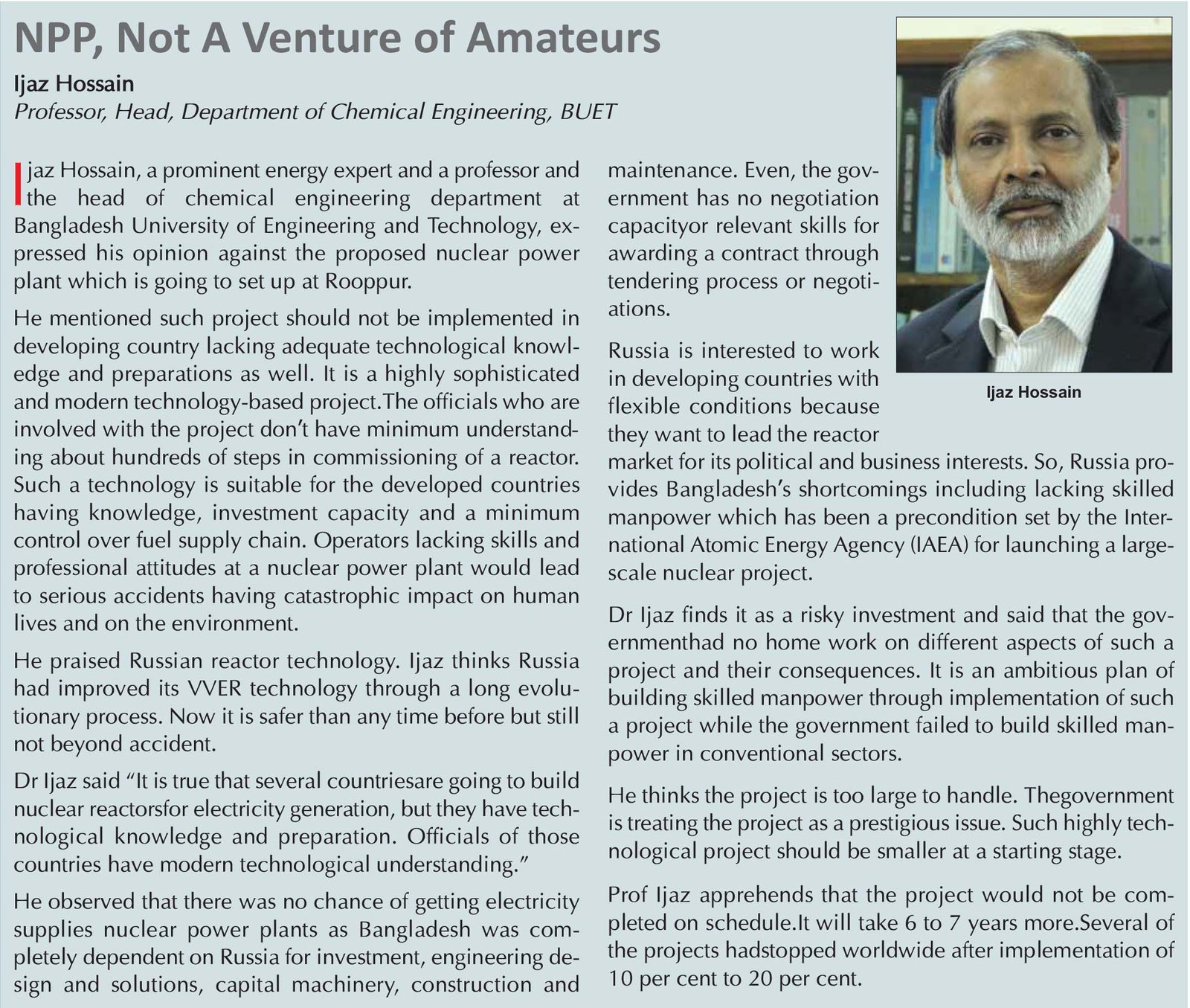
Local experts fear that the cost of Rooppur nuclear power project would be much higher than the estimates as they believe that the project implementation would be delayed significantly. Not a single beginner nation completed its nuclear power project on schedule, said Prof. M Tamim at the Petroleum Engineering Department of BUET. A country like Bangladesh with limited resources and scarce of funding should have been more selective in planning of its future spending. He feared that the project might be a burden on the nation and said that it was very risky venture for the country.
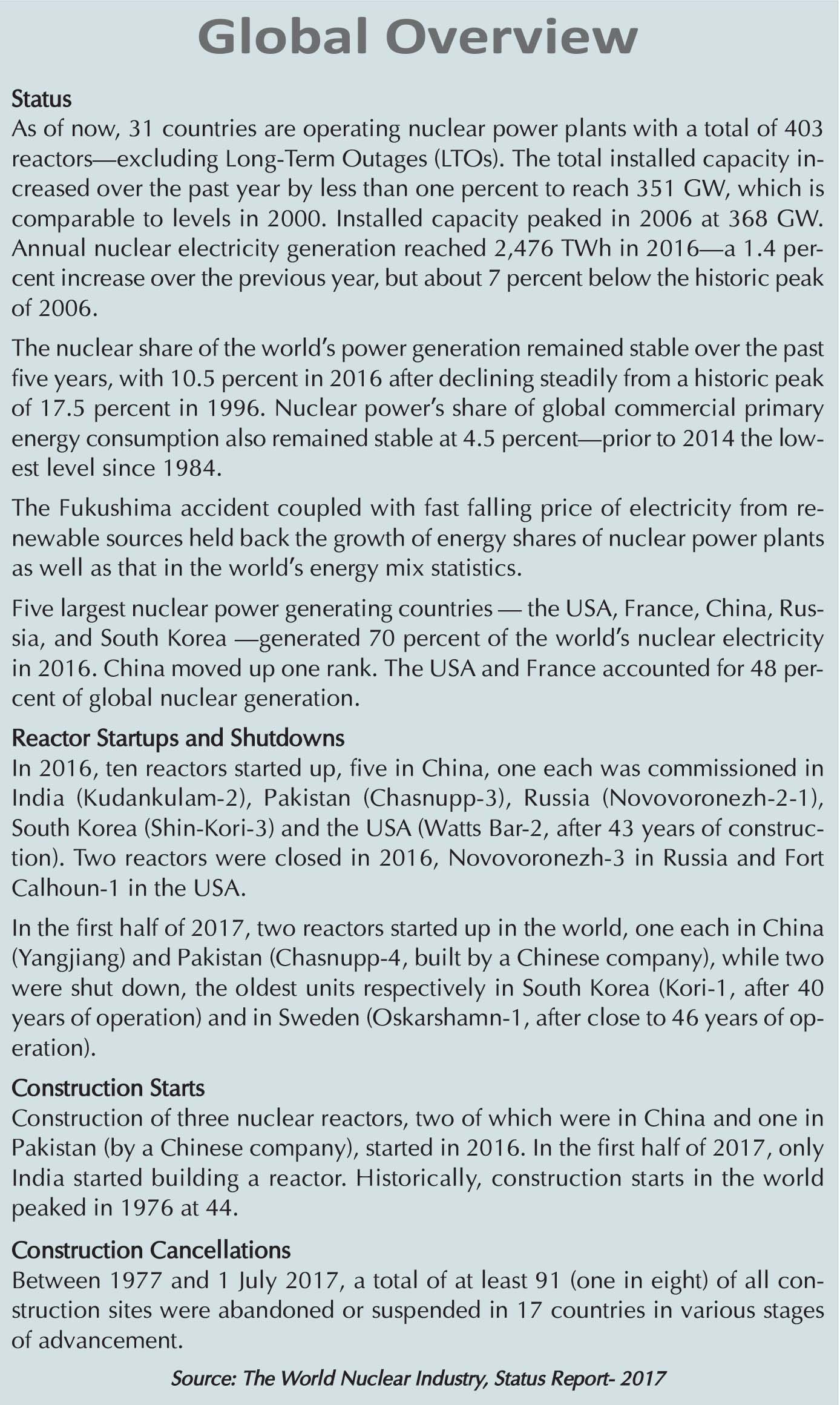
The local experts’ concerns were echoed in the world nuclear industry’s status report published in September this year. At least 37 out of 53 under construction nuclear reactors are behind the schedule. Advanced nations with the nuclear technology like Russia, USA, China and Japan are implementing those projects among others.
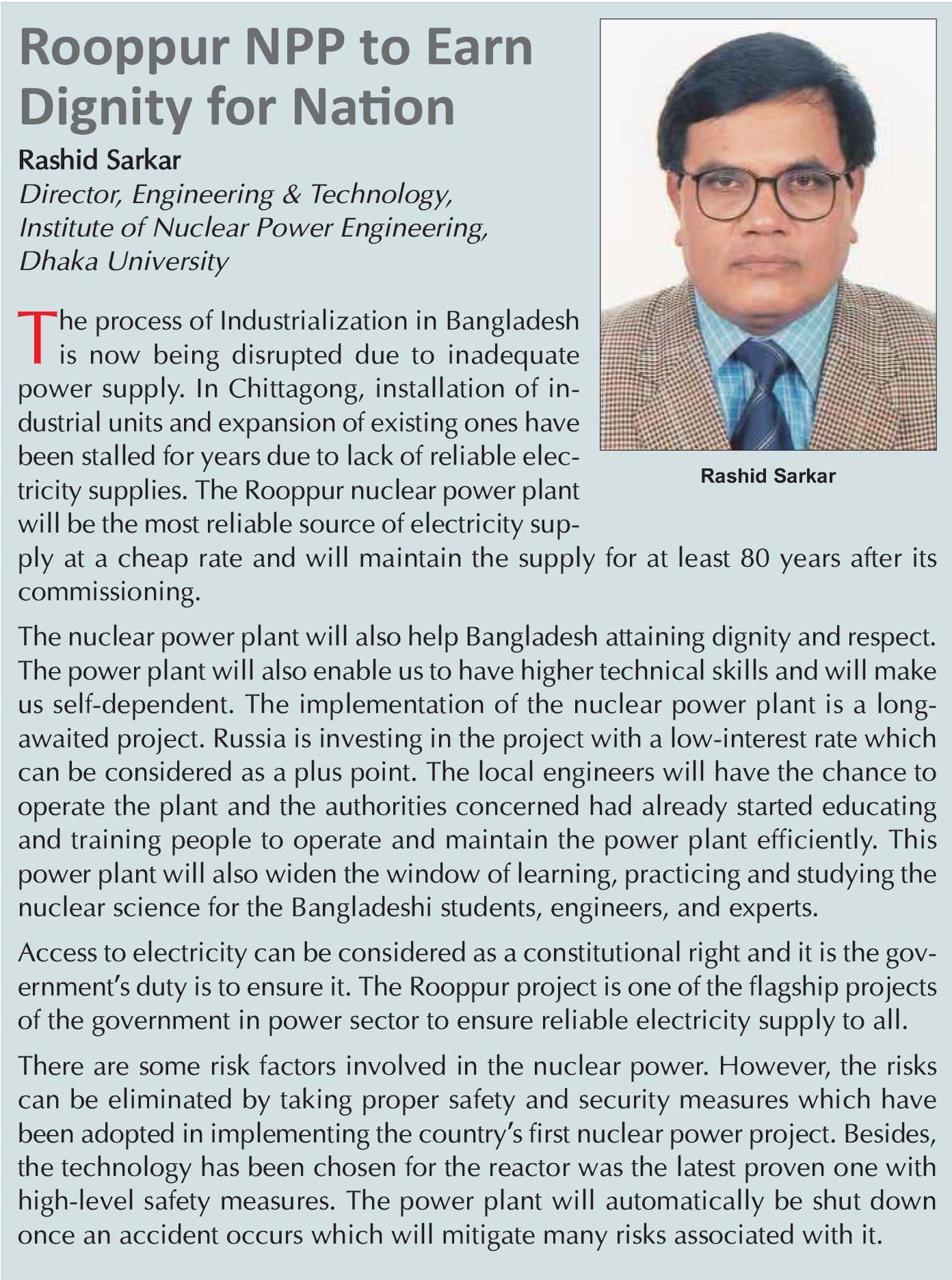
Prof. Tamim, who was also the special assistant to chief adviser of the former interim government, also expressed his concerns as the pressure of repayment might leave the future governments no options but to slash budget allocation for more fundamental projects in areas like health, education and disaster management.Like him, other experts opined that Bangladesh should have assigned more priorities to the other conventional ways for electricity generation. They argued that the project had already triggered some major infrastructure projects to facilitate safe and smooth construction, and operation and maintenance of the power plant.
Finally, the experts warned that the price of electricity from the Rooppur nuclear power plant will be beyond the affordability of the power consumers. The officials related to the project, however, asserted on several occasions that the electricity price will be much less than coal-fired ones. Besides, the government finds no problem in repayment of the credit as the country’s economy and the government’s financial capability would grow significantly in the next 10 years before the repayment of $11.385 billion is matured.
Preparing Infrastructure for NPP
The government has so far launched two major infrastructure projects, involving approximately $1.8 billion or more than Tk 14,000 crore, related to river communication and power grid upgradation. Further investments will be required for building awareness and preparedness on nuclear safety, human resource development for long-term activities, preparation for low-level radioactive nuclear waste management and national security enhancement to protect nuclear infrastructures from thefts, attacks and sabotages.
The additional investments would be required to facilitate construction and safe operation of the nuclear power plant at the cost of $13.21 billion. Although Russia will train and educate 1,950 individuals under an Intergovernmental General Agreement, Bangladesh would require a regular flow of own manpower for operation and maintenance of nuclear infrastructures, regulatory functions and carrying out negotiations with the capital machinery and technology suppliers and relevant service providers for new projects.
On August 1, the Executive Committee of the National Economic Council approved a dredging project to improve the navigability of river route from Mongla to Pakshi via Chandpur-Mawa-Goalanda to facilitate transportation of heavy machinery to Rooppur site.The Bangladesh Inland Water Transport Authority is implementing the dredging project at a cost of Tk 956 crore on government funding, according to the project proposal.The project will be implemented in 290 kilometers of the river route flowing through Munshiganj, Manikganj, Rajbari, Faridpur, Madaripur, Dhaka, Barisal, Pirojpur, Kushtia and Pabna.The project is set to be implemented by 2025, according to the project proposal, which put BAEC in uncertainty as they need the river route ready before 2019 for transportation of the reactor with more than 600 tonnes weight.
Meanwhile, the Power Grid Company of Bangladesh prepared a project proposal for upgrading power grid system to facilitate synchronization of the grid with the nuclear power plant, said the company’s managing director Masum-Al-Beruni.The project would require more than $1.6 billion investments, he said, adding that the funding would be sourced from India’s third line of credit. The project is expected to be completed by June 2021, he said.
The government is preparing project outlines to enhance national security preparation necessary for ensuring security of the nuclear infrastructures like 2,400MW nuclear power plant. The government will also require building awareness and infrastructures to address the issues like nuclear radiation safety and low-level radioactive nuclear waste management.
All the preparations are needed to be taken before commissioning of the power plant as they are made mandatory in the IAEA guidelines. And these preparations need investments of several billion US dollars. The government considers the investments as much needed in every area for their individual role in the economy. Critics, however, say that the government’s nuclear power program is premature as the country’s economy and infrastructure were not ready for it. They warned that all the investments and infrastructures might become a burden in terms of safety, security and economy.
The nuclear power project has only expedited development projects which have long been necessary for the country’s overall progress to keep pace with the global advancement, said Yeafesh Osman. He explained that a dedicated river route connecting a seaport and the North Bengal with better navigability has been needed for long time for cheap and reliable transportation of goods. Likewise, a stable grid system is essential for quality power supply, he said, adding that modernization and upgradation of national security arrangement is a regular phenomenon. Therefore, it is not a rational argument that all the investments will be made only to facilitate construction and operation of one nuclear power plant.Besides, the country will expand its nuclear power generation capacities following the success of Rooppur nuclear power project.
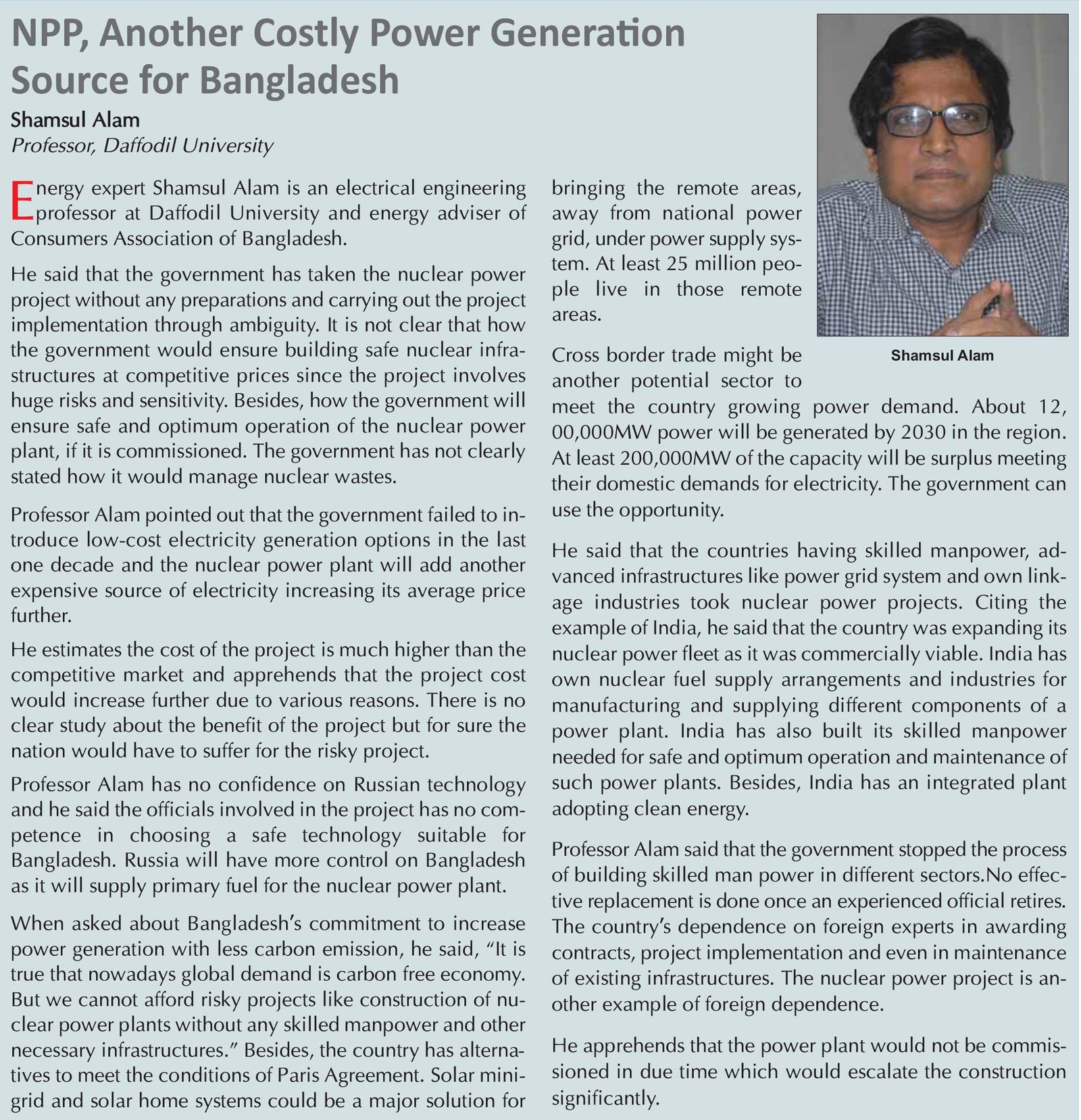
It is not clear whether the expensive infrastructures would benefit the country’s economy beyond the nuclear project, said Consumers Association of Bangladesh energy adviser M Shamsul Alam, also an electrical engineer. The government has so far implemented many projects including expansion of gas transmission capacity offering little utility.It is hard to believe that the government would be able to ensure optimum use of the expensive infrastructures. ‘I do not think that the infrastructure projects are taken after conducting any credible feasibility study estimating their utilities and requirement of real investment,’ he said.
Prof Tamim questioned the justification of conceiving nuclear power project in a country lacking both economic and infrastructure capabilities.He said that the country like Bangladesh should take projects considering priorities as it lacked funding capacity.
Pricing of Nuclear Power
The debate in financing capacity and long-term impact of heavy debt on the Bangladesh’s economy also included the potential rise in electricity price to be generated by the Rooppur nuclear power plant. Although the BAEC in 2015 estimated the price of nuclear power at Tk 3 per unit or kilowatt-hour as Levelized tariff, later it revised the price twice as its key officials said that the price would be Tk 5-Tk 5.30 per unit and then they hinted the price would stand at Tk 6 to Tk 7 per unit. They claimed that the nuclear power company would supply electricity at less than the price at which other companies would supply electricity from imported coal-and/or-LNG-fired power plants.The BAEC officials also said that the price of the $12.65 billion general agreement and operation and maintenance cost to be spent over the plant’s 51 years of economic life were considered in estimating the price.
Local experts like M Tamim, M Shamsul Alam and Ijaz Hossain said that the price of electricity would be much higher than the latest estimates as the BAEC did not consider the costs to be spent on sending high-level radioactive nuclear wastes to Russia and that on the decommissioning cost of the Rooppur nuclear power plant. The two issues might involve a spending of several billion US dollars, they said.
Criticisms about Pricing and Investment Cost
Hesitant stances of the government in determining the technology with escalation of construction cost drew severe criticism from conscious citizens. The government has so far shifted its position twice between 2007 and 2014 with significant rises in investment costs.In 2007, the BAEC prepared its proposal with an old version of VVER-1,000 reactor of Russia or equivalent technology developed by other supplier countries.The project cost was estimated at a range from $0.9 billion to $2 billion. In 2010, the BAEC responded positively to a Russian proposal to install the two-unit power plant with AES-92 or VVER-1,000 reactors. After Fukushima accident on 11 March 2011, issues of additional safety measures were surfaced. At that time, Bangladesh had three options of choosing reactor model with passive safety measures for physical protection of the nuclear reactor from natural disasters and attacks by terrorists or any foreign force. The options included VVER-1,000 reactors with the passive safety measures, VVER-1,200 reactors and VVER-TOI reactors with 1,300MW capacity each. Russia was reportedly pursuing for supplying its latest technology, the VVER-TOI, for Ruppur nuclear power plant. But the proposal was rejected citing the grounds that there was no reference plant that used VVER-TOI and the IAEA guidelines recommends that a beginner country should implement nuclear power project following the footsteps of a reference plant using the technology.
Finally, in 2014, Atomic Energy Power Corporation, AEP, of Russia announced that they will supply and install two units of VVER-1,200 or AES-2006 with a version of its V-392M reactors and its Novovoronezh unit-II in Russia would be the reference plant. On 25 December 2015, the BAEC and the Atomstroyexport signed $12.65 billion general contract for the construction of the two-unit Rooppur NPP with a total of 2,400MW power generation capacity. Under the contract, the Russian authorities will educate and train 1,950 individuals mainly for operation and maintenance of the power plant.
Signing Deals for Nuclear Disarmament and SendingNuclear Waste to Russia
Bangladesh signed the United Nations’ nuclear disarmament treaty outlawing nuclear weaponson 27 September 2017. The United Nations on 7 July 2017 adopted the Treaty on the Prohibition of nuclear weapons.Meanwhile, Bangladesh signed an agreement on 30 August 2017 to send spent nuclear fuel to Russia for its ultimate management. Apparently, the two agreements would earn the country confidence of the other countries that Bangladesh has no intention to enrich uranium through recycling the spent nuclear fuel to be produced from its power plant. Recycling of such spent fuel is one of the options some other countries use to develop nuclear weapons.But no doubt it is again an expensive way to earn the confidence. Having the facilities to recycle the spent nuclear fuel could help Bangladeshto develop fuel fabrication facilities for its power plants and that could save significant amount of money in foreign currency every year and could increase level of energy security of the country.
The contract to send high-level radioactive nuclear waste to Russia also earned confidence of local critics of the nuclear power project as they had been opposing the project arguing that management of nuclear wastes was risky for a country like Bangladesh. The critics have other points including shortcomings in economic and infrastructure capabilities in developing large-scale nuclear infrastructure like the Rooppur nuclear power plant.
Inadequate Institutional Support for Nuclear Technology
Although electricity acts as a vital input to industrial production system, its generation process is itself a large industry involving a wide range of activities that includes manufacturing of capital machinery and spares for power plants, their engineering designs and construction, fuel production and supply, and operation and maintenance of the plants. Each of the activities in the electricity generation industry offers scopes of adding value having significant impacts on a country’s economy. These capacities also enable a country to ensure its energy security at the highest level and to reduce the cost of electricity generation significantly.
Bangladesh, however, launched its nuclear program with a single focus on installation of the nuclear power plant, keeping asideeven building research and development facilities for manufacturing simple components of nuclear power plants, uranium mining, uranium ore’s conversion into oxide, uraniumenrichment, fuel fabrication, reprocessing of high-level radioactive spent fuel and waste management facilities. Different studies showed that Bangladesh has potentials for mining uranium used for nuclear reactors as fuel.
Since its inception in February 1973, the BAEC has so far developed some nuclear research facilities including Atomic Energy Research Establishment, Institute of Nuclear Science and Technology, Institute of Food and Radiation Biology, Centre for Research Reactor, Tissue Banking and Biomaterial Research Unit, Institute of Radiation and Polymer Technology, Nuclear Mineral Unit and Energy Institute. But the facilities are hardly capable of facilitating skilled manpower development for operation and maintenance of nuclear power plant as well as that for management and disposal of low-level radioactive wastes to be produced from the plant.
Experience with Research Reactor at Savar
The TRIGA Mark-II research reactor of BAECis the only nuclear reactor in the country. It has a maximum steady-state thermal power of 3 MW. The reactor achieved its first criticality or was commissioned on 14 September 1986. The reactor has so far been used in various fields of research and utilization such as, Neutron Activation Analysis(NAA), Neutron Radiography (NR), Neutron Scattering (NS), experimental reactor safety research, production of radioisotopes, training of manpower (local and foreign), education etc. Center for Research Reactor(CRR) of BAEC is responsible for the operation and maintenance of the reactor. CRR have the responsibilities for its associated equipment and systems ensuring appropriate level of safety as delineated in the Safety Analysis Report (SAR) of BAEC TRIGA Research Reactor(BTRR). CRR is also responsible for the preparation of various Safeguards and Additional Protocol related reports on routine basis. These reports are sent to the IAEA through Nuclear Safety, Security and Safeguards Division(NSSSD) and International Affairs Division (IAD) of BAEC.
· By successful operation of the reactor for more than thirty years in different power, CRR provide neutron beam to the different division of INST for various research and development activities as well as for students of different universities and trainee of BAEC to perform nuclear reactor safety related experiment.
· Manpower development in the field of nuclear science and technology especially for nuclear power project in Bangladesh.
· Until 2016, using the reactor facility 80 studentscompleted their Masters/MPhil/PhDthesis, 745 studentsfrom different universities have completed their industrial attachment program and Three foreign trainee received reactor operation training from CRR.
· Recently around 300 students per year from different universities complete their practical training program from CRR.
· Regular training of reactor operational personnel for successful operation of the reactor
· CRR scientists/engineers have been published more than 70 research paper about the reactor safety as well as on other related fields.
· Preparation of various operational and safety documents as required by the Nuclear Safety and Radiation Control Rule (Rule-97).
· Repair of RBP-1 using local technology and expertise saved significant amount of currency.
· Consistent operation and maintenance with safety enabled entering in the Integrated Safeguards(IS) of IAEA in January 2007.
· Modernization of reactor control system by installing digital control console system.
· The experience of reactor operation, maintenance and management are contributing directly and indirectly to the nuclear power program in Bangladesh.
Human Resource Development
Building own capability to operate and maintain nuclear power plant could be the lone component to add value to the electricity generation process. The IAEA also recommends having own manpower for operation and maintenance of a nuclear power plant and performing safety regulatory responsibilities to ensure optimal operation and safety and security of the installations. In 2011, Bangladesh took fresh programs to build its manpower for the two fields only.
The government’s human resource development program is broadly divided into two parts — training and educating 1,950 individuals for operation and maintenance of Rooppur nuclear power plant while the other part covers initiatives of institutions like public and private universities for building human resources in the field.
The authorities concerned including the BAEC, however, performed frustratingly the worst in advancing the human resource development program. The BAEC has been delayed by almost a year in sending its future operators of the nuclear power plant to Russia for training and education. Officials of the BAEC and the science and technology ministry claimed that the delay would not affect the program as they would have six years before schedules for commissioning of the reactors.
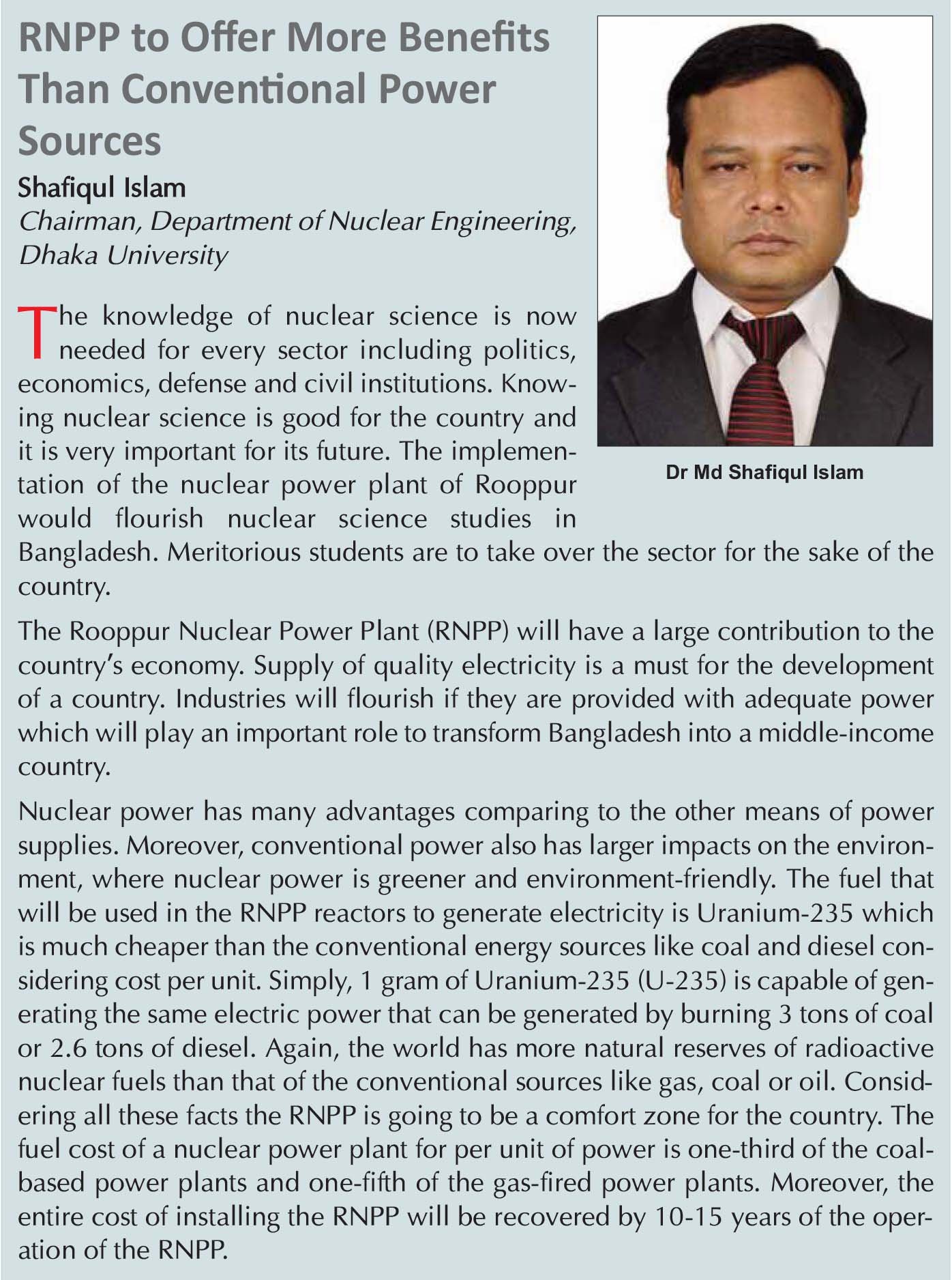
In the other part, only the University of Dhaka opened nuclear engineering department four years ago under its Engineering Dean with 25 seats each at the undergraduate level and post-graduate level. The new department has been limping since its inception with inadequate teachers and almost no laboratory facilities. An associate professor, an assistant professor and four lecturers with a supernumerary professor and a few guest lecturers from the BAEC and other DU departments are conducting the course curriculum. Only masters students get opportunity to have access to the research reactor at Savar. Among the other universities, Military Institute of Science and Technology opened nuclear engineering department three years ago with limited resources. Bangladesh University of Engineering and Technology is yet to launch its nuclear engineering department although it had announced it more than two years ago.
India’s Involvement in Bangladesh’s Nuclear Program
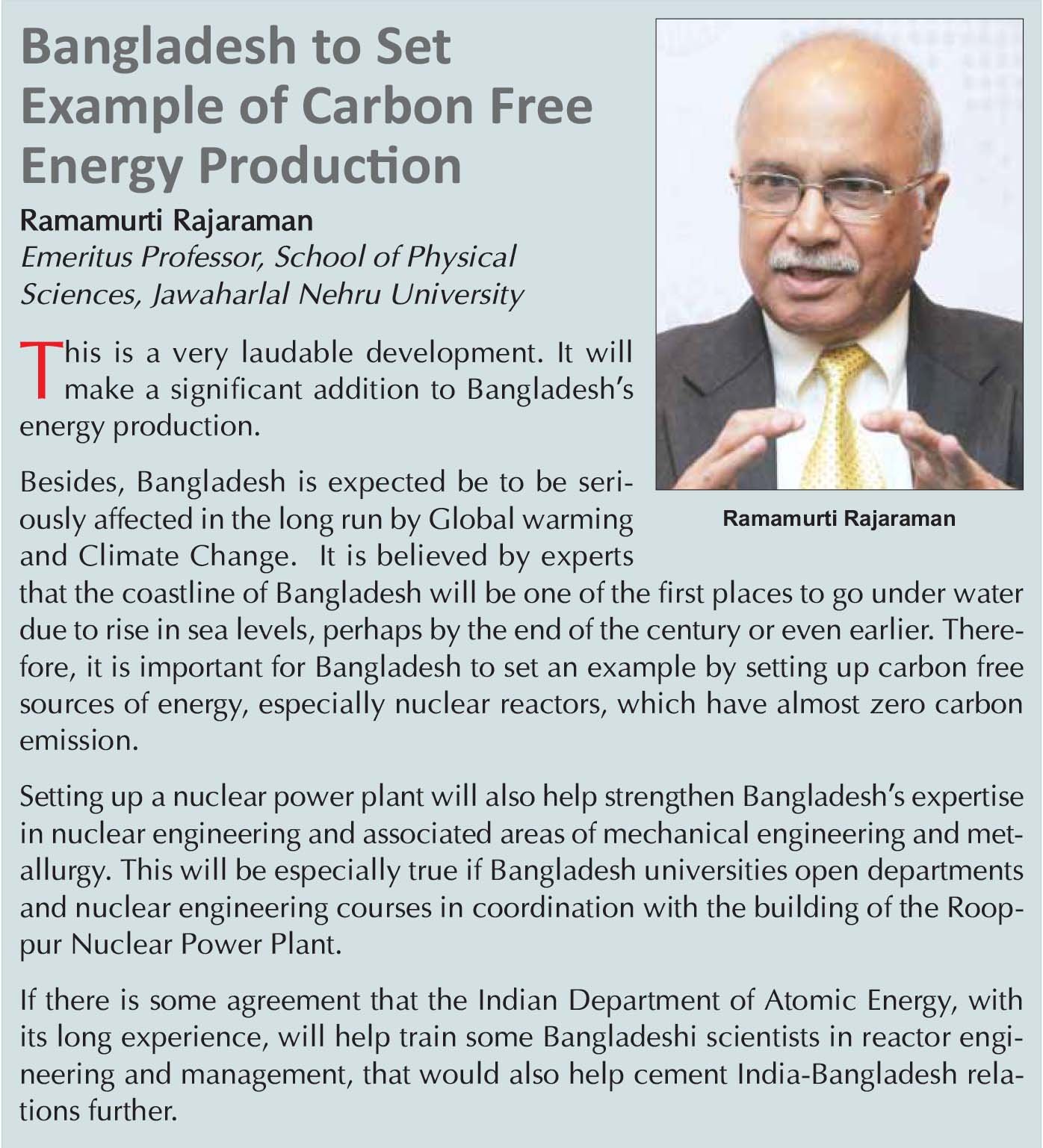
On 8 April 2017, during a visit of Bangladesh Prime Minister Sheikh Hasina to India, the two countries signed three separate deals on cooperation in field of peaceful use of nuclear technology in Bangladesh.The deals are signed —on ‘Cooperation in Peaceful uses of Nuclear Energy’ between the governments of Bangladesh and India, ‘Exchange of Technical Information and Cooperation in the Regulation of Nuclear Safety and Radiation Protection’ between BAERA and Atomic Energy Regulatory Board (AERB) of India and ‘Cooperation regarding Nuclear Power Plant Projects in Bangladesh’ between BAECand Global Centre for Nuclear Energy Partnership (GCNEP), India. National grid stabilization and power evacuation facilities of the nuclear plant will be developed under India’s third Line of Credit (LoC) deal.
Under some defense deals, Bangladesh also engaged India to upgrade national security system to protect nuclear infrastructures.It is not clear that how India would help Bangladesh to develop its security system in protecting nuclear infrastructures as a neighboring country is considered as one of the major threats for a country’s sovereignty as well as for such strategic installations. It is also pertinent to mention that countries with similar nuclear infrastructures have bilateral defense deals that none of the two countries would attack nuclear installations even if they engage themselves in a war against each other. But people of Bangladesh kept in dark about deals signed with India in this regard.
Recently, India’s Atomic Energy Commission’s chairman Shekhar Basu, however, hinted further involvements of India in construction as well as in operation and maintenance of the Rooppur nuclear power plant. On 20 September this year, he told the IAEA’s 61st general conference that India was collaborating with Russia to build the Rooppur nuclear power plant in Bangladesh, the first initiative under an Indo-Russia deal to undertake atomic energy projects in third countries, according to a report of India’s state news agency PTI.Many Bangladeshi media carried the news on September 21, 2017.
Basu's remarks were significant given that the Indian nuclear establishment for years has not been able to grow, internationally, due to sanctions imposed on New Delhi post the 1974 Pokhran(nuclear weapon)tests. It was, however, not clear what kind of ‘collaboration’ India was doing since it is not a member of the Nuclear Suppliers Group (NSG) – a48-member grouping that controls the export of materials, equipment and technology that can be used to manufacture nukes, according to the news report.
According to the December 2014 'Strategic Vision for Strengthening Cooperation in Peaceful Uses of Atomic Energy' between India and Russia, the ‘two sides will explore opportunities for sourcing materials, equipment and services from Indian industry for the construction of the Russia-designed nuclear power plants in third countries,’ according to the PTI news. India signed a civil nuclear cooperation deal, along with two more agreements, with Bangladesh in April under which the two sides can supply and manufacture equipment, material for the atomic power plant, the news added.
Bangladeshi people are remained in dark about the extent of India’s involvement in the country’s nuclear power program. Many experts expressed concerns about the hide-and-seek approach of the government in this regardand questioned the quality of equipment and services of India as the country was yet to develop its relevant industries at the world’s standards while India’s credits were tagged with some mandatory provisions of purchasing/using its equipment and services.
Significance of Rooppur NPP and Future in Bangladesh
In the developed countries, their education system, power grid system or national security arrangements have been beefed up with their economic growth as well as improvements in living standards which made it easy to develop and cope with the large-scale nuclear infrastructures like power plants.Now questions arose that whether a country like Bangladesh should have adopted the nuclear program after the development of the sectors. The government bypassed the process and adopted a short-cut method for the sectors’ development. First, it set an ambitious target of building the nuclear infrastructures with a tight schedule and then it started developing the sectors necessary to cope with the power plant. The critics compared it as an act of ‘putting the cart before the horse’.They find it as a huge risky venture for Bangladesh which could severely affect the current economic growth. The government, however, took a firm stand about the project that had made the progress to current stage of marking the FCP for the first reactor.
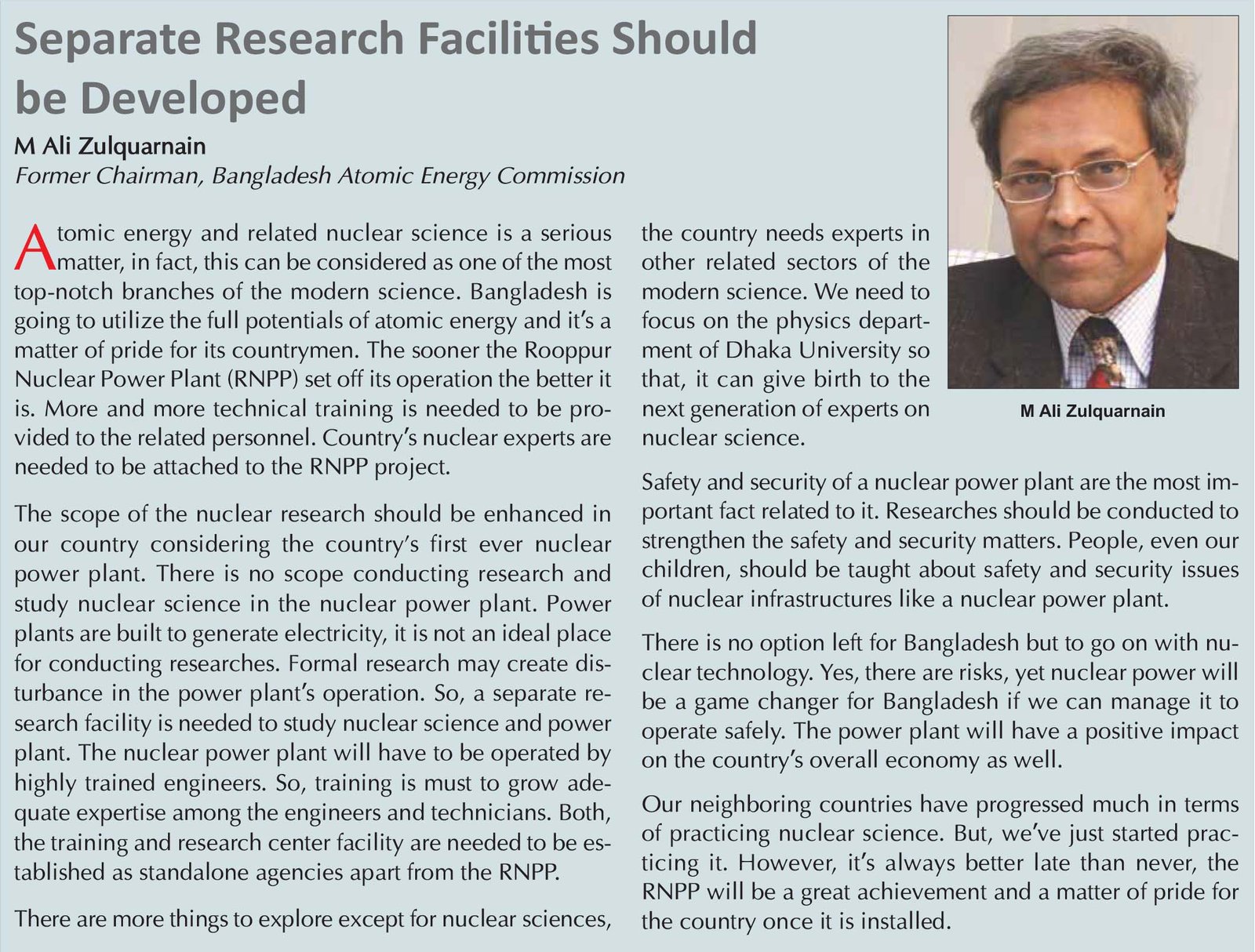
The government expectsRooppur nuclear power plant’s due time commissioning and commencement of its safe and optimum operation would open a new window for the energy-hungry Bangladesh. It will help bringing fuel diversity in power generation as well as will supply electricity without carbon emission. Although the Power System Master Plan(PSMP)- 2016 recommended for a total of six units of nuclear reactors to be installed by 2041 to have approximately 12 per cent of the total power generation capacity, the success might encourage the government to think of doubling the capacity to generate electricity. As the science and technology minister Yeafesh Osman said, nuclear power plants can ensure the most reliable and steady supply of clean electricity round the year. A success story with Rooppur NPP would encourage the future generation to take more ventureswith advanced technologies, he added.
Beside all these issues, the 100-year assets will play the most vital role in formulation and implementation of future energy sector reforms as the other fuel-based power plants have economic life of around 20 years.
The prospects of the use of nuclear technology in electricity generation would however be determined by how fast the country develops its human resourcesfor the industry. But above all, a nuclear program requires integrating the entire nation which the government is needed to ensure as soon as possible.
Manjurul Ahsan Shuvro;
Dhaka-Based Reporter With Focus In Energy Sector