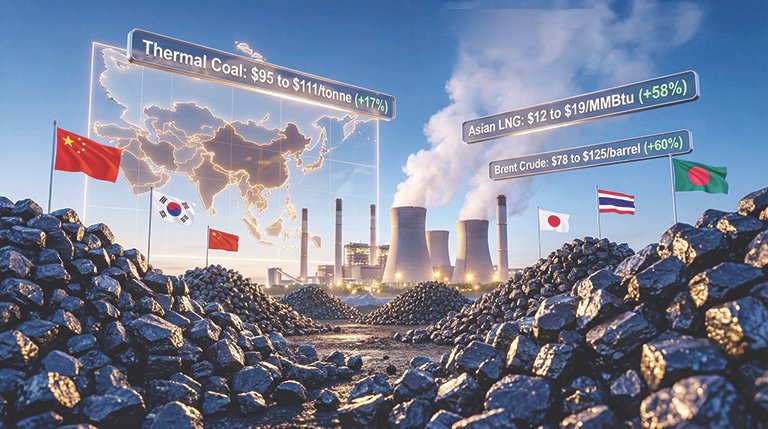
The ongoing Iran conflict is prompting many Asian countries to rethink their energy strategies, with governments placing greater emphasis on energy security through diversified fuel supplies—even if it means extending the use of fossil fuels and slowing climate action.
According to an Associated Press (AP) report, the sharp rise in oil and gas prices, and supply disruptions caused by the conflict have accelerated policy shifts across East and Southeast Asia.
While countries continue to expand renewable energy and explore nuclear power, many are also increasing investments in coal-fired generation to ensure reliable electricity supplies during periods of geopolitical uncertainty.
Energy analysts say the latest crisis has reinforced a familiar reality: energy security often takes precedence over climate commitments during periods of global instability.
“At the end of the day, energy security triumphs any other climate considerations,” said Sandeep Pai, a researcher at Duke University’s Nicholas Institute for Energy, Environment and Sustainability.
Coal Regains Strategic Importance
The closure of the Strait of Hormuz during the conflict disrupted oil and liquefied natural gas (LNG) supplies to Asia, prompting countries including Japan, South Korea, Thailand, Vietnam and the Philippines to rely more heavily on coal to maintain electricity generation.
Analysts believe what began as an emergency response is now influencing longer-term energy policy, giving coal a renewed role in regional energy security.
The International Energy Agency (IEA) projects global coal investment will reach US$180 billion in 2026, the highest level since 2012, reflecting growing concerns over fuel supply security.
Renewables Continue to Expand
Despite the renewed interest in fossil fuels, renewable energy development continues across the region.
Indonesia, the world’s largest exporter of thermal coal, plans to expand rooftop solar capacity dramatically, targeting 100 GW by 2034, compared with approximately 1.3 GW today.
“Indonesia’s obviously tied to coal in so many ways, but it’s seen beyond that,” said Dave Jones of energy think tank Ember.
Vietnam is also expanding coal generation while pursuing ambitious rooftop solar deployment, aiming to install solar systems on 10% of public buildings and homes by 2030.
In the Philippines, coal use increased after the conflict began, although the government maintained its moratorium on approving new coal-fired power plants. Meanwhile, rooftop solar installations have continued to grow rapidly.
“This really doesn’t cancel out any of the green energy gains, but it does show that the energy transition is non-linear and contested,” said Brenda Valerio of New Energy Nexus Philippines.
Nuclear Power Returns to the Spotlight
The energy crisis has also renewed interest in nuclear power.
South Korea has delayed the retirement of several coal-fired power plants while increasing output from existing nuclear reactors to offset fuel shortages.
Japan has accelerated efforts to restart nuclear plants that were shut down following the 2011 Fukushima disaster as part of its strategy to reduce dependence on imported fossil fuels.
India, meanwhile, plans to invest US$3.9 billion in technologies that convert coal into industrial fuels and chemicals, reducing reliance on imported energy products while maintaining domestic coal demand.
Climate Goals Face Fresh Challenges
Experts warn that repeated geopolitical shocks—including Russia’s invasion of Ukraine in 2022 and the current Iran conflict—are complicating global decarbonization efforts.
“We see that they are easily distracted,” said Luke Holt, Asia-Pacific Director of Energy at consultancy Ramboll. “We’ve had a number of shocks to the decarbonization plan.”
While governments continue to invest in renewable energy, the AP report concludes that ensuring secure and affordable energy supplies has become the immediate priority for many Asian economies, highlighting the difficult balance policymakers face between energy security and long-term climate commitments.