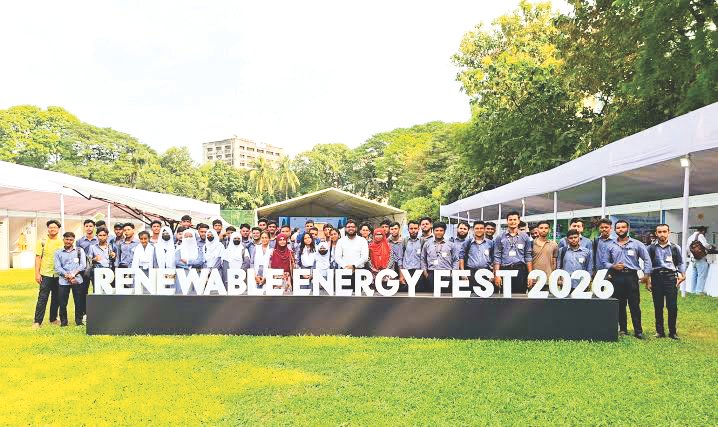
Bangladesh’s second Renewable Energy Fest 2026 concluded at the Bangladesh University of Engineering and Technology (BUET) on 28 October, with a 12-point declaration calling for stronger renewable energy policies, increased investment, modern power infrastructure, and effective social and environmental safeguards to accelerate a just, inclusive, and green energy transition.
ActionAid Bangladesh, BUET, the Just Energy Transition Network Bangladesh (JETnet-BD), and BUET’s Institute of Energy and Sustainable Development (IESD) jointly organized the three-day festival, held at BUET's Central Field from October 26 to 28. It brought together policymakers, researchers, investors, renewable energy companies, development partners, civil society representatives and young innovators to develop practical pathways for expanding clean energy in Bangladesh.
Power, Energy and Mineral Resources Minister Iqbal Hasan Mahmood inaugurated the Renewable Energy Fest 2026 and announced that the government had set a target of generating 10,000 megawatts of electricity from renewable sources by 2030. Addressing the opening session at BUET on October 27, the minister said, “Our excessive dependence on fossil fuels has exposed us to global market volatility and the impacts of the conflict in the Middle East. To ensure future energy security, we are developing a Special Renewable Energy Law that will facilitate decisions and activities during 2026–2030.” He also highlighted government initiatives to remove duties on solar power technologies and equipment, promote rooftop solar installations and provide incentives for renewable electricity. Acknowledging challenges in integrating electricity from nuclear, fossil-fuel and renewable sources, he said efforts were underway to modernize Bangladesh’s power grid.
The declaration urged the government to enact a dedicated Renewable Energy Act, accelerate solar power deployment, promote agrivoltaics, modernize the national electricity grid and expand battery energy storage. It also called for stronger green financing through concessional loans, green bonds and public-private partnerships.
The recommendations reflect growing concerns over Bangladesh’s dependence on fossil fuels and imported energy, as well as the need to mobilize investment and strengthen domestic technological capacity to meet the country’s renewable energy ambitions.
Policy Reform and Investment Priorities
Discussions on the final day focused on four major areas: energy policy and governance, renewable energy finance and investment, technology and infrastructure, and social and environmental safeguards.
Participants stressed that ambitious renewable energy targets must be supported by clear policies, predictable regulations, appropriate tariff structures and coordinated action among government agencies, financial institutions, researchers and the private sector.
A panel discussion titled Renewable Energy Finance and Investment in Bangladesh featured a keynote presentation by Zakir Hossain Khan, executive director of Change Initiative. The session was moderated by Kazi Morshad Alam, head of program and engagement at ActionAid Bangladesh.
Panelists included Tanzina Dilshad, representing the European Union in Bangladesh; Nure Alam, chief executive officer of Greener Garments Initiative; and A K M Nurun Nabi, director of the Sustainable Finance Department at Bangladesh Bank.
The discussion highlighted the importance of mobilizing affordable financing for renewable energy projects, expanding public-private partnerships, increasing research funding and strengthening domestic technical expertise. Speakers also emphasized technology transfer and the need for coordinated action to translate policy commitments into bankable projects.
The festival’s technology and infrastructure sessions called for greater investment in grid modernization, energy storage and innovative renewable energy solutions to improve the reliability of clean power supplies.
Youth, Innovation and Green Jobs
Youth participation was a central feature of the festival. A youth-led dialogue, titled From Commitment to Community: Advancing a Just Energy Transition through Bangladesh NDC 3.0, called for stronger action to reduce air pollution and dust and wider adoption of innovative solutions, including solar-powered irrigation and Internet of Things (IoT) technologies.
Participants also called for an effective roadmap within the next 12 months to strengthen young people’s skills, encourage green entrepreneurship and expand youth engagement in the energy transition.
The declaration underscored the importance of developing domestic renewable energy industries, creating green jobs and building the technical skills needed to support the expansion of clean energy.
An innovation and technology fair showcased locally developed renewable energy ideas alongside commercially available technologies and services. The exhibition provided a platform for innovators, businesses and potential investors to explore opportunities for collaboration and the commercialization of clean energy solutions.
The Felite Project won first prize in the innovation competition, followed by Carbon Credit BD Project in second place and IUB Formula-E Project in third. The winning teams received certificates of recognition and seed funding. Students from Independent University, Bangladesh (IUB), BUET and East West University also received recognition for the three best academic posters.
Safeguards for an Inclusive Transition
The declaration placed particular emphasis on ensuring that the shift towards renewable energy does not deepen existing social and economic inequalities.
It called for meaningful participation by women, Indigenous peoples, workers and marginalized communities in energy transition planning and implementation. It also stressed transparency and accountability in climate finance, worker protection, and independent monitoring of environmental and social impacts.
Participants highlighted the importance of ensuring that renewable energy projects deliver benefits to local communities while protecting livelihoods and the environment. Regional cooperation and technology transfer, including between Bangladesh and Australia, were also identified as important areas for strengthening renewable energy capacity.
A puppet theatre performance by Kaktarua Puppet Theatre presented the opportunities and benefits of a just energy future, adding a public engagement and cultural dimension to the event.
Call for Action
The closing ceremony was attended by Jahrat Adib Chowdhury, a member of parliament and chairperson of the Parliamentary Standing Committee on the Ministry of Foreign Affairs, as chief guest. Ibrahim Khalil Al-Zayad, board chair of ActionAid International Bangladesh Society, attended as a special guest.
Farah Kabir, country director of ActionAid Bangladesh, delivered the closing remarks. Professor M A A Shoukat Choudhury of BUET and Abul Kalam Azad, ActionAid Bangladesh’s manager for just energy transition and member secretary of JETnet-BD, delivered the vote of thanks.
The declaration provides a policy and investment agenda for advancing Bangladesh’s renewable energy transition. Its effectiveness, however, will depend on translating the recommendations into concrete government action, financing commitments, technological development and inclusive implementation.
For Bangladesh, the challenge is no longer simply to expand renewable energy capacity, but to build an energy system that is affordable, reliable, environmentally sustainable and accessible to all.
Download Special Report As PDF/userfiles/EP_24_10_SR3.pdf
Afroza Hossain, Editor, Rang Berang & Managing Editor, Energy & Power