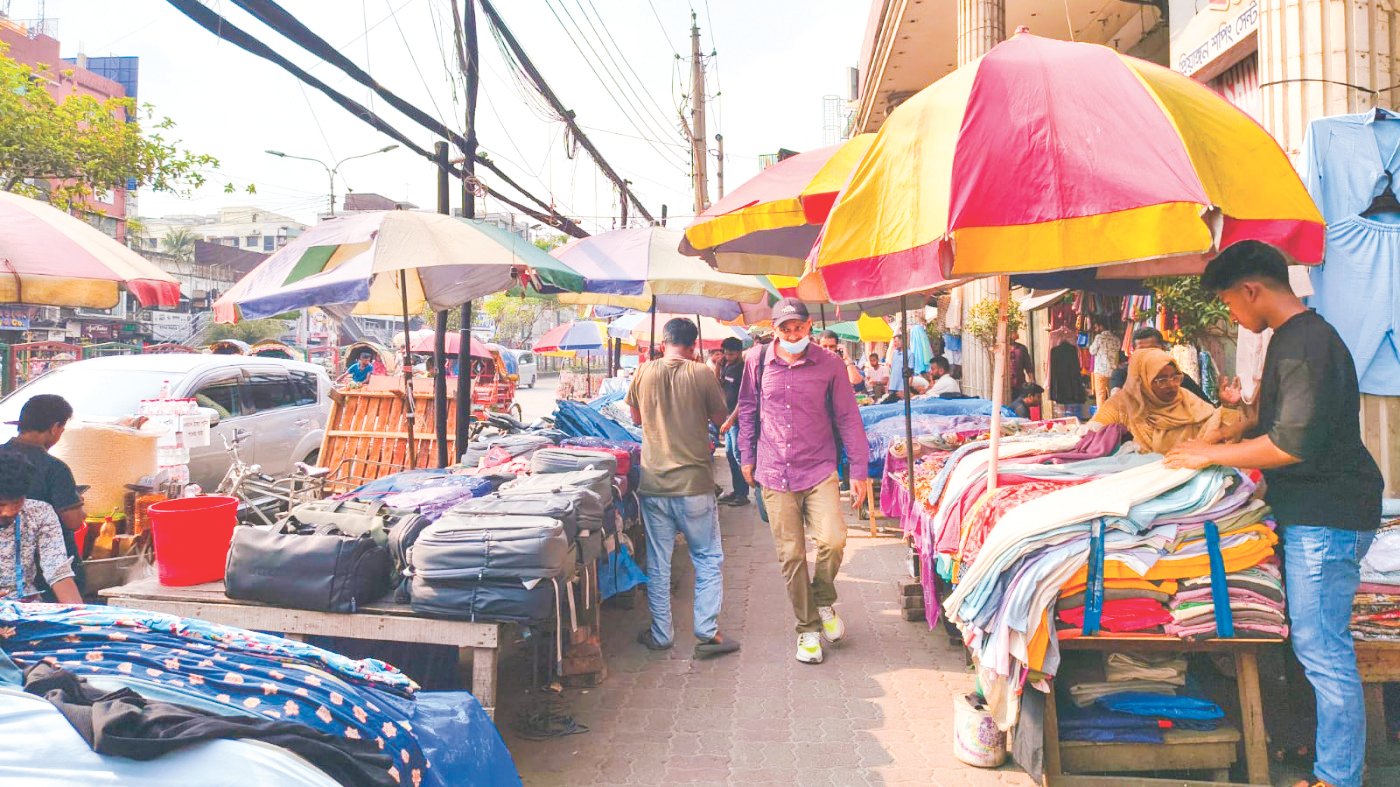
When the Dhaka North City Corporation (DNCC) bulldozed hundreds of make-shift structures in a drive to evict the street hawkers on September 30 (Wednesday) the area descended into violence. Angry vendors clashed with police and eviction workers for hours. The clashes saw attacks on police vans, torching of DNCC garbage trucks and even attacks on journalists covering the eviction drive. Many of the brick-and-mortar stores offering a variety of commodities ranging from clothes to mobile accessories to fruits and snacks were either removed in a hurry or damaged during the drive. After police and law enforcement agencies intensified the drive the protesting vendors retreated only to face the consequences of the rioting that left some police personnel injured.
The Mirpur-10 footpath cleaning eviction came days after hundreds of men armed with hammers, sticks and excavator vandalized and dismantled part of a health center run by Radda at Mirpur-1 on the night of September 24. The attack allegedly by men linked to the ruling BNP stunned the entire nation putting the government under severe pressure to take action against those responsible for it. The center, popularly known as clinic for the poor, has been offering affordable health services mainly to mothers and children from the poor families since 1974. It was preparing to provide measles shots to children as part of a nationwide drive launched by the health ministry on September 25.
Whether the eviction drive was an attempt to divert the attention from the Radda demolition is still a matter of speculation. But the eviction has raised many eyebrows. It has sparked a mixed reaction. A section of city dwellers demand that the pavements must be kept clear of all vendors for smooth movement of the pedestrians. They are right because the footpaths are meant for pedestrians and not for the vendors. But there have long been strong arguments against such unplanned eviction without giving any thought to sustainability of the drive. Few will support an eviction dismantles the means of livelihoods for thousands of poor people. The economy involving Dhaka’s footpath though informal can’t be brushed aside as negligible. Dhaka city has 355 kilometers of footpaths and 40% to 60% of it are used by the street vendors making it hazardous for the city commuters. Ironically, because of the affordability of the low-priced commodities and services available on footpaths at least 60% of the city’s 20 million people conduct pavement shopping. Footpaths are used not only by an estimated 350,000 to 500,000 hawkers, but by a huge number of city dwellers. A hawker earns an average of Tk 3,000 to Tk 5,000 from one store daily, while earnings increase to Tk 20,000 for those owning more than one store. Footpath business has always been huge during Eid festivals with some authorities estimating it Tk1.70 lakh crore. Consider this in the backdrop of what the Asian Development Bank says – 89% of all jobs in Bangladesh are in informal sectors. It is also easy to start vending on the streets with only a few thousand takas as the capital. Migrants from the rural areas where jobs are seasonal and people left homeless by river erosion make up majority of the street vendors. The business survives and flourishes because of a network of local musclemen, police and politicians who benefit by way of getting daily toll collections.
Eviction of hawkers from the Dhaka pavements has never worked. Consider what happened after the drive against hawkers in Farmgate, Panthapath and Gulishtan in April this year. The evicted businesses returned to the streets days after the drive, this time under new arrangement. It does not work because of the absence of alternative means of livelihoods. The pro-eviction authorities must take this reality into consideration.
Download Column As PDF/userfiles/EP_24_08_Column.pdf