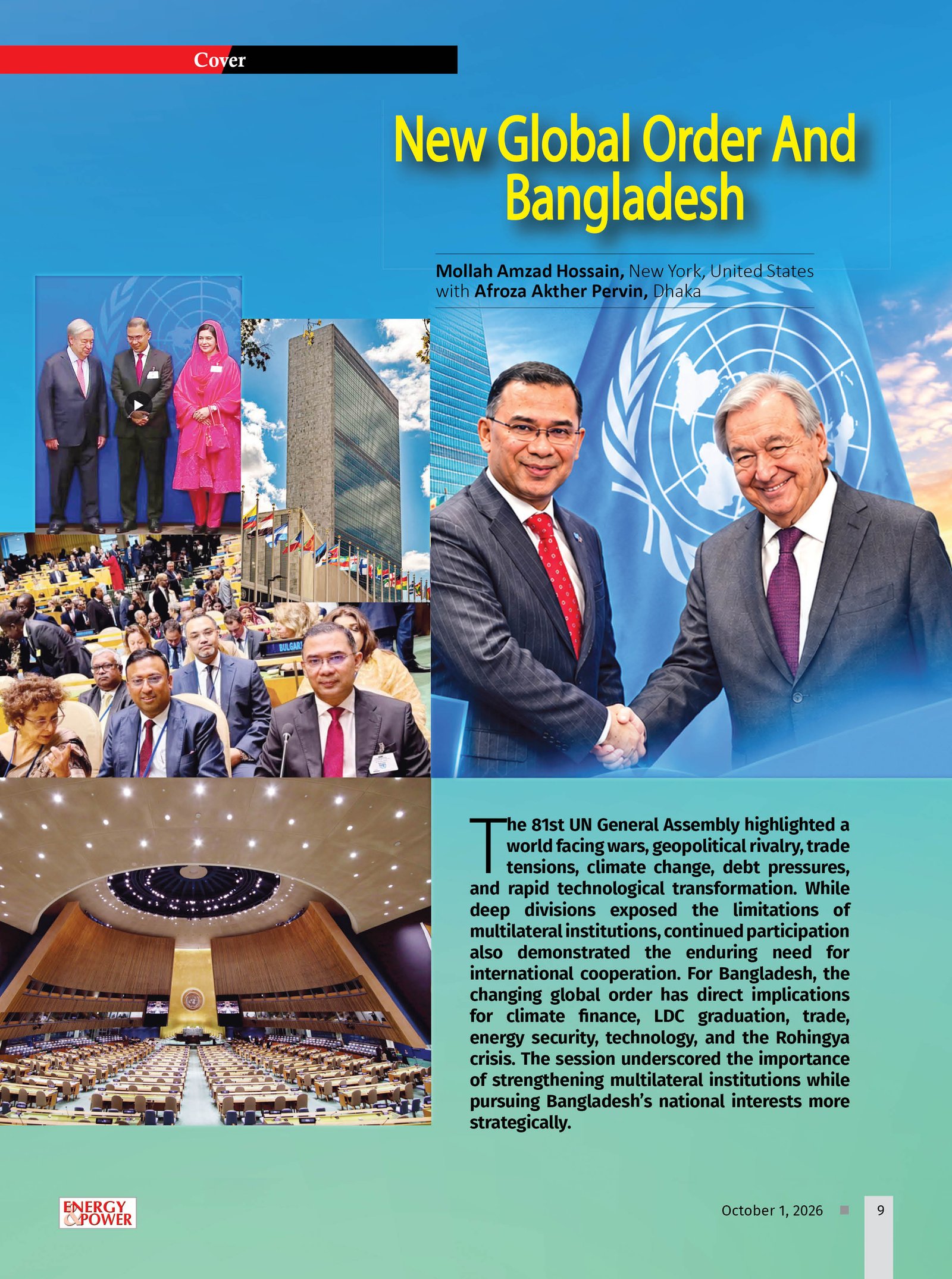
Wars, geopolitical rivalries, trade tensions, climate change, mounting debt, and the rapid expansion of artificial intelligence are reshaping the global order, exposing the limits of international cooperation at a time when collective action is increasingly necessary. The 81st session of the United Nations General Assembly (UNGA 81) brought these interconnected crises into sharp focus, raising a fundamental question: can the multilateral system respond effectively to challenges that no country can resolve alone?
For Bangladesh, the stakes are particularly high. As the country prepares to graduate from the least developed country (LDC) category, it must navigate climate vulnerability, energy-import pressures, changing trade conditions and the need for investment, technology and development finance. The prolonged Rohingya crisis adds another urgent diplomatic challenge.
Against this backdrop, UNGA 81 gave Bangladesh a platform to advance its national priorities while highlighting how much its economic prospects, climate resilience, and humanitarian concerns depend on a more effective, responsive international system.
The 81st session of the United Nations General Assembly (UNGA 81) concluded its high-level week amid wars, geopolitical divisions, trade tensions, climate change, debt pressures, energy-security concerns and the rapid expansion of artificial intelligence.
.jpeg)
The General Debate, held from September 22 to 26 and on September 28, saw 194 delegations take the floor, including 113 heads of state and government, one crown prince, 11 vice presidents, seven deputy prime ministers and 48 ministers.
But UNGA 81 was significant not only for the speeches delivered in New York. It also renewed questions about how effectively the existing multilateral system can respond to increasingly interconnected global crises.
More than 50 heads of state and government were reported to have been absent from the General Debate, including Chinese President Xi Jinping, Russian President Vladimir Putin, German Chancellor Friedrich Merz, Italian Prime Minister Giorgia Meloni, and Palestinian President Mahmoud Abbas. The reasons for their absences varied, including domestic affairs and other commitments.
The absences do not, by themselves, establish a decline in the relevance of the United Nations. However, they underscore the challenges facing multilateral diplomacy at a time when major powers are increasingly pursuing national, bilateral or regional approaches alongside global institutions.
Multilateralism under Pressure
The central challenge highlighted during UNGA 81 was the widening gap between the scale of global problems and the capacity of international institutions to deliver collective solutions.
Conflicts in Iran, Gaza, Ukraine, Sudan, Myanmar and elsewhere, along with refugee crises, climate disasters, trade tensions and financial pressures, cannot be addressed by individual countries alone.
Yet differences among major powers and structural limitations within the international system continue to complicate collective action. General Assembly resolutions and political declarations can demonstrate broad international support, but implementation often depends on political will, financial resources and the balance of interests among states.
UN Secretary-General António Guterres repeatedly warned about widening global divisions, declining trust and the interconnected nature of war, inequality, climate change and technological disruption.
The theme chosen for the 81st session by General Assembly President Dr. Khalilur Rahman—“Restoring Trust, Managing Transformation: A United Nations that Delivers for All”—directly reflected these challenges.
In his closing remarks, Rahman said that 194 delegations had participated in the General Debate and noted that “peace” was the word heard most frequently. He also highlighted the uneven burden of debt, development constraints and climate vulnerability facing many developing countries.
The issue, therefore, is not whether the United Nations remains necessary, but how the organization can become more representative, effective and capable of delivering results.
SDGs: Targets Exist, but Implementation Lags
The UNGA discussions also highlighted the widening gap between development ambitions and implementation.
At the SDG Moment on September 18, world leaders and development partners called for accelerated action to achieve the 2030 Sustainable Development Goals.
The latest UN assessment shows that progress remains uneven, with financing gaps, debt distress, conflicts, inequality and climate shocks continuing to undermine development efforts.
For developing countries, the SDG agenda is increasingly inseparable from questions of debt, climate finance, food and energy security, technology access and reform of the international financial system.
This is particularly important for Bangladesh as it prepares for LDC graduation while simultaneously confronting climate vulnerability, energy-import pressures and the need for continued investment in infrastructure and human development.
Climate and the Road to COP31
Climate change was another major focus of the high-level discussions, reinforced by the parallel NYC Climate Week program and several climate-related meetings at the UN.
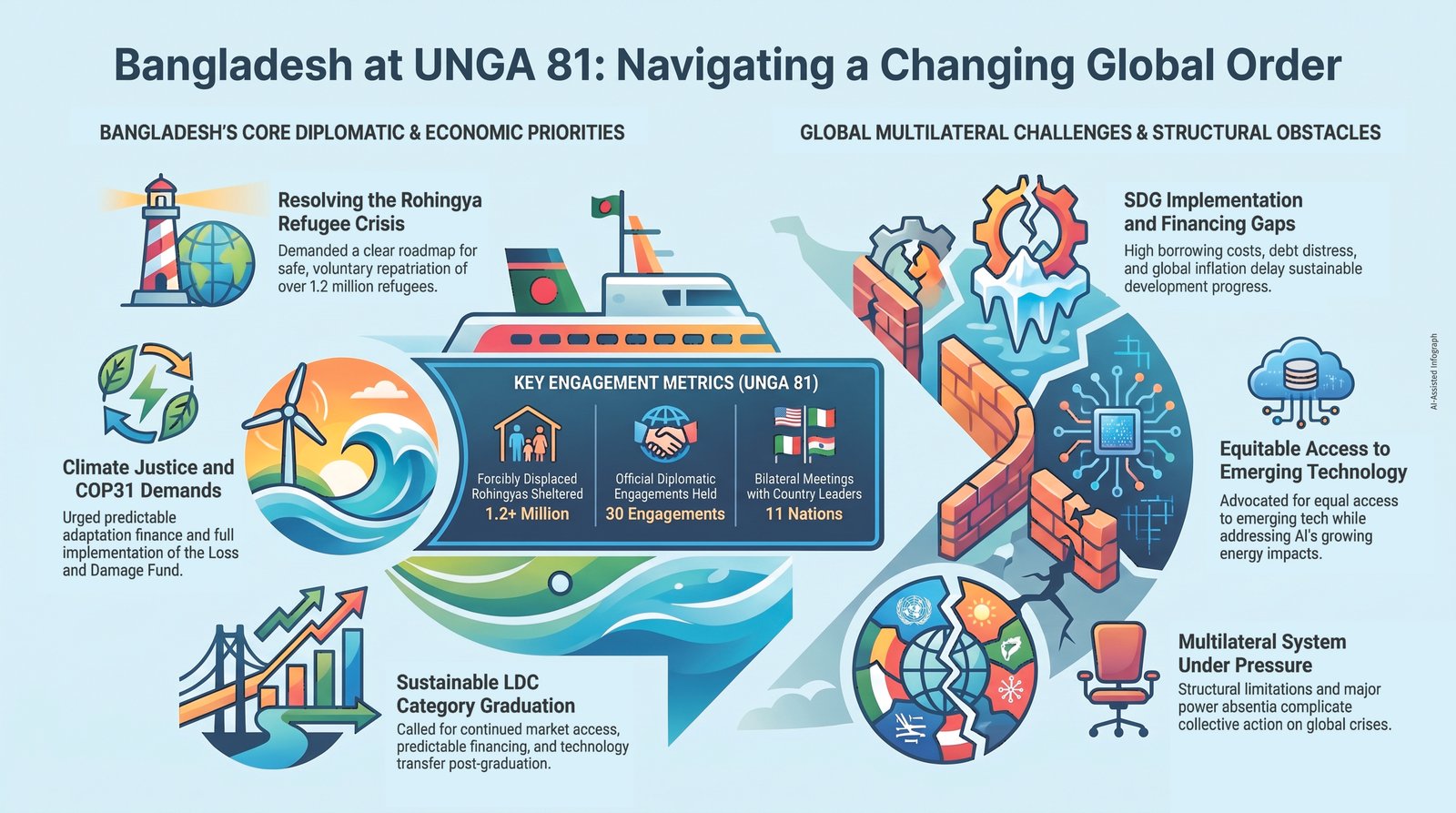
On September 23, the UN Secretary-General convened a high-level meeting on Climate Action and the Just Transition, where Bangladesh highlighted the priorities of climate justice, adaptation finance, technology access, renewable energy and loss and damage.
Prime Minister Tarique Rahman called for stronger international action to keep the 1.5°C goal within reach, predictable and accessible adaptation finance for vulnerable countries, greater access to climate-smart technologies, increased deployment of renewable energy through financing and technology transfer, and full implementation and regular replenishment of the Loss and Damage Fund.
For Bangladesh, these issues are directly linked to national development and energy security. The country contributes relatively little to global greenhouse gas emissions but remains highly exposed to climate impacts.
The Prime Minister also used his UNGA address to call for stronger global action on climate justice, climate finance, and adaptation support ahead of COP31.
Sea-Level Rise: A Strategic Concern for Bangladesh
Sea-level rise received high-level attention during the General Assembly. The issue is particularly important to Bangladesh because of its potential consequences for coastal communities, agriculture, water resources, infrastructure and migration.
For Bangladesh, the issue provides an opportunity to link its climate vulnerability with the broader international agenda on adaptation, resilience and loss and damage.
The leadership of General Assembly President Khalilur Rahman also gave particular visibility to issues affecting vulnerable coastal and developing countries during the session.
Tarique Rahman’s First UNGA Address
Prime Minister Tarique Rahman delivered his maiden address to the General Debate in Bangla on September 24. His speech covered peace and security, multilateralism, climate change, sustainable development, technology, economic cooperation, migration and the Rohingya crisis.
On multilateralism, he reaffirmed Bangladesh’s support for the United Nations as the central platform for international peace and cooperation. He called for conflicts to be resolved through dialogue, diplomacy and cooperation.
He also highlighted the economic consequences of wars and geopolitical tensions, including disruptions to global energy supplies and rising inflation—issues with direct implications for Bangladesh as an energy-importing economy.
The emphasis on multilateralism has practical significance for Bangladesh. International rules and institutions influence the country’s access to trade, climate finance, development assistance, technology, migration opportunities, and peacekeeping mechanisms.
LDC Graduation and Economic Multilateralism
Bangladesh’s graduation from the least developed country category was another important element of its international agenda.
The country’s position is that sustainable graduation requires continued access to markets, predictable financing, technology transfer, and capacity-building support.
These issues are closely connected to the wider UNGA debate over the international financial system. High borrowing costs, debt pressures, limited fiscal space and unequal access to technology can constrain developing countries’ ability to invest in climate resilience and economic transformation.
For Bangladesh, therefore, LDC graduation is not simply a domestic economic milestone. It is also a test of how effectively the international system can support countries moving into a new stage of development.
Rohingya Crisis: Bangladesh’s Most Immediate Diplomatic Priority
The Rohingya crisis remained one of Bangladesh’s most immediate diplomatic priorities during UNGA 81.
At a Bangladesh-Gambia side event on September 23, Prime Minister Tarique Rahman called for a clear and credible roadmap for the safe, voluntary, dignified, and sustainable repatriation of Rohingyas to Myanmar.
He also called for an end to violence against civilians, continued humanitarian support for Rohingyas and host communities, stronger justice and accountability mechanisms, and greater regional and international cooperation to combat trafficking, narcotics, illegal arms and other cross-border crimes.
In his UNGA address, the Prime Minister said Bangladesh had been sheltering more than 1.2 million forcibly displaced Rohingyas for more than nine years and urged the international community to continue providing humanitarian assistance until their repatriation.
For Bangladesh, keeping the Rohingya crisis on the international political agenda is increasingly important as humanitarian funding pressures grow and the displacement becomes more protracted.
Meeting with António Guterres
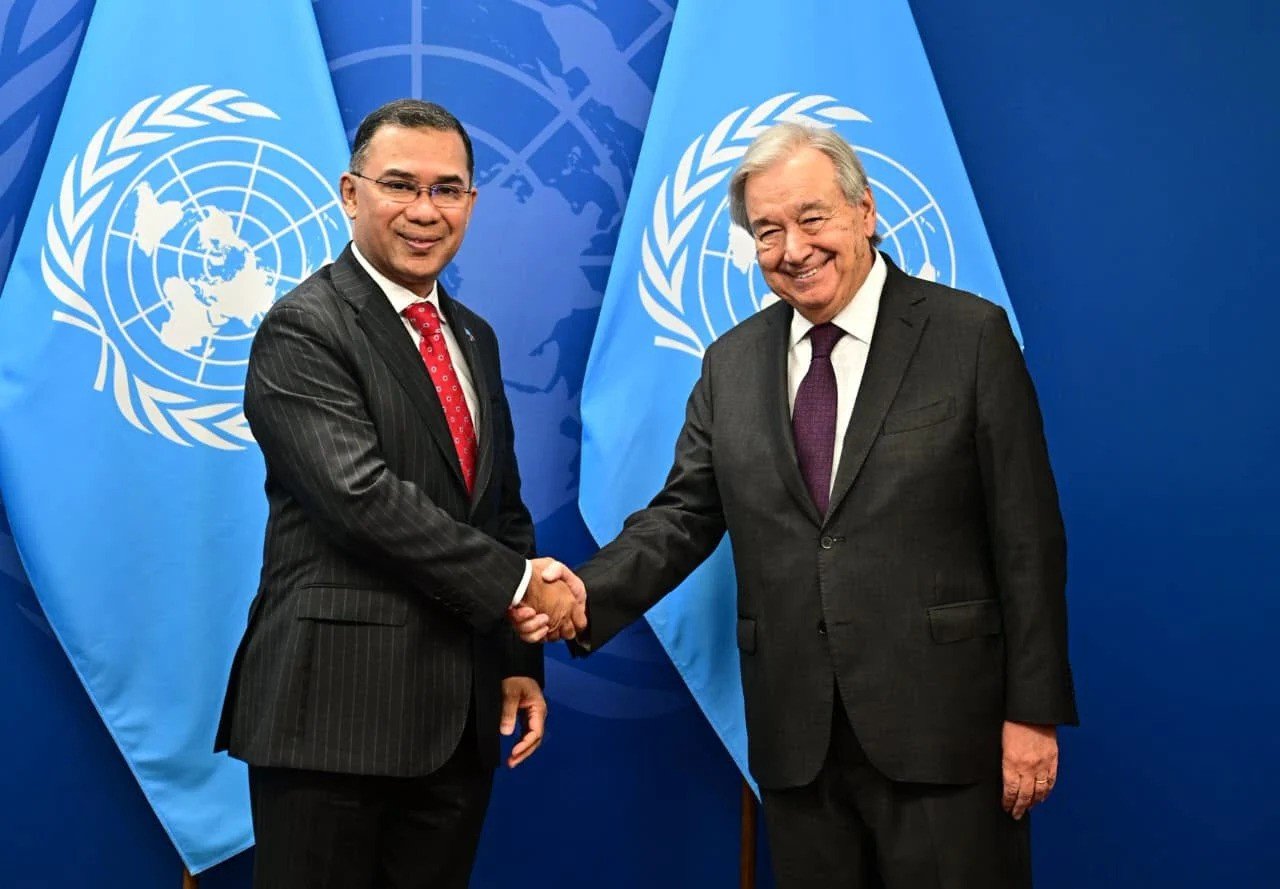
On September 24, Prime Minister Tarique Rahman met UN Secretary-General António Guterres at UN headquarters.
The two discussed the Rohingya crisis, climate change, Bangladesh-UN cooperation and Bangladesh’s broader development, peace and security priorities. The Prime Minister reaffirmed Bangladesh’s commitment to multilateralism and international cooperation, while both sides agreed to continue working together on common global challenges.
The meeting was significant because both the Rohingya crisis and climate change require sustained international cooperation rather than short-term bilateral responses.
Broader Diplomatic and Economic Engagement
The Prime Minister’s New York program extended well beyond the General Assembly chamber.
According to the Bangladesh government, he took part in 30 official engagements over four working days and held bilateral meetings with leaders and senior representatives from 11 countries, alongside UNGA-related programs and high-level side events.
The wider diplomatic program included meetings with international organizations, development partners and business representatives. Economic diplomacy focused on trade, investment, human resources, technology and opportunities for Bangladesh.
The delegation also engaged with organizations including the World Bank and the Gates Foundation, as well as investors and representatives of international institutions.
This reflects an effort to use the UNGA platform not only for political diplomacy but also to strengthen economic and investment relations.
Technology and the Future of the Global Economy
Science, technology, artificial intelligence and biotechnology also featured in Bangladesh’s message.
The Prime Minister stressed the importance of ensuring that developing countries can access the benefits of technological progress.
This issue is becoming increasingly relevant to both the SDGs and climate action. AI can improve productivity, energy efficiency and climate-risk management, but its rapid expansion also requires substantial amounts of electricity, water, and digital infrastructure.
As a result, future multilateral discussions are likely to address not only AI governance but also AI’s energy and environmental footprint and equitable access to emerging technologies.
Did UNGA 81 Signal a Revival of Multilateralism?
UNGA 81 presented a mixed picture.
On one hand, the absence of many senior leaders, continuing geopolitical divisions, unresolved conflicts and persistent implementation gaps in the SDGs and climate finance underscored the limitations of the current multilateral system.
On the other hand, 194 delegations participated in the General Debate, while governments continued to use the UN platform to address conflicts, climate change, development, debt, migration, health and humanitarian crises.
The UN General Assembly president’s closing remarks captured this contradiction. While acknowledging the deep divisions facing the international community, Rahman said the discussions demonstrated a shared conviction that the challenges confronting the world require action and that the United Nations remains indispensable.
The evidence therefore points less to the disappearance of multilateralism than to a struggle over how to make it more effective and representative in a changing global order.
What Does It Mean for Bangladesh?
UNGA 81 presented Bangladesh with both opportunities and challenges.
First, Bangladesh’s presidency of the 81st General Assembly provided a prominent platform for advancing discussions on trust, reform, development finance, and the concerns of vulnerable developing countries.
Second, the Prime Minister’s UNGA address brought together several major Bangladeshi priorities—peace, multilateralism, climate finance, renewable energy, technology, sustainable development and the Rohingya crisis—within a broader international framework.
Third, the session demonstrated the need to connect LDC graduation, trade and investment, energy security, climate action and development financing rather than treating them as separate policy issues.
Fourth, the Rohingya crisis will require both humanitarian and political diplomacy if Bangladesh is to maintain international attention and support for a sustainable solution.
The Road Ahead
UNGA 81 took place as the established rules and institutions of the international system came under significant pressure, while a new global balance of power was still evolving.
For Bangladesh, weakening multilateral institutions would carry risks because many of its national interests—including climate finance, LDC graduation, market access, technology transfer, energy security and the Rohingya crisis—depend on international cooperation.
At the same time, simply preserving existing institutions will not be enough. Bangladesh and other developing countries have a stake in making those institutions more representative, responsive and capable of delivering practical outcomes.
The central lesson from UNGA 81 is therefore not that multilateralism has become irrelevant. Rather, the session demonstrated the growing gap between the need for collective international action and the ability of existing institutions to deliver it.
For Bangladesh, the task is twofold: to support efforts to strengthen and reform the multilateral system while using it more strategically to advance national priorities.
As global challenges become increasingly interconnected—from war and climate change to food and energy security, migration, debt and artificial intelligence—the need for international cooperation is unlikely to diminish. The more fundamental question is whether the world’s multilateral institutions can adapt quickly enough to remain effective, representative and accountable.
Download Cover As PDF/userfiles/EP_24_08_Cover.pdf