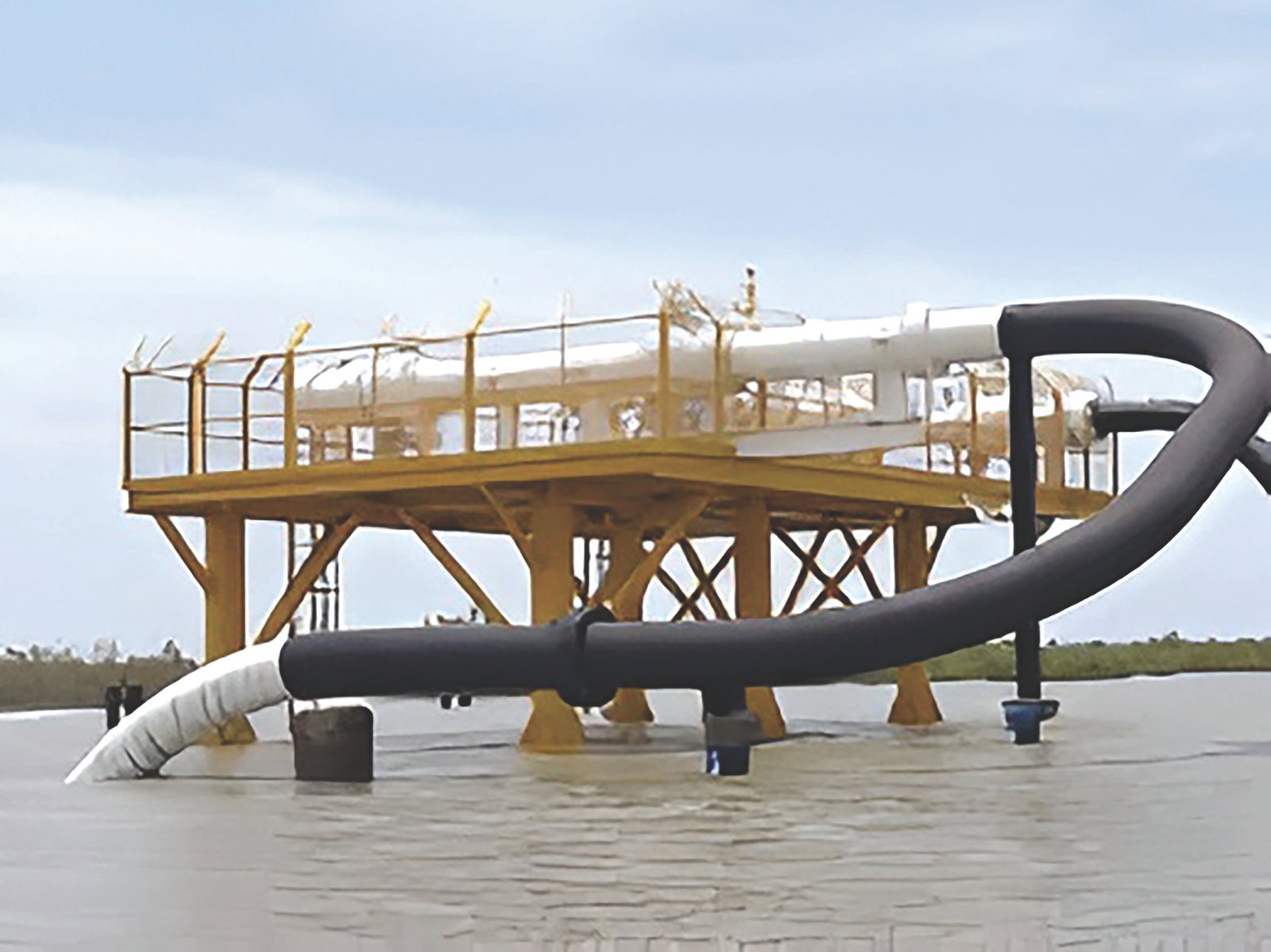
Gas Transmission Company Limited (GTCL), a Petrobangla subsidiary mandated to own and operate Bangladesh’s gas transmission grid, has invested heavily in new infrastructure over the past decade and a half. Today, GTCL’s high-pressure transmission network stretches across the country—from Moheshkhali in the southeast to Rangpur in the northwest, and from Beanibazar in the north to Khulna in the south. Its pipelines and related facilities can transport more than 6,000 MMCFD of gas. The only missing link in this nationwide system is the segment needed to connect the stranded gas reserves of Bhola Island to the national grid.
Sector insiders know that, due to resource constraints, the country currently supplies only about 2,800 MMCFD of gas—including roughly 1,100 MMCFD of imported LNG regasified by two floating storage and regasification units anchored off Moheshkhali. A lack of coordinated planning has left a large portion of the transmission system underutilized. GTCL has gained little from these expensive assets; instead, they have become a burden. The government formed after the February 2026 general election will need to take stock and assess options before making further investments in gas transmission. This reassessment must cover not only transmission but the entire gas supply chain.
To meet rising demand in the expanding franchise area, Petrobangla—guided by development partners—decided in the 1990s to unbundle the gas sector into production, transmission, and distribution. This led to the creation of GTCL, responsible for receiving metered gas from upstream producers and delivering it to downstream distribution companies. Nearly three decades later, GTCL has grown from scratch into the country’s largest gas transmission utility. Still, incomplete asset transfers from some distribution companies and unresolved custody-transfer processes continue to cause disputes over metered gas deliveries. In recent years, these disputes prompted Petrobangla to impose up to a 3% system loss allowance on GTCL, even though technically transmission losses should be negligible apart from minor metering inaccuracies. GTCL has since replaced most aging meters with modern systems, and SCADA now supports gas transactions across its network.
Investments that Pushed GTCL Toward Financial Distress
Gas fields in the Sylhet region, located along the northern corridor, are major suppliers to the national grid. Two large pipelines, the 178 km, 24-inch Koilashtila–Ashuganj line and the 30-inch Rashidpur–Ashuganj line, form the backbone of transmission. Ahead of the development of the Bibiyana field, GTCL planned three compressor stations at Muchai, Rashidpur, Ashuganj (AGMS), and Elenga in Tangail. However, under pressure from Chevron, the production-sharing-contract operator for Blocks 12, 13, and 14, the government in 2009 allowed Chevron to build and operate the Muchai station. GTCL was instead tasked with constructing a 42-inch high-pressure pipeline from Bibiyana to Dhanua across difficult terrain, as well as compressor stations at Ashuganj and Elenga.
A large share of Bibiyana’s gas was diverted downstream, while nearby power plants began consuming gas directly at the source. The resulting shift rendered the Ashuganj and Elenga GTCL compressor stations redundant within a short time. AGMS remained operational for a period, but the Elenga station never went into service. Many believe Chevron’s involvement in Muchai was an attempt to prolong its cost-recovery period. One former Petrobangla chairman opposed the decision, but his objections were ignored.
It remains unclear why GTCL was instructed to build a 30-inch parallel pipeline from Ashuganj to Bakhrabad despite declining supply from the northern corridor. Petrobangla’s daily production and transmission reports show that both AB1 and AB2 pipelines from Ashuganj are operating at low flow. The Ashuganj compressor cannot function within its design parameters due to upstream shortages, and the Elenga compressor station remains idle.
GTCL also built transmission pipelines from Moheshkhali and Cox’s Bazar to Anowara, Chattogram, to evacuate RLNG from the FSRUs. Within a few years, RLNG demand exceeded the design capacity of the first pipeline, prompting construction of a 42-inch parallel line. Inspections have shown that the metering facilities in the area were installed at three to four times the required scale. These projects, carried out under the Special Act of 2010 without proper feasibility studies, primarily benefited entrenched energy-sector interests. The resulting financial burden has crippled GTCL.
Sector specialists know Bangladesh has long faced a chronic gas supply crisis. Despite extending a pipeline from Ishwardi to Khulna via Kushtia and Jessore, gas supply to the Khulna region remains unachievable. The priority should have been a transmission line from Bhola to Khulna. Instead, GTCL was directed to extend the pipeline network from Bogura to Rangpur via Dinajpur—regions unlikely to receive gas in the near future.
GTCL officials did voice objections, but frequent changes of managing directors undermined institutional continuity. These costly, unnecessary investments benefited only an unholy alliance of vested interests while pushing GTCL into financial distress.
In the near future, GTCL must undertake major projects to evacuate gas from Bhola and build a third parallel pipeline from Moheshkhali/Matarbari. Without government grants or a revised wheeling charge, GTCL will struggle to absorb these investments.
Recommendation
The incoming government must review unnecessary investments in GTCL’s infrastructure and identify ways to utilize idle facilities. A transparent audit will reveal the intentional missteps and vested interests behind past decisions. At the same time, rigorous techno-economic feasibility studies must precede all future projects. As the regulator of the energy and power sector, BERC must approve all upcoming gas-sector projects to prevent further financial strain and ensure rational planning.
Download Article As PDF/userfiles/EP_23_12_Article(1).pdf