Of the many problems plaguing the energy sector, unaccounted-for gas (UFG) or system loss is certainly a significant one. It constitutes a direct financial loss at a time when the government has to provide subsidies, and does not have enough foreign currency to purchase LNG. System loss is an age-old problem in Bangladesh, as it is in many developing countries.
Unpublished data for 11 months of the latest fiscal year (FY 2024-25) from Petrobangla reveal that the total system loss based on the difference between gas entering the national grid and gas sold to customers is 7.77%.If this is the only loss, it wouldn’t be too bad. The problem arises with the hidden loss in the domestic or residential sector. Since this sector is predominantly unmetered and consumers pay a flat fee according to the number of burners, the question that logically arises is: how is the amount of gas consumed by this sector determined? The gas shown as consumed is calculated using a hypothetical consumption per burner. The data from the gas consumption of metered customers indicate that this figure is an overestimation. Petrobangla, in their annual gas consumption data for FY 2023-24, has shown a gas consumption of 11% in this sector. Knowledgeable insiders strongly believe this cannot be more than 8%. Therefore, nearly 3% gas is unaccounted-for (UFG). This UFG is in addition to the 7.8% normally shown in annual reports. Thus, the actual gas loss exceeds 10%.
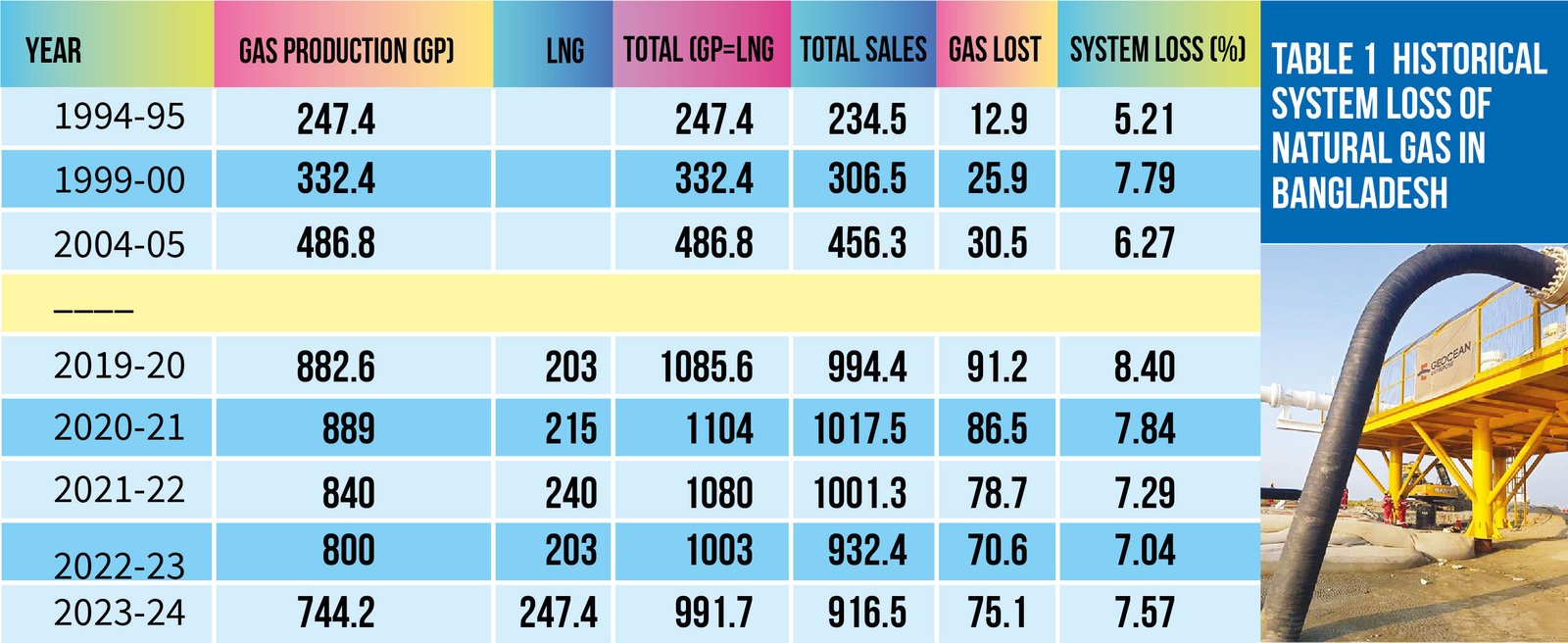
Table 1 presents a historical picture of system loss from the FY 1994-95 to the present. The first noteworthy thing is that the system loss has increased from 5-6% in the late 1900s/early 2000s to 7-8% in recent years. The second is that in volume terms, the gas loss has gone from around 25 Bcf to nearly 80 Bcf. Before 2017, the gas loss was something no one worried much about because gas was cheap, and it was thought we would comfortably cross 2030 before any shortage was felt.This belief was shattered in 2015 when the gas shortage started to bite, especially in the industrial sector. The reason oil-fired power plants were introduced was precisely because we could not supply enough gas to our gas-fired power plants. This crisis was considered so serious that power plants started to be built having dual-fuel capability – oil and gas. Today, as a result of the huge scarcity of gas, even a 1% system loss must be looked upon with great seriousness. Moreover, the financial implications of gas loss must be computed in terms of the cost of importing LNG.
Petrobangla data on gas sector system loss between the years 2006-07 and 2018-19, nearly 12 years, is unreliable. During this period, gas pressure at the customers' meters would fall to dramatically low values. Under these pressures, the old meters gave erroneous readings because the meters assume the designated pressure of 15 psig is available. This resulted in over-billing of hundreds of customers. As a result, instead of system loss, Petrobangla’s data showed system gain. This metering error continued for a long time. This has been corrected for all the larger distribution companies (Discoms), but the smaller distribution companies still have metering errors. As a result, their gas situation, even in FY 2023-24, shows system gains (see Table 2). Since system gain is a physical impossibility, hundreds of customers are being overcharged, and theft of gas is continuing undetected.
Petrobangla has recently released the financial loss due to UFG or system loss company-wise (Table 2). It estimates that Tk 3,790 crores is lost as a result of UFG. The financial loss is calculated using a gas price of Tk 18.6 per cubic meter, which is the average price of gas for Petrobangla (LNG gas price + domestic gas price). If this loss is calculated at the full LNG import price, the loss will exceed Tk 12,000 crores or nearly USD 1.0 billion.
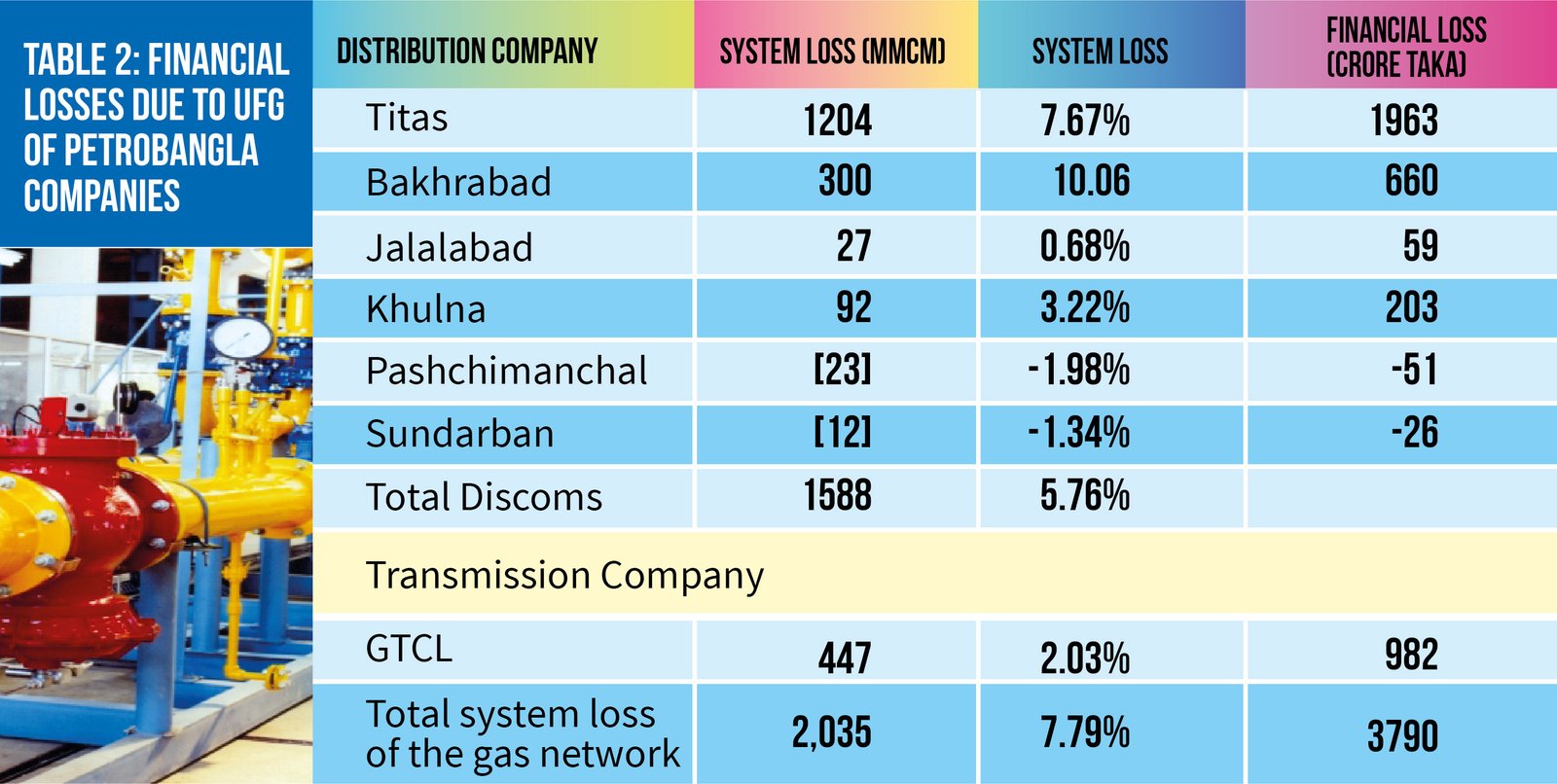
Note UFG – Unaccounted-for Gas; MMcm – million cubic meters
One always hears the name of Titas when it comes to system loss, but it is interesting to note from Table 2 that Bakhrabad has the highest loss at 10%. This is an unacceptably high distribution system loss. Another interesting thing that has come to light in recent times is the GTCL system's loss of 2%. Such a high transmission loss is unusual, to say the least. This implies that even before the gas reaches the distribution companies, 2% of the gas handled by GTCL, worth approximately Tk 1,000 crore, is lost. At the full LNG import price, the UFG is worth at least Taka 3,000 cores. Each cargo of imported LNG costs approximately Tk. 500 crore. That means the equivalent of nearly 6 cargoes of LNG is lost in the transmission network operated by GTCL.If UFG is assumed to be a metering error, such a high metering discrepancy is technically extremely difficult to explain. Since theft from the high-pressure transmission lines would be highly challenging, to explain this phenomenon to everyone’s satisfaction, Petrobangla needs to investigate this with due importance.
The actual system loss of the distribution companies, especially Titas and Bakhrabad, is much more than revealed by the data in Table 2. This is because these larger distribution companies supply a lot of gas to bulk users, i.e., the gas-based power plants and fertilizer plants. There is very little or no system loss in the supply to these customers. If the gas supplied to these bulk users is deducted from the total supplied by the discoms, then the actual performance with regard to gas loss emerges. For example, in FY 2023-24, a total of 992 Bcf of gas was supplied, of which 75 Bcf was UFG, 545 Bcf, and 51 Bcf were supplied to gas-based power plants and fertilizer plants, respectively. Therefore, 992-545-51 = 396 Bcf of gas was distributed by the distribution companies to non-bulk users, i.e., industries, CNG stations, commercial institutions, and domestic customers. The loss of 75 Bcf of gas shown for 2023-24 occurs in these sub-sectors. Therefore, the actual loss is approximately 18.9% (75/396).
A long time back, there was a study of gas loss according to feeders (pipelines serving areas); some feeders with a high percentage of residential and small commercial/industrial customers were found to have a loss exceeding 30%. This clearly indicates the problem of distributing gas to densely packed areas.
Table 3 shows the mean UFG (system loss) in various regions of the world. As can be seen, the average system loss of the world's natural gas transmission and distribution infrastructures is only 1.67%. However, high system losses do exist, but very high system losses are becoming rare. The countries with the highest UFG percentages are Myanmar (15%), Syria (13.8%), Pakistan (11.7%), and South Africa (8%) (Ravalec et al., 2025). It should, however, be noted that two of the high system loss countries are embroiled in civil wars, while the other two are countries that have never been able to manage their energy sector well.
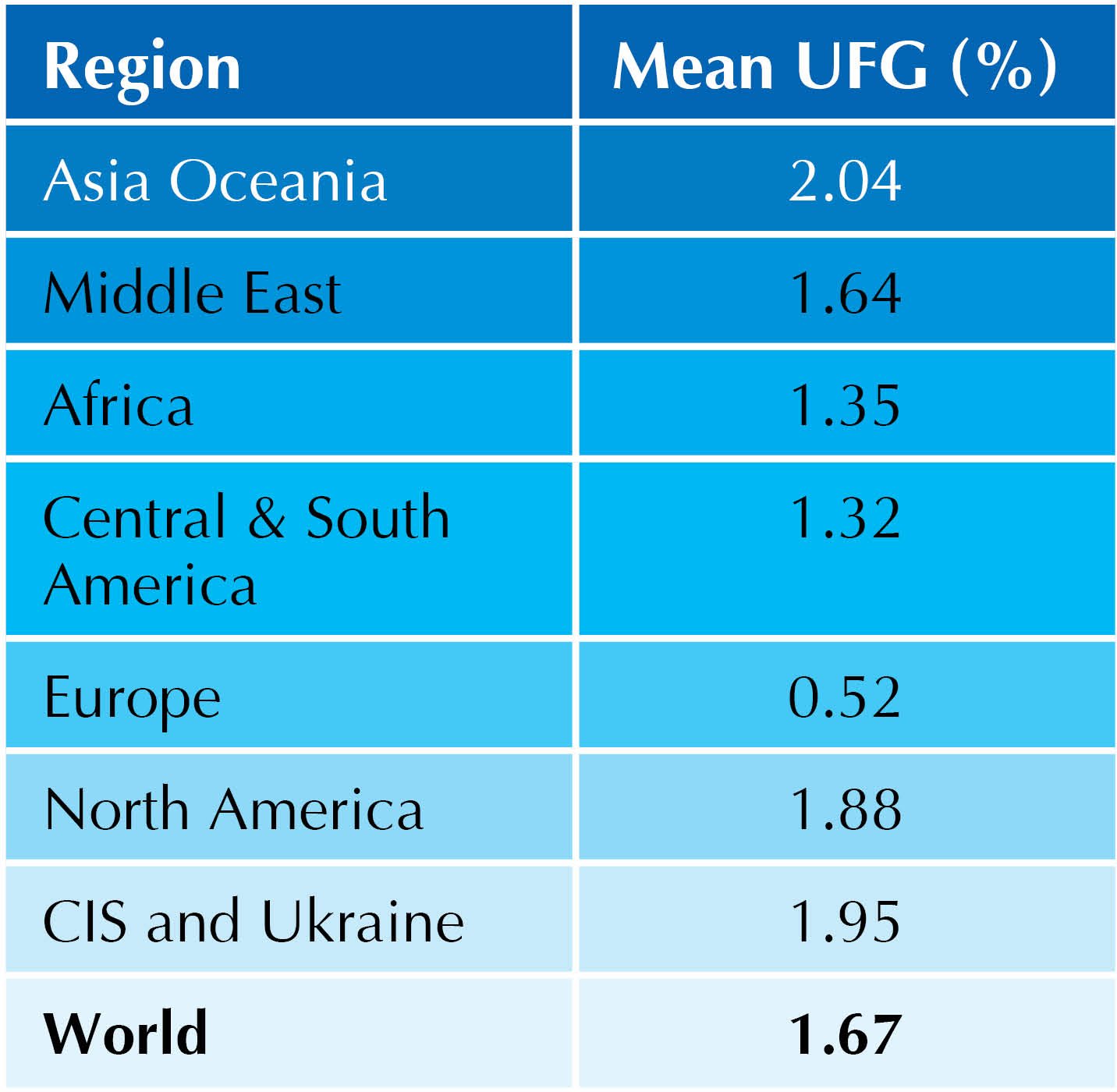
Source – Global methane emissions from natural gas transmission and distribution networks
Geoffroy Hureau, Armelle Lecarpentier, Sylvain Serbutoviez, Jean Kaniewicz, Mike Madden, Chris Brooks, Aileen Robertson, Colin Harrison, Chris Langston and Mickaele Le Ravalec
Sci. Tech. Energ. Transition, 80 (2025) 28
DOI: https://doi.org/10.2516/stet/2025007
Countries with moderate system losses are Russia (2.0%) and the USA (2.1%) (Ravalec et al., 2025). It is worth pointing out that at one time, Russia was a big methane emitter with pipeline losses exceeding 10%. With regards to the USA, the average of 2.1% comes from a spread of 1-4%. The average system loss of developed countries, as reported by Eurostat, is 0.5%. Several EU countries have system losses below 0.5%. These system loss data point to one unmistakable fact, and that is Bangladesh’s gas system loss is very high. The fact that some countries have similar high losses is no excuse to continue this bad performance.
The fact that Petrobangla is being transparent by revealing the financial losses of its distribution and transmission companies is indeed praiseworthy. Moreover, they have initiated measures to reduce UFG, including disconnecting illegal connections. The problem is monumental, and it is certainly not possible to bring down the system loss to the global average of 1.67% considering the poor state of the distribution pipelines, especially within Dhaka city, and the numerous socio-economic constraints, but a 4.0% UFG and the elimination of theft through illegal connections in the domestic sector are targets that can be set. The future of sustainable gas supply in Bangladesh depends on reducing UFG to levels that will meet the expectations of the people.
Professor Dr. Ijaz Hossain, Former Dean, BUET, Energy & Climate Expert
Download this Article As PDF/userfiles/EP_23_09_Anni_Ijaz.pdf