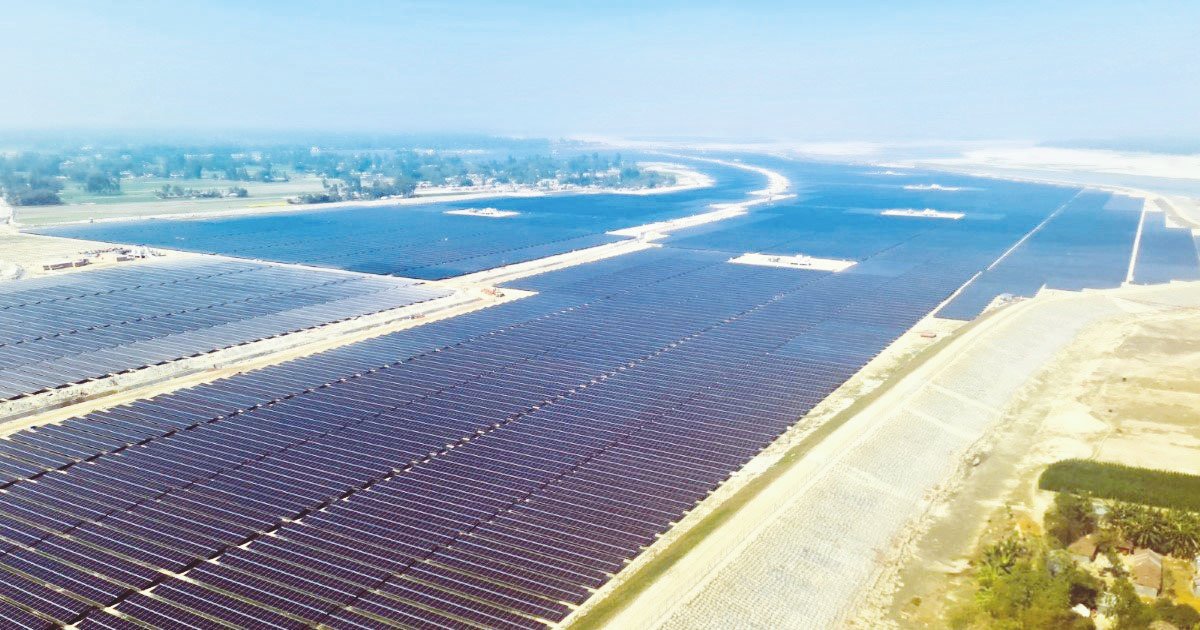
As of January 2026, Bangladesh’s pursuit of solar energy is a sophisticated balancing act between its tropical potential and the terrestrial constraints of a densely populated riverine delta. While the nation has expanded its grid-connected capacity to 1,397.54 MW, accounting for 82% of its total renewable energy, the journey towards the 40% renewable target by 2041 faces significant headwinds. The primary challenge remains the ‘land-energy trade-off’, as 76% of land is strictly reserved for agriculture. Despite having the highest regional production costs (USD 0.040-0.055 per kWh) due to lower yields and flood-resistant engineering needs, Bangladesh is pioneering the use of floating solar and elevated structures to harmonize food security with clean energy expansion.
Preamble
Bangladesh stands at a critical junction in its energy transition, having a substantial hypothetical possibility of solar energy due to its tropical climate and geographic location. As of January 2026, the country has extended its grid-connected solar capacity with 76 solar parks totaling approximately 4,903 MWp, in planned or operational capacity. At present, renewable energy accounts for 1,690.60 MW of installed capacity, with solar providing the maximum share at 1,397.54 MW, approximately 82%.
Present Set-up and Strategic Goal for 2041
The landscape of solar power in Bangladesh is characterized by several major operational hubs and ambitious future projects:
- Teesta Solar Ltd: Located at Sunderganj, Gaibandha, is a 200 MW operational capacity covering over 600 acres with more than 520,000 panels.
- Pabna Solar Park: An operational 100 MW site that generates approximately 110 million kWh annually.
- Mymensingh Solar Park: A 73 MW operational park covering 174 acres.
- Imminent Projects: Significant capacity is under implementation by 2027, which includes solar projects at Rampal (300 MW), Fatikchari (200 MW), Jamalpur (180 MW), and Parbatipur (200 MW).
These developments align with the Government’s ‘Climate Prosperity Plan’. It aims to generate 20% of its electricity from renewable energy sources by 2030 and 40% share by 2041. Economically, the sector is becoming more competitive; while older plants sold electricity at approximately Tk 13.90 per unit, new open-tender projects have reduced tariffs to between Tk 7.96 and 9.98 per unit.
Technical and Environmental Limitations
Despite various steps, the transition is challenged by ‘terrestrial certainties’, including generation intermittency and land scarcity.
- Intermittency: In Bangladesh, average daily sunlight hours drop from 7.6 hours in the dry season to just 4.7 hours during the monsoon. This creates a mismatch with peak demand, which typically occurs in the late evening when solar generation ceases.
- Grid Limitations: The existing national grid lacks the ‘smart grid’ technology required to seamlessly absorb and manage large-scale fluctuating renewable inputs. Furthermore, Battery Energy Storage Systems (BESS) remain vulnerable to high costs and a lack of local recycling infrastructure.
- Environmental Risks: Bangladesh, a low-lying delta, faces floods and riverbank erosion that can damage equipment or demand expensive reinforcements. A floating solar energy system requires specialized anchoring and reinforcement due to mud, silt, and delicate wetland environments.
The Land-Energy Trade-off
The most substantial barrier is the shortage of non-cropped land in a densely populated nation. Approximately 76% of Bangladesh’s land is identified for farming, and national policy strictly forbids converting fertile, multi-cropped acreage for energy purposes. Large-scale projects like Teesta Solar Park require roughly 600 acres for 200 MW, a mark that is increasingly difficult to repeat where land is in high demand for habitation and cultivation. Vis-à-vis, the country is directing towards innovative solutions such as Floating Solar (FSPV) and Agri-PV (elevated structures over farms) to maximize limited space. Furthermore, identifying government-owned ‘khas’ land is stalled by complex legal disputes and highly fragmented ownership patterns.
Comparative Regional Analysis (2025-26)
Bangladesh faces unique economic and physical challenges when compared to its peers:
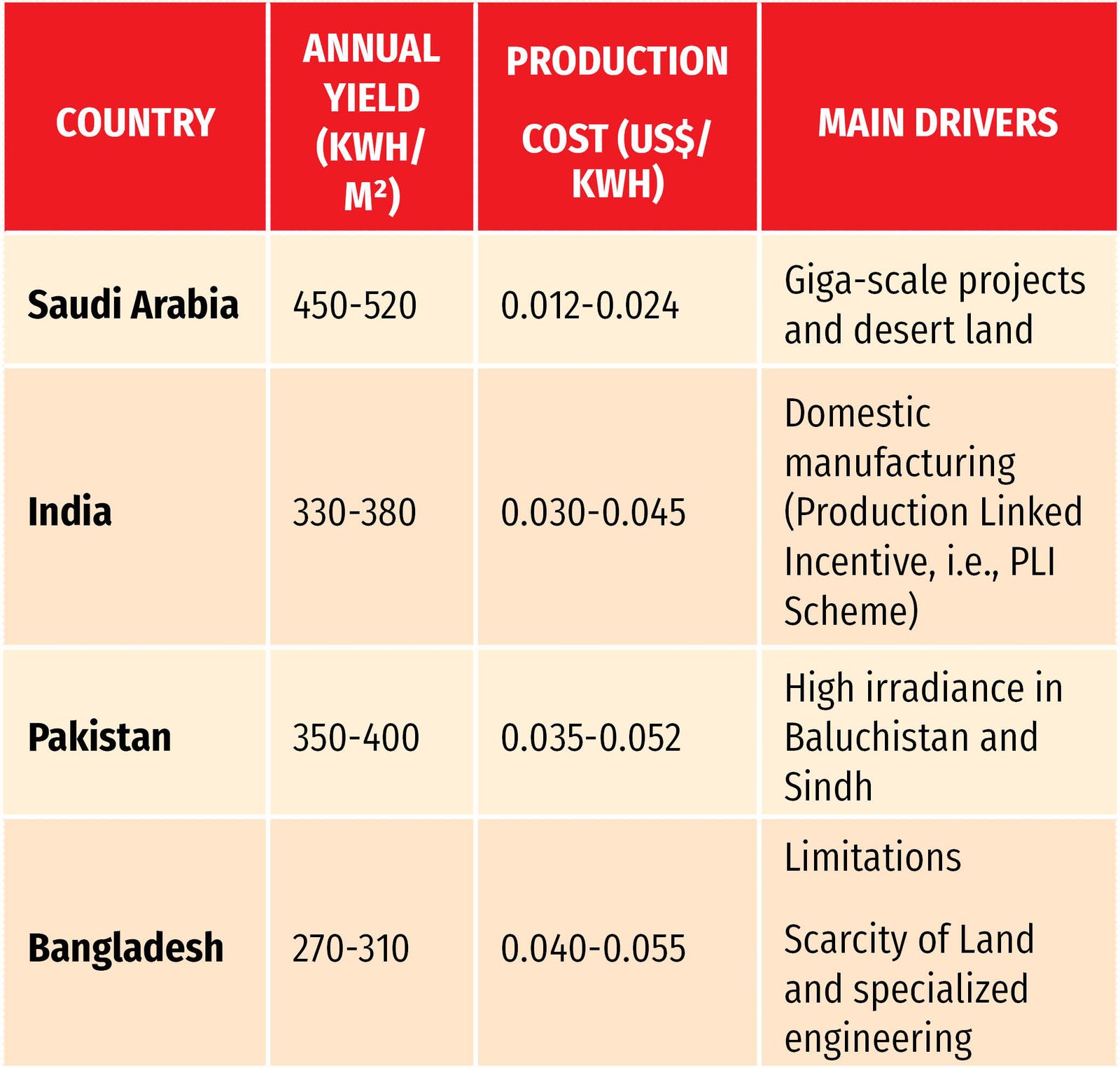
Saudi Arabia and Pakistan benefit from higher raw sunlight. They also face a ‘heat penalty’, where temperatures above 25°C decrease panel efficiency by 0.3-0.5 percent per degree. In contrast, Bangladesh’s lower yield is compounded by high cloud cover during monsoons and the high cost of specialized engineering required for marshlands and water bodies.
Existing Solar Incentives in Bangladesh
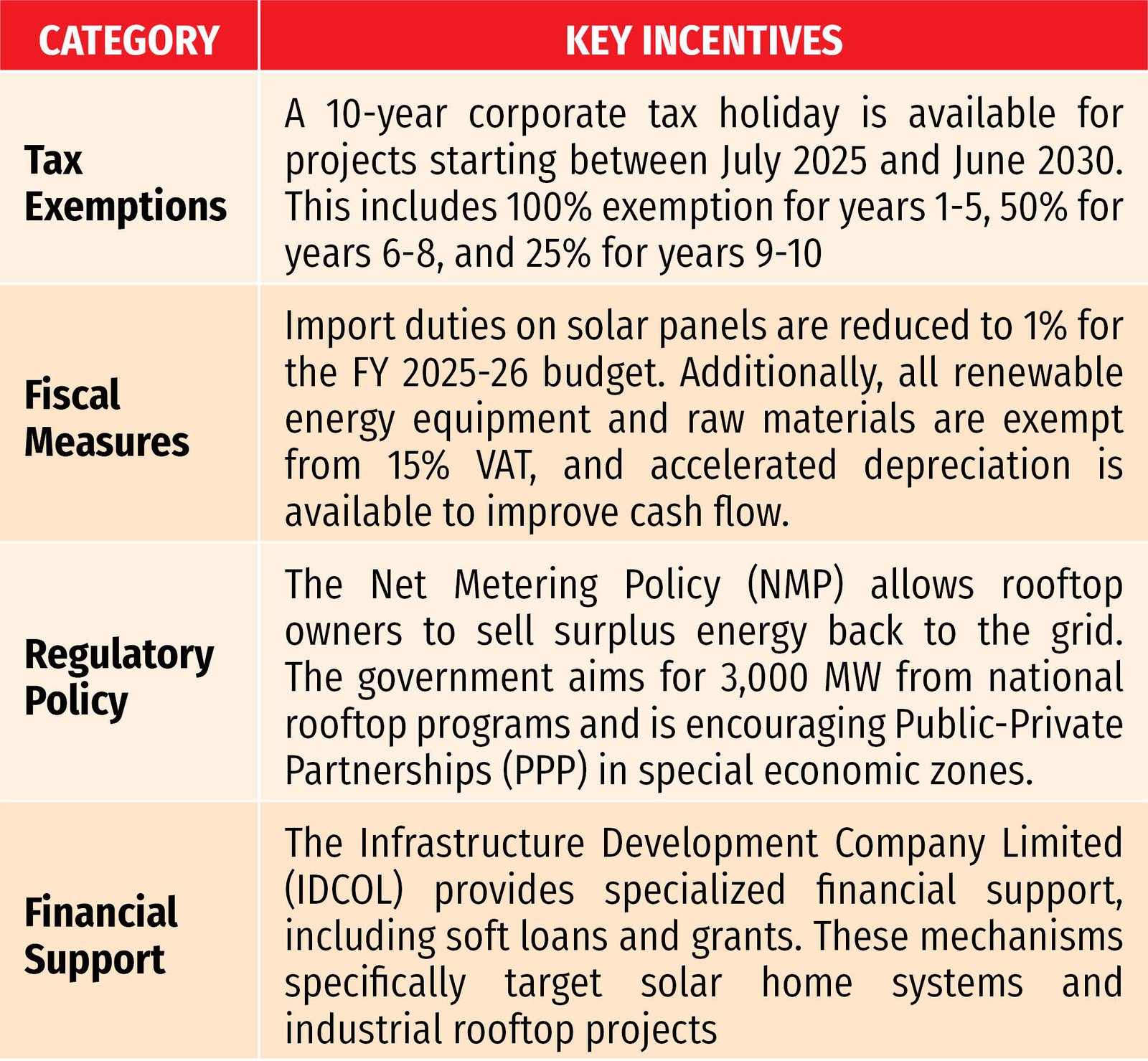
The Government is heavily incentivizing the solar energy sector through tax holidays, import duty exemptions on machinery, and competitive bidding for projects to promote local manufacturing and renewable adoption, as outlined below:
Policy Recommendations for Bangladesh’s Solar Ambition
To bridge the gap between theoretical potential and practical grid integration with respect to present incentives, Bangladesh needs to move beyond traditional land-based solar models.
- Fusion of Soil and Sunlight: The Government should plan for a ‘dual-use’ land policy. Applying tax incentives for Agri-PV can catalyze the development of elevated solar arrays. This allows crops to thrive in the dappled shade below. Simultaneously, the country may extend its scope to waterways through Floating Solar PV (FSPV) by establishing rigorous national engineering standards for anchoring systems in silt-heavy deltas.
- Grid Modernization and BESS Integration: Smart Grid Technology is necessary using Climate Prosperity Funds to stabilize variable renewable inputs. A comprehensive local framework for BESS (Battery Energy Storage Systems) could also be established to provide installation subsidies and ensure regulated, environmentally sound battery disposal.
- Streamlining Land Acquisition and Legal Frameworks: Administrative reforms must simplify the process of securing government-owned ‘khas’ land through the digitalization of land banks. Additionally, a ‘one-stop service’ for fast-track permitting would allow entrepreneurs to resolve legal and land-use issues through an efficient single-window.
- Tariff and Trade Reform: To lower equipment costs, the Government should provide duty waivers for advanced technologies like high-efficiency bifacial modules and automated cleaning robotics. Shifting away from fixed tariffs towards open-tender competitive bidding will further decrease the ‘Levelized Cost of Energy’ (LCOE).
- Investment Hurdles: Tenders for utility-scale solar have faced low engagement, with some developers hesitant due to the removal of certain payment guarantee clauses.
Conclusion
Bangladesh’s solar journey is one of engineering resilience. The nation lacks suitable lands for massive manufacturing scales. It needs to focus on innovative space utilization, such as floating solar over wetlands or elevated structures over farmlands, which could be essential for balancing food security with its 2041 renewable energy targets. At the same time, investment security and commercial viability entail the overall success of the solar energy ambitions in Bangladesh.
Colonel (Retd) Engineer A R Mohammad Parvez Mazumder, afwc, psc
Download Article As PDF/userfiles/EP_V_23_19_Article.pdf