Due to the continuous gas supply crisis and high gas prices, the country’s textile and ready-made garments sector has become like a cancer patient. The industry is surviving in a deteriorating state, just like a cancer patient. Along this painful journey, some factories are dying, and others are becoming increasingly weak. To keep the wheels of industry running, there is no alternative to a steady gas supply at proper pressure. Moreover, the price must be competitive. With the latest gas tariff, expanding existing industries or establishing a new one is impossible.
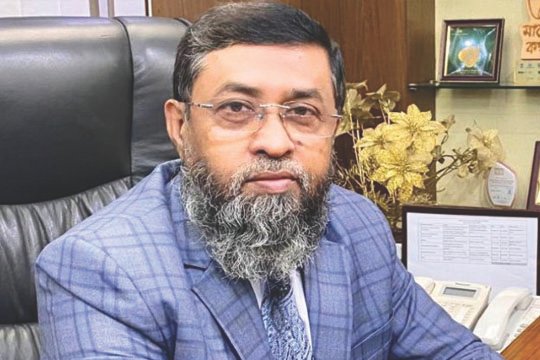
Mohammad Hatem, President of the Bangladesh Knitwear Manufacturers and Exporters Association (BKMEA), said this in an interview with Mollah Amzad Hossain, Editor of Energy & Power.
The gas crisis in the industrial sector has been persisting for a long time. At a recent meeting with the Energy Adviser, you were assured of getting 250 MMCFD more gas for industry. A week has passed since then. Has there been any improvement in gas supply?
The gas crisis in industry is not new. It has been going on for more than three years. We, the entrepreneurs, have helplessly watched our production being disrupted. As a result, we met with the Energy Adviser to find a solution. He showed sincerity in addressing the crisis and promised to divert gas from grid power and increase LNG supply by 250 million cubic feet per day (MMCFD) to industries. Since then, the situation has improved slightly. The gas pressure improved from 0-0.5 PSI to around 3-4 PSI. We hope that once the promised supply is ensured, the situation will improve further.
What kinds of problems are industries facing due to the gas crisis? And how are you dealing with it?
We use gas in boilers, dryers, and other process operations. On the other hand, due to the government’s failure to provide consistent, quality electricity, we had to invest in generating our own power. So, we need gas both for production processes and for captive power generation.
Recently, during severe gas shortages, we have had to rely on diesel generators to continue production. This significantly increases costs, pushing us toward losses. Because of the gas crisis, many industries cannot even produce their required fabric locally and are now importing it instead.
Many factories have already shut down due to this ongoing crisis. You may recall the incident with Mahmud Denim, where, due to consistent losses from the energy crisis, they failed to pay wages and faced backlash from workers, and ultimately were forced to shut down. Many other factories are also becoming sick and moving toward death. The country’s industrial sector is suffering like a cancer patient due to the power and energy crisis - it may not die in a day, but it’s gradually heading toward collapse.
In February 2022, the gas price was increased from Tk 11.98 per cubic meter to Tk 30, with the assurance of uninterrupted supply. But the truth is, since then, the gas crisis in industry has only worsened.
Energy experts say there’s little hope of improvement in gas supply before 2029. In this situation, what measures are you expecting from the government?
We’ve already spoken to the government about this. We’ve urged them to take both medium- and long-term measures to increase domestic gas production and LNG imports. Entrepreneurs are willing to contribute financially to additional LNG imports if necessary. However, it must be guaranteed that this additional gas will be dedicated to industry. Without an assured and quality supply of gas and electricity, no new investment will come, and existing industries cannot survive.
Recently, a successful investment summit, organized by BIDA, was held in Dhaka, with many investors expressing interest. When these investors evaluate the gas and power supply situation, along with the cost of doing business in Bangladesh, they may no longer feel confident about investing. So, it’s essential to strengthen domestic oil and gas exploration and invest in the infrastructure needed to increase LNG import capacity.
The Energy Adviser has informed us that exploration is ongoing with domestic investment. Preparations are also underway to call tenders for a new FSRU to facilitate more LNG imports. Moreover, the government has adopted a plan to set up a land-based LNG terminal under a PPP model. We hope these initiatives will quickly lead to an improvement in gas supply.
If natural gas is not supplied or the government fails to provide it, will entrepreneurs shut down production? Or are you considering alternative energy sources to keep the industries running?
Look, the current total gas supply in the country fluctuates between 2700–2730 MMCFD, of which LNG contributes about 820 to 850 MMCFD. Using existing infrastructure, the government can increase LNG supply to 1050 MMCFD. We hope the government will do so. If that happens, total gas supply can reach 2900 MMCFD, which would allow the industrial sector to temporarily overcome the gas crisis.
However, we are not sitting idly, depending only on gas. Entrepreneurs have already started working on running boilers using waste fabric (jhoot). Many are also continuing production using LPG as an alternative to natural gas. Overall, entrepreneurs are now placing the highest importance on efficient energy usage.
How sincere do you think the distribution companies are in improving the gas supply situation?
The supply contracts for fuel, especially gas and electricity, are not favorable for entrepreneurs. Despite that, the industrial sector has consistently paid its bills under tremendous pressure, even when gas is not being supplied as per demand. Yet, whenever they get the chance, distribution companies tend to harass industrial consumers.
Let me give you an example. A factory was using a boiler with a gas load of 6,500 cubic meters. They later increased their load by 9,500 cubic meters and started operating two boilers. Although the company told them to use only one boiler, the total usage from both was still less than their allotted gas. Yet, their connection was cut off, and they were fined a large amount for using two boilers. These practices by distribution companies need to be made more reasonable.
The country now has more power generation capacity than demand. Then why are industries not switching from captive power plants to grid electricity during this gas crisis?
Electricity generation is not the job of industrial entrepreneurs. We never wanted to do it. But the government encouraged us to set up captive power plants when it couldn’t ensure a reliable power supply. We made massive investments in those facilities. Now the government cannot supply enough gas, but still we are ready to shut down captive generation and switch to grid power if quality electricity can be supplied consistently.
Currently, there is no guarantee of uninterrupted, quality power. Those using grid power have long been facing issues that are affecting their production and damaging equipment. If the government can ensure consistent and quality grid power, we will certainly use it.
You often complain that rising gas prices have hurt your competitiveness. Still, gas prices have been raised again recently. What is your take on this?
The newly announced gas prices for process use and captive generation made it unviable for us to expand existing industries. Nor will we take the risk of investing in new ones, as it would erode our competitiveness. Even before this latest hike, many industries became sick under the pressure of high energy costs. Some have even been forced to shut down.
Many believe domestic coal should be utilized more to reduce gas usage in power generation. What’s your view?
The country currently has around 7,000 MW of coal-based power generation capacity. But all these run on imported coal, which requires a huge amount of foreign currency. The government should develop our domestic coal fields and start production from there. Those power plants should run on local coal. If needed, coal power capacity should be increased.
Rather than spending foreign currency on coal imports, we could use that money to import LNG, thereby supporting industrial growth.
The government has a plan to invest in oil and gas exploration until 2028. Many suggest attracting foreign investment alongside. What is your position?
I see no problem with engaging foreign investors and companies in oil and gas exploration, so long as national interests are protected alongside domestic efforts.
Green compliance is now crucial for the textile sector. Under the government’s net-metering policy, there is an opportunity to invest in rooftop solar for industries. However, despite starting, the pace hasn’t picked up. Why do you think that is?
Rooftop solar is a great initiative. The electricity produced from it is also cheaper. We could use it for our own needs and also supply some to the grid. But many solar components still carry high import duties. These should be removed entirely. At the same time, access to low-interest loans for solar investment should be ensured.
Download Interview As PDF//userfiles/EP_22_23_Interview.pdf