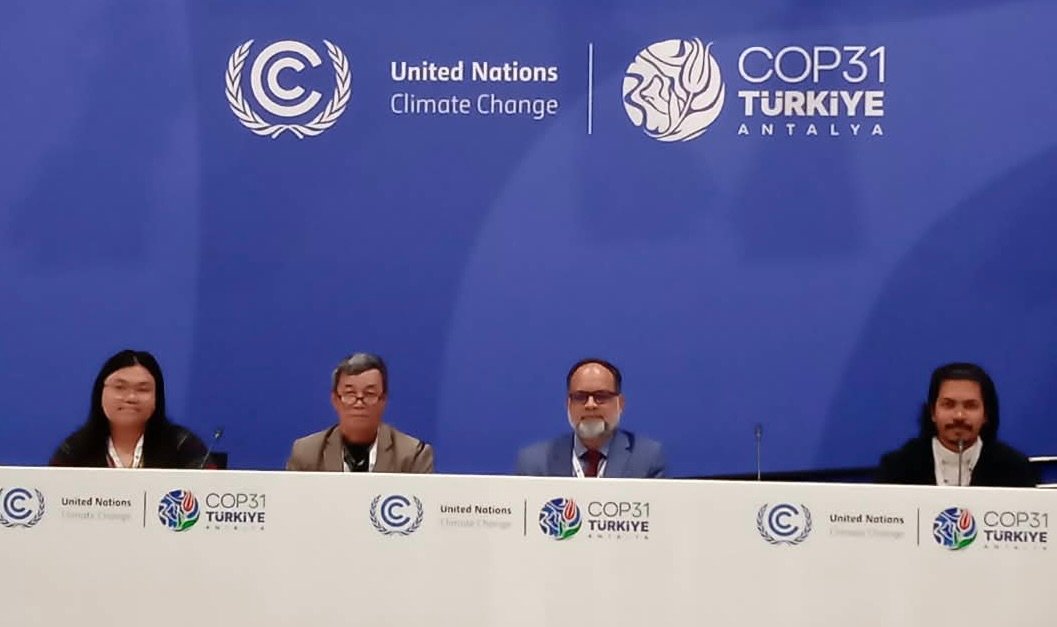
Antalya, Türkiye, 18 November 2026: Change Initiative (CI) today called for a shift in global food and climate policy: protect not only the food reaching people today, but also its safety, nutritional quality and the seed, soil, water and community rights needed to produce tomorrow’s harvest. At a COP31 press conference organised with Maleya Foundation, CI presented “Beyond Food Security: The Natural Right to Food and Global Survival”, which proposes a Food Capital Sustainability Test to reveal depletion before it becomes hunger.
“Global food governance measures how much food reaches people, but it does not measure whether the food is really safe, whether its nutrients are intact, or whether the people who grow it still control the seed, soil, water and land that produce it,” said M. Zakir Hossain Khan, Co-Founder and Chief Executive of Change Initiative and proponent of Natural Rights-Led Governance (NRLG), who presented the findings. “The natural right to food has four components, and the world measures barely one and a half of them. That blind spot is now a question of global survival.”
The presentation’s central argument is that adequate food supplies can coexist with contamination, nutrient loss and the erosion of people’s control over the resources that sustain production. International definitions of food security already include safe and nutritious food; CI argues that headline indicators do not adequately capture contamination, nutrient integrity and control over the resources that sustain production.
Hunger is only part of the crisis
The presentation brings together evidence showing how much conventional hunger figures leave out. The UN’s State of Food Security and Nutrition in the World 2026 estimates that 645 million people faced hunger in 2025, while approximately 2.7 billion could not afford a healthy diet. A 2024 study in The Lancet Global Health used 2018 dietary estimates to assess inadequate iodine intake from food for more than five billion people, excluding the contributions of fortification and supplements. These overlapping indicators cannot be added to produce a single population total.
Food safety creates another major burden. WHO’s 2026 estimates attribute 866 million illnesses and about 1.5 million deaths to unsafe food in 2021. Chemical hazards accounted for 73% of foodborne deaths. Foodborne disease caused an estimated US$310 billion in lost productivity that year, rising to US$647 billion after adjustment for purchasing power parity.
“Arsenic in groundwater is a decades-long problem, yet groundwater-irrigated rice is one of the largest mass-poisoning exposures in history,” Mr Khan said. “A household eating three adequate meals of contaminated rice a day is ‘food secure’ by every indicator in use.”
Climate change is also weakening the productive base. A 2021 study in Nature Climate Change estimated that global agricultural total factor productivity was about 21% lower than it would have been without human-induced climate change, based on analysis covering 1961–2015, with larger effects in warmer regions.
“Rights failure is not only a moral loss; it is an output loss that is already banked,” Mr Khan said. He argued that it is falling household productive capacity combined with rising prices, rather than absolute scarcity on its own, that turns food stress into disorder, displacement and social instability.
Four components of a natural right to food
CI’s proposed definition covers four components: sufficiency, meaning enough dietary energy and diversity; safety at habitual intake; integrity of the food’s nutrient content; and sovereignty over, or lawful access to, seed, soil, water, land tenure and knowledge. It extends protection to future generations and proposes duties of restoration and legal standing when the productive base is harmed. Under the proposal, these protections could not be traded away through contracts, investment treaties or loan conditions.
“A state can be food-secure and rights-failing at the same time,” the presentation states. It offers four practical checks: the Withdrawal Test asks whether another party can end access at will; the Reversibility Test asks whether a household could return to producing its own food within one season; the Body Test examines contamination or nutrient deficits from habitual intake; and the Ledger Test tracks whether food-producing resources are being replenished or depleted.
A prototype Natural Right to Food Risk Index groups countries and territories into three exposure tiers. Bangladesh is placed in the structural exposure tier alongside Pakistan, Nigeria, Ethiopia, India, Egypt and Syria. The prototype examines sufficiency, safety, integrity and sovereignty together and presents ordinal tiers rather than a numerical league table.
“The four components produce four overlapping lists, and therefore a far wider constituency,” Mr Khan said. “States that would never accept a ‘hunger’ framing will accept a contamination or sovereignty framing, because on those, they are themselves exposed.”
The hidden loss behind the next harvest
CI describes a recurring mechanism: farmer-saved seed becomes an annual purchase, natural fertility becomes purchased fertiliser, local knowledge becomes a subscription, and farm data becomes a corporate asset. Spending can rise while the household loses a self-renewing resource and acquires a recurring obligation. The proposed Food Capital Sustainability Test would make this change visible in public accounts and early-warning systems.
The presentation warns that grain supply disruptions, fertiliser shocks and climate stress can reinforce one another. In its illustrative phosphate scenario, farmers defer expensive phosphate while soil reserves temporarily sustain yields; visible losses could emerge by 2028. CI calls for monitoring soil reserves and financing balanced nutrient management before declining harvests trigger emergency responses.
Responding to an audience question on organic fertiliser, Mr Khan cautioned against an abrupt switch, pointing to the fall in food production that followed Sri Lanka’s abrupt 2021 ban on chemical fertiliser imports. He called instead for a planned transition backed by economic incentives, with governments redirecting subsidies from fossil fuels to crop and other input subsidies. “If any country focuses on food sovereignty, there is no scope to rely on chemical fertilisers, in terms of both availability and health hazards,” he said, adding that the Hormuz crisis has shown the vulnerability of fertiliser supply chains.
For Bangladesh and other downstream states, the presentation identifies sediment and river-borne nutrients as food-production assets. Interception upstream can remove a natural fertility contribution and increase dependence on purchased fertiliser. CI calls for a sediment and nutrient flux protocol in the India–Bangladesh Ganges treaty process before the existing agreement is scheduled to expire on 12 December 2026, supported by joint monitoring and published delivery ratios.
“Sediment is a food right, and no treaty allocates it,” Mr Khan said. “Whenever you cut short the sedimentation, your food production has to fail.”
Moderating the press conference, Mofazzal Hossain, Research Coordinator at Change Initiative, said: “Access to shared river rights is not a geopolitical issue alone; it is fundamental to the natural right to food. When a country seeks to control transboundary river flow in the name of geopolitics, it puts a direct threat on humanity’s access to safe and sufficient food.”
Indigenous knowledge and the right to food
Speaking about the experiences of Indigenous communities in Bangladesh’s Chittagong Hill Tracts, Dayang Tripura of Maleya Foundation said food has always meant more than simply having something to eat. “It means having access to our ancestral land, forest and water, seeds, and the knowledge passed down through generations,” she said. “For Indigenous communities, food sovereignty is closely connected to land sovereignty.”
She described Jum cultivation, the traditional rotational farming system in which rice, vegetables and other Indigenous crops are grown together and land recovers through fallow periods. Shrinking access to ancestral land, shortened fallow periods, unpredictable rainfall and climate change are now putting the system under pressure, with women carrying the greatest burden. “We should not simply replace Indigenous farming knowledge with external solutions,” she said. “We should recognise, protect and invest in the knowledge that Indigenous communities have maintained for generations.”
“Communities cannot carry the responsibility of saving the planet alone,” she added, calling for political commitment, climate finance, recognition of Indigenous land rights, and meaningful participation of Indigenous peoples, especially women and young people, in decision-making. “Food is not merely a commodity; it is a natural right connected to our land, culture, identity, mental well-being and survival.”
In his closing remarks, Mrinal Kanti Tripura, Director of Maleya Foundation, said the world is living through a polycrisis of biodiversity loss, climate change and land degradation. “Indigenous peoples live in very fragile ecosystems and they are on the frontline,” he said. “It is really important for global leaders to understand the land tenure system and the knowledge system of Indigenous peoples in relation to nature, because Indigenous peoples know how to live in harmony with nature. That knowledge needs to be considered in global policy.”
What CI is asking governments and funders to do
The response is grounded in seven NRLG pillars: recognising nature as a rights-holder; protecting life and property; nature justice; equity, integrity and shared rights; peaceful grievance resolution; community stewardship and Indigenous knowledge; and regenerative processes. CI translates these into the following priorities:
• Measure and restore the productive base. Fund the Food Capital Sustainability Test and a Safe Intake Deficit measure, establish ecological integrity thresholds, and monitor soil, aquifers and nutrient flows. Missing data should trigger precautionary assessment rather than exclusion from global estimates.
• Recognise nutritional loss and damage. Create a dedicated financing window for attributable nutrient losses linked to climate and ecological damage, alongside compensation for upstream nutrient interception and a standing Food Rights Grievance Facility.
• Make climate mitigation accountable for food displacement. Require a Carbon–Calorie Displacement Ratio for land-based projects seeking credits and make Free, Prior and Informed Consent a financing condition. CI proposes withholding credits where food displacement is not disclosed.
• Protect community control and transparency. Strengthen enforceable farmers’ rights, community seed banks and community data trusts; require disclosure of private food stocks and scrutiny of market concentration. Treat agricultural data as a shared rights issue rather than another enclosure.
• Protect import-dependent states and food infrastructure. Pursue joint reserves, mutual non-restriction pledges, joint fertiliser procurement and exemptions from export restrictions for highly dependent importers. CI also proposes protection for grain terminals and fertiliser plants regardless of the parties’ reciprocal commitments. Reopen public stockholding negotiations on food-rights grounds.
• Establish a food rights floor. Protect seed, soil, water, tenure and uncontaminated intake from being weakened by treaties or loan conditions, with accessible legal remedies and support for Indigenous stewardship.
CI proposes three delivery mechanisms operating concurrently: an Ecological Stock Council publishing regular evidence; a Guardianship Compact linking delta states, import-dependent least developed countries and Indigenous networks; and a Nature Standing Mechanism using available legal and human rights forums. States would advance common safeguards, civil society would build community records, and funders would support measurement, phosphate reserve monitoring and preventive action.
“I am not asking for a new convention,” Mr Khan said in closing. “I am asking for three things that already exist in other domains: somebody to publish the numbers, a coalition to bind itself to them, and a forum that will hear the claim we have raised today at COP31.”