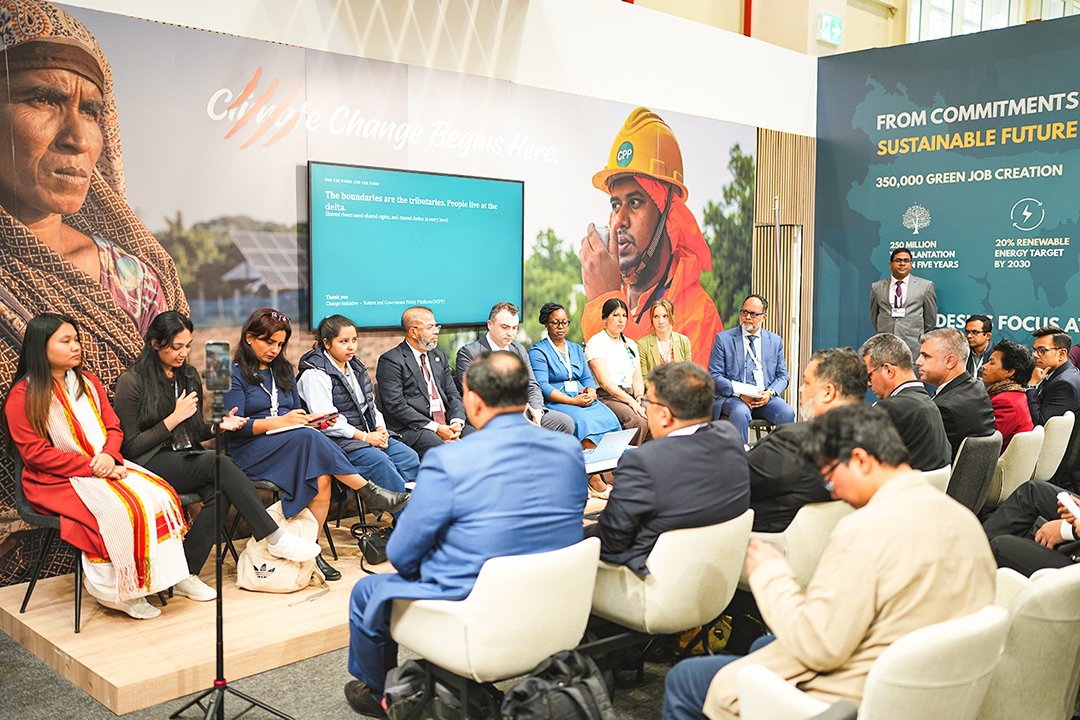
ANTALYA, Türkiye, November 9, 2026: A Bangladesh-led policy platform has called for stronger cross-border cooperation to protect rivers, secure equitable access to water and recognise the natural rights of water systems, as climate and water security emerged as key issues at the opening of COP31.
The call came at a high-level dialogue titled “Living Waters, Shared Rights: Climate Resilience through Natural Rights-Led Governance”, organised by Change Initiative at the Bangladesh Pavilion on the opening day of the UN climate conference in Antalya. The event also marked the global launch of the Nature and Governance Policy Platform (NGPP), which seeks to promote science-based and natural rights-led approaches to climate, water and nature governance.
The dialogue brought together Bangladeshi lawmakers, Turkish government representatives, international development and research organisations, climate finance experts, Indigenous representatives and civil society leaders. Participants stressed that rivers cross political boundaries and therefore require cooperation among countries sharing river basins.
Dr Shaikh Faridul Islam, State Minister for Environment, Forest and Climate Change of Bangladesh and Convener of NGPP, called for collective action to address growing water insecurity. He said sea-level rise was threatening drinking water, food security, housing and infrastructure, particularly in vulnerable countries.
“ If the Global South and vulnerable countries work together, we can argue on this platform and achieve something, so that our people can get a better life, especially drinking water and food security,” he said.
M. Zakir Hossain Khan, Co-Founder and Chief Executive of Change Initiative and a proponent of the Natural Rights-Led Governance model, said water security was central to the planetary crisis. He cited research showing that seven of the nine planetary boundaries had been breached and that deviations in river flows affected 22.6% of global land area, compared with a proposed safe threshold of 12.9%.
Highlighting Bangladesh’s vulnerability as a downstream delta, Khan noted that the country shares 54 rivers with India. He also drew attention to the expiry of the 1996 Ganges Water Sharing Treaty on December 12, 2026, arguing that regional cooperation was essential for sustainable river management.
He further highlighted inequalities in climate finance. According to Change Initiative research, Bangladesh received US$7.78 in loans for every US$1 in grants for water-supply-related climate finance between 2002 and 2023. Globally, only 0.17% of international adaptation finance during 2016–2023 explicitly referred to community-led action, he said.
Khan proposed river stewardship arrangements under which riverside communities could help map, monitor and report on shared water systems. He said NGPP could provide a policy platform for governments, experts and communities to agree on priorities, assign responsibilities and monitor implementation.
“Water is non-negotiable. Oxygen is non-negotiable. You can restrict people’s movement, but you cannot restrict a river system,” Khan said, calling for global governance frameworks informed by natural science and the ecological realities of river systems.
Bangladeshi lawmaker Mansura Akter, an NGPP core member, said people in her constituency were more concerned about access to safe drinking water, irrigation and flood protection than the broader language of climate change. “For them, water is climate change,” she said, warning that future generations would judge lawmakers by the condition of rivers and water resources they left behind.
Representing the host country, Dr Mustafa Berk Duygu, Head of the Drinking Water Department at Türkiye’s General Directorate of Water Management, said Türkiye was not a water-rich country and emphasised the importance of protecting water resources from source to tap. He welcomed technical exchanges with countries such as Bangladesh that face similar challenges.
Chitembo Kawimbe Chunga of the Climate Investment Funds stressed that locally led adaptation was essential to ensure finance reached communities that understood and managed climate risks. Dr Manohara Khadka of the International Water Management Institute called for water security to become a stronger priority in climate investment, while Sejal Patel of the International Institute for Environment and Development urged sustained, grant-based financing that would not increase the debt burden of vulnerable communities.
Indigenous representatives also called for their rights and knowledge to be recognised in water governance. Bangladeshi youth activist Twisa Tripura stressed the need for Indigenous Peoples’ inclusion and adherence to free, prior and informed consent. Fernanda Castro Purrán of Chile’s Ríos to Rivers described the struggle of Mapuche communities against further hydropower development on the Biobío River, highlighting their limited role in decisions affecting their ancestral waters.
The dialogue was organised with support from the Embassy of Switzerland and in collaboration with WaterAid Bangladesh. NGPP, launched in Dhaka in October 2026, is intended to connect policymakers, researchers, experts and communities to develop practical policy responses to climate and nature-related challenges. Change Initiative serves as its global technical secretariat.
Closing the event, Khan said the experience shared by Indigenous communities in Chile reflected a wider global challenge that should inform climate action and development planning. Engineer S. Adnan Mahmud, delivering the vote of thanks on behalf of Bangladesh’s environment ministry and Department of Environment, urged participants to turn the discussion into practical partnerships and action.