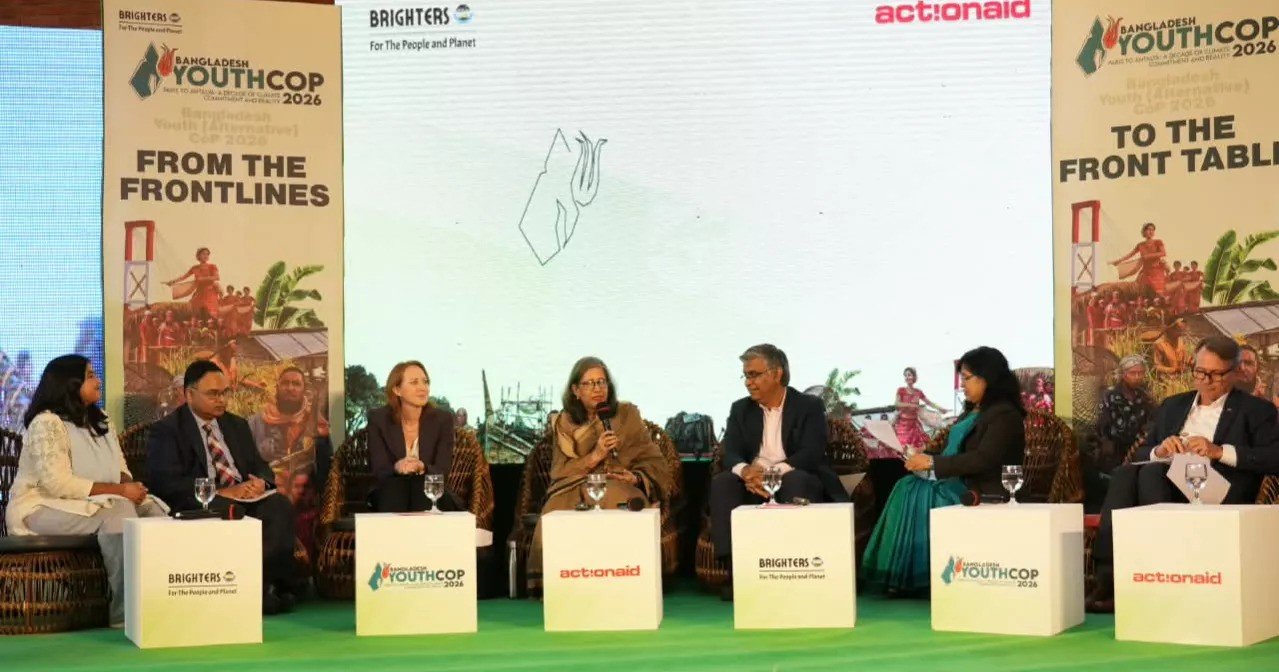
DHAKA, September 23, 2026: More than 100 young climate activists have unveiled a 20-point Youth Climate Rights Charter and submitted a position paper to the Environment Ministry, calling for the experiences and demands of climate-vulnerable communities to be reflected in Bangladesh’s national climate policies.
The charter was unveiled and the Youth Climate Position Paper 2026 was formally handed over at the closing ceremony of the four-day Bangladesh Youth COP 2026 in Tejgaon. The event was jointly organised by ActionAid Bangladesh and Brighters.
Developed through consultations with young people from all 64 districts and marginalised communities in climate-vulnerable areas, the position paper identifies seven priority areas: climate mitigation, locally led adaptation, loss and damage and climate finance, technology transfer, climate education and awareness, gender equality and social inclusion, and youth leadership in policymaking.
The paper draws on focus group discussions, storytelling sessions, participatory mapping and community scorecards, as well as experiences from seven climate-vulnerable locations and three years of research covering six vulnerable clusters.
Held under the theme “Paris to Antalya: A Decade of Climate Commitments and Realities,” the conference brought together civil society representatives, climate experts, diplomats and children from marginalised communities to discuss Bangladesh’s climate challenges and priorities ahead of COP31.
Nineteen young participants from the Climate Policy Negotiation Fellowship also took part in a mock international climate negotiation covering loss and damage, climate finance, a just transition and Bangladesh’s strategic priorities for COP31.
Speaking at the event, Dr Fahmida Khanam, acting secretary of the Ministry of Environment, Forest and Climate Change, said young people could make significant contributions to addressing the climate crisis by raising awareness, helping prevent biodiversity loss and highlighting climate risks.
Kazi Ehsanul Haque, director general of the Climate, Environment and Transboundary Water Resources Wing at the Ministry of Foreign Affairs, stressed the need for greater youth participation in climate policy and decision-making, noting that decisions taken today would affect future generations.
Australian High Commissioner Susan Ryle said effective climate action requires cooperation among governments, local communities, young people and climate-affected populations. She also said COP31 should focus on implementation and ensuring that the voices of vulnerable communities are heard.
Representatives from Denmark and the Maldives similarly highlighted the importance of linking climate policymaking with conditions on the ground and placing young people at the centre of climate action.
Nizam Uddin, a youth representative from a marginalised community in Hatiya, Noakhali, said storms and waterlogging frequently isolate island communities and disrupt transport and access to healthcare.
“Basic services and local protection must be prioritised in climate adaptation policies,” he said.
The closing session, moderated by Farah Kabir, Country Director of ActionAid Bangladesh, highlighted the importance of bringing the concerns of marginalised communities to national and international climate negotiations.
Brighters Chairperson Fariha Aumi presented the Bangladesh Youth Position 2026 on behalf of young people, which was formally received by Dr Fahmida Khanam.
The session was chaired by Ibrahim Khalil Al-Zayad, chairperson of ActionAid International Bangladesh Society, who expressed hope that the recommendations would be incorporated into Bangladesh’s official climate policy positions ahead of COP31.
The four-day programme began on September 19 with a climate march from Police Plaza to Global Platform Bangladesh, followed by thematic discussions, an international online dialogue and the closing conference.