Mollah Amzad Hossain
NEW YORK, USA
Global leaders have called for faster clean electrification and a tripling of global renewable energy capacity by 2030, saying these should be central to government and corporate strategies.
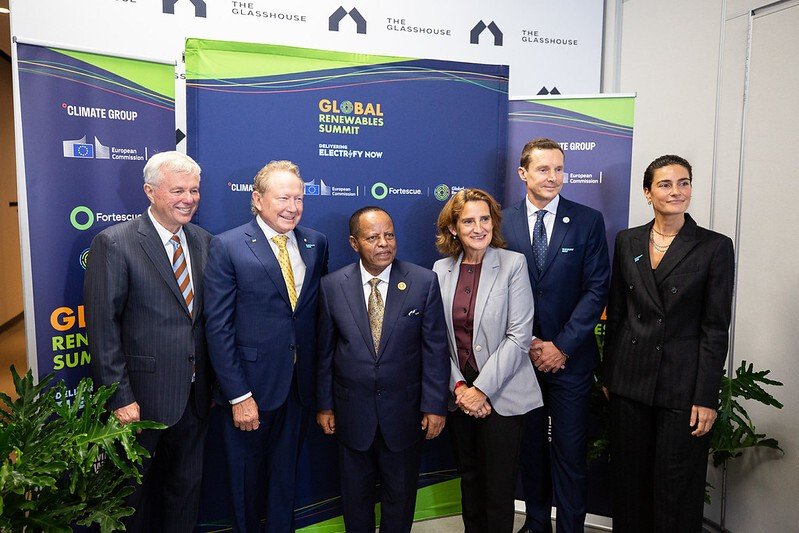
More than 20 senior figures from governments, business and civil society joined a High-Level Leaders Dialogue at the Global Renewables Summit, a flagship event of Climate Week NYC. The closed-door session was co-hosted by Fortescue, the Global Renewables Alliance and The Climate Group.
The discussion brought together representatives of the COP31 Presidency, which has identified a target of achieving 35% global electrification by 2035, along with leaders including Ethiopian President Taye Atske Selassie, European Commission Executive Vice-President Teresa Ribera, UK Secretary of State for Energy Security and Net Zero Miatta Fahnbulleh, Fortescue Executive Chairman Andrew Forrest and UNFCCC Executive Secretary Simon Stiell.
Participants stressed that future energy systems should be secure, reliable, resilient and affordable, with greater reliance on domestic clean electricity and modern, resilient power grids.
With electricity demand rising rapidly, participants highlighted the need to accelerate renewable energy deployment while maintaining efforts to reduce emissions. A survey of nearly 2,000 business leaders across 18 countries found that 90% expect their businesses to be largely electrified by 2035, with battery storage playing an important role.
The leaders also discussed investment barriers, market reforms and policy measures needed to strengthen business confidence, competitiveness and resilience. They highlighted the importance of international cooperation to prepare energy systems for wider electrification and growing electricity demand from emerging technologies, including artificial intelligence.
The discussions are aligned with Electrify Now, a global initiative launched in June 2026 to accelerate clean electrification through international cooperation, knowledge-sharing and investment mobilisation. Coordinated by the European Commission, the government coalition includes Armenia, Australia, Brazil, Canada, Ethiopia, Germany, Jordan, Kenya, Palau, the Philippines, South Korea, Singapore, Türkiye, the UK and Uruguay.
COP31 President-designate Murat Kurum said the upcoming climate conference in Antalya would focus on electrifying the global economy, with the “35-by-35” target serving as a key ambition.
Global Renewables Alliance CEO Bruce Douglas called for faster permitting, expanded and optimized grids and greater deployment of energy storage, saying these measures could help protect consumers from fossil-fuel price volatility while supporting investment and economic growth.
IRENA Director-General Francesco La Camera said the global energy transition was not progressing fast enough. He stressed that rapid electrification of end-use sectors, powered by renewable energy, would be essential to improving efficiency and reducing final energy demand while advancing the goals of the Paris Agreement.
Participants also emphasized the need for greater grid investment, simpler permitting procedures, stronger support for distributed generation and storage, and policies to accelerate the electrification of buildings and other sectors.
Brandon Spencer, President of ABB’s Motion Business Area, said the technologies needed for a more productive, resilient and efficient energy system already exist, but must be scaled up faster.
“The challenge now is scaling them faster,” Spencer said. “Achieving that requires accelerated electrification, improved energy efficiency and stronger collaboration across industry, government and civil society.”
He said the Global Renewables Summit provided an opportunity for stakeholders to turn shared ambitions into practical action, adding that such partnerships are important for expanding proven technologies, strengthening competitiveness and building a more resilient and lower-carbon energy system.