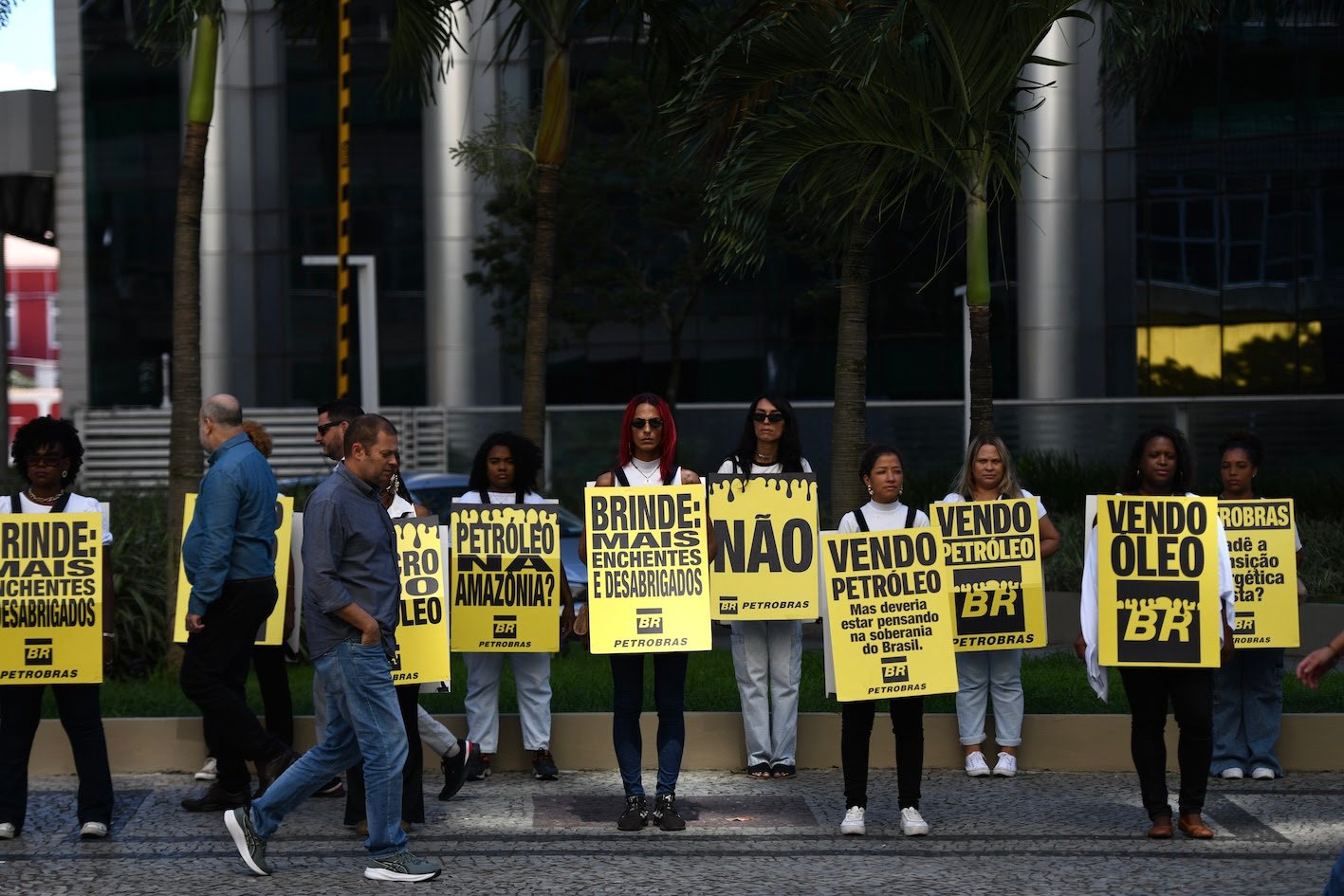
Brazil’s state-owned oil giant Petrobras has reported profits exceeding $22 billion (BRL 110 billion) in 2025, drawing sharp criticism from climate advocates who argue the company is prioritizing fossil fuel expansion over a meaningful energy transition.
Protests were held outside Petrobras headquarters in Rio de Janeiro during the company’s Annual General Meeting on April 16, where civil society organizations called for climate justice and a shift toward cleaner energy.
Activists accused the company of contradiction—promoting a “just energy transition” through influencer campaigns while simultaneously reducing investment in renewable energy. Under its 2026–2030 Business Plan, Petrobras has cut funding allocated to energy transition initiatives by 20 percent.
In a statement released in March 2026, Petrobras President Magda Chambriard emphasized the company’s continued reliance on fossil fuels, citing strong production growth as a key driver of profits. She noted that increased oil and gas output helped offset falling Brent crude prices and sustain robust financial performance.
The profit announcement comes just days ahead of the 1st International Conference on the Transition Away from Fossil Fuels, scheduled for April 24–29 in Santa Marta. The timing has raised concerns, particularly as Brazil continues to hold the presidency of the UN Climate Conference (COP) through November.
Critics say Petrobras is diverging from Brazil’s climate commitments by maintaining plans to expand oil exploration, including in environmentally sensitive areas such as the mouth of the Amazon River.
The climate policy network Observatório do Clima has proposed an alternative strategy in its 2025 position paper, urging Petrobras to diversify into low-carbon fuels and renewable energy rather than investing in new refineries.
Activists argue that the company’s profits come at a broader social cost. João Cerqueira of 350.org said fossil fuel dependency burdens citizens as taxpayers, consumers, and victims of climate-related disasters.
Similarly, Suely Araújo of Observatório do Clima stressed that Petrobras must move beyond rhetoric and take concrete steps toward renewable energy investment.
Researcher Shigueo Watanabe Jr. of ClimaInfo warned that continued investment in fossil fuels—particularly in ecologically sensitive regions—could undermine the company’s long-term financial sustainability, especially in a shifting global energy landscape.
He also noted that recent geopolitical tensions, including conflicts involving the United States, Israel, and Iran, have exposed vulnerabilities in fossil fuel-based energy security, reinforcing the urgency of transitioning to more sustainable energy systems.