New report highlights $200 bcm opportunity amid global energy crisis
Methane emissions from the global energy sector remained near record highs in 2025, with no clear signs of decline, according to the latest analysis by the International Energy Agency (IEA). However, the report underscores that proven and cost-effective mitigation measures could significantly reduce emissions while improving energy security and increasing gas availability.
The findings come from the newly released Global Methane Tracker 2026, which draws on the latest satellite data and measurement campaigns to assess emissions trends and evaluate abatement options and costs. The report was launched at a high-level international event on methane action in Paris, organized under the G7 Presidency of France.
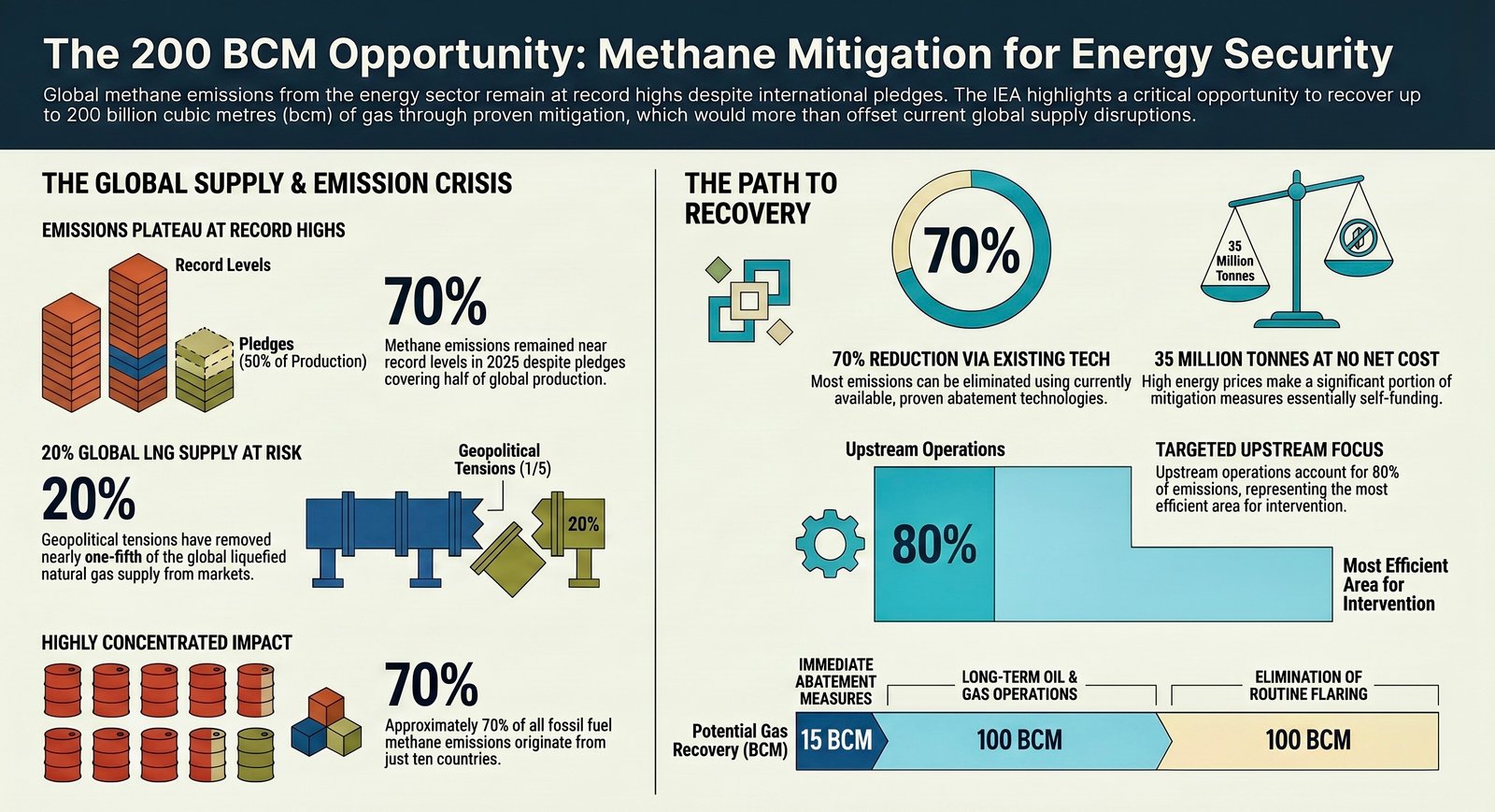
Despite growing commitments from governments and companies—now covering more than half of global oil and gas production—methane emissions have plateaued at high levels. This points to a substantial gap between pledges and actual implementation.
At the same time, the report highlights considerable scope for progress. Improved monitoring and reporting indicate that around 70% of fossil fuel methane emissions originate from just ten countries. Emission intensity also varies widely, with the most efficient producers performing more than 100 times better than the least efficient.
The report places particular emphasis on the role of methane mitigation in enhancing energy security, especially amid ongoing geopolitical tensions. Disruptions linked to the near-closure of the Strait of Hormuz have removed close to 20% of global liquefied natural gas (LNG) supply from the market, intensifying concerns over supply stability.
According to the IEA, implementing readily available methane abatement measures could quickly make nearly 15 billion cubic metres (bcm) of gas available to global markets. Over the longer term, reducing methane emissions from oil and gas operations could unlock up to 100 bcm annually, while eliminating routine gas flaring could add another 100 bcm. Combined, these gains would exceed the volumes lost due to recent supply disruptions.
Tim Gould emphasized that ambition must now translate into action.
“Setting reduction targets is only a first step. These must be backed by concrete policies, implementation plans, and real action. Tackling methane is not only a climate priority—it also offers major energy security benefits at a time when additional supply is urgently needed,” he said.
The report finds that around 70% of methane emissions from fossil fuels—equivalent to nearly 85 million tonnes—can be reduced using existing technologies. More than 35 million tonnes could be avoided at no net cost, particularly under current high energy price conditions.
A major share of emissions—around 80% in the oil and gas sector—comes from upstream operations, making them a key focus area for mitigation. Countries such as Canada and the European Union have already introduced strong regulatory frameworks, while Brazil, Ghana, and Kazakhstan are in the process of strengthening their policies.
Advances in satellite monitoring are further supporting global methane reduction efforts. Dozens of satellites now provide real-time data on large emissions events, enabling faster response by governments and operators. To enhance coordination, the IEA has partnered with the International Methane Emissions Observatory under the United Nations to launch a new response framework.
The report also highlights emerging initiatives to develop markets for fuels with near-zero methane intensity, alongside improvements to the IEA’s interactive data tools for tracking emissions and policy progress.
Overall, the analysis makes clear that tackling methane emissions presents a critical opportunity—not only to address climate change and improve air quality, but also to strengthen energy security and stabilize global gas markets during a period of heightened uncertainty.