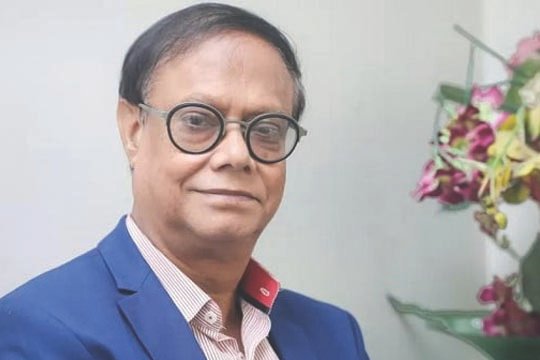
Like the economy of Bangladesh, its power and energy sector is also suffering from a liquidity crisis. The present interim arrangement for repayment of outstanding bills that the government is pursuing will not last long. These must be made free from subsidy by adopting a comprehensive plan. Besides exploration and extraction of coal and petroleum resources, required initiatives must be taken to increase contributions of solar and other renewable energy. Otherwise, it will not be possible to come out of the deep hole.
Dr. Ahsan H. Mansur, Executive Director at the Policy Research Institute of Bangladesh,said this in an exclusive interview with Mollah Amzad Hossain, Editor of Energy & Power.
Though the government is not agreeing, the outstanding bills in the power and energy sector would be worth around US$4.4 billion. The situation has threatened to create stagnancy in the sector. What is your observation?
Outstanding payments are not in the power and energy sector alone. It has now spread to almost every sector. Starting from the aviation industry and import of fertilizer, no sector of Bangladesh is now free from this menace. The cost of doing business is getting dearer for failures in making payments on time. The situation has severely impacted the power and energy sector. The situation of the energy sector cannot be improved in isolation till the overall economic situation improves. Consequently, a major disruption in the energy supply chain cannot be avoided if it happens from nonpayment of accumulated huge outstanding payments.
BPC has already borrowed a US$1.4 billion loan from ITFC at 7% interest. Efforts are being made to borrow US$500 million in additional loans. Petrobangla is also going to borrow US$500 million from ITFC. How will you explain the situation?
The impacts of such borrowing in the long term will complicate the situation. The crisis may be kept under control somehow till the ensuing general election. These are short-term commercial loans. Hence, 7% interest is not so big. The interest rate of the Federal Bank of USA is 5-6%. But the question is whether Bangladesh can repay the loan on time. These are loans from an enterprise of IDB. There is no scope for defaulting in payment. But the major question is whether Bangladesh would be able to repay on time.
The Energy Division is going for automatic adjustment of the price of petroleum products from April 2024. Do you think Bangladesh is now ready for it?
The matter of automatic price adjustment has already been delayed. There is no option for delaying it further. End users must get prepared for buying not only petroleum products, but all forms of energy based on market price. Electricity also must be supplied at market price. The government can no longer sustain providing huge subsidies.
The price of crude oil in the global market has been reduced by 20%. There should not be that great a problem if the automatic adjustment of energy pricing in Bangladesh is introduced and practiced.
Import of primary fuel is ever-increasing as the supply from indigenous sources has depleted. The total contribution of imported energy has grown above 50% now. Can Bangladesh achieve the envisioned growth in the industrial sector by absorbing the price impacts of imported energy?
Bangladesh has already graduated from a developing country. The dream is now to grow into a developed economy. There is no scope now in Bangladesh to continue supplying energy at subsidized prices. Industries now in operation must be operated by buying energy at market price. New entrepreneurs must also be ready to start businesses using energy at market price.
Entrepreneurs have also realized the situation. There are also going for energy-efficient industries. Initiatives have also been launched for setting up rooftop solar power generation for economic utilization of energy. This initiative must be further extended as much as practicable.
EMRD informs us that the prevailing dollar crisis is increasing the outstanding dues in the payment of bills of energy suppliers. Bangladesh Bank can provide required US Dollars to public sector utilities. But that is being delayed for non-availability of Taka due to nonpayment of bills against electricity purchased. It appears that the power sector is now in both a Dollar and Taka supply crisis. How can the sector come out of the crisis?
Please note that the crisis is not only in arranging the dollars required but there is also a crisis of taka. We must come out of the cheap-money policy. Taka must be made costlier through increasing the rate of interest. There is no option for it now. The most important matter is that the power and energy sector cannot get out of the present chaotic situation till the supply of dollars and Taka increases in the country’s economy. There is no scope for Energy and Power getting out of it on a stand-alone basis.
Bangladesh now has kept provision for Tk 125,000 crore payment as subsidies annually. Where would this money come from? A huge subsidy is being paid in the energy sector. Since 2012 we have kept on advising the Government to gradually and progressively get out of the subsidy regime. Unfortunately required initiatives for reducing subsidies were not taken. Rather these have been increased.
Bangladesh cannot move out of the vicious circle of borrowing till it can effectively increase revenue earning. Unfortunately, we are not able to do that.
Is there any opportunity for Bangladesh to reduce the stress created by increasing reliance on imported energy by increasing the contribution of fuel from indigenous sources?
There is no denying that Bangladesh so far could not economically utilize its primary fuel resources. This led to progressively increased dependence on imported energy. Bangladesh must explore and utilize discovered coal resources. There is scope for extending the utilization of natural gas as a transition fuel. Bangladesh must invest in coal, oil, and gas exploration in a planned manner. This will relieve Bangladesh from the stress created by imported fuel.
This is the time for expansion of the use of alternate fuel. Short, medium, and long-term plans and strategies must be adopted for expanding the use of solar and wind energy. If local solar and renewable power expansion proves expensive, we can initiate the process of importing Renewables from the Indian private sector by the private sector companies of Bangladesh. Khash lands can be made available for grid solar and other incentives like government investing in power transmission infrastructure for evacuating renewable generated to the power grid will provide incentives to local private sector entrepreneurs.
Failure to do all above will increase reliance on imported energy.
What would you like to suggest for combatting the dollar crisis?
The crisis is not for dollars only. Intra-enterprise payments are also in limbo for the taka crisis. Fertilizers and power plants cannot pay Petrobangla for gas supplied to them. Consequently, Petrobangla cannot pay for the gas and LNG it purchases. There are some other issues here as well.
Now let us discuss about dollar crisis. Money flow to the economy must increase. FDI must come in green energy projects. This has almost reduced to nothing now. Initiatives have been taken now to reduce stress on dollars through regulating imports. But the balance of payment situation in the current account still stays negative. A lot of work still needs to be done. I have mentioned above that the Taka must be made costlier by increasing the rate of interest. The dollar must be left on the market to determine its fate. Otherwise, the Taka will continue to suffer in exchange rate valuation.
Click Here to Download Interview as PDF/userfiles/Interview(2).pdf