Click Here to Download Cover Article as PDF /userfiles/V_20_15_Cover Article.pdf
The Bangladesh government has announced a power price hike through an executive order at a time when Bangladesh Energy Regulatory Commission (BERC) completed a public hearing on the proposals in this regard by the power utilities and was reviewing the observations put forward by the stakeholders concerned. Observers consider this as showing utter disregard for people’s opinion and stabbing BERC from behind. The BERC mandate authorizes it to determine the price of electricity and primary fuel through conducting a public hearing. BERC is also mandated for creating a level playground for private and public sector companies. Slowly and steadily, BERC was bringing some sort of transparency and accountability in the management and operation of the power and energy sector. The recent government action to amend the BERC act in letting the government adjust prices was nothing but stabbing BERC in the back. The purpose and objective of the BERC act have been shown utter disregard. None can understand why the government was in a hurry. Why could the government not wait till BERC completes the price determination? While the government cannot ensure a reliable supply of quality power and energy to all increasing prices through executive order is mere mockery.
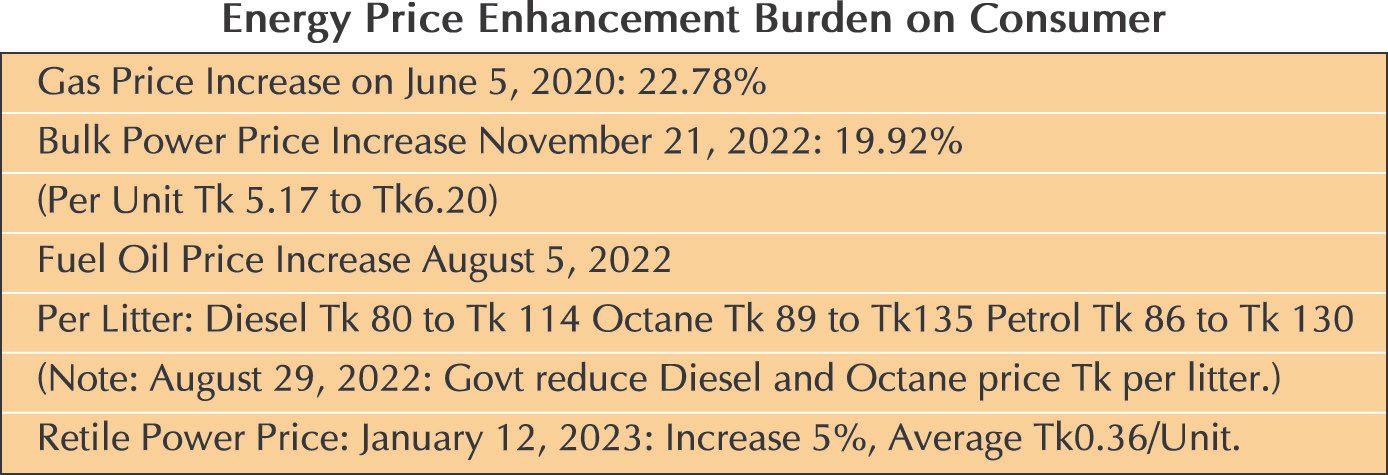
The Power Division through an executive order on 12 January 2023 refixed the retail price and service charge of electricity for the consumers under DPDC, DESCO, WZPADCO, NESCO, BPDB distribution wings and all PBSs of BREB. In addition to the increase in retail price and service, the executive order also refixed late payment charges, VAT, power factor surcharge, security deposit, payment for exceeding limits of usage and for refixing the load, bills for battery charging stations, rents of prepaid meters, etc. The government did this as per provision of the subclause 35 ka of the BERC act 2003 (Law 13 of 2003). The BERC authority was bypassed by the government in the arbitrary refixing of the retail price of power. The government earlier amended the BERC act assuming the authority to adjust the price of power and energy alongside BERC.
BERC, like independent regulatory commissions of most countries, is tasked with the creation of level playgrounds for the private and public sectors. Government formulates policies, acts and regulations and BERC works to ensure transparency and accountability. It ensures enforcement and compliance by carrying out energy auditing and management auditing. One of the purposes of BERC was determining the price of electricity and gas through public hearings. The utilities started improving efficiency. The business operation started getting transparent and accountable. In view of the present and emerging energy crisis, the role of BERC is extremely critical. Cannot understand why the government had to curb BERC authority at this stage. How can a bureaucracy-dominated government be more efficient in setting prices? Why should BERC stay when the government considers itself smart enough in determining prices? We do not believe that any donor agency or development partner can advise the government for curtailing the authority of an independent commission or abolishing it. BERC was launched with the support and assistance of USAID. We understand the World Bank, and ADB also came to support strengthening BERC. The present unpalatable situation of the energy and power sector emanated from flawed policies, strategies and the high-handedness of the bureaucracy-dominated government. We are sure the latest act of the government squeezing BERC through amendment of the act came from suggestions of bureaucrats. The government must have fallen into the trap.
BERC has failures and limitations as well. It could not employ qualified, efficient executives for driving it anywhere near its destination. Even then the creation of a gas development fund (GDF), determining the price of gas and electricity through a public hearing on the proposals of utilities was some sort of transparency to the operation of the business. In a domain where public and private sector companies are in business, the necessity of an independent commission cannot be overemphasized. The government being the owner of the public sector must not remain in business. It is tantamount to a conflict of interest. The government could amend the BERC act to the extent that it could determine prices a few more times in a calendar year. The 90-day period between conducting a hearing and announcing the price could be reduced to 45 days. But curtailing BERC authority through amending acts was not fair.
Bangladesh’s energy and power sector is neither mature nor resilient enough to absorb price adjustments every month as the state minister was alluding to. Do not understand the reasons behind his thinking, it sounds ridiculous as the government for its own failure cannot ensure a quality supply of power and energy at affordable cost. The government celebrated achieving milestones in power generation. But it is a pity that it went back to power loadshedding at last summer’s peak in managing 15,000MW power demand. The transmission grid has constraints and the distribution network has many issues. The government failed miserably in exploiting coal reserves and expanding the petroleum resource exploration campaign. It may not be unjustified that bureaucracy-dominated MOPEMR is solely responsible for the present and emerging crisis, now the desperate government is trying to seek a remedy by increasing the price of fuel and electricity. Why are the consequences of the failures of the government transferred to the consumers?
The government through the speedy power supply act bypassed the national procurement policy. Politically favored business syndicates were given generous permission for setting up contingency power plants in a non-transparent manner. Why has the power market peak demand of 15,000MW over 25,000MW plus installed generation capacity been created? Private sector entrepreneurs have reasons to claim capacity charges if sole buyer BPDB fails to purchase minimum contracted power. BPDB, paying capacity charges through its nose, is on the verge of bankruptcy. Who benefitted from the huge reserve margin? High-capacity charges caused higher generation costs. Transmission grid constraints handicapped capacity utilization. An unreliable distribution network caused industries to set up expensive captive power plants. These plants use about 15% natural gas. This gas could be better utilized had the power distribution utilities could guarantee 24/7 reliable grid power. The government could not plan and execute projects for the utilization of its own coal resource or expedite the exploration of petroleum from onshore frontier areas and offshore. Gas supply is now a major constraint not only for power generation but also for the operation of industries, especially export-oriented industries. Flawed government policy and strategy in ignoring own fuel resource development and going for imported fuel are among the main reasons for the crisis, Petrobangla companies have no resources for importing LNG from the spot market. BPDB is huffing and puffing in making payments to IPPs. The above situation put Petrobangla in the catch-20 situation for adjusting the price of fuel and electricity. But the government must not have assumed responsibility for adjusting prices while BERC is mandated for that.
At a time when the global crisis is looming large with the possibility of economic meltdown, price increases in electricity will obviously have domino effects. Price increases in liquid fuel and gas have already impacted the cost of living. Moreover, the government cannot ensure quality power and gas supply on a sustainable basis. Now the price has already reached beyond an affordable limit. The government falling into the trap of a miserable bureaucracy has delivered a deadly blow to the existence of BERC.
The government has not acted in the public interest. Rather the opinions and observations of different stakeholders (Consumers Association of Bangladesh, different trade bodies and organizations, civil society representatives, etc.) provided in the public hearing were not heeded. The government did not care or wait for BERC determination. If this continues to happen, there is no justification for the existence of BERC. In developing and developed countries, regulatory commissions act as quasi-Judicial organizations. But through the latest act, the government served a deadly blow to BERC. Many observers thought that BERC now is effectively dead and buried. We understand the government may have been pressed for reducing or abolishing subsidies. But these could be done through adjustment of prices based on BERC determination as was being done in the past. After all, BERC was in the process of conducting a public hearing. Wonder how the government claiming democracy can show utter disrespect to public opinion. The government really put BERC to the brink.