Introduction
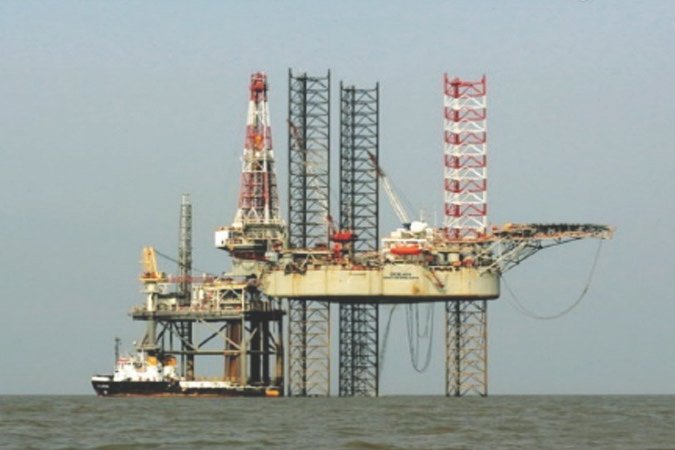
Sangu is Bangladesh’s first offshore gas rig project, which is 40-50km off the Salimpur coast, Chattogram. Built by Petrobangla in 1998 with the help of international companies – Cairns and Santos – it initially produced 50 mmcfd of gas before increasing it to 180 mmcfd. Finally, the production dropped to 18 mmcfd in 2011. It was declared abandoned when production dropped to 2.0-3.0 mmcfd at the end of 2013.
The offshore platform Sangu remained abandoned over the past seven years, apart from the loss of usefulness, posing a threat to permanent damage. Though the gas field is shut down, a big amount of money is spent on its maintenance. So, the advice aims to show how we can revive such aquatic infrastructure through adaptive reuse as an alternative to demolishing.
Petrobangla, the owner of the platform, can modify it and use it as a gateway to import LNG, store, regasify and supply gas to the national grid through a seabed pipeline to existing facilities.
Sangu facilities include:
Platform in the Bay of Bengal
Onshore gas process plant
50-kilometer, 20-inch diameter subsea pipeline from the platform to the onshore plant.
The onshore gas process plant is located at Fouzdarhat in the south-eastern Chattogram district.
FSRU: FLOATING STORAGE REGASIFICATION UNIT
FSRU is used to supply LNG to the NG transmission pipeline. Normally, LNG carriers visit these FSRUs periodically to provide. LNG is stored in floating LNG carrier (ship) storage tanks and later liquid fuel is regasified by regasification units. It will increase the delivery pressure of gaseous fuel so that it can be transported through subsea pipeline systems to the NG transmission grid.
Barge FSRU LNG Terminal: LNG from carrier (ship) offloaded to flatbed Barge LNG tanks.
The BFSRU tanks: Tanks are designed to store LNG at a very low temperature (around -160 c) and insulation is specially designed to protect against any spill and to reduce brittleness.
Loading and unloading systems: Unloads LNG from carrier to barge LNG storage tanks.
Regasification System: Regasify LNG to NG to export regasified fuel to the national grid.
Power Generation: BFSRU uses boil-off LNG for power and doesn't need other fuels.
Mooring systems: Designed for a permanent basis are for a continuous supply of natural gas to the grid with design life ranging from 15 to 25 years.
A Large-Scale FSRU on Barge
A large-scale FSRU is a fit-for-purpose facility designed with practical operation considerations. It features scalable storage capacity from 150,000 cu m to 265,000 cu m and a base case design of 750 million standard cubic feet per day regasification capacity expandable to fit the needs.
BFSRU is designed for near-shore or offshore with a single-point mooring system. The full-size floating BFSRU LNG terminal anchored to an offshore platform, offers an economical alternative to the conventional LNG FSRU, especially for markets with long-term demand.
The barge design lowers initial capital investments by an estimated 20-30 % compared with FSRU of equivalent size as well as O&M costs, while enabling uninterrupted service throughout the project lifecycle. A comprehensive range of FSRU will cater to LNG import markets with various scales of demand. BFSRU integrates the functions of LNG loading, storage, and regasification.
BFSRU is designed for the storage of LNG on non-propelled barges with a regasification capacity of 750 MMscfd. By adopting a modularization strategy, tanks and regasification modules can be fabricated simultaneously, which not only reduces the risks of safety but also improves construction quality.
The unit will be connected to the Sangu fixed offshore platform. The platform-based BFSRU will be engineered and developed to facilitate LNG import and Regasification as a fixed-floating terminal.
The platform-based BFSRU consists of multiple barges forming a bridge platform-connected to offshore platforms capable of receiving un-loaded LNG from the tanker, storage, and regasification. Existing utilities and accommodations facilities in the offshore platform can be used. Platform-based BFSRU concept is an alternative to onshore LNG import terminals or FSRU.
Platform-Based BFSRU Solution
The offshore-fix platform is connected to floating barge-bridge LNG unloading, storage and regasification facilities connected to the onshore national grid pipeline via a seabed pipeline. The offshore structures are coupled with LNG regasification and storage barges. The concept relies on conventional jacket solutions for shallow water to water depths of up to 60m. It is principally designed to address offshore import terminals at locations between near-shore and deepwater.
Key enablers for the development include the fit-for-purpose structural design of the fixed platforms. The floating barge platforms are engineered to support substantial loads of BFSRU with a regasification unit at full capacity. Advances in the flat-panel barge LNG storage system have facilitated the evolution of the Platform based BFSRU solution.
Completed concept development requires pre-FEED feasibility studies for the Sangu Offshore Platform. The pre-FEED includes optimization of the general design concept and harmonization with safety and environmental regulations. The installation strategies should be based on the initial design of the Sangu Platform as a terminal, which is capable of integrating with the BFSRU processing facility. Two BFSRUs are to be installed and anchored to the platform tied to the seabed pipeline.
Comparing Alternatives: Alternate to the BFSRU has the following characteristics:
· FLNG vessels are considered best suited for deepwater offshore applications, typically for accessing stranded LNG Imports. However, they require significant capital investment.
· Onshore LNG terminals have a significant construction risk, with a large percentage of contracts either delayed or over-budgeted.
FSRU: Current LNG FSRU regasification of Excelerate Energy and Summit Group at Moheshkhali Island in the Bay of Bengal were disrupted several times due to rough seas. It is a natural disruption and will repeat during the annual monsoon windy and storm season.
Advantages of Sangu Platform-Based BFSRU
Location
Sangu platform is located at calm sea near the gas processing terminal near Chittagong port at Silimpur, which is free from sea turmoil. Unlike the country's two operational FSRUs, it has the advantage to be functional even during peak monsoon season without interruption
After giving due consideration to site-specific bathymetry and geotechnical/geophysical conditions, the BFSRU solution was found suitable and can be easily deployed on the Sangu Platform. The existing offshore site provides a fixed anchor for Barge LNG storage and enhanced online regasification, with fewer weather-related interruptions, and eliminated port congestion and terminal maintenance.
.jpg)
BFSRU vs Onshore LNG Terminal: Onshore LNG terminals are predominantly developed for baseload (large-scale) capacities. A Platform based BFSRU terminal can be designed in incremental intervals for capacities to meet small, mid-, and large-scale demands, as required.
Platform-Based BFSRU concept is considered favorable for the incremental small, mid or large-scale LNG segment as a viable alternative to either onshore or offshore FSRU. The capacity of near-shore FLNG, or FSRU, could be widely constrained if rigorous regasification requirements are needed as limited by the available deck space for a given hull size. Whereas the modularized BFSRU has no such constraint due to the construction of stackable levels and/or additional Barge platforms to meet such requirements.
Storage: Another parameter regarding terminal capacity is the size and type of LNG storage. An onshore terminal is for large storage. Of the offshore alternatives, the BFSRU is the most flexible, and storage barges can be added and tailored for project volume requirements.
Alternate to a barge LNG tank is a bullet-type tank design on a barge incorporating several elements that differentiate it. These include a lower construction cost for equivalent tanks for most sizes, and the ability to be fabricated in parallel with the barge bridge to shorten the critical path.
Water depth: Water depth is very relevant to all offshore solutions. Therefore, water depths are dictated by the design draft requirements of the LNG carrier fleet visiting the BFSRU unit for unloading. So, site weather conditions (i.e., storms and hurricanes) can play a decisive role in the configuration. The FSRU solution is involved significantly with higher loads on mooring systems than fix Platform BFSRU locations, making the mooring system more complicated.
.jpg)
BFSRU solution overcomes space limitations of the FSRU and water depths and site conditions. The SANGU offshore structure is constructed with deep support piles penetrating the seabed, allowing for greater stability, simpler mooring, and increased terminal utilization rates.
Cost considerations
Onshore LNG terminals, especially greenfield projects in remote locations can involve high costs, long schedules, and complex execution plans, making them cost-prohibitive, particularly for small and mid-scale LNG projects.
FLNG or FSRU solutions requiring sophisticated, high-technology designs of offshore components tend to involve similar drawbacks.
Platform-based BFSRU terminals are being developed as alternatives to offset these cost impacts with various drivers including relatively simpler system components, and parallel construction strategies which are faster and less expensive to develop.
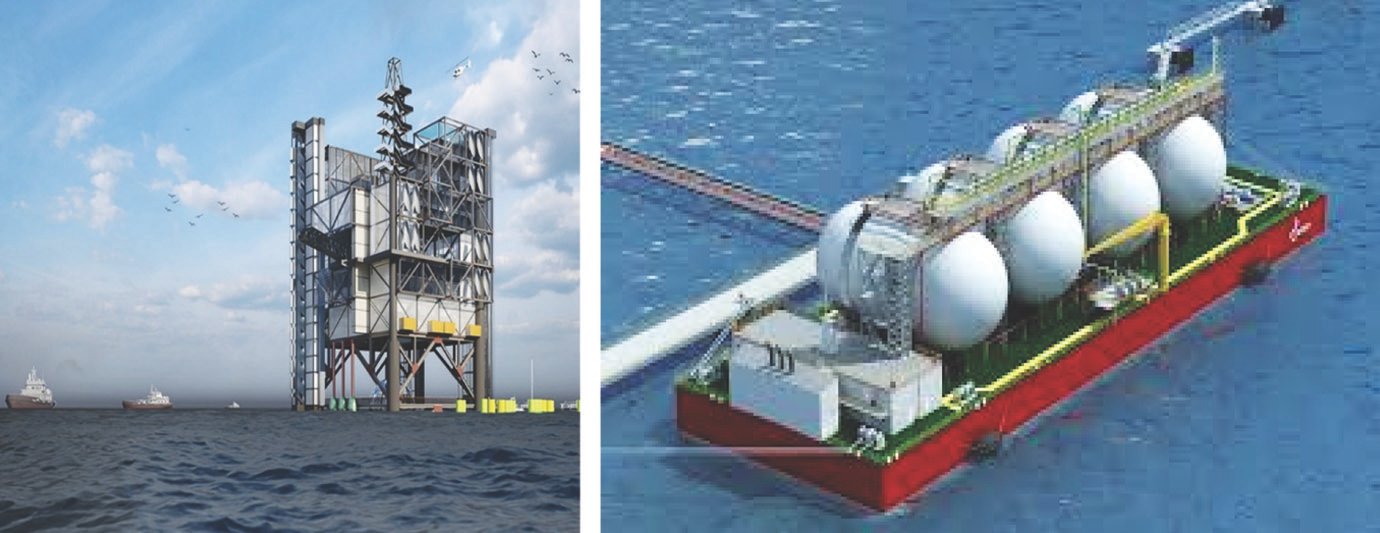
The BFSRU concept utilizes proven topsides equipment, including Regasification technologies, LNG storage tanks and standard LNG unloading arms widely used in onshore, near-shore FLNG, and FSRU applications. Reliance on less sophisticated equipment helps reduce the overall project costs. The use of fixed platforms BFSRU for LNG unloading greatly simplifies the configuration as compared to FLNG and FSRU.
Safety
BFSRU solution is less complex as separate terminal components are in their own fixed barges allowing for “plug-and-play” flexibility and scalability. The risk of hazards is manageable and is inherently safer design eliminates risks through spacing.
To promote positive safety assurance, the BFSRU layout configurations are developed and modified such that:
@ Separation distances between LNG gasification and storage provide a safeguard from potential leakages and dispersion to live equipment.
@ The marine docking arrangements are set downstream of the prevailing wind and current, so LNG carriers can drift away in case of mooring failure.
@ For personnel safety, the accommodations will remain on the offshore platform.
@ The BFSRU terminal orientation, loading, and berthing arrangements are configured to facilitate the approach of LNG carriers relative to established shipping routes.
It is of high importance to have urgent government action to use the Sangu platform with its seabed pipeline before it’s damaged. As millions of dollars were invested there, the government can allow a private company in PPP form to engineer, procure, and install platform-based Barge FSRU Terminal and supply regasified LNG to end-users through the existing pipeline on a BOO basis.
Conclusion
The platform-based BFSRU concept excels as an alternative for mid-scale LNG developments in 60 m or less water depth near-shore locations. The concept is flexible and scalable, accommodating additional capacity as necessary. The Platform based BFSRU concept is suitable as an alternative where an onshore LNG facility may be cost-prohibitive, or site constrained. The BFSRU is cost-effective, fast to construct, and less complex to execute than other LNG infrastructure solutions.