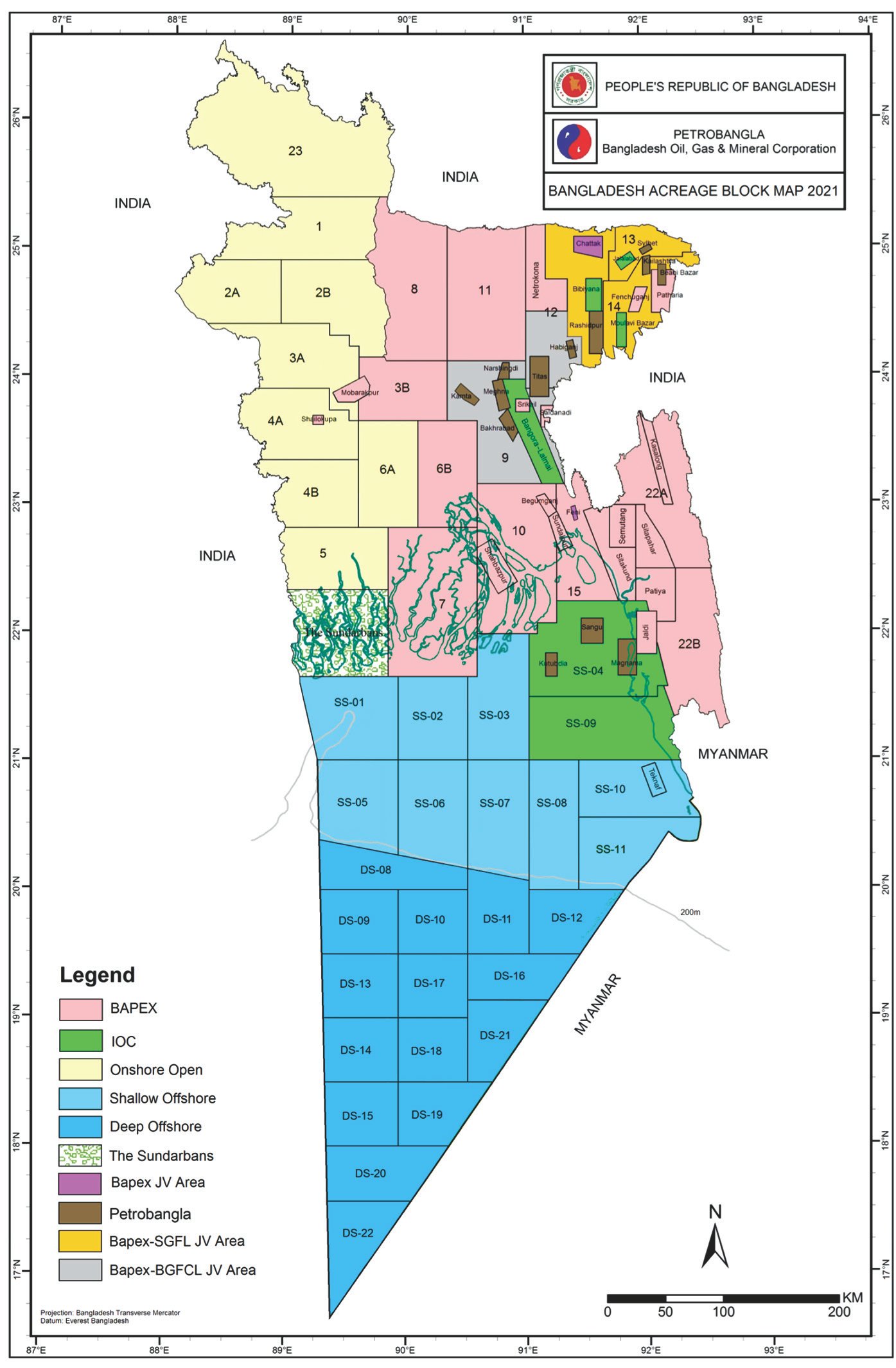
Bangladesh, like the rest of the world, is struggling from the topsy-turvy global fuel market situation triggered by the COVID-19 pandemic and the Ukraine war. The circumstances of Bangladesh are a bit different. For many different reasons, it failed to expertly explore and exploit huge potential hydrocarbon resources believed to be buried below the bed of the blue waters of the Bay of Bengal. Neither could it exploit its potential resources in onshore frontier areas. The mission for importing fuel from the global market is constrained by the absence of a deep sea port and shallow coastal region. Volatile global fuel market and supply chain disruptions for regional and global geopolitics have also put paid to Bangladesh’s endeavors for confronting the challenges emanating from the huge deficit of natural gas and fuel. Virtually nothing has been done to aggressively exploit the offshore potential. The present global situation may not encourage leading IOCs to commit fortunes to offshore exploration. But Bangladesh has no option but to go for a fresh round of PSC bidding by the end of 2022. The contractor engaged in carrying out multi-client surveys may also start working soon.
Relevant experts for a long time have been talking about the bright prospects of discovering significant petroleum resources in the deep and shallow water of the Bay of Bengal. But that possible or probable resource could not be harvested in the right earnest and remains buried for decades. Some large and small-to-medium gas fields were discovered from the late 1060s to 2000 in the onshore areas and most of these were developed subsequently. Shangu is the only offshore gas field that was developed. That field got depleted after exploiting that reserve for a few years. For various reasons, offshore exploration did not get the required momentum through a major impediment- the maritime boundary disputes with Myanmar and India - got resolved a few years back. Shangu gas field was discovered by Cairn PLC and later developed and operated by Santos Australia. ConocoPhillips USA worked on some blocks for a few years and after conducting seismic surveys went back relinquishing their blocks. The same thing happened with Posco-Daewoo. Though lack of data and information on deep water is sometimes quoted as the main reason for the lukewarm response of IOCs in Bangladesh offshore, the main reason remains unknown.
Following the oil shock triggered by the outbreak of the Arab–Israel war in 1974, the Bangabandhu government could launch exploration for petroleum in the Bay of Bengal as the first country in the region. The model PSC was developed, and approved, a bidding round was announced, and 6 IOCS were engaged for the exploration in 8 offshore blocks. All these were accomplished in the shortest possible time. Following the unfortunate killing of Bangabandhu, all IOCs left the country one by one relinquishing their assigned blocks. The Kutubdia gas field was discovered by Union Oil Company. Significant information and data on offshore resources were gathered from seismic surveys. Data from works of Cairn-Santos, ConocoPhillips, and Daewoo-Posco, we believe, can be packaged with the PSC bidding document. Some policymakers having no hands-on experience working as professionals in the energy sector are talking negatively about Bangladesh’s gas prospects. We hope none will talk about matters about which he/she has no clues. Petroleum resources need exploring, testing, and assessing. Before doing all these in professional manners by experts none should indulge in uninformed academic debates.
Chronological Development of Offshore Exploration
Apart from the discovery of the Kutubdia gas field by Union Oil Company in the 1970s, the Shangu offshore gas field was discovered by Cairn Energy PLC (Later assigned to Santos, Australia) in 1996. Starting production in 1998 the field got watered out on 1 October 2013. About 500 BCF gas has been produced from the field. Santos drilled 2 more wells at South East Shangu and South Shangu. It also drilled well at Magnama. But these works could not conclude in a commercial discovery.
PSC was signed with Total E&P Bangladesh on 18 January 1997 for explorations at block 17 (now block 10). It carried out 2065 line-kilometer 2D seismic surveys from 1997–99. Later in 2009, it also carried out 283 square Kilometer 3D surveys in Teknaf prospect. Total left Bangladesh finding no encouraging indications for further exploration.
Through another PSC bidding round in 2008, ConocoPhillips was awarded PSC for two deepwater blocks DES-10 and DS-11 on 16 June 2011. IOC carried out 5860 line-Kilometer 2D seismic surveys. Talks were there of identifying some potential structures. But ConocoPhillips left Bangladesh relinquishing the blocks after their parleys for changing some conditions of PSC and gas price review.
Two PSCs were signed with ONGC Videsh Limited (OVL Limited), Oil India Limited, and BAPEX for two blocks SS4 and SS9 on 17 February 2014 following the successful resolution of the maritime boundary dispute with Myanmar. The operators carried out 5081 line-kilometer 2D seismic surveys and upon an interpretation of data selected 2 drilling locations at SS4 and SS09. From September 2021, they started drilling at Kanchon 1. The work was completed in March 2022. But the exploration did not yield any positive dividend even after drilling up to 4228 meters in depth as per the plan. Exploratory wells will be drilled at Titli 1 at SS04 and Moitri 01 at SS09 by February 2023.
Through the same bidding round, another PSC was concluded with Santos Shangu Field Limited, Australia for SS11. Santos carried out 3146 Line-Kilometer 2D and 305 square kilometer 3D surveys. Upon interpretation, some potential structures were identified through interpretations. But for the decision to withdraw from operations in Asia, Santos quits Bangladesh, relinquishing the block.
Two rounds of PSC bidding were conducted following the resolution of the maritime boundary dispute with India. The first round did not achieve any response. Through the subsequent bidding round, PSC could be concluded with Posco-Daewoo for exploration in deep water block DS12. IOCs carried out 3580 line-kilometer 2D seismic surveys. They completed their mandatory requirements but they left Bangladesh failing to reach a meeting of minds with Petrobangla for reviewing some fiscal incentives.
Petrobangla Initiatives for Offshore Exploration
Petrobangla after persistent efforts for 4 years could sign an agreement with TGS Schulmberger JV to carry out non-inclusive multi-client surveys over 32,000 Kilometers in 22 offshore blocks of the Bay of Bengal on 21 March 2020. TGS Schlumberger has obtained Environment Clearance Certificate (ECC) as a stepping stone of their works but has not started survey works as yet. They informed Petrobangla that they could not start work as they have not received any pre-funding commitment from any international oil company. They also informed that greater interests can be attracted from IOCs if incentives of Model PSC can be increased. That will also pave the way for them in getting pre-funding commitments. However, they are continuing their parleys with IOCs for pre-funding and they expect to commence works in the ensuing dry season.
Model PSC 2012 was updated and replaced with offshore Model PSC 2019 adjusting and widening fiscal and financial incentives making it more investor friendly. Government approval was accorded. Time bound action program necessitated for inviting bidding round by September 2019 in print media and website. But the outbreak of COVID pandemic put paid to it.
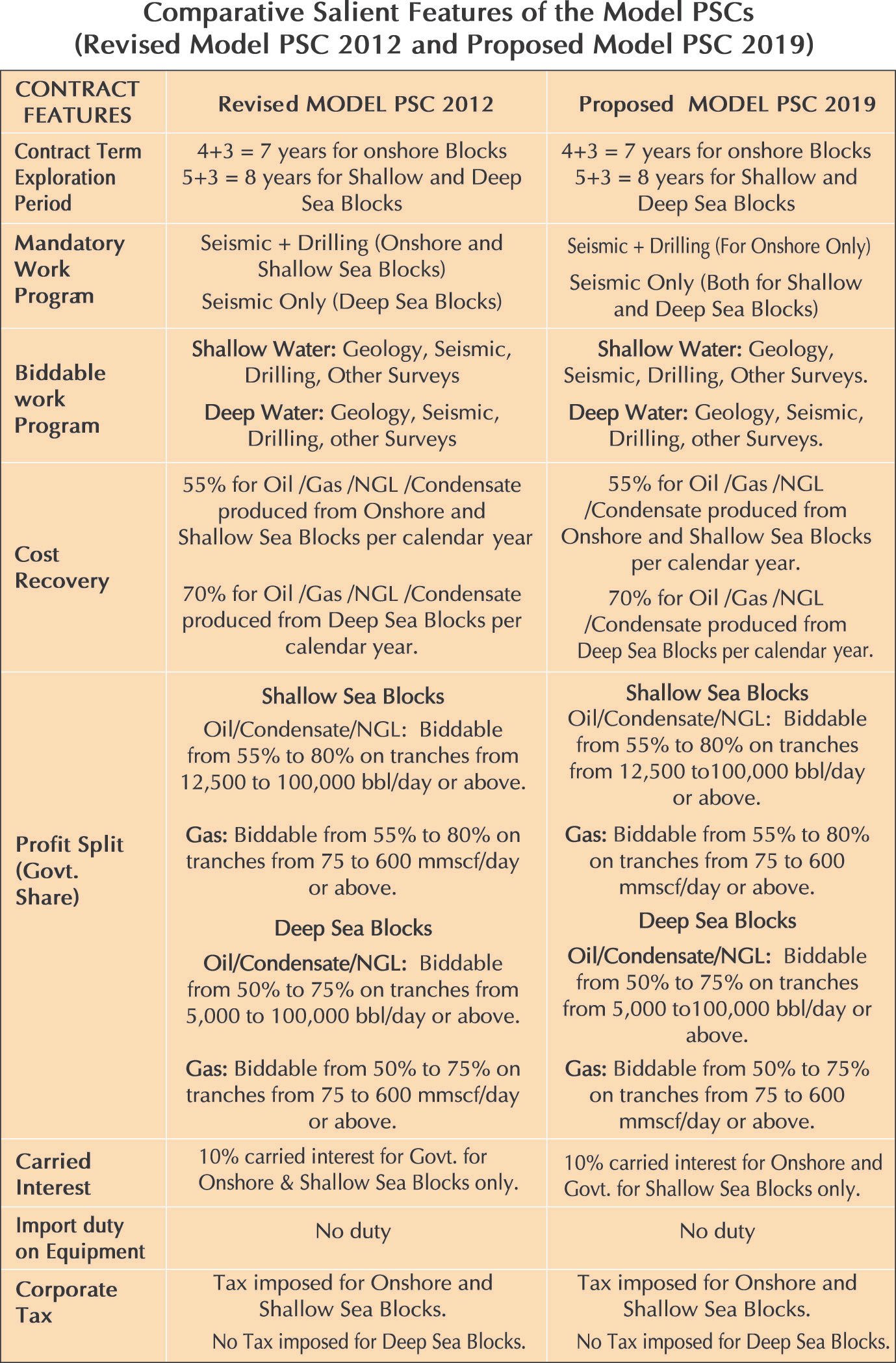
Since 2010, three PSCs were signed for 3 deepwater blocks and two PSCs for 3 shallow water blocks. 17,767 line-kilometer 2D and 305 square kilometer 3D surveys have been carried out under the provisions of these PSCs. Two exploration wells in 2012 - one in 2015 and another in 2017 - were drilled. But these, however, did not lead to any commercial discoveries. Exploration onshore is continuing at its own pace. Commencement of exploration activities both at shallow and deep water will create fresh dynamism for a positive outcome.
Observations
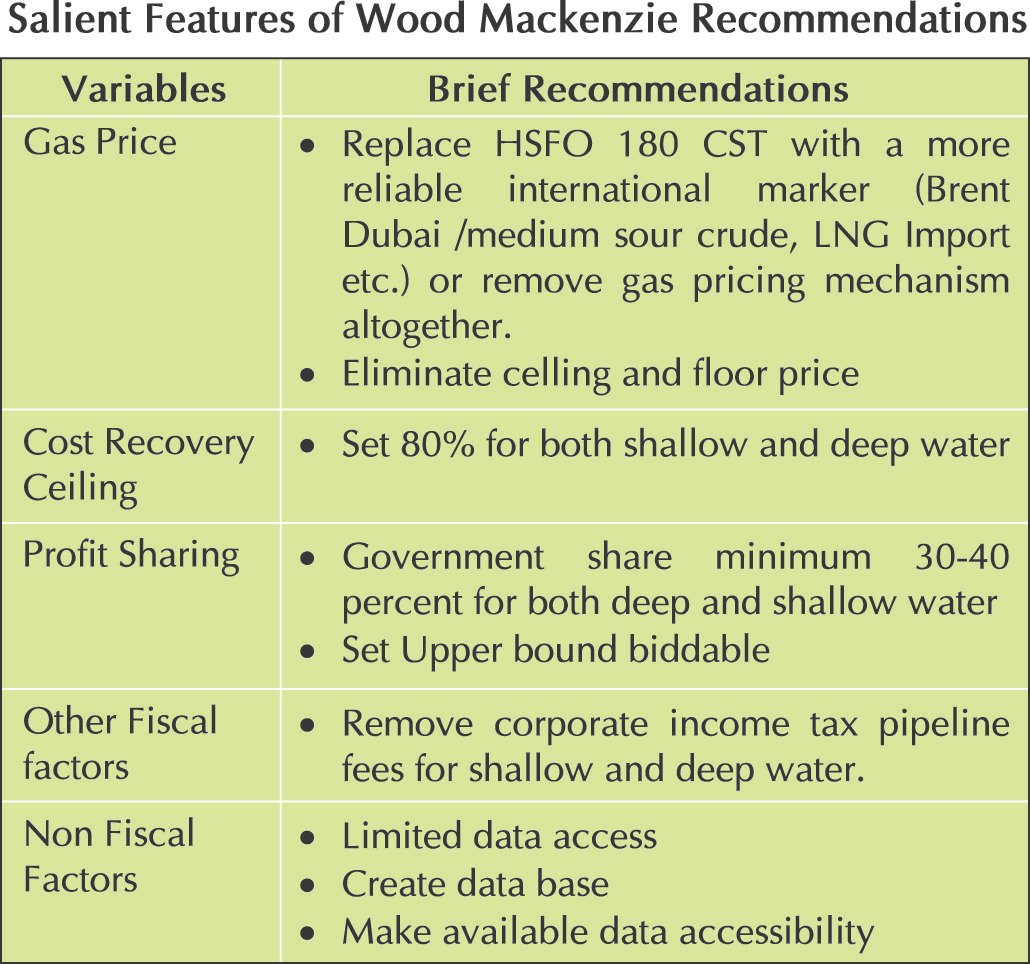
Gas price fixing is a major disincentive for IOCs in Bangladesh offshore exploration. In the past, ConocoPhillips and Posco-Daewoo reportedly left Bangladesh failing to come to terms with Petrobangla over price revision in 2016, Monash University, RMIT administered a capacity enhancement program of Petrobangla officials at Adelaide in Australia, an exercise with a standard pricing model gas price was computed as US$8.00/MMBTU for an imaginary discovery of a 2 TCF gas reserve 200 KM off Bangladesh coastal line. Now in 2022 even if we use that model gas price will not be less than US$12.00/MMBTU. Other fiscal and non-fiscal adjustments that Wood Mackenzie proposed appeared acceptable.
Every IOC plans risk investments for making profits after recovering investments. They follow a financial model. None can prepare a win-win bid for a PSC lasting for 20 years while a model PSC contains ceiling and floor prices. We completely agree with Wood Mackenzie’s recommendation for doing away with the gas pricing mechanism. It should be linked with alternate fuel prices (crude or LNG) and may be openly biddable. All available data must be immediately made accessible to all intending bidders. We do not understand what Petrobangla and EMRD gain from keeping these wrapped up. We believe that the data Bangladesh possess is good enough for attracting IOCs at least for preparing bidding document. It is like looking for a bridegroom hiding the site of the bride.
Conclusion
Through the resolution of the maritime boundary dispute with Myanmar, Bangladesh lost some potential gas blocks adjacent to Cox’s Bazar where Myanmar made few discoveries. The chances of finding gas in adjacent blocks are bright. Woodside Petroleum Australia voluntarily proposed to invest in 5 blocks which government should have considered. Hope IOCs will be encouraged in bidding if fiscal and other incentives of the revised model PSC facilitate win-win prospects for risk investments. The IOC community is worried about prolonged delays in decision-making. Time is the essence of such ventures. Delays change the situation.
Bangladesh has made extraordinary delays in the exploration of petroleum in onshore frontier areas and offshore. Less than minimum exploration work is one of the main reasons for the present huge gas deficit. Offshore exploration could be started at least 4-5 years earlier if Petrobangla and EMRD could be more proactive. Relevant experts were pressing for it but they were not heeded. What has been done with the multi-client survey was a scam. There was no reason for waiting for it. Bangladesh already has enough data to start. No entertaining proposal of Woodside Petroleum for 5 offshore blocks was a huge mistake. ConocoPhillips and Posco-Daewoo proposals could be given more thought. Some persons at the decision-making level have wrong perceptions about Bangladesh’s gas resources.
Bangladesh in near future may find it extremely challenging in accessing primary energy from the volatile global fuel market. Offshore exploration may take at least 7-8 years to bear fruits. But for that happening, we have no scope to keep our fingers crossed. Dream of Bangladesh cannot remain buried under the blue water of the Bay of Bengal for an indefinite period.