LNG or liquid natural gas is a cryogenic fluid. In Greek ‘Cryo’ means very cold, and ‘genics’ is a common root for the English verb – to generate. So, cryogenicsis generally referred to as the science and technology of producing low-temperature environment for applications. It is a multidisciplinary science and have wide variety of areas as metallurgy, chemistry, power industry, medicine, rocket propulsion, to name but a few of them.
A number researchers define cryogenic temperature as those ranging from 123 Kelvin (-150 deg C or -238 deg F) down to 0 Kelvin (-273 deg C or -450 deg F). It generally means in cooling process till 123 Kelvin it is refrigeration, but if it is required to achieve temperature below 123 Kelvin it would be considered as cryogenics. Common Cryogenic fluids are Liquid Hydrogen, Liquid Nitrogen, Liquid Oxygen, Liquid Helium and LNG.
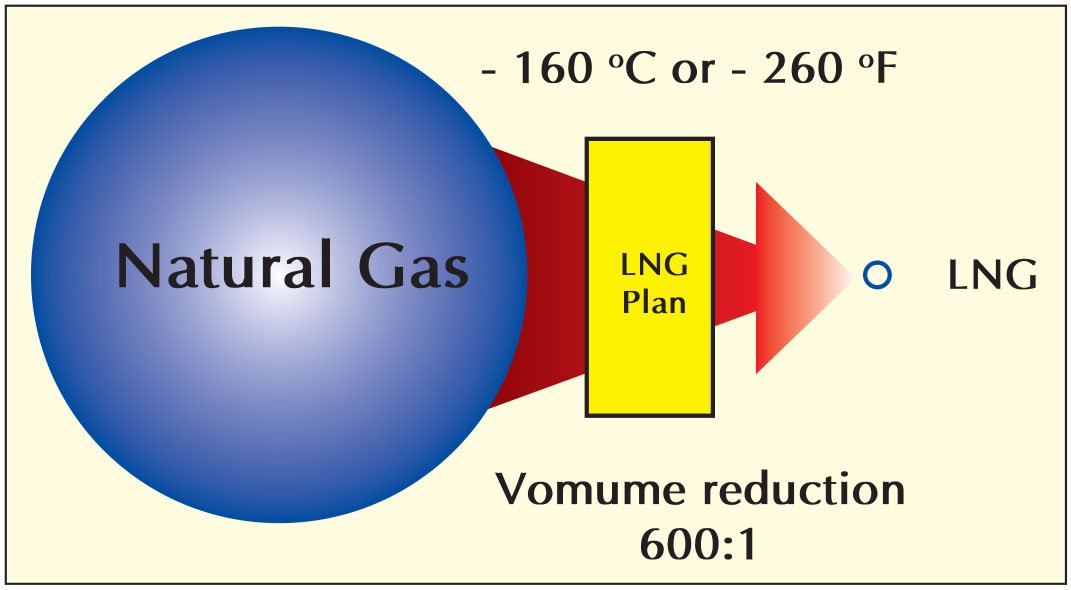
The most important commercial application of cryogenic gas liquefaction technologies is the storage and transportation of liquefied natural gas. In this process natural gas is cooled to -260 Deg. Fahrenheit, thus shrink the volume by about 600 times. LNG or liquid natural gas is clear, odorless, noncorrosive liquid. It is not stored under pressure and is not explosive or flammable in its liquid state.Specific materials are used in Cryogenic operations, because metal properties are changed in temperature changes. Instrumentation and calibration techniques are also different in cryogenic conditions.
History
Transportation of LNG is done in specially designed ocean vessels. Ocean transportation is undertaken wherever traditional pipeline transportation systems would be less economically attractive and could not be technically infeasible. Thus, LNG technology makes natural gas available throughout the world.
In January 1959, the world’s first LNG tanker, The Methane Pioneer, a converted world war-II Liberty Freighter built in 1945 and originally called the Marline Hitch, carried 5,000 Cu Meter of LNG in five 7000 bbl aluminum prismatic tanks with balsa wood supports and insulation of plywood and urethane form Lake Charles, Louisiana, in the United States, to Canvey Island in the U.K. The first commercial LNG plant in Algeria became operational in 1964 and exported LNG to western Europe.
The World's top five Liquefied Natural Gas Exporters are: Qatar, Australia, Malaysia, Nigeria and Indonesia. In 2016 Qatar exported 77.2 million metric tons (MMT) of LNG, 29.9% of the global total. The country is still the third-largest reserves in the world. Australia 44.3 MMT of LNG, putting it second in global market share with 17.2% of the total. Malaysia exported 25 MMT of LNG, nearly 10% of the global supply. Nigeria produced and exported 18.6 MMT of LNG in 2016, or 7.2% of global market share. Indonesia liquefied and exported 16.6 MMT of natural gas which is 6.4% of global supply.In 2016 global LNG trade set a new record, reaching 258 Million tonnes, equivalent 12.5 Trillion CFT of Natural Gaswhich is the amount of current approximateknown reserve ofBangladesh.This marks an increase of 13.1 MT (+5%) from 2015.Currently, 12 countries have liquefaction facilities with 64 LNG trains, and 38 receiving terminals are operating in 10 countries.
LNG value chain
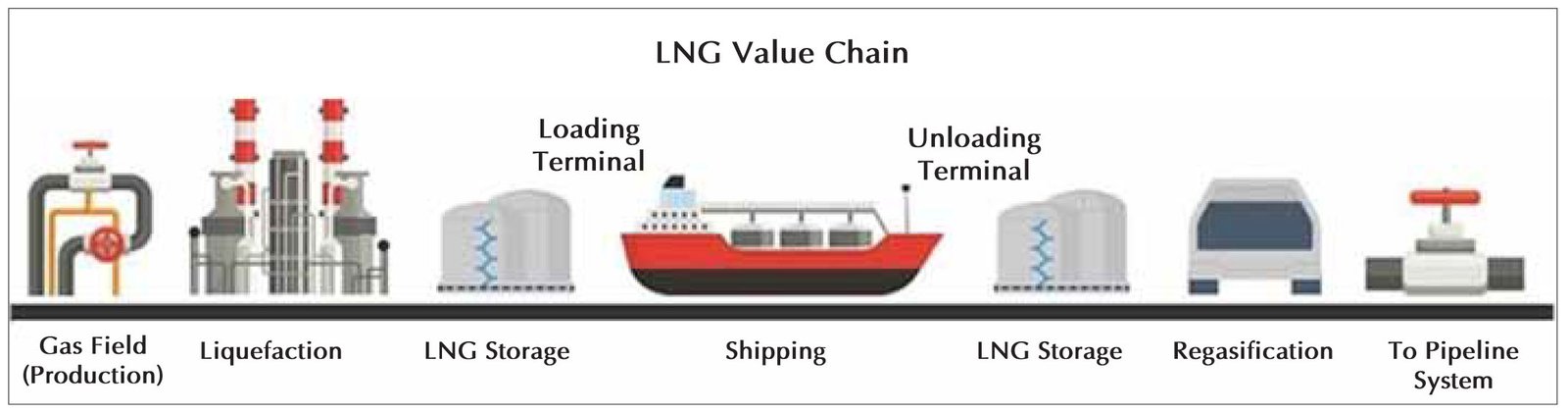
A number of different operations that are highly linked and dependent upon one another is known as LNG value chain. Excluding pipeline operations, the major stages of Value Chain activity includes: Production, Liquefaction, Shipping, and Regasification.
Liquefaction
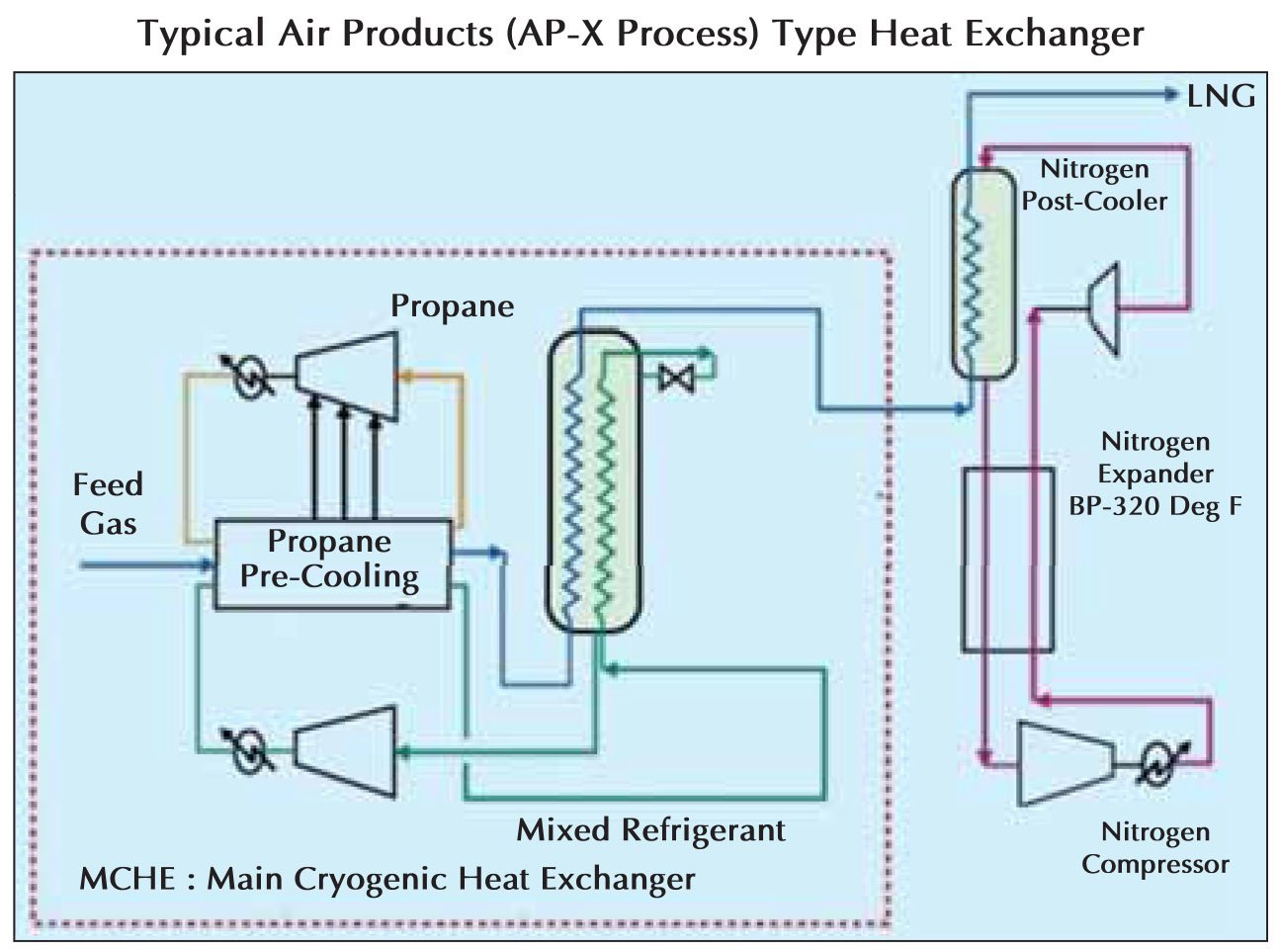
Prior to liquefaction, components, such as dust, acid gases, Nitrogen, carbon dioxide and heavy hydrocarbons, are removed.Once the natural gas is clean and dry, it is ready for the liquefaction process. The process for the liquefaction of Natural Gas is essentially the same as that used in modern domestic refrigerators, but in a massive scale. A refrigerant gas is compressed, cooled, condensed and let down in pressure through a valve that reduces itstemperature by Joule-Thomson effect (temperature change can occur in a gas as a result of a sudden pressure change over a valve). The refrigerant gas is then used to cool the feed gas. The temperature of the feed gas is eventually reduced to −161°C, the temperature at which methane, the main constituent of natural gas, liquefies. At this temperature, all the other hydrocarbons in the natural gas will also be in liquid form and its volume is reduce to 600 times.
One or more heat-exchangers may be required for liquefaction process depending on the cycle selected. Different processes are used for the liquefaction of natural gas.
Major commercial liquefaction processes are --Propane pre-cooled mixed refrigerant (C3MR) process, the air products Exxon Mobil (AP-X method, Cascades method, Dual Mixed Refrigerant (DMR) method and Single Mixed Refrigerant (SMR)process.An enormous refrigeration compressor required for all these methods. High capacity Gas turbines are used to drive them, so high-level engineering knowledge and experience is required to design, manufacture and assemble the compressor including gas turbines.
Shipping
LNG ships enable large amounts of clean natural gas energy to be transported to the consumer over large distances from the LNG Liquefaction Plant. LNG ships vary in cargo capacity, modern vessels are between 125,000 cubic meters and 175,000 cubic meters capacity. All LNG ships have double hulls and is carried near atmospheric pressure in specially insulated tanks. Double hull compartments are used as ballast tanks. This type of structure of a cargo ship can prevent water coming into the hold when the outer shell is wrecked by grounding and collision. Design and constructions of the all the carriers are govern by the International codes and standards.
While the tanks on an LNG carrier are designed to stay cool, they can’t provide perfect insulation against warming. Heat slowly affects the tanks, which cause the LNG inside of evaporate and produces a substance known as Boil of Gas (BOG). Boil of Gas should be collected using an appropriate vapor recovery system. For LNG plants, (excluding LNG carrier loading operations) the vapor should be returned to the process for liquefaction or used on site as a fuel;
Regasification
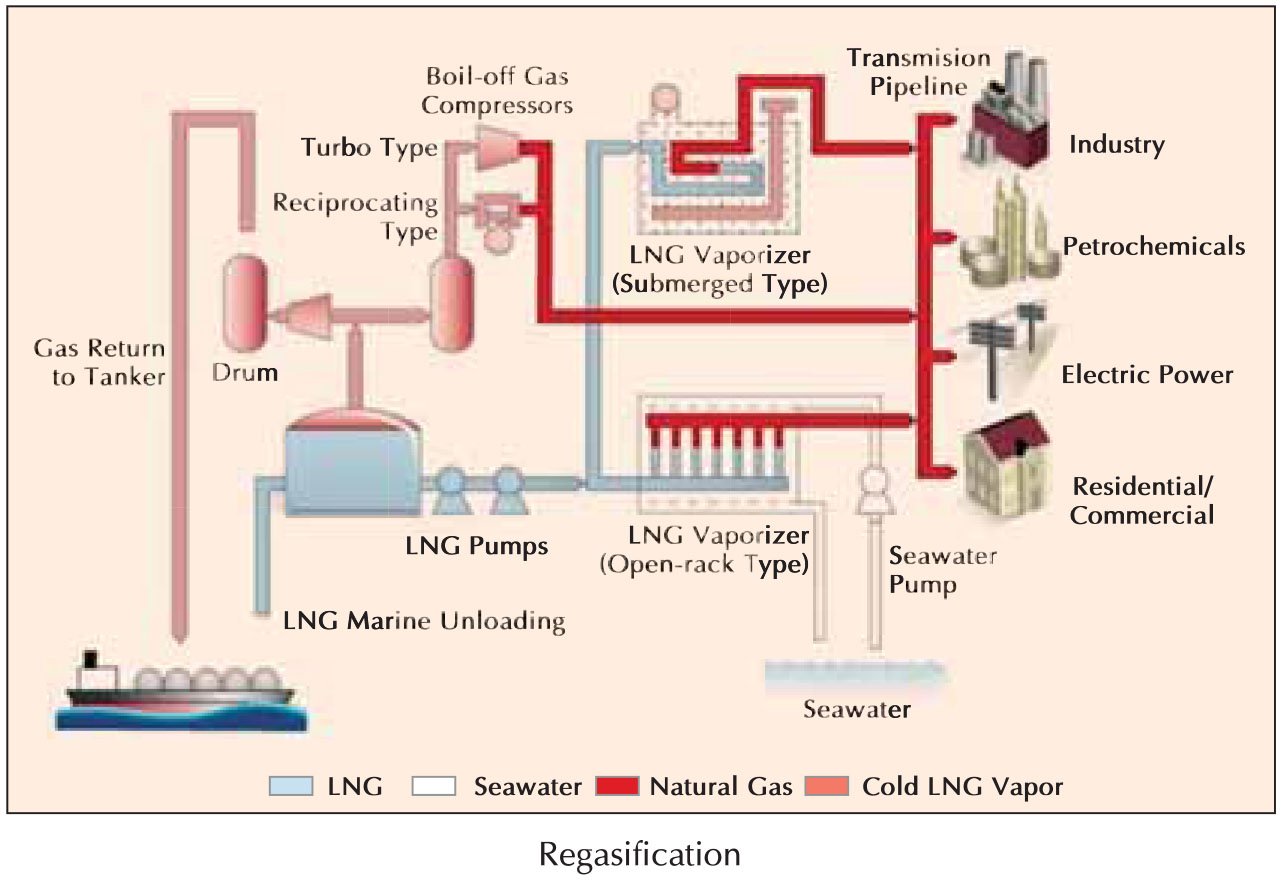
Regasification is the physical process by which liquefied natural gas (LNG) is heated to be returned intoits gaseous state. Common LNG regasification technologies are Open Rack Vaporizers (ORV), submerged combustion vaporizers (SCV), Shell & Tube Vaporizers (STV), Intermediate fluid (IFV), Ambient air vaporizers (AAV).
Each vaporizer includes a bundle of tubes housed in a bath of tepid or lukewarm water where the LNG is gently heated to a point where it reverts to liquefied natural gas (LNG) at −162 °C (−260 °F) temperature back to natural gas at atmospheric temperature. The gas is then transported via Transmission pipeline for distribution to residential, commercial and industrial end-users across the country.
SK Moinul Isam;
Deputy General Manager, GTCL