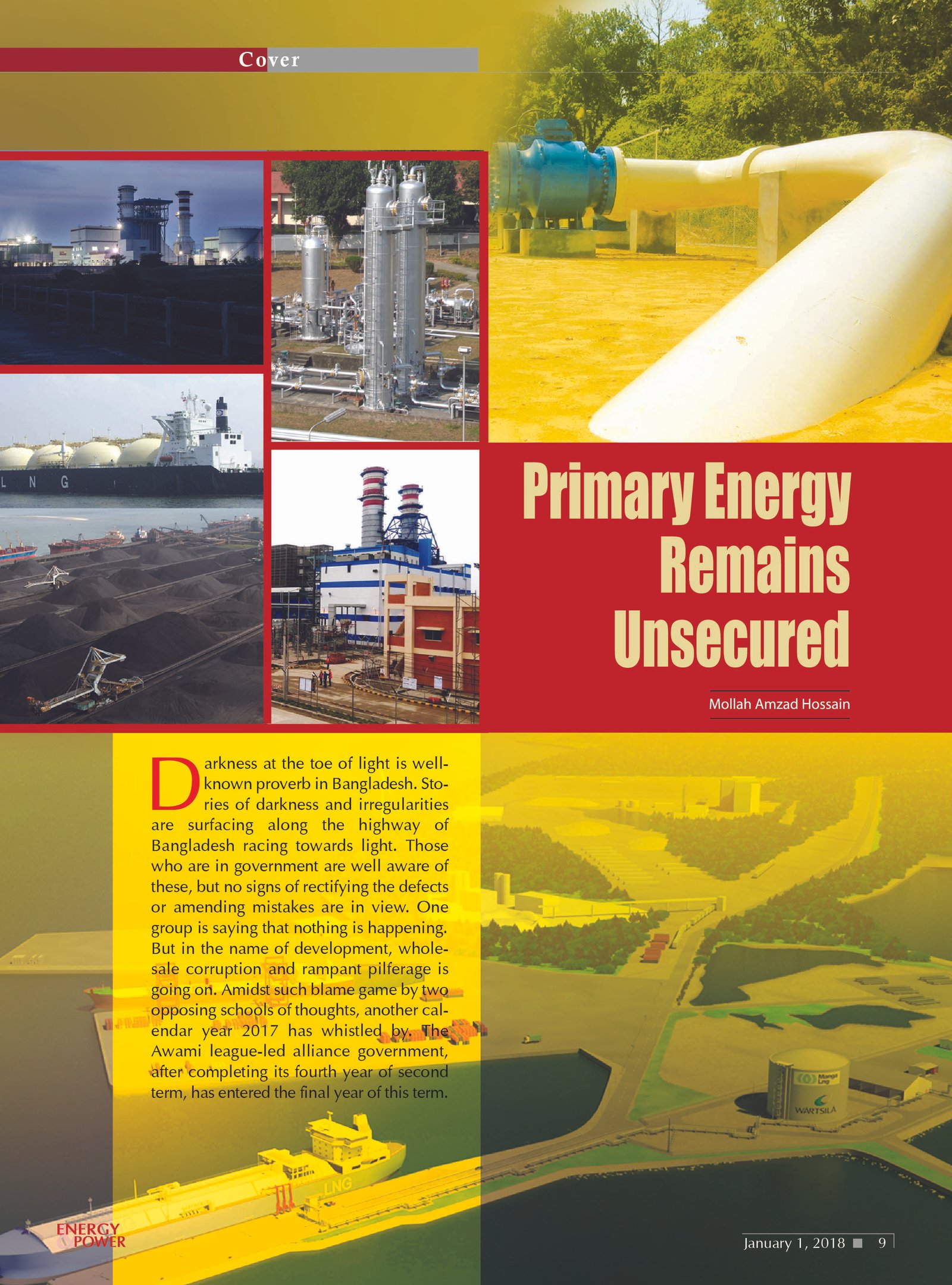
Darkness at the toe of light is well-known proverb in Bangladesh. Stories of darkness and irregularities are surfacing along the highway of Bangladesh racing towards light. Those who are in government are well aware of these, but no signs of rectifying the defects or amending mistakes are in view. One group is saying that nothing is happening. But in the name of development, wholesale corruption and rampant pilferage is going on. Amidst such blame game by two opposing schools of thoughts, another calendar year 2017 has whistled by. The Awami league-led alliance government, after completing its fourth year of second term, has entered the final year of this term. Mentionable achievements have been visible in the power and energy sector infrastructure development that broke all earlier records. But in terms of sustainable development, there are significant drawbacks as well. During this period the largest single project of 2,400 MW nuclear power plant at Rooppur commenced. Around 8,000 MW new generation capacity has been added. Projects totaling 20,000 MW are at different stages of implementation.
Development of energy sector is an integral part of developing power sector during the tenure of this government. The then government of Bangabandhu Sheikh Mujibur Rahman had initiated development of the power and energy sector immediately after liberation. Bangladesh Power Development Board was created integrating Power and Water Development boards. But power generation did not happen automatically. Fuel is essential requirement for that. Realizing this necessity, Bangabandhu had initiated programs for harnessing and developing own primary fuel resources. With this end in view, he had created Petrobangla (Oil & Gas Development Corporation) and Mineral Development Corporation. He attached greater importance to exploration for own fuel resources when global energy crisis in 1973 started rocking the economy of nascent Bangladesh. He gave equal emphasis on exploration of own petroleum resources and coal. Under this initiative, Petrobangla formulated draft Production Sharing Contract (PSC) following the footprints of Indonesia and as the pioneer of offshore exploration entered into the Bay of Bengal offshore exploration. For minerals, initiatives were launched for exploring coal, hard rocks and limestone. Realizing the importance of such works, he kept BMDC and Petrobangla under the purview of Prime Minister’s Office. But after the gruesome murder of Bangabandhu along with most of his family members, these organizations were devalued and were thrown under the control of ministry. The process of bureaucratic control entangled power and energy sector development. With the passage of time, power and energy sector was losing autonomy and went under exclusive control of bureaucracy.
Of course the present government since assuming office first in 1996 started following the footprints of the Bangabandhu government for developing power and energy sector. Gas crisis was not an issue at that stage. Experts were talking about the possibility of finding 10-15 tcf additional gas resources. The Sheikh Hasina-led government in 1996 inherited a chronic power crisis for failure of the immediate past BNP government. Fuel was not a problem, but getting required investment was a huge challenge. Within a month in state power, the government launched major power generation initiative through adoption of independent power policy (IPP). At the same time, industries were encouraged with special tax incentives for setting up captive power generation units for protecting their production from power load shedding. Immediate success was achieved. Industries set up captive power generation units quickly. The government also started construction of baseload power plants under IPP and contingency power plants. Within a year, three barge-mounted power plants came into operation. Two of these were natural gas based and one used furnace oil. These were the first private sector power generation units in Bangladesh. Within a very short time, AES was engaged under IPP for 450 MW power plant at Meghnaghat and 360 MW plant at Haripur near Dhaka. These were fuel-efficient combined cycle power plants. It needs mentioning here that the power tariff of the Haripur plant was the lowest in the world at that time. Haripur plant came into operation during the Awami League tenure and Meghnaghat plant started commercial operation in 2002 during the BNP government rule.
Appropriate planning and right strategy for implementation could facilitate the government in doubling power generation capacity from 1,800 MW to 3,500 MW in five years. Consequently, the power crisis has changed to a much comfortable state. During the handing over of power to the interim government, about 15-20 new projects were in the pipeline. During the five years term from 1996-2001, the energy sector also experienced major growth. Large gas reserve was discovered at Bibiyana. Another gas field was discovered at Moulvibazar, the lone offshore gas field at Sangu, was developed and brought into production. Meghna and Salda gas fields were connected to the national grid. Ashuganj-Bakhrabad Gas transmission pipeline was constructed in a record time. The gas transmission system was expanded on the western side of Jamuna River along the Bangabandhu Multipurpose Bridge. Besides, these new PSCs were initialed with IOCs for exploration of petroleum resources in onshore and offshore. Initiatives were launched for strengthening BAPEX for making it flagship exploration and production company of Bangladesh. Provision was created for 10% carried over interest for BAPEX at every PSC block.
The government realized that the natural gas alone cannot exclusively contribute to future energy demand. Initiatives were taken for exploration and exploitation of coal resource. During this time, the exploration contract and mining lease for BHP Minerals discovered Phulbari mine was reassigned to Asia Energy Corporation (AEC).
The BNP-led alliance government came to power again in 2001. At the very outset, they were engaged in unnecessary debates whether or not to carry forward the immediate past government-initiated projects. The then finance minister clearly stated that no suppliers’ credit would be entertained for any project. Consequently, implementation of many under implementation power projects became uncertain. Of course, power supply during the first two years remain comfortable as few of the under implementation large projects initiated during the Awami League government tenure started commercial operation. But from the third year, the situation started worsening. Although during the entire five-year term, the generation capacity increased by 1,400 MW, yet only 100 MW came from initiatives of BNP-Jamaat government. The installed capacity reduced from 5,200 MW to 3,400 MW. The people’s agitation started fuming all over the country. Some 14 people were killed when police opened fire on agitated people at Kansat in Chapainawabganj in the northern Bangladesh. Situation went beyond control even in Dhaka. The initiative for setting up small plants could not proceed due to the conflicting ideas of the policymakers.
Right from the outset of taking over state power in 2001, the then government created serious controversy aligning with US Company UNOCAL proposal of gas export to India from Bibiyana Gas Field. However, strong opposition from all stakeholders had forced the government, abandoning the plan. On the other hand, IOCs kept their fingers crossed from gas exploration finding no assured market of their probable explored gas.
During this period, the government also failed to deal positively with the proposed tri-nation gas pipeline from Myanmar to India across Bangladesh. Bangladesh could access this open access pipeline for gas import and also transport its own gas from one end to the other. This project was essential for confronting the gas crisis in the Chittagong region. This was a major failure of the government. Failure to explore and new gas resources started widening the gas deficit. Especially, the deficit in Chittagong region grew acute.
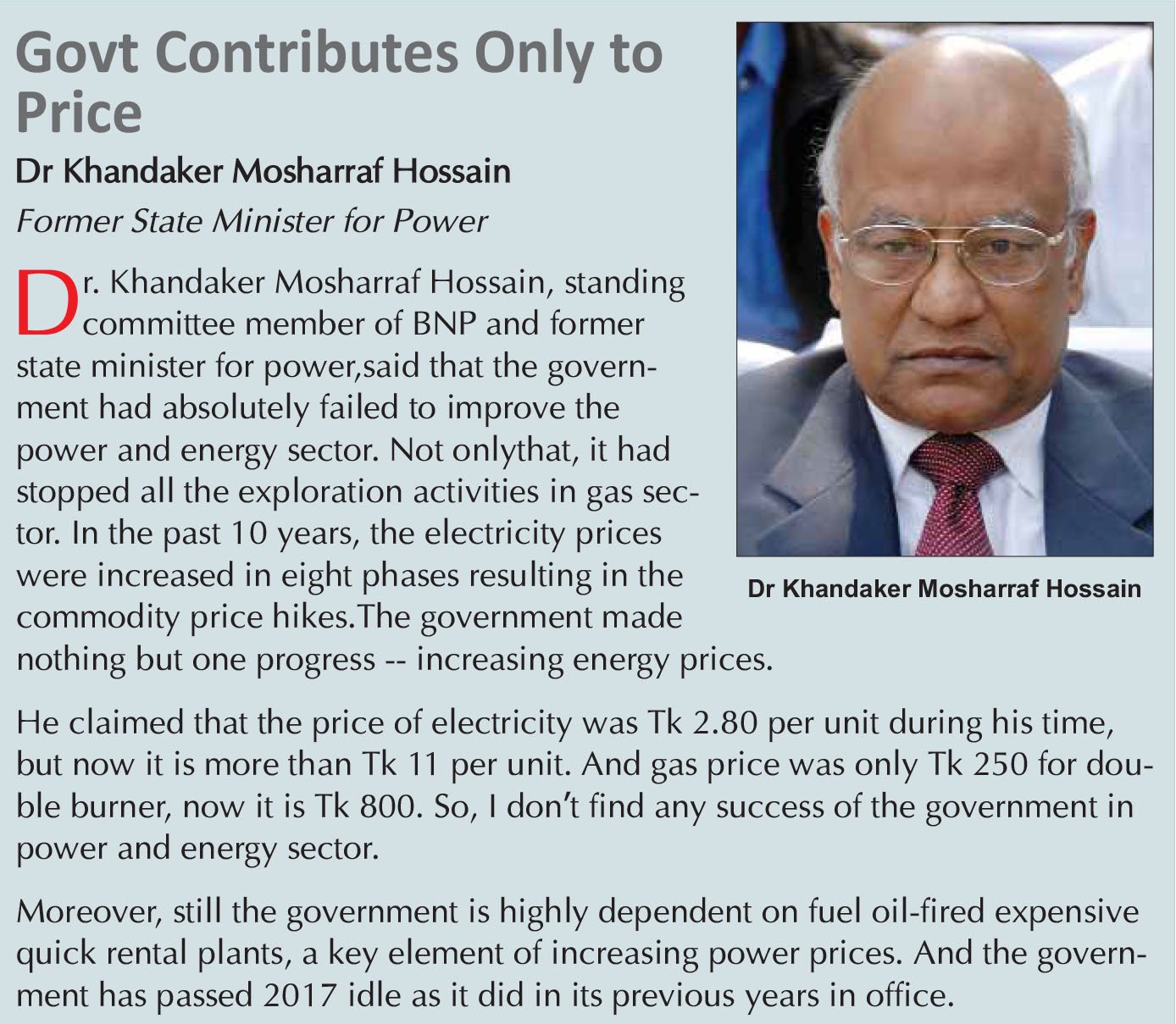
Asia Energy Corporation under exploration permit and mining license for Phulbari mine concluded during Awami League tenure submitted the Scheme of Development (SoD) for consideration by the government after carrying out detail feasibility study. After few days, State Minister for Energy Mosharraf Hossain was forced to resign for NIKO controversy. Mahmudur Rahman was made Energy Advisor to the Prime Minister. He started coal politics from the beginning. With ulterior motive of bringing in Indian conglomerate Tata in energy and power sector, he started foul-play with Tata proposal. Once he told media that contract with Asia Energy was illegal. With the support of a section of the government, the Oil, Gas and Port Protection Committee (OGPC) started fueling to the fire in Phulbari. Finally due to police firing on a demonstration in Phulbari and killing three agitators, the Phulbari project became uncertain. Raising issue of irrelevant coal policy, Mahmudur Rahman and BNP could successfully kill the initiatives of local coal exploration. Of course, present Prime Minister Sheikh Hasina lent support to the movement of the OGPC.
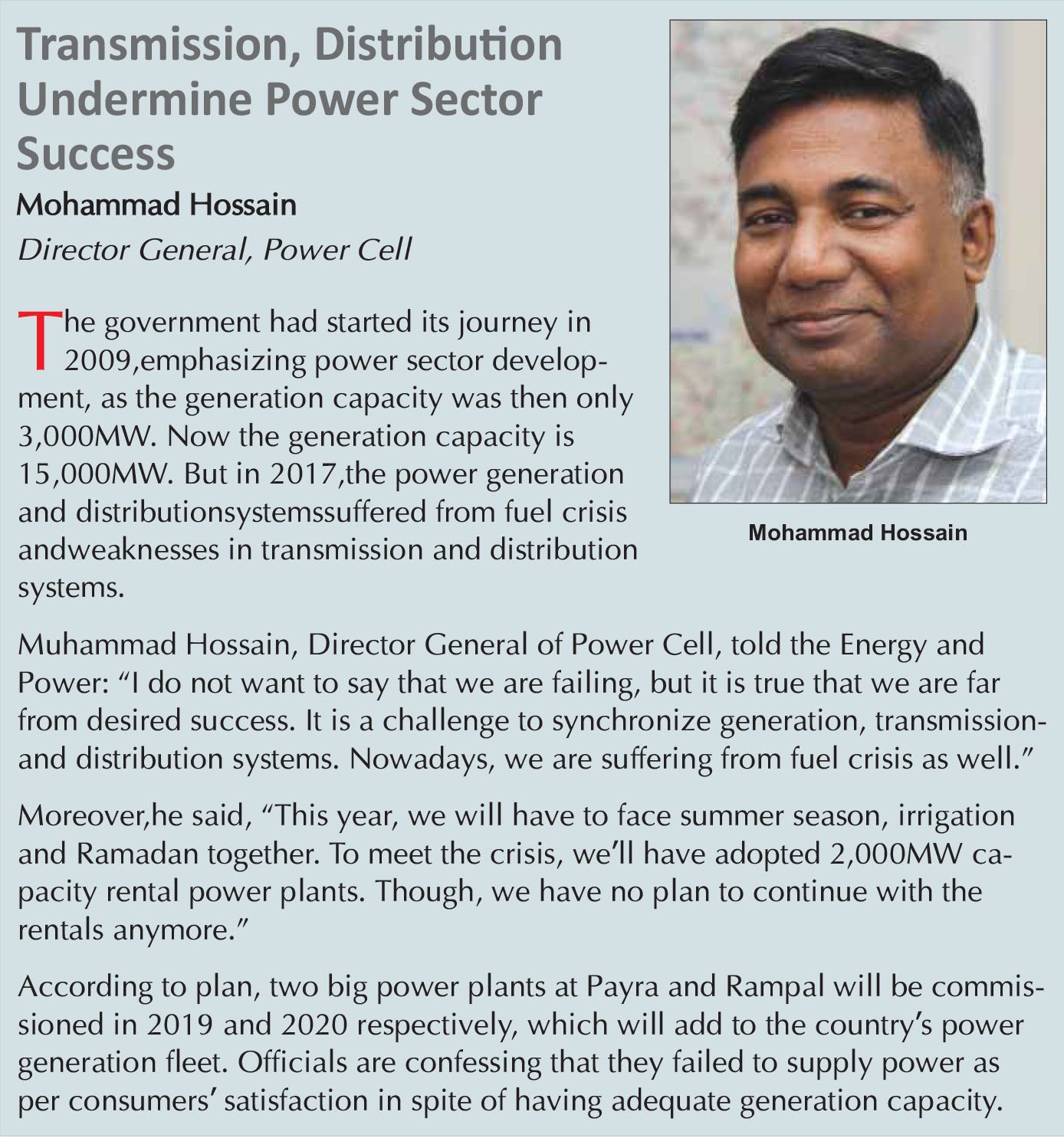
After this, state activities almost came to a halt for confrontations over selection of the head of the caretaker government. Army backed interim government grabbed power keeping the provision of caretaker government in abeyance. This government continued for two years. Power and gas crisis went from bad to worse. The interim government could bring Bibiyana Gas Field into operation for meeting the gas deficit. This field alone now contributes about 40% of the total national production. During this time, initiative was taken for further strengthening the Bapex technically and financially. At the same time fresh round of offshore blocks bidding was invited for engaging IOCs. But widening gas deficit created challenges for continued gas supply to power and fertilizer plants. The interim government initiated process for engaging companies for contingency power generation under small IPP policy, adopted earlier by the BNP-Jamaat government. This increased actual generation capacity from 2,800-3,500 MW. Although some of these plants were originally gas based, but was later changed to furnace oil while finalizing the contract. The new gas connections to industries were suspended for maintaining gas supply to the connected consumers.
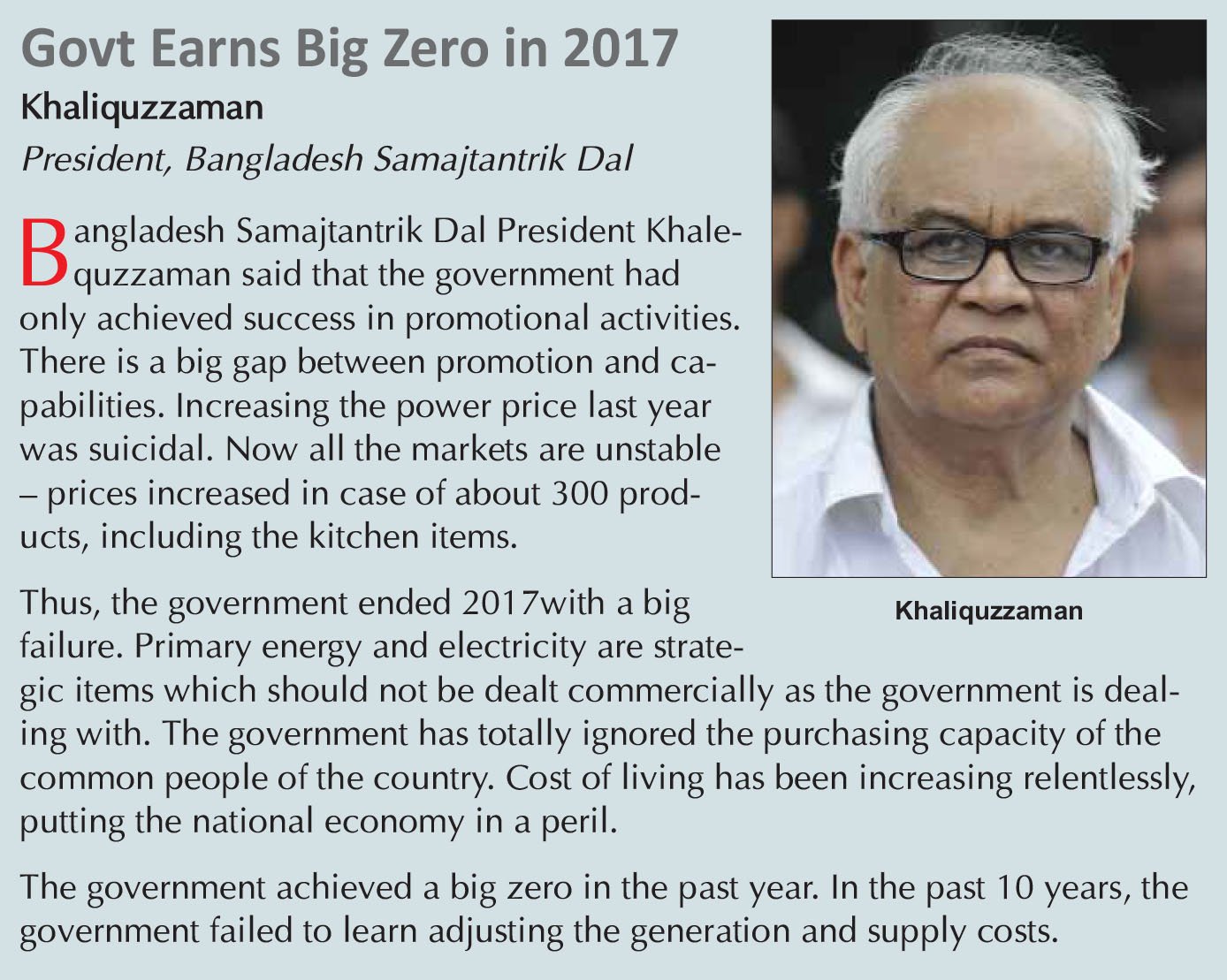
The interim government finalized the coal policy for breaking the deadlock of coal exploration. The objective was to review the Scheme of Development of Phulbari and Khalaspir by experienced international consultants and start mining after approval of the coal policy. But the finalized policy could not be approved for reluctance of the Chief Advisor of the interim government. Sources confirmed that his reluctance was influenced by an advice of one of his teacher. A British consultant reviewed the Scheme of Development of Khalaspir mine. But nothing could be done to implement the recommendation. The Phulbari mine development was kept in suspended animation.
During its two years, the interim government took various initiatives for gas production and power generation. It also took initiative for new gas exploration, especially offshore exploration. In the meantime, the Awami League-led alliance government came to power in January 2009. New gas connections were kept suspended for the industrial and domestic consumers for chronic gas crisis. That suspension is still in place till the end of 2017. For a certain period, new power connections were also kept suspended. On the other hand, the interim government-initiated contingency power plant program was expedited with more and more liquid fuel-based power plants in the name of rental and quick rental power plants. Furnace and diesel-based plant construction were given priority in view of the continued gas supply crisis. These achieved success. Some initiatives were taken for gas production augmentation. But hardly any success was made. ConocoPhillips, one of the IOCs selected by the interim government, was awarded PSC for offshore exploration in two blocks. But later, ConocoPhillips relinquished the blocks and wind up business in Bangladesh, failing in its efforts for gas price increase through negotiation with the government.
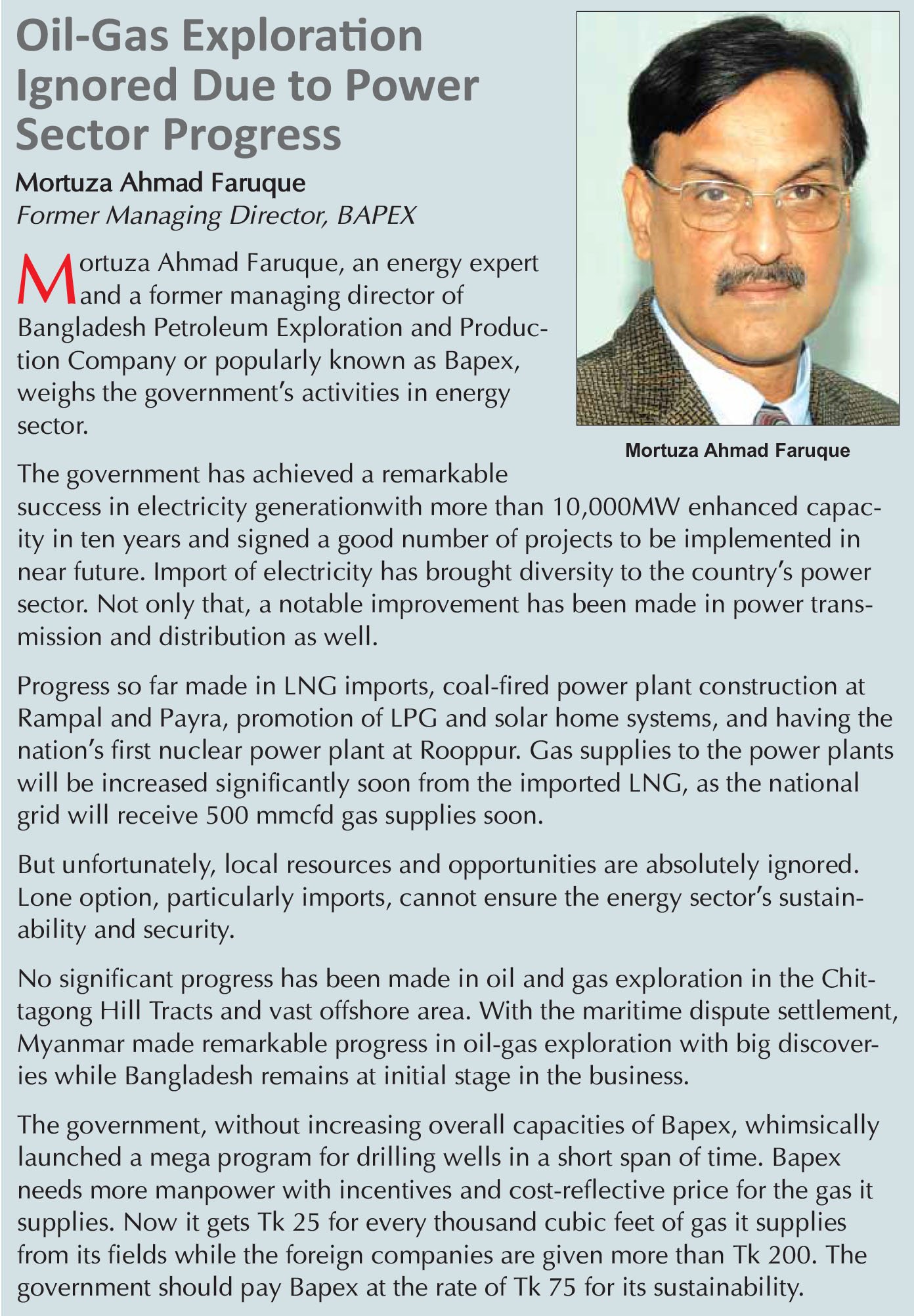
Following the footprints of immediate past interim government for contingency power plants, it was possible to increase power generation by 300 MW within the first six months. During this period several contracts could be signed for new such plants. Power supply situation eased a lot by 2010 as many such plants came into operation by then. Power System Master Plan could be adopted in 2010. Considering the continued gas crisis, emphasis was given on fuel diversification. The essence of PSMP 2010 was achieving 40,000 MW generation capacity by 2030. Half of it, meaning 20,000 MW was planned to be generated from coal -- 60% was to be coming from local coal and 40% from imported coal. Dependence on natural gas was planned to bring down from 90% to 25%. This 25% was planned to be contributed from local gas and imported LNG. The planned contribution by imported liquid fuel was 5%. The remaining 20% was planned to come from power import, nuclear power and renewable energy.
The term of the government-initiated contingency power plants was 1-5 years. Till 2010, it was being told that such plants would be gradually phased out as gas and coal-fired baseload power plants would come into operation. But till the end of 2017, the government failed to keep its promise. At the end of 2010, the government initiated projects for 15-year term liquid fuel-based IPPs. Initiatives were also taken for imported coal-based power plants. The first such plant is 2X1320 MW imported coal-based Rampal power by Bangladesh India Friendship Power Company Limited. The first unit was planned to come into operation in 2014. After a series of controversies and disputes, the final decision was to construct 2X660 MW power plants. The construction is ongoing and the first unit is expected to come into operation by 2020.
There were admirable achievements in short and medium term power generation initiatives over the first 5 years of the government, but the performance in energy sector was like darkness below the candle lamp. It was announced in 2010 that gas crisis would be confronted through importing LNG by using floating LNG terminal. But nothing could be done over the entire term of the government. It is expected that in the last year of the second consecutive term, the first FSRU of 500 MMCFD capacity may come into operation in March-April, 2018. Few initiatives were taken to increase gas production at onshore and offshore during this period. Some marginal gas fields could be discovered by BAPEX in the onshore. But these could not make notable progress. But further development of earlier gas fields increased production from 1,700 MMCFD to 2,700 MMCFD. But deficits further widened. The ministry informed that the entire discovered gas reserve would deplete by 2031 if no large gas fields are discovered and brought into production in the mean time.
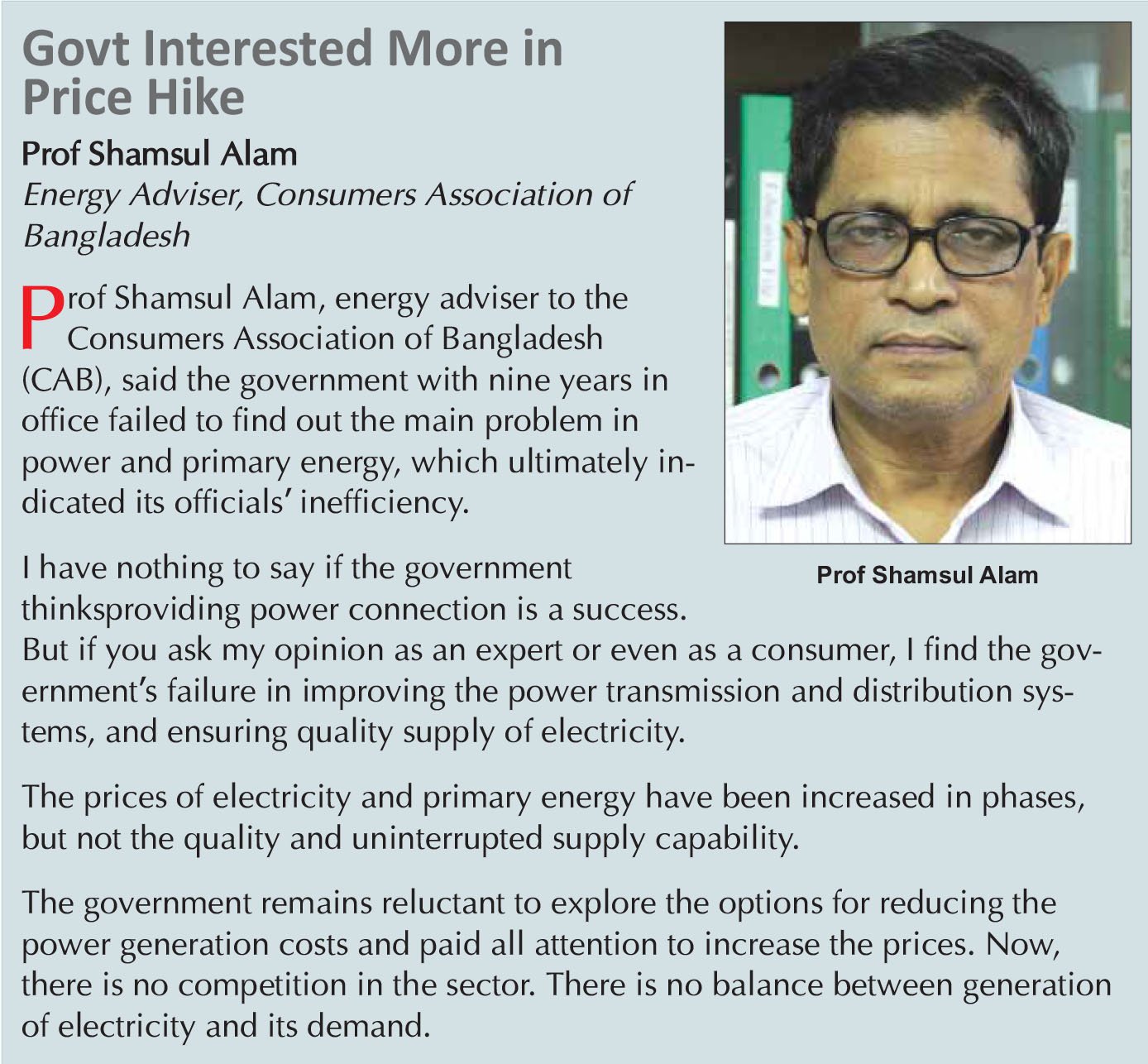
Taking note of demand by the civil society, a gas development fund (GDF) was created setting aside a portion of additional gas price. It was told that the GDF would be exclusively used for exploration of new petroleum resources. But failure of BERC in formulating a policy guideline for utilizing this GDF has led to its use in the entire gas sector development. This was never expected. Again, the proceeds of the fund are given as loan to BAPEX. This in future would create serious liability for BAPEX.
During this time BAPEX was entrusted with the task of drilling 10 development wells by using US$195 million. But Russian Energy giant GAZPROM was engaged as contractor for the work. A drilling company ARIEL worked on behalf of GAZPROM. It was told that 270-300 MMCFD gas would be added from these 10 wells. But actual outcome was a little over 100 MMCFD. This work was given to GAZPROM without any tender. During the second term of the present government, the same company was awarded contract for five more development wells. But relevant experts observe that BAPEX could very well do these works at half the cost.
One of the two notable successes of the government over the two terms is the much talked about cross-border power trading. It started with 250 MW from India. Now 660 MW is being imported from India through two entry points at Bheramara and Comilla. Around 1,200 MW power import would be possible by 2020 through cross-border trading. The four-nation power trading initiative among Bhutan, Bangladesh, India and Nepal through grid connectivity is advancing. A cross-country power transmission line project from Assam to Bihar is also at advanced stage. An agreement for joint investment for a hydropower project in Bhutan by Bangladesh, India and Bhutan is at final stage of negotiation. Talks are on for power import from China as well. State Minister Energy Nasrul Hamid said recently that the government is working with a target of importing 10,000 MW power from neighboring countries by 2041. Recently in India, Bangladesh signed an agreement with Adani Group. They have started working on construction of a 1,600 MW coal-based power plant at Jharkhand and will export power by a transmission line to Bangladesh.
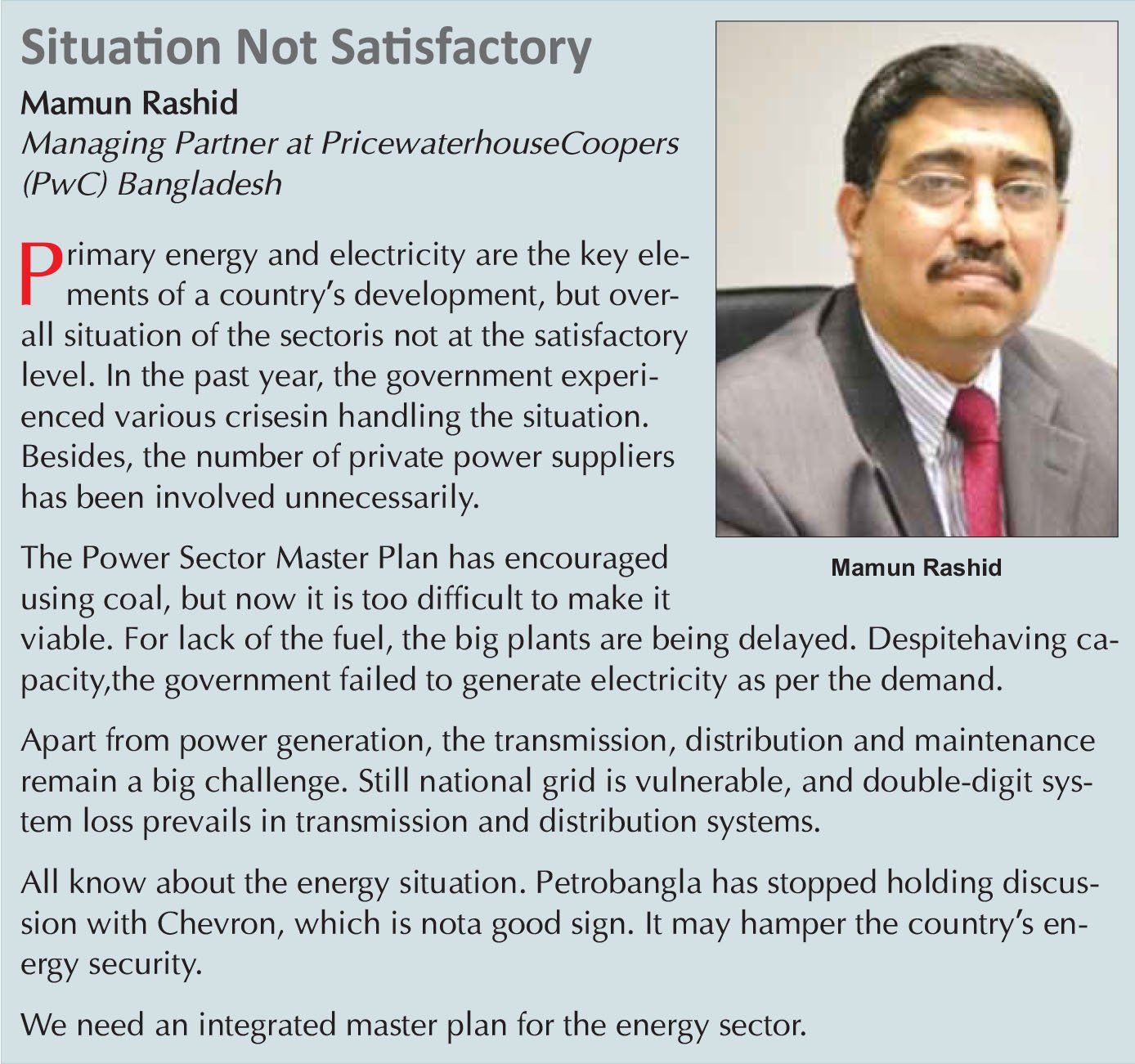
Another achievement during this time merits mentioning. Foreign companies earlier exclusively contributed to power generation as IPP. But during this time, local entrepreneurs started investing under short, medium and long term power generation initiatives. Consequently, 6-7 companies including Summit, United, Orion and Energypac have made significant investment and are running business successfully. Local companies even signed agreements with the government on imported coal and LNG-based mega power projects.
The much talked about issue of the first term of the government was the coal policy. At each time during the budget speeches in the first five years, Finance Minister Abul Mal Abdul Muhith informed the nation that the government is finalizing coal policy while saying that the coal exploration and mining would start after adoption of the coal policy. But at the end of the term, the Prime Minister herself stated putting greater emphasis on protecting farming land over mining coal. The coal mining initiative did not proceed. At the initial stage of the second term of this government, some initiatives were observed for talks with Asia Energy and Hosaf Group for coal mining and mine mouth power plant construction. But talks did not gather momentum. At some stage a former energy secretary stated of non-existence of any contract with Asia Energy for mining coal at Phulbari and if there is any, it would be terminated. But nothing could be done to that effect. State-owned company BCML is managing mining from Barapukuria and engaged consultant for Dighipara. A feasibility study for extracting coal bed methane from Jamalganj mine met with no success. The government has actually moved completely away from local coal mining while changing from PSMP 2010 to PSMP 2015. Almost all 35% of 60,000 MW power targeted for achieving by 2041 would come from imported coal. This plan of course mentioned about extracting 10 million tonnes of coal from local source by 2030. There is no option but going for mining own coal right now to achieve this. The best candidate for mining is Phulbari mine. Experts observe that an independent expert may be engaged for reviewing Scheme of Development of Asia Energy and mining must commence soon.
We already mentioned about PSMP 2015. This is under approval process. This plan prescribes for 57,000 MW generation target by 2041 -- 35% will be contributed by coal, 35% by Gas and LNG and remaining 30% would come from nuclear power, power import and renewable energy. Of the 30%, about 5% would come from imported oil, 5% from nuclear and the remaining 20% from renewable energy. Experts observe that Bangladesh would become 92% dependent on imported fuel by 2030 if local coal is not explored and exploited. The economy may not be able to sustain that situation. The government claims that Bangladesh can sustain as Japan and Korea survives in world market with almost 100% dependence on imported fuel.
Before approval, the government has started reviewing PSMP 2015. The policymakers are thinking now of increasing the target of LNG import and reduce coal import. Indian company Reliance has started working on a plan for importing LNG and set up 3,000 MW LNG-based power generation facilities. They have already signed PPA with the government for its first 750 MW plant. Summit Power has signed an agreement for another 700 MW power plant at Meghnaghat. NWPGCL has started working on a 800 MW LNG-based power plant in Khulna. It has plan for a 3,600 MW LNG-based power plant at Payra. They will construct it in joint venture with a reputed German company, Siemens. MOU has been signed to this effect. Local company INTRACO has expressed interest for setting up of a 2,000 MW LNG-based power plant in joint venture with Marubeni and GE. INTRACO is in discussion with BPDB for another 3,600 MW LNG-based power plant at Maheshkhali power hub. Summit Power and GE is also going to submit another proposal for a similar capacity LNG based power plant. United Group started negotiation with the government for an imported LNG-based power plant. So far, proposals for 15,300 MW LNG-based power generation plants are at different stages of implementation.
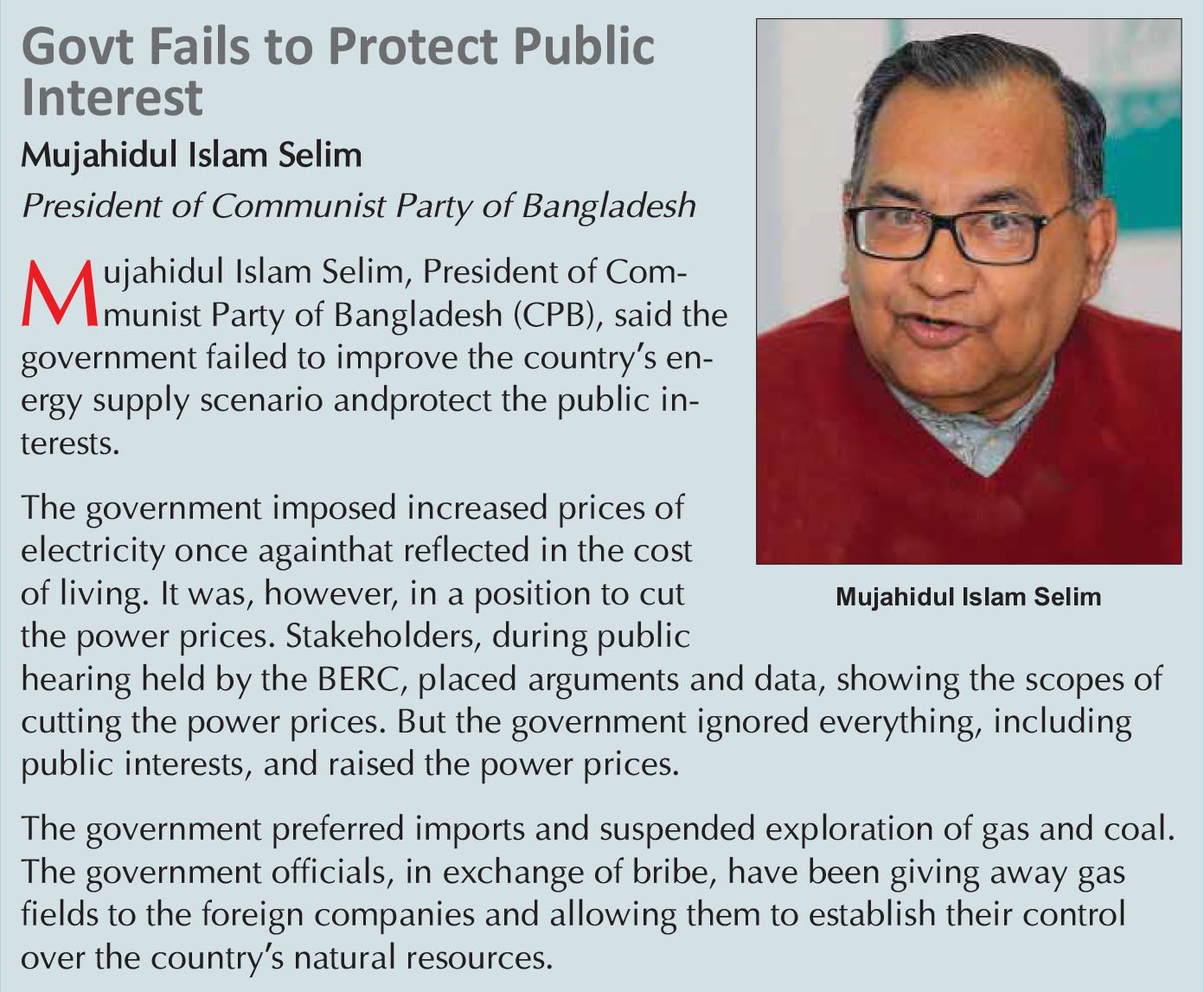
The government has taken up major initiatives for LNG import and supplying LNG to the proposed LNG-based power plants. Contracts have been signed with Excellerate and Summit Group for 7 million tonnes (1000MCFD) annual LNG import. The supply would start by the end of 2018. Petrobangla has signed agreements with two companies for supply of 400 MMCFD LNG within the next 6 months. Negotiation is going on with some other companies for LNG supply. Four other companies have signed MOU with the government for setting up FSRUs and land-based terminals. The LNG import terminals would be set up at Maheshkhali and Payra. The shallow draft along the Bangladesh coastal area is a major challenge for the terminals. The government plan states of 6,000 MMCFD gas demand in 2041. Around 80% of this would require to be met from imported LNG. Some 16-meter deep draft channel is being developed in Matarbari and Maheshkhali for LNG terminal and coal port. Ramnabad Channel in Payra has 16-18-meter draft, but capital dredging is essential for 35-km from entrance to the channel. Regular maintenance dredging would be a major challenge.
Works are going on for different projects for 22,000 MW imported coal-based power generation by 2041. Of these, the works of 1,320 MW NWPGCL managed project at Payra has achieved 34% progress so far. NWPGCL will start working on a second 1,320 MW plant as soon as the first unit comes into operation. Rural Power Company and Ashuganj Power Company Limited in joint venture with Chinese companies are setting up two 1,320 MW power plants at Payra. Bangladesh India Friendship Coal Power Company has started construction work of Rampal 1,320 MW power plant. Bangladesh Coal Power Generation Company is working on 1,200 MW coal power project and coal port at Matarbari. BPDB is implementing plan for 8 more 1,320 MW each power plants in 8 blocks in Matarbari. Electricity Generation Company Limited (EGCL) is working on a 1,320 MW power plant at Matarbari. Singapore company Sembcorp is also working on a similar capacity plant there. S. Alam Group in joint venture with a Chinese company is working on land development for a 1,320 MW capacity plant at Anwara. Local company Orion Group is working on two 1,320 MW each coal power plants near Dhaka.
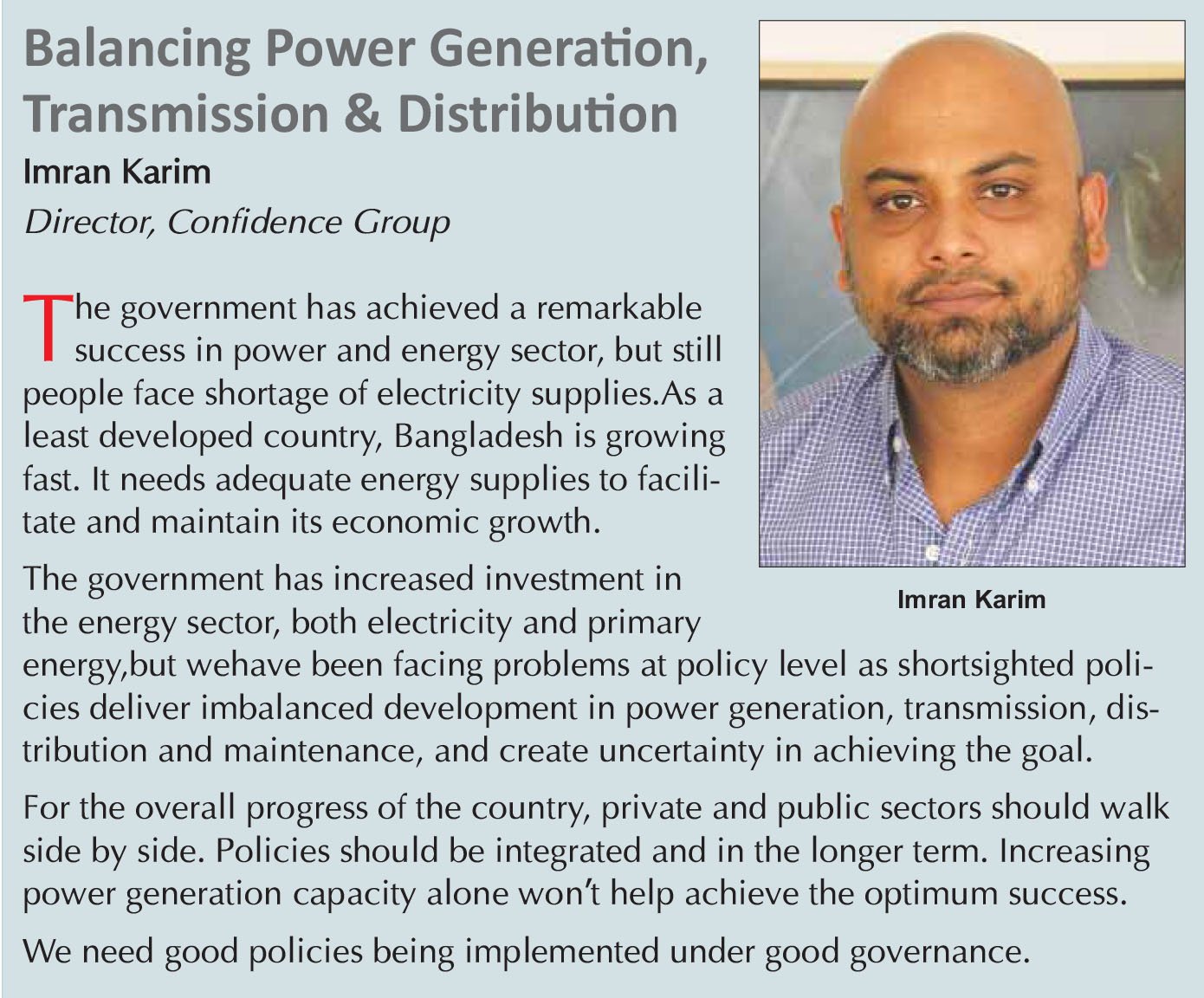
Imported coal based power projects have experienced different challenges. Works for developing import enabling infrastructures could not be started yet. Questions are being raised about costs of these facilities though these may be implemented in 5 years. In view of above, fresh thoughts have started focusing on local coal exploration. Fresh feasibility studies at Barapukuria and Dighipara provides positive indications. One government official on condition of not being identified informed the EP that of the Mines of Phulbari is the best candidate for starting mining. Its Scheme of Development is waiting for approval. There are talks about getting the SoD reviewed by an international coal consulting company. The State Minister for Energy preferred to keep silence when asked about it.
The government would require 66 million tonnes of coal annually for generating 22,000 MW of power. Of these, the government has taken initiative for setting up of a coal transfer terminal at Matarbari with a capacity of 40 million tonnes annually. It will be developed under public private partnership (PPP). Sumitomo Corporation, Japan has expressed the interest for it. Around 20 billion dollar investment will be required for it and it will come into operation by 2030. But for a start, Sumitomo Corporation and Toshiba JV under the management of CPGCL and financial assistance of JICA started working on a 1,200 MW power plant and coal port. Another coal port would be constructed at Payra too. Payra Port Authority has initiated actions for engaging a consultant for a study on a coal terminal at Payra port. It is being told that coal import using this terminal facility would be available by 2022.
Till 2009, the natural gas exclusively contributed fuel supply to power. About 88% contribution came from gas. In 2016-17, the total energy generation was 57,276 Gwh -- 38,052 Gwh (66.44%) was gas based, 9,950 Gwh (17.37%) came from furnace oil, 2,627 Gwh (4.59%) came from diesel, 1,109 Gwh (1.76%) was contributed by coal, 982 Gwh (1.71%) came from hydropower and power import contributed 4,656 Gwh (8.13%).
Though the generation cost increased due to liquid fuel, the cost came down to Tk 5.15/unit in 2015-16 from Tk 6.00 /unit in 2014-15 for low global price of oil. In 2016-17, it increased marginally to Tk 5.34/unit. During the first 6 months of 2017-18, it increased to Tk 5.99/unit. Experts observed that the generation cost may further increase if present increasing trend of oil price in global market persists.
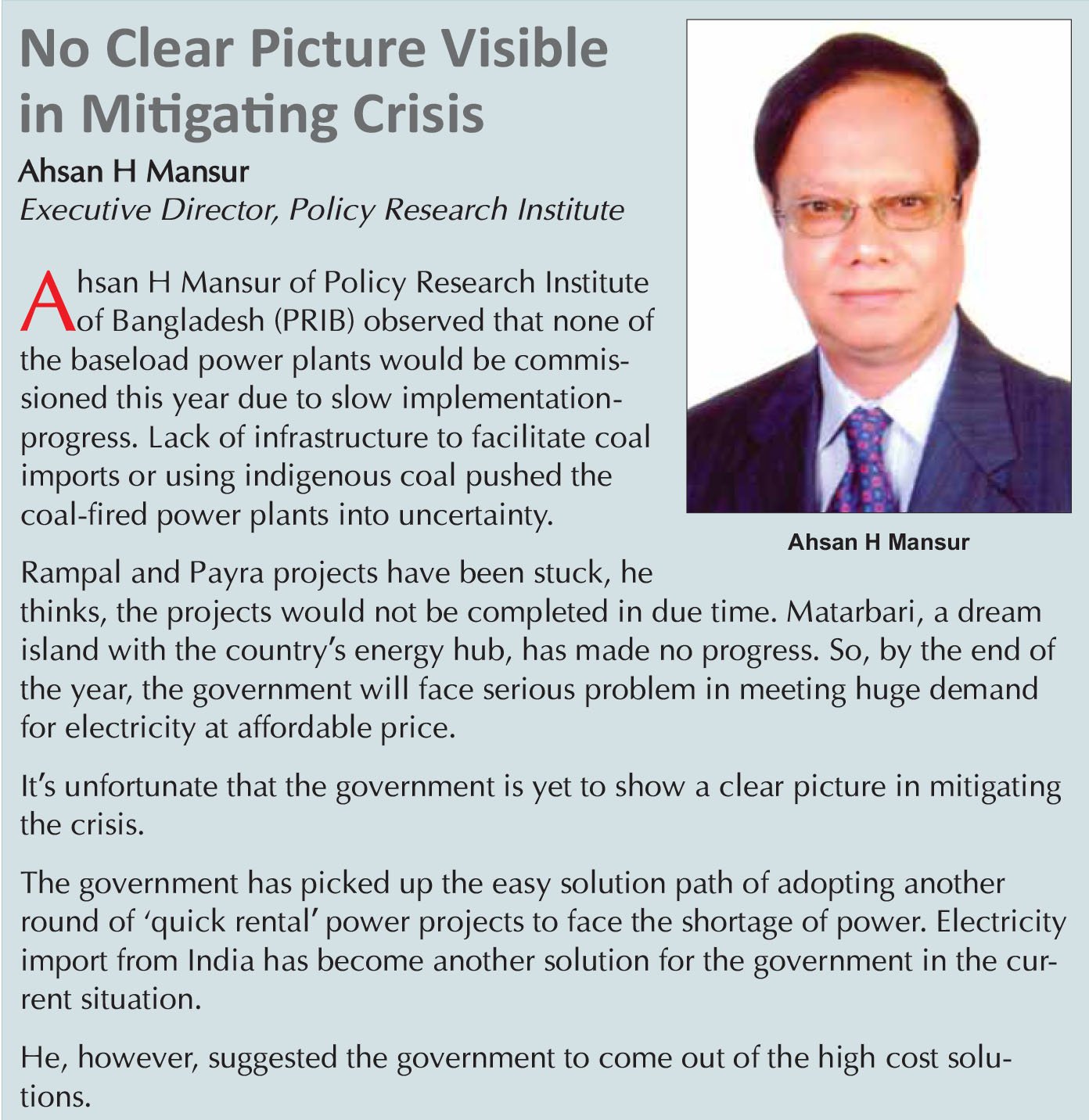
Looking behind, we see in 2009 the power tariff of Bangladesh was among the lowest in the region. The power tariff increase initiated at that time to reduce subsidy. Till now power tariff at consumers’ level has been revised 8 times. The government is saying that even after last revision the power tariff of Bangladesh is the lowest in South Asia, excepting Bhutan. Former BPDB Chairman Alamgir Kabir in 2009 mentioned that power generation cost would increase for the subsequent three years for more and more contribution of liquid fuel. Power price adjustment would become essential at the consumer level.
The power tariff can be revised to the lower level after 2012 when coal and gas-based major power plants would come into commercial operation. But such optimistic forecast did not see the light at the end of the tunnel yet. PSMP 2016 indicated a possible generation cost of Tk 6/unit in 2021. If prescribed fuel mix can be implemented, the generation cost in 2041 would be Tk 12.00. Prof M Tamim, former special assistant to the Chief Advisor of the interim government observed that it will not be possible to stick to this estimated generation cost.
Energy experts are observing that the present contribution of liquid fuel of power generation capacity is 37%. During the last year, the liquid fuel contributed 22% of actual generation. The government has initiated actions for new liquid fuel-based power generation. By next year, the contribution would increase to over 50%. Liquid fuel will become major contributor next year. About 1,000 MMCFD of LNG may be available for energy generation by end-2018. This would increase gas based power generation. But the imported LNG being costlier than local gas would also increase the cost of generation.
For disadvantaged geological location, fuel import in Bangladesh especially coal and LNG have additional challenges. Countries like Japan and Korea have advantages of deep draft near their coastal areas. But Bangladesh being riverine delta the situation is very different. Matarbari-Maheshkhali and Payra combined can facilitate coal port and LNG terminal development. But the cost of capital dredging and continuous maintenance may add significant costs. No study has been done yet about the extent of total cost of fuel import and the cost of power generation using imported fuel. No study has also been done about the challenges of setting up import-enabling infrastructures.
It is true that the price of coal and LNG in the international market is now on the lower side as these are linked with lower oil price in global market. But the price would also increase with every increase of oil price. That would increase price of fuel and power in Bangladesh market. Analysts are recognizing the success of the government in increasing power generation capacity over the last 9 years. Successes have also been noticed in formulating new infrastructure projects and acquiring investment. But at the same time, the government miserably failed in exploring and exploiting own fuel -- coal and gas. The achievements would be questioned in not too distant future if the government fails strike the right balance of local and imported fuel in the mix. Special concerns would be there when the power tariff and energy price would shoot beyond the affordable limit. The economy would stumble. Hence, without any delay, local coal exploitation must start and exploration for petroleum must be invigorated.
Cover Interview by: Jannatul Ferdoushi Sova