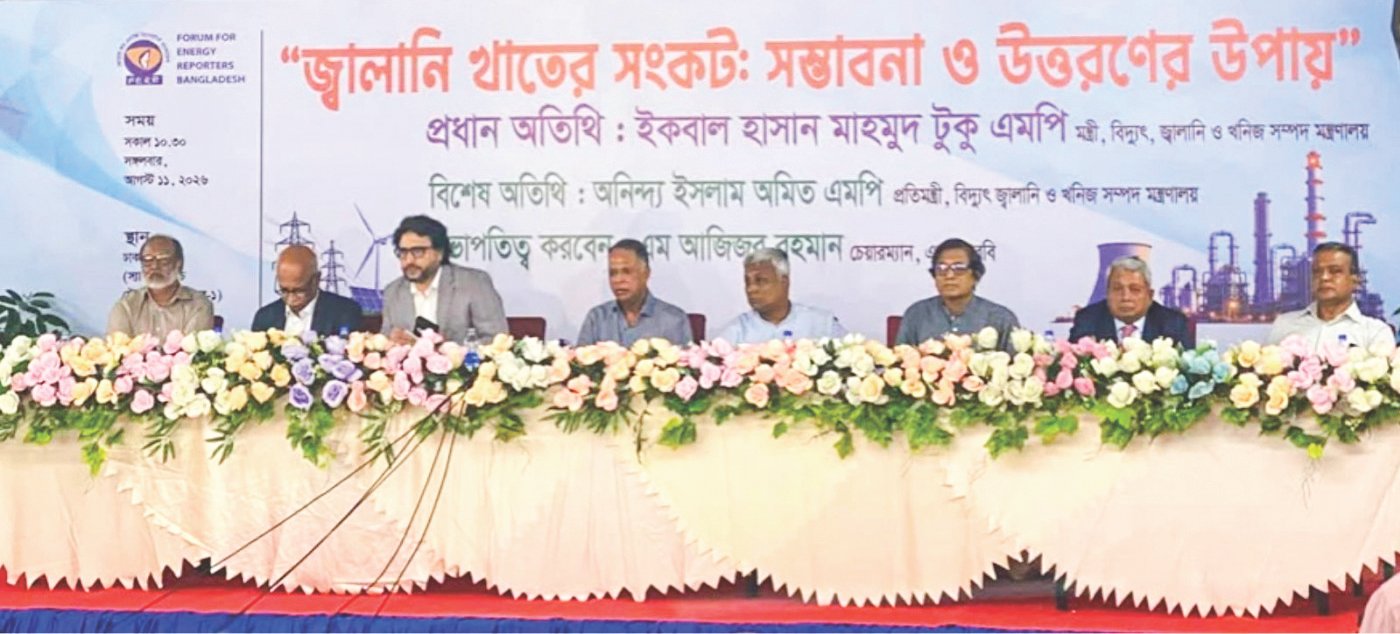
Bangladesh needs urgent and coordinated measures to address its worsening energy crisis, with greater emphasis on domestic gas exploration, renewable energy, energy efficiency, sector reforms and private investment, experts said at a seminar in Dhaka recently.
They also called for reducing dependence on imported fuels, developing neglected gas fields and creating a predictable regulatory and investment environment for private-sector participation.
The observations came at a seminar titled “Energy Sector Crisis: Prospects and Way Forward”, organized by the Forum for Energy Reporters Bangladesh (FERB) at Dhaka Club.
In his keynote paper, former Dean of Engineering at Bangladesh University of Engineering and Technology (BUET) Prof Ijaz Hossain said Bangladesh must accelerate gas exploration to assess its remaining reserves and reduce its growing dependence on imported LNG.
Domestic gas production has fallen to around 1,700 million cubic feet per day (MMFCD) from a peak of 2,786 MMCFD in 2017, he said. Maintaining even 2,000 MMCFD of domestic production would require drilling at least 10 wells annually, according to his presentation.
Bangladesh has already consumed around 15 trillion cubic feet (TCF) of gas, while only around 2 TCF has been added since the discovery of Bibiyana in 1997. The country now has less than 8 TCF in remaining reserves, he said.
Without accelerated exploration, these reserves could be nearly exhausted by 2030, Prof Ijaz warned.
He called for the rapid development of Bhola’s gas resources, deepwater offshore exploration and the revival of idle fields such as Kutubdia. He also stressed the need for improved reservoir management and timely workovers.
According to Prof Ijaz, LNG imports and additional terminals are necessary to address the immediate crisis but cannot provide a sustainable long-term solution.
He projected that gas demand could reach around 4,600 MMCFD by 2030, requiring domestic production of about 2,000 MMCFD and LNG imports of around 2,600 MMCFD. This would require existing LNG terminals to operate at full capacity and two additional FSRUs to be added.
However, he cautioned that LNG imports would depend heavily on the availability of foreign currency. “Without the ability to purchase LNG, regasification capacity will be useless,” he said.
Prof Ijaz proposed an eight-point approach to energy security, including greater use of coal, energy conservation and efficiency, and increased use of renewable technologies in cooking and transportation.
Former BUET professor and Vice Chancellor of Independent University, Bangladesh, M Tamim said there was no single solution to the country’s energy crisis.
Bangladesh needs to increase domestic gas production, import fuel where necessary, maximize coal-fired power generation and rapidly add 2,000-3,000MW of solar power, he said.
He also called for reconsidering the country’s dependence on BAPEX for exploration and suggested bringing international companies into the sector to address gaps in technology, expertise and investment.
M Shamsul Alam, energy adviser to the Consumers Association of Bangladesh, called for a “revolutionary change” in the power and energy sector. He identified irrational pricing as one of the major challenges and urged the government to establish clear benchmark prices and predictable investment conditions for power generation.
Power and Energy Minister Iqbal Hassan Mahmood Tuku said the government was taking steps to expand rooftop solar generation, with a target of 10,000MW.
The government plans to encourage private investment in cluster-based rooftop solar projects under an OPEX model, with incentives including a five-year tax holiday. Under the model, third-party developers would finance, install, own and maintain solar systems on consumers’ rooftops.
Regarding private-sector participation in fuel imports and marketing, the minister said the proposed policy would allow companies to compete on an equal footing rather than favoring any particular business.
He said the government hopes to cooperate with Malaysia’s state-owned Petronas in developing Bhola’s gas resources and plans to invite international companies to participate in offshore exploration.
A Bangladeshi delegation has already discussed the issue with Petronas officials in Malaysia, while the minister plans to visit Houston to hold discussions with major international oil and gas companies on offshore exploration.
The minister acknowledged that inadequate gas pressure was severely affecting businesses, disrupting cash flow and increasing the risk of loan defaults.
“I don’t want any businessman’s name to appear in the banks’ red ledger because of us,” he said, adding that the government would arrange a meeting involving the Prime Minister, industrialists and experts to discuss the industrial crisis.
State Minister for Power, Energy and Mineral Resources Anindya Islam Amit apologized to consumers for the ongoing gas crisis and said the government was working to address the situation.
Bangladesh has around 30,000MW of power generation capacity, but inadequate fuel supplies are preventing power plants from operating at full capacity, he said.
“If we could run the gas-fired power plants at full capacity, people would not have to suffer the current power crisis,” Amit said.
He noted that immediately increasing LNG imports was not possible because of inadequate infrastructure, even if sufficient funds were available. The government is seeking to bring a third FSRU into operation within less than two years, while work is also underway on a fourth FSRU and a land-based LNG terminal, he said.
Updating the seminar on the Excelerate Energy-operated FSRU, Amit said one boiler was undergoing repairs while the other remained out of operation.
He said restarting the second boiler would require the operating boiler to be shut down for at least 72 hours, potentially causing another temporary disruption to gas supplies.
“The biggest challenge now is deciding when people’s suffering will be the least and when we can operate this FSRU at full capacity,” he said.
FERB Chairman M Azizur Rahman chaired the seminar.
Download Special Report As PDF/userfiles/EP_24_05_SR1.pdf